On psychoanalytic training
Journal title PSICOTERAPIA E SCIENZE UMANE
Author/s Siegfried Bernfeld
Publishing Year 2026 Issue 2026/3
Language Italian Pages 24 P. 393-416 File size 353 KB
DOI 10.3280/PU2026-003004
DOI is like a bar code for intellectual property: to have more infomation
click here
Below, you can see the article first page
If you want to buy this article in PDF format, you can do it, following the instructions to buy download credits
FrancoAngeli is member of Publishers International Linking Association, Inc (PILA), a not-for-profit association which run the CrossRef service enabling links to and from online scholarly content.
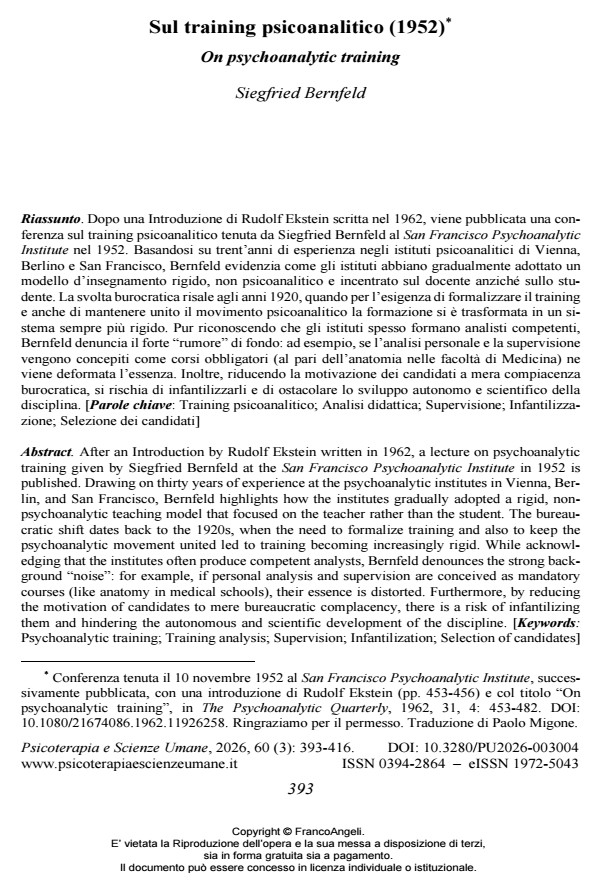
After an Introduction by Rudolf Ekstein written in 1962, a lecture on psychoanalytic training given by Siegfried Bernfeld at the San Francisco Psychoanalytic Institute in 1952 is published. Drawing on thirty years of experience at the psychoanalytic institutes in Vienna, Berlin, and San Francisco, Bernfeld highlights how the institutes gradually adopted a rigid, nonpsychoanalytic teaching model that focused on the teacher rather than the student. The bureaucratic shift dates back to the 1920s, when the need to formalize training and also to keep the psychoanalytic movement united led to training becoming increasingly rigid. While acknowledging that the institutes often produce competent analysts, Bernfeld denounces the strong background “noise”: for example, if personal analysis and supervision are conceived as mandatory courses (like anatomy in medical schools), their essence is distorted. Furthermore, by reducing the motivation of candidates to mere bureaucratic complacency, there is a risk of infantilizing them and hindering the autonomous and scientific development of the discipline.
Keywords: Psychoanalytic training; Training analysis; Supervision; Infantilization; Selection of candidates
- Bernfeld S. (1925). Sisyphus oder Die Grenzen der Erziehung. Wien: Internationaler Psychoanalytischer Verlag (trad. inglese: Sisyphus or the Limits of Education. Berkeley, CA: University of California Press, 1973).
- DeBell D.E. (1963). A critical digest of the literature on psychoanalytic supervision. Journal of the American Psychoanalytic Association, 11, 3: 546575. DOI: 10.1177/000306516301100305
- Ekstein R. (1960). A historical survey of the teaching of psychoanalytic technique. Journal of the American Psychoanalytic Association, 8, 3: 500516. DOI: 10.1177/000306516000800307
- Ekstein R. & Wallerstein R.S. (1958). The Teaching and Learning of Psychotherapy. New York: Basic Books (Second Edition: 1972).
- Freud S. (1899 [1900]). L’interpretazione dei sogni. Opere, 3. Torino: Boringhieri, 1966.
- Holt R.R. & Luborsky L. (1958). Personality Patterns Psychiatrists: A Study of Methods for Selecting Residents. New York: Basic Books.
- Lewin B.D. & Ross H. (1960). Psychoanalytic Education in the United States. New York: Norton.
Siegfried Bernfeld, Sul training psicoanalitico (1952) in "PSICOTERAPIA E SCIENZE UMANE" 3/2026, pp 393-416, DOI: 10.3280/PU2026-003004