The ideal psychoanalytic institute: A utopia
Journal title PSICOTERAPIA E SCIENZE UMANE
Author/s Anna Freud
Publishing Year 2026 Issue 2026/3
Language Italian Pages 14 P. 429-442 File size 288 KB
DOI 10.3280/PU2026-003006
DOI is like a bar code for intellectual property: to have more infomation
click here
Below, you can see the article first page
If you want to buy this article in PDF format, you can do it, following the instructions to buy download credits
FrancoAngeli is member of Publishers International Linking Association, Inc (PILA), a not-for-profit association which run the CrossRef service enabling links to and from online scholarly content.
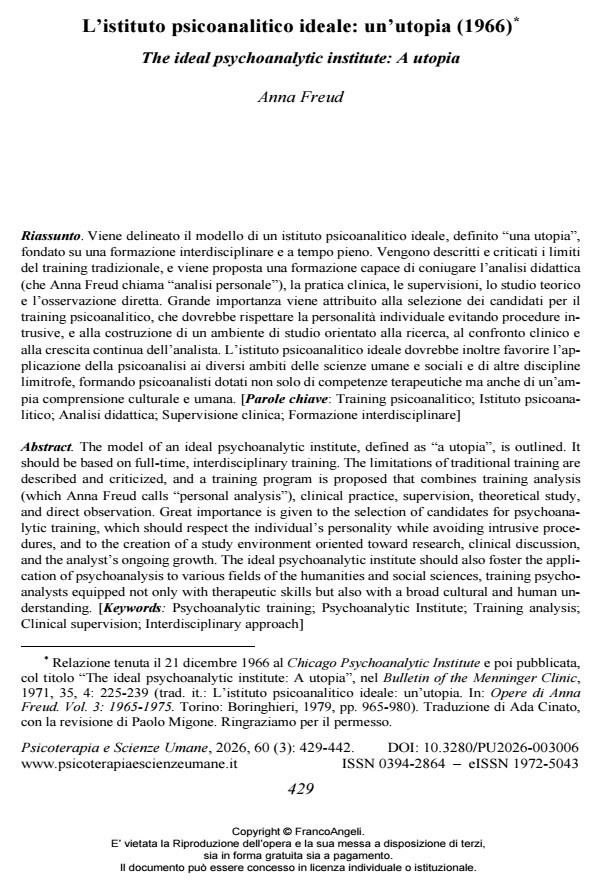
The model of an ideal psychoanalytic institute, defined as “a utopia”, is outlined. It should be based on fulltime, interdisciplinary training. The limitations of traditional training are described and criticized, and a training program is proposed that combines training analysis (which Anna Freud calls “personal analysis”), clinical practice, supervision, theoretical study, and direct observation. Great importance is given to the selection of candidates for psychoanalytic training, which should respect the individual’s personality while avoiding intrusive procedures, and to the creation of a study environment oriented toward research, clinical discussion, and the analyst’s ongoing growth. The ideal psychoanalytic institute should also foster the application of psychoanalysis to various fields of the humanities and social sciences, training psychoanalysts equipped not only with therapeutic skills but also with a broad cultural and human understanding.
Keywords: Psychoanalytic training; Psychoanalytic Institute; Training analysis; Clinical supervision; Interdisciplinary approach
- Fleming J. & Benedek T. (1966). Psychoanalytic Supervision. A Method of Clinical Teaching. New York: International Universities Press.
- Freud A. (196264). Assessment of pathology in childhood (trad. it. riveduta in: Anna Freud, 1965, cap. 4; Anche in: Opere di Anna Freud. Vol. 3: 19651975. Torino: Boringhieri, 1979, pp. 801916).
- Freud A. (1965). Normality and Pathology in Childhood. New York: International Universities Press (trad. it.: Normalità e patologia del bambino. Milano: Feltrinelli, 1969. Anche in: Opere di Anna Freud. Vol. 3: 19651975. Torino: Boringhieri, 1979, pp. 765932).
- Freud A. (1970). The symptomatology of childhood: A preliminary attempt at classification. Psychoanalytic Study of the Child, 25: 1941 (trad. it.: Sintomatologia dell’infanzia: tentativo preliminare di una classificazione. In: Opere di Anna Freud. Vol. 3: 19651975. Torino: Boringhieri, 1979, pp. 10651088)
- Freud A., Nagera H. & Freud W. E. (1965). Metapsychological assessment of the adult personality. The adult profile. Psychoanalytic Study of the Child, 20: 941 (per una trad. it. si veda: Anna Freud, 1965).
- Freud S. (1926). Il problema dell’analisi condotta da non medici. Conversazione con un interlocutore imparziale. Opere, 10: 347415 (Poscritto del 1927. Opere, 10: 416423). Torino: Boringhieri, 1978.
- Kohut H. (1961 [1978]). The selection process. In: The Search for the Self: Selected Writings of Heinz Kohut: 19501978. Volume 1. Edited by Paul Ornstein. New York: International Universities Press, 1978, pp. 397411.
- Kohut H. (1968). The evaluation of applicants for psychoanalytic training. International Journal of Psychoanalysis, 49, 4: 548554. Anche in: The Search for the Self: Selected Writings of Heinz Kohut: 19501978. Volume 2. Edited by Paul Ornstein. New York: International Universities Press, 1978, pp. 547561.
- Strozier C.B. (2001). Heinz Kohut. The Making of a Psychoanalyst. New York: Farrar, Straus and Giroux (trad. it.: Heinz Kohut. Biografia di uno psicoanalista. Roma: Astrolabio, 2005).
Anna Freud, L’istituto psicoanalitico ideale: un’utopia (1966) in "PSICOTERAPIA E SCIENZE UMANE" 3/2026, pp 429-442, DOI: 10.3280/PU2026-003006