The confusions of young T. Years of psychoanalytic apprenticeship beside the couch
Journal title PSICOTERAPIA E SCIENZE UMANE
Author/s Johannes Cremerius
Publishing Year 2026 Issue 2026/3
Language Italian Pages 14 P. 443-456 File size 301 KB
DOI 10.3280/PU2026-003007
DOI is like a bar code for intellectual property: to have more infomation
click here
Below, you can see the article first page
If you want to buy this article in PDF format, you can do it, following the instructions to buy download credits
FrancoAngeli is member of Publishers International Linking Association, Inc (PILA), a not-for-profit association which run the CrossRef service enabling links to and from online scholarly content.
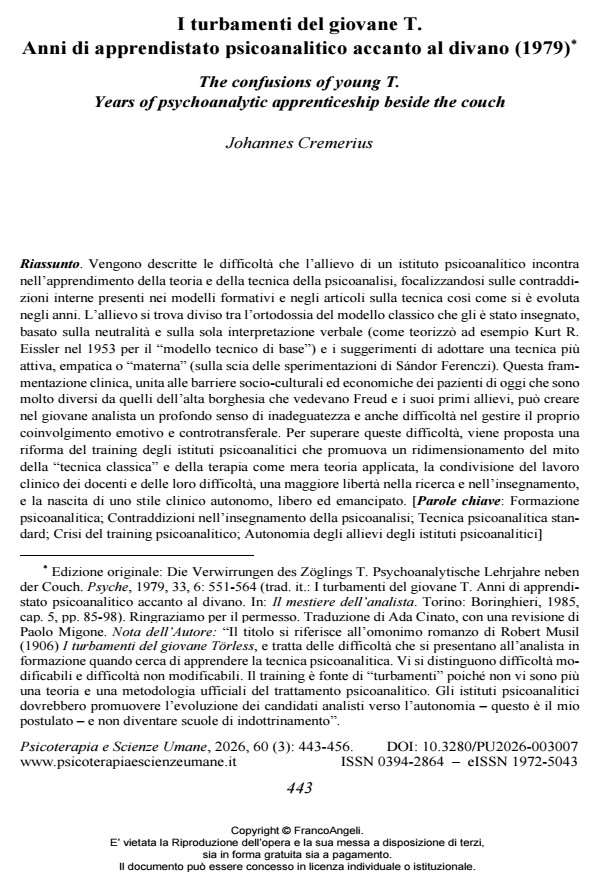
The difficulties that candidates of a psychoanalytic institute encounter in learning the theory and technique of psychoanalysis are described, focusing on the internal contradictions of training models and in articles on technique as it has evolved over the years. Candidates find themselves torn between the orthodoxy of the classical model they have been taught, based on neutrality and verbal interpretation alone (as theorized, for example, by Kurt R. Eissler in 1953 for the “basic model technique”), and the pressures toward a more active, empathic, or “maternal” technique (in the wake of Sándor Ferenczi’s experimentations). This clinical fragmentation, combined with the sociocultural and economic barriers of today’s patients, who are very different from the uppermiddleclass patients Freud and his early pupils treated, can create a profound sense of inadequacy in young analysts, as well as difficulty managing their own emotional and countertransferential involvement. To overcome these difficulties, a reform of the training of psychoanalytic institutes is proposed that promotes a critique of the myth of the “classical technique” and of therapy as a mere applied theory, the sharing of the clinical work of faculty members and their difficulties, greater freedom in research and teaching, and the birth of an autonomous and emancipated clinical style.
Keywords: Psychoanalytic training; Contradictions in psychoanalytic education; Standard psychoanalytic technique; Crisis of psychoanalytic training; Autonomy in candidates of psychoanalytic institutes
- Alexander F., French T.M. et al. (1946). Psychoanalytic Therapy: Principles and Applications. New York: Ronald Press (trad. it. dei capitoli 2, 4 e 17: La esperienza emozionale correttiva. Psicoterapia e Scienze Umane, 1993, 27, 2: 85101. Edizione su Internet: www.psychomedia.it/pm/modther/probpsiter/alexan1.htm).
- Cramer B. & Flournoy O. (1975). Panel on “The changing expectations of patients and psychoanalysts today” (29th International Psychoanalytic Association Congress, London, July 27August 1, 1975). International Journal of Psychoanalysis, 1976, 57, 4: 419427.
- Eissler K.R. (1953). The effect of the structure of the ego on psychoanalytic technique. Journal of the American Psychoanalytic Association, 1, 1: 104143.
- Eissler K.R. (1958). Remarks on some variations in psychoanalytical technique. International Journal of Psychoanalysis, 39: 222229 (trad. it.: Osservazioni su alcune variazioni nella tecnica psicoanalitica. In: Genovese C., a cura di, Setting e processo psicoanalitico. Milano: Raffaello Cortina, 1988, pp. 186199).
- Ferenczi S. (1929). Il bambino mal accolto e la sua pulsione di morte. In: Opere, 19271933, vol. IV, pp. 4553. Milano: Raffaello Cortina, 2002.
- Ferenczi S. (1931). Analisi infantili con gli adulti. In: Opere, 19271933, vol. IV, pp. 7383. Milano: Raffaello Cortina, 2002.
- Ferenczi S. (1932). Sprachverwirrung zwischen den Erwachsenen und dem Kind. Internationale Zeitschrift für Psychoanalyse, 1933, 19, 1/2: 515 (Relazione al XII Congresso dell’International Psychoanalytic Association [IPA], Wiesbaden, 47 settembre 1932). Anche in: Schriften zur Psychoanalyse. Frankfurt a.M.: Fischer, 1972, Vol. 2, pp. 303313 (trad. it.: Confusione delle lingue tra adulti e bambini. Il linguaggio della tenerezza e il linguaggio della passione. In: Fondamenti di psicoanalisi, Vol. 3, pp. 415427. Rimini: Guaraldi, 1974. Anche in: Masson, 1984a. Anche in: Opere, 19271933, Vol. IV. Milano: Raffaello Cortina, 2002,
- pp. 91100. Trad. inglese: The confusion of tongues between adults and children: The language of tenderness and passion. In: Balint M., editor, Final Contributions to the Problems and Methods of Psychoanalysis. New York: Basic Books, 1955, vol. 1, pp. 156167).
- Ferenczi S. & Rank O. (1924). Entwicklungsziele der Psychoanalyse (1923). Wien: Internationaler Psychoanalytischer Verlag (trad. it. dei capitoli 1, 3 e 5 dalla traduz. francese: Prospettive di sviluppo della psicoanalisi. In: Fondamenti di psicoanalisi, Vol. III. Rimini: Guaraldi, 1974, pp. 175193; riedizione in: Opere, 1919/1926, vol. III. Milano: Raffaello Cortina, 1992, pp. 201216. Nuova trad. italiana completa dall’originale tedesco, con una Postfazione di Michael Turnheim: Psicoterapia e Scienze Umane, 2012, 46, 4: 487538. DOI: 10.3280/PU2012004001)
- Freud A. (1976). Changes in psychoanalytic practice and experience. International Journal of Psychoanalysis, 57, 3: 257260.
- Freud S. (191114 [191115]). Tecnica della psicoanalisi. Opere, 6: 517541. Nuovi consigli sulla tecnica della psicoanalisi. Opere, 7: 333374.
- Freud S. (1914 [1918]). Dalla storia di una nevrosi infantile (Caso clinico dell’Uomo dei lupi). Opere, 7: 483593. Torino: Boringhieri, 1975.
- Freud S. (191517 [191617]). Introduzione alla psicoanalisi. Opere, 8: 191611. Torino: Borin ghieri, 1976.
- Freud S. (1918 [1919]). Vie della terapia psicoanalitica. Opere, 9: 1928. Torino: Boringhieri, 1977.
- Freud S. (1925 [1926]). Inibizione, sintomo e angoscia. Opere, 10: 231317. Torino: Boringhieri, 1978.
- Freud S. (1932 [1933]). Introduzione alla psicoanalisi (nuova serie di lezioni). Lezione 34: Schiarimenti, applicazioni, orientamenti. Opere, 11: 242261. Torino: Boringhieri, 1979.
- Freud S. (1938 [1940]). Compendio di psicoanalisi. Opere, 11: 569634. Torino: Boringhieri, 1979.
- Freud S. (1927). Poscritto del 1927 [a “Il problema dell’analisi condotta da non medici” (1926)]. In Opere (Vol. 10, pp. 416423). Boringhieri, 1978.
- Freud S. & Abraham K. (190726). Briefwechsel 19071925. Vollständige Ausgabe. Edited by Ernst Falzeder & Ludger M. Hermanns. Wien: Turia + Kant, 2009 (trad. it.: Lettere 19071925. Edizione integrale. Roma: Alpes, 2024). Precedente edizione, non integrale: Briefe 19071926. Edited by Hilda C. Abraham & Ernst L. Freud. Frankfurt a.M.: Fischer, 1965 (trad. it.: Lettere 19071926. Torino: Boringhieri, 1969).
- Jones E. (195357). The Life and Work of Sigmund Freud (3 volumes). New York: Basic Books, 1953 (vol. I), 1955 (vol. II), 1957 (vol. III) (trad. it.: Vita e opere di Sigmund Freud. Milano: Il Saggiatore, 1962, 3 volumi; Milano: Garzanti, 1977, 3 volumi).
- Loewenstein R.M. (1958). Remarks of some variations in psychoanalytic technique. I International Journal of Psychoanalysis, 39, 2/3/4: 202210 (trad. it.: Osservazioni su alcune variazioni nella tecnica psicoanalitica. In: Genovese C., a cura di, Setting e processo psicoanalitico. Milano: Raffaello Cortina, 1988, pp. 151165).
- Musil R. (1906). Die Verwirrungen des Zöglings Törleß. Wien: Wiener Verlag (trad. it.: I turbamenti del giovane Törless. Torino: Einaudi, 1959).
- Rangell L. (1954). Similarities and differences between psychoanalysis and dynamic psychotherapy. Journal of the American Psychoanalytic Association, 2, 4: 734744.
Johannes Cremerius, I turbamenti del giovane T. Anni di apprendistato psicoanalitico accanto al divano (1979) in "PSICOTERAPIA E SCIENZE UMANE" 3/2026, pp 443-456, DOI: 10.3280/PU2026-003007