Thirty methods to destroy the creativity of psychoanalytic candidates
Journal title PSICOTERAPIA E SCIENZE UMANE
Author/s Otto F. Kernberg
Publishing Year 2026 Issue 2026/3
Language Italian Pages 14 P. 543-556 File size 350 KB
DOI 10.3280/PU2026-003012
DOI is like a bar code for intellectual property: to have more infomation
click here
Below, you can see the article first page
If you want to buy this article in PDF format, you can do it, following the instructions to buy download credits
FrancoAngeli is member of Publishers International Linking Association, Inc (PILA), a not-for-profit association which run the CrossRef service enabling links to and from online scholarly content.
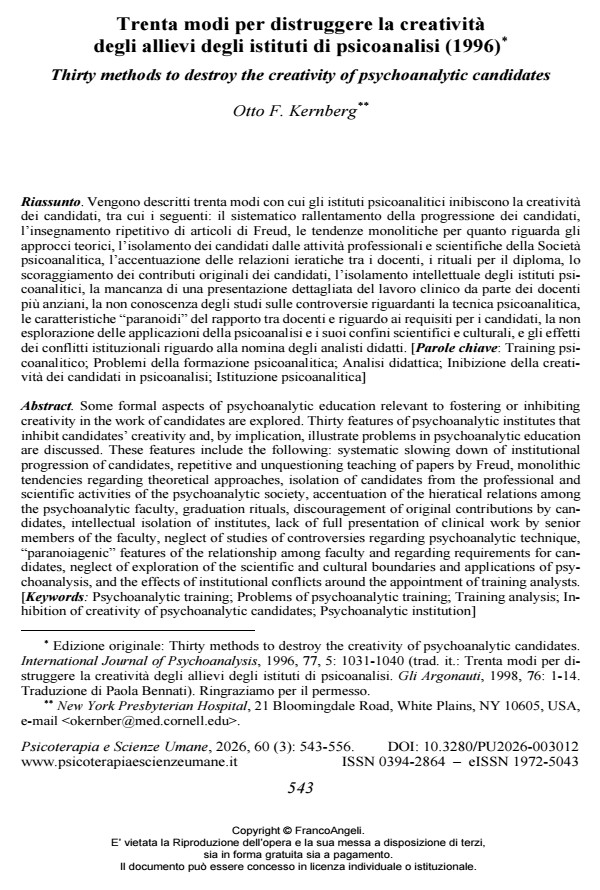
Some formal aspects of psychoanalytic education relevant to fostering or inhibiting creativity in the work of candidates are explored. Thirty features of psychoanalytic institutes that inhibit candidates’ creativity and, by implication, illustrate problems in psychoanalytic education are discussed. These features include the following: systematic slowing down of institutional progression of candidates, repetitive and unquestioning teaching of papers by Freud, monolithic tendencies regarding theoretical approaches, isolation of candidates from the professional and scientific activities of the psychoanalytic society, accentuation of the hieratical relations among the psychoanalytic faculty, graduation rituals, discouragement of original contributions by candidates, intellectual isolation of institutes, lack of full presentation of clinical work by senior members of the faculty, neglect of studies of controversies regarding psychoanalytic technique, “paranoiagenic” features of the relationship among faculty and regarding requirements for candidates, neglect of exploration of the scientific and cultural boundaries and applications of psychoanalysis, and the effects of institutional conflicts around the appointment of training analysts.
Keywords: Psychoanalytic training; Problems of psychoanalytic training; Training analysis; Inhibition of creativity of psychoanalytic candidates; Psychoanalytic institution
- Lussier A. (1991). “Our training ideology”. Fifth IPA Conference of Training Analysts, Buenos Aires, July 2627, 1991 (non pubblicato). Riassunto in: Wallerstein, 1993.
- Arlow J.A. (1991). Address to the graduating class of the San Francisco Psychoanalytic Institute, 16 June, 1990. The American Psychoanalyst, 25, 2: 1516, 21.
- Britton R. (1994). Publication anxiety: Conflict between communication and affiliation. International Journal of Psychoanalysis, 75, 5/6: 12131224.
- Bruzzone M., Casaula E., Jimenez J.P. & Jordan J.F. (1985). Regression and persecution in analytic training. Reflections on experience. International Review of Psychoanalysis, 12, 4: 411415.
- Dulchin J. & Segal A.J. (1982a). The ambiguity of confidentiality in a psychoanalytic institute. Psychiatry, 45, 1: 1325. DOI: 10.1080/00332747.1982.11024128
- Dulchin J. & Segal A.J. (1982b). Third party confidences: The uses of information in a psychoanalytic institute. Psychiatry, 45, 1: 2737. DOI: 10.1080/00332747.1982.11024129
- Giovannetti M. De Freitas (1991). “The couch and the Medusa: brief considerations on the nature of the boundaries in the psychoanalytic Institution”. Fifth IPA Conference of Training Analysts, Buenos Aires, July 2627, 1991 (non pubblicato). Riassunto in: Wallerstein, 1993.
- Green A. (1991). “Preliminaries to a discussion of the function of theory in psychoanalytic training”. Fifth IPA Conference of Training Analysts, Buenos Aires, July 2627, 1991 (non pubblicato). Riassunto in: Wallerstein, 1993.
- Infante J.A. (1991). “The teaching of psychoanalysis: Common ground”. Fifth IPA Conference of Training Analysts, Buenos Aires, July 2627, 1991 (non pubblicato). Riassunto in: Wallerstein, 1993.
- Kernberg O.F. (1984). Institutional problems of psychoanalytic education. Journal of the American Psychoanalytic Associaton, 1986, 34, 4: 799834. cap. 2, pp. 2134 (trad. it.: pp. 4570).
- Kernberg O.F. (1998). Ideology, Conflict, and Leadership in Groups and Organizations. New Haven, CT: Yale University Press (trad. it.: Le relazioni nei gruppi. Ideologia, conflitto, leadership. Milano: Raffaello Cortina, 1999).
- Kernberg O.F. (2016). Psychoanalytic Education at the Crossroads. London: Routledge (trad. it.: Psicoanalisi e formazione: cambiamenti e prospettive del training psicoanalitico. Milano: FrancoAngeli, 2018).
- Lifschutz J.E. (1976). A critique of reporting and assessment in the training analysis. Journal of the American Psychoanalytic Association, 24, 1: 4359. DOI: 10.1177/000306517602400103
- Wallerstein R.S. (1993). Between chaos and petrification: A summary of the Fifth IPA Conference of Training Analysts. International Journal of Psychoanalysis, 74, 1: 165178.
Otto F. Kernberg, Trenta modi per distruggere la creatività degli allievi degli istituti di psicoanalisi (1996) in "PSICOTERAPIA E SCIENZE UMANE" 3/2026, pp 543-556, DOI: 10.3280/PU2026-003012