Training as a problem. A brief historical journey
Journal title PSICOTERAPIA E SCIENZE UMANE
Author/s Giorgio Meneguz
Publishing Year 2026 Issue 2026/3
Language Italian Pages 26 P. 583-608 File size 383 KB
DOI 10.3280/PU2026-003015
DOI is like a bar code for intellectual property: to have more infomation
click here
Below, you can see the article first page
If you want to buy this article in PDF format, you can do it, following the instructions to buy download credits
FrancoAngeli is member of Publishers International Linking Association, Inc (PILA), a not-for-profit association which run the CrossRef service enabling links to and from online scholarly content.
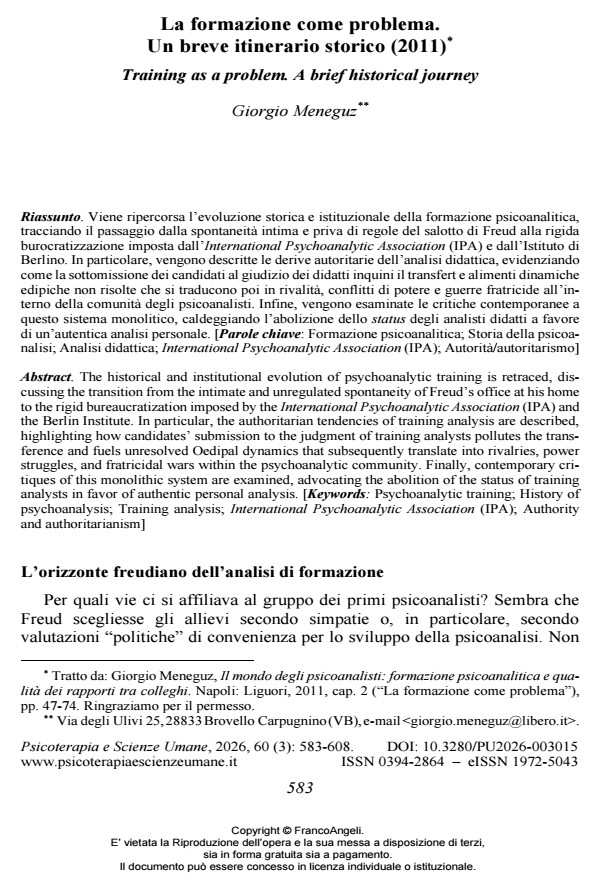
The historical and institutional evolution of psychoanalytic training is retraced, discussing the transition from the intimate and unregulated spontaneity of Freud’s office at his home to the rigid bureaucratization imposed by the International Psychoanalytic Association (IPA) and the Berlin Institute. In particular, the authoritarian tendencies of training analysis are described, highlighting how candidates’ submission to the judgment of training analysts pollutes the transference and fuels unresolved Oedipal dynamics that subsequently translate into rivalries, power struggles, and fratricidal wars within the psychoanalytic community. Finally, contemporary critiques of this monolithic system are examined, advocating the abolition of the status of training analysts in favor of authentic personal analysis.
Keywords: Psychoanalytic training; History of psychoanalysis; Training analysis; International Psychoanalytic Association (IPA); Authority and authoritarianism
- Aarons Z.A. (198283). The training analyst concept: A superego problem. International Journal of Psychoanalytic Psychotherapy, 9: 679689.
- Albano L., a cura di (1987). Il divano di Freud. Memorie e ricordi dei pazienti di Sigmund Freud, Parma: Pratiche.
- Alexander F. & Selesnick S.T. (1965). FreudBleuler correspondence. Archive of General Psychiatry, 12, 1: 19.
- Balint M. (1947). On the psychoanalytic training system. International Journal of Psychoanalysis, 1948, 29, 2: 163173. Anche in: Balint, 1965, pp. 253274 (trad. it.: Il sistema didattico in psicoanalisi. In: Balint, 1965, pp. 1747. Anche in: Psicoterapia e Scienze Umane, 2026, 60, 3: 373392. DOI: 10.3280/PU2026003003)
- Balint M. (1953). Analytic training and training analysis. International Journal of Psychoanalysis, 1954, 35, 2: 157162. Anche in: Balint, 1965, pp. 275285 (trad. it.: Formazione analitica e analisi didattica. In: Balint, 1965, pp. 4964. Anche in: Psicoterapia e Scienze Umane, 2026, 60, 3: 417428. DOI: 10.3280/PU2026003005)
- Balint M. (1965). Primary Love and Psychoanalytic Technique (Second Edition Enlarged). London: Tavistock (trad. it.: L’analisi didattica. Chi psicoanalizzerà gli psicoanalisti? Rimini: Guaraldi, 1974).
- Balint M. & Balint E. (1968). The Basic Fault. London: Tavistock (trad. it.: Il difetto fondamentale. In: La regressione. Milano: Raffaello Cortina, 1983, pp. 117319).
- Bartolomei G. (2002). Attività psicoanalitica e professione di psicoanalista. Setting, 14: 6170. Bernfeld S. (1952). On psychoanalytic training. Psychoanalytic Quarterly, 1962, 31, 4: 453482.
- Bertin C. (1982). La derniére Bonaparte. Paris: Libraire Académique (trad. it.: L’ultima Bonaparte. Torino: Centro Scientifico Torinese, 1984).
- Bettelheim B. (1956). Freud’s Vienna and Other Essays. New York: Knopf (trad. it.: La Vienna di Freud. Milano: Feltrinelli, 1990).
- Bibring G. (1954). The training analysis and its place in psychoanalytic training. International Journal of Psychoanalysis, 35, 2: 16973.
- Blanton S. (1971). Diary of My Analysis with Sigmund Freud. New York: Hawthorn Books (trad. it.: La mia analisi con Freud. Milano: Feltrinelli, 1974).
- Bolko M. & Rothschild B. (2006). Una “pulce nell’orecchio”. Cronaca del controcongresso dell’International Psychoanalytic Association di Roma del 1969. Psicoterapia e Scienze Umane, 40, 3: 703718. Ristampe: 2015, 49, 3: 431446 (
- Borgogno F. (2001). Che cosa trasmettiamo e come: pensieri sparsi e, forse, un po’ irriverenti. Gli Argonauti, 23, 90: 23348.
- Burrow T. (1958). A Search for Man’s Sanity. The Selected Letters of Trigant Burrow. With Biographical Notes. Oxford, UK: Oxford University Press.
- Cremerius J. (1981). Freud bei der Arbeit Über die Schulter geschaut. In: Jahrbuch Psychoanalyse (Ehebald U. & Eikkoff F., editors, Humanität und Technik in der Psychoanalyse), 6: 123158 (trad. it: Freud al lavoro: uno sguardo al di sopra della sua spalla. La tecnica nei resoconti di allievi e pazienti. In: Il mestiere dell’analista. Torino: Boringhieri, 1985, pp. 184215).
- Cremerius J. (1986a). Spurensicherung: Die “Psychoanalytische Bewegung” und das Elend der psychoanalytischen Institution. Psyche, 40, 12: 10631091 (trad. it.: Alla ricerca di tracce perdute. Il “movimento psicoanalitico” e la miseria della istituzione psicoanalitica. Psicoterapia e Scienze Umane, 1987, 21, 3: 334).
- Shapiro D. (1976). The analyst’s own analysis. Journal of the American Psychoanalytic Association, 24, 1: 542. DOI: 10.1177/000306517602400102
- Waelder R. (1962). Symposium: Selection criteria for the training of psychoanalytic students. International Journal of Psychoanalysis, 43, 3: 283286.
- Wallerstein R.S. (1988). One psychoanalysis or many? International Journal of Psychoanalysis, 69, 1: 521 (trad. it.: Una o molte psicoanalisi? Gli Argonauti, 1989, XI, 43: 253276).
- Cremerius J. (1986b). Unterdrückung von Wahrheit, persönlicher Freiheit und wissenschaftlichen Denken in der psychoanalytischen Bewegung (Conferenza letta al convegno InstitutionalisierungDesinstitutionalisierung. Zur Geschichte und Gegenwart der psychoanalytischen Linken [Istituzionalizzazione/deistituzionalizzazione: sulla storia e sul presente della sinistra psicoanalitica], organizzato dal Seminario Psicoanalitico di Zurigo [PSZ] il 30 maggio1° giugno 1986). In: Psychoanalytisches Seminar Zürich, editor, Between the Devil and the Deep Blue Sea. Freiburg im Bresgau: Kore, 1987, pp. 1526 (trad. it. della relazione di P.F. Galli in: Psicoterapia e Scienze Umane, 2025, 59, 4: 675688).
- Cremerius J. (1987). Die Einrichtung des Zulassungsverfahrens 19231926 als machtpolitisches Instrument der “Psychoanalytischen Bewegung”. In: Brede K. Lohmann H.M. & Fehlhaber H., editors, Befreiung zum Widerstand. Aufsätze über Feminismus, Psychoanalyse und Politik. Margarete Mitscherlich zum 70. Geburtstag. Frankfurt a.M.: Fischer, 1987, pp. 3653 (trad. it.: L’istituzione, tra il 1923 e il 1926, del sistema di selezione come strumento della politica di potere del “movimento psicoanalitico”. Psicoterapia e Scienze Umane, 1990, 24, 4: 2844).
- Cremerius J. (1988). Analisi didattica e potere. La trasformazione di un metodo di insegnamentoapprendimento in strumento di potere della psicoanalisi istituzionalizzata. Psicoterapia e Scienze Umane, 1989, 23, 3: 327 (versione ampliata della relazione tenuta al 3° Convegno del Collegamento Psicoanalitico Internazionale, Palazzo delle Stelline, Milano, 3 giugno 1988). Internet: https://priory.com/ital/riviste/psicouman/cremer89.htm. Ristampe: Psicoterapia e Scienze Umane, 2021, 55, 3: 487508 (
- Cremerius J. (1996). Die Begrenzung der analytischen Selbstaufklärung durch die Ausbildungshierarchie. LuziferAmor, 9, 17/18: 6883 (trad. it.: I limiti dell’autorischiaramento analitico e la gerarchia della formazione istituzionalizzata. Psicoterapia e Scienze Umane, 1999, 23, 3: 522. Internet: www.priory.com/ital/riviste/psicouman/cremerius99.htm).
- Deutsch H. (1973). Confrontations with Myself. New York: Norton (trad. it.: A confronto con me stessa. Roma: Astrolabio, 1981).
- Doolittle H. (194556). Writing on the Wall. Boston, MA: D.R. Godine (trad. it.: I segni sul muro. Roma: Astrolabio, 1973).
- Falzeder E. (1994). The threads of psychoanalytic filiations or psychoanalysis taking effect. In: Haynal A. & Falzeder E., editors, 100 Years of Psychoanalysis. Contributions to the History of Psychoanalysis. London: Karnac, 1994, pp. 169194).
- Ferenczi S. (1911). A pszichoanalitikusolk szervezkedése. Gyógyászat, 51, 22: 386388 (trad. it.: A proposito della storia del movimento psicoanalitico. In: Opere, Vol. II: 19081912. Milano: Raffaello Cortina, 1989, pp. 144153).
- Ferenczi S. (1915). Psychogene Anomalien der Stimmlage. International Zeitschrift für Psychoanalyse, 3, 1: 2528 (trad. it.: Anomalie psicogene del timbro di voce. In: Opere, Vol. II: 19131919. Milano: Raffaello Cortina, 1990, pp. 148151).
- Ferenczi S. (1932a [1985]). Journal clinique: janvieroctobre 1932. Paris: Payot, 1985 (trad. it.: Diario clinico. GennaioOttobre 1932. Milano: Raffaello Cortina, 1988).
- Ferenczi S. (1932b). Sprachverwirrung zwischen den Erwachsenen und dem Kind (Die Sprache der Zärtlichkeit und der Leidenschaft). Internationale Zeitschrift für Psychoanalyse, 1933, 19, 1/2: 515 (Relazione al 12° Congresso dell’International Psychoanalytic Association, Wiesbaden, 47 settembre 1932). Anche in: Schriften zur Psychoanalyse. Frankfurt a.M.: Fischer, 1972, Vol. 2, pp. 303313 (trad. it.: Confusione delle lingue tra adulti e bambini. Il linguaggio della tenerezza e il linguaggio della passione. In: Fondamenti di psicoanalisi, Vol. 3, pp. 415427. Rimini: Guaraldi, 1974. Anche in: Opere, Vol. IV: 19271933. Milano: Raffaello Cortina, 2002, pp. 91100).
- Ferenczi S. (1932c). Fragmentarische Aufzeichnungen aus den Jahren 1920 und 19301933. Bausteine zur Psychoanalyse (4 volumi). Wien: Internationaler Psychoanalytischer Verlag, 1939, vol. IV (trad. inglese: Notes and fragments, 19201932. In: Final Contributions to the Problems and Methods of PsychoAnalysis. Edited by M. Balint. London: Hogarth, 1955, pp. 216279; trad it.: Note e frammenti, 19201932. In: Opere, Vol. IV: 19271933. Milano: Raffaello Cortina, 2002, pp. 220264).
- Freud A. (1927). Einführung in die Technik der Kinderanalyse. Wien: Internationaler Psychoanalytischer Verlag (trad. it.: Quattro conferenze sull’analisi infantile. In: Opere, Vol. 1: 19221943. Torino: Boringhieri, 1978, pp. 1117).
- Freud A. (1938). Probleme der Lehranalyse. In: Max Eitingon in Memoriam. Jerusalem: Israel Psychoanalytic Society, 1950, pp. 8094 (trad. it.: Problemi dell’analisi didattica. In: Opere, Vol. 1: 19221943. Torino: Boringhieri, 1978, pp. 267280. Anche in: Psicoterapia e Scienze Umane, 2026, 60, 3: 363372. DOI: 10.3280/PU2026003002)
- Freud S. (1912). Tecnica della psicoanalisi. Consigli al medico nel trattamento psicoanalitico. Opere, 6: 532541. Torino: Boringhieri, 1974.
- Freud S. (1914). Per la storia del movimento psicoanalitico. Opere, 7: 377438. Torino: Boringhieri, 1975.
- Freud S. (1926). Il problema dell’analisi condotta da non medici. Conversazione con un interlocutore imparziale. Opere, 10: 347415. Torino: Boringhieri, 1978.
- Freud S. (1937). Analisi terminabile e interminabile. Opere, 11: 497535. Torino: Boringhieri, 1979.
- Freud S. (1938 [1940]). Compendio di psicoanalisi. Opere, 11: 569634. Torino: Boringhieri, 1979.
- Freud S. & Jones E. (190839 [1993]). The Complete Correspondence of Sigmund Freud and Ernest Jones 19081939. Cambridge, MA: Harvard University Press, 1993 (trad. it.: Epistolari. Corrispondenza con Ernest Jones, 19081939. Torino: Bollati Boringhieri, 2001, 2 voll.).
- Freud S. & AndreasSalomé L. (1966). Sigmund FreudLou AndreasSalomé Briefwechsel. Frankfurt a.M.: Fischer (trad. it.: Eros e conoscenza. Lettere tra Freud e Lou Andreas Salomé, 19121936. Torino: Boringhieri, 1978).
- Freud S. & Groddeck G. (191734 [1970]). Briefwechsel GroddeckFreud. Wiesbaden: Limes Verlag, 1970 (trad. it.: Carteggio FreudGroddeck. Milano: Adelphi, 1973).
- Freud S. & Ferenczi S. (191214 [1992]). Briefwechsel. Band I/2: 19121914. Wien: Böhlau, 1992 (trad. it.: Lettere. Volume Primo: 19081914. Milano: Raffaello Cortina, 1993).
- Friedman L. (1988). The Anatomy of Psychotherapy. Hillsdale, NJ: Analytic Press (trad. it.: Anatomia della psicoterapia. Presentazione di Pier Francesco Galli. Torino: Bollati Boringhieri, 1993).
- Gabbard G. O. (1985). The role of compulsiveness in the normal physician. Journal of the American Medical Association, 254, 20: 29262929.
- Galli P.F. (2006). Tecnica e teoria della tecnica in psicoanalisi tra arcaico e postmoderno. Psicoterapia e Scienze Umane, 40, 2: 153164. Anche in: Di Sauro R., Maltese M. & Mura A., a cura di, Princìpi di terapia psicodinamica. Prefazione di Giulio Cesare Zavattini. Roma: Aracne, 2019, Vol. II, pp. 379420 (trad. inglese in: Method, technique, and theory in psychoanalysis. Trauma and Memory, 2016, 4, 1: 4859.
- Galli P.F. (2013). From Basle to Milan to Zurich: On psychoanalytic training. International Journal of Psychoanalysis, 94, 6: 12091214.
- Gay P. (1988). Freud: A Life for Our Time. London: J.M. Dent (trad. it.: Freud: una vita per i nostri tempi. Milano: Bompiani, 1988).
- Gitelson M. (1954). Therapeutic problems in the analysis of the “normal” candidate. International Journal of Psychoanalysis, 35, 2: 174183. Anche in: Psychoanalysis: Science and Profession. New York: International Universities Press, 1973, pp. 270291 (trad. it.: Problemi terapeutici nell’analisi del candidato “normale”. In: Psicoanalisi: scienza e professione. Torino: Boringhieri, 1980, cap. 11, pp. 171190).
- Gray P. (1994). The Ego and Analysis of Defense. Northvale, NJ: Aronson (trad. it.: L’Io e l’analisi della difesa. Roma: Fioriti, 2004).
- Greenacre Ph. (1966a). That “impossible” profession. Journal of the American Psychoanalytic Association, 14, 1: 927. DOI: 10.1177/000306516601400102
- Greenacre Ph. (1966b). Problems of training analysis. Psychoanalytic Quarterly, 35, 4: 540567. DOI: 10.1080/21674086.1966.11926405
- Grosskurth Ph. (1986). Melanie Klein: Her World and Her Work. London: Karnac (trad. it.: Melanie Klein. Il suo mondo e il suo lavoro. Torino: Bollati Boringhieri, 1988).
- Hale N.G. (1978). From Berggasse XIX to Central Park West: The Americanization of Psychoanalysis. Journal of the History of the Behavioral Sciences, 14, 4: 299315.
- Hoche A. E. (1910). Eine psychische Epidemie unter Ärtzen. Medizinische Klinik, 6, 26: 10071010.
- Holzman P.S. (1975). The future of psychoanalysis and its institutes. Psychoanalytic Quarterly, 45, 2: 25073. DOI: 10.1080/21674086.1976.11926756
- Jappe G. (1983). Die Lehranalyse “Analyse mit Apostroph”. In: Hoffmann S.O., editor, Kritische Beiträge zur Behandlungskonzeption und Technik in der Psychoanalyse. Frankfurt a.M.: Fischer, 1983, pp. 219227.
- Jaques E. (1976). A General Theory of Bureaucracy. London: Heinemann (trad. it. Teoria generale della burocrazia. Milano: ISEDI, 1979).
- Jones E. (1927). Symposium on child analysis. International Journal of Psychoanalysis, 8, 3: 387391.
- Jones E. (195357). The Life and Work of Sigmund Freud (3 volumes). New York: Basic Books, 1953 (vol. I), 1955 (vol. II), 1957 (vol. III) (trad. it.: Vita e opere di Sigmund Freud. Milano: Il Saggiatore, 1962, 3 volumi; Garzanti, Milano, 1977, 3 volumi).
- Jung C. G. (1914). Psychotherapeutische Zeitfragen. Ein Briefwechsel mit Dr. C.G. Jung, Privatdozenten der Psychiatrie in Zürich. Herausgegeben von Dr. R. Loÿ, dirigerendem Arzt des Sanatoriums “L’Abri” in MontreuxTerritet. Leipzig: Franz Deuticke. Anche in: Freud und die Psychoanalyse. Olten: Walter Verlag, 1969 (trad. it.: Questioni attuali di psicoterapia: carteggio tra C.G. Jung e R. Loÿ. In: Opere. Vol. 4: Freud e la psicoanalisi. Torino: Bollati Boringhieri, 1998, pp. 271310).
- Kernberg O.F. (1984). Institutional problems of psychoanalytic education. Journal of the American Psychoanalytic Association, 1986, 34, 4: 799834.
- Kernberg O.F. (1996). Thirty methods to destroy the creativity of psychoanalytic candidates. International Journal of Psychoanalysis, 77, 5: 10311040 (trad. it.: Trenta modi per distruggere la creatività dei candidati in psicoanalisi. Gli Argonauti, 1998, 76: 114. Anche in: Le relazioni nei gruppi. Ideologia, conflitto, leadership [1998]. Milano: Raffaello Cortina, 1999, cap. 14, pp. 259270. Internet: www.psychomedia.it/pm/modther/probpsiter/kernberg1.htm.
- Anche in: Psicoterapia e Scienze Umane, 2026, 60, 3: 543556. DOI: 10.3280/PU2026003012)
- Kernberg O.F. (2001). “Some thoughts regarding innovations in psychoanalytic education”. Presentation at the International Psychoanalytic Association Executive Council Meeting in Puerto Vallarta, Mexico, January 7, 2001 (trad. it.: Alcuni pensieri sulle innovazioni nella formazione psicoanalitica. Psicoterapia e Scienze Umane, 2003, 37, 2: 3549).
- Kirsner D. (2001). The future of psychoanalytic institutes. Psychoanalytic Psychology, 18, 2: 195212.
- Knight R.P. (1953). The present status of organized psychoanalysis in the United States. Journal of the American Psychoanalytic Association, 1, 2: 197221.
- Limentani A. (1973). Bemerkungen zur Lehranalyse. Zu den Aufsätzen von Dr. De Blécourt und Dr. Green. Bulletin Europäischer Psychoanalytischer Föderation, 3: 1119.
- Lombardi R. (2006). Passioni e conflittualità nelle istituzioni psicoanalitiche. Rivista di Psicoanalisi, 52, 1: 191212.
- Lynn D.J. & Vaillant G.E. (1998). Anonimity, neutrality, and confidentiality in the actual method of Sigmund Freud: A review of 43 cases, 19071939. American Journal of Psychiatry, 155, 2: 163171.
- McDougall J. (1997). Joyce McDougall. In: Molino A., editor, Freely Associated. London: Free Association Books, 1997 (trad. it.: Joyce McDougall. In: Molino A., a cura di, Liberamente Associati. Roma: Astrolabio, 1999, pp. 5287).
- Mitchell S.A. (1991). Editorial philosophy. Psychoanalytic Dialogue, 1, 1: 17. DOI: 10.1080/10481889109538881
- Nunberg H. & Federn E., editors (1962). Minutes of the Vienna Psychoanalytic Society. Vol. 1: 19061908. International University Press (trad. it.: Dibattiti della Società psicoanalitica di Vienna, 19061908. Torino: Boringhieri, 1973).
- Perlman F.T. (2021). Cronache psicoanalitiche: il dibattito sull’analisi didattica all’interno dell’American Psychoanalytic Association. Psicoterapia e Scienze Umane, 55, 3: 363424. DOI: 10.3280/PU2021003001
- Pohlen M. (2006). Freuds Analyse: Die Sitzungsprotokolle Ernst Blums. Hamburg: Rowohlt (trad. it.: In analisi con Freud, Torino: Bollati Boringhieri, 2009).
- Ponsi M. & Rossi Monti M. (1997). A proposito dell’articolo di Otto Kernberg “Trenta modi per distruggere la creatività dei candidati psicoanalisti”. Rivista di Psicoanalisi, 43, 1: 9197. Internet: www.psychomedia.it/pm/modther/probpsiter/ponsrm.htm.
- Reeder J. (2004). Hate and Love in Psychoanalytical Institutions. The Dilemma of a Profession. New York: Other Press.
- Rivière J. (1927). Symposium on child analysis. International Journal of Psychoanalysis, 8, 3: 370377.
- Sandler J. (1982). The selection and function of the training analyst in Europe. International Review of Psychoanalysis, 9, 4: 386392.
- Sachs H. (1944). Freud, Master and Friend. New York: Books for Libraires Press (trad. it.: Freud, maestro e amico. Roma: Astrolabio, 1973).
- Schafer R. (1983). The Analytic Attitude. New York: Basic Books (trad. it.: L’atteggiamento analitico. Milano: Feltrinelli, 1984).
Giorgio Meneguz, La formazione come problema. Un breve itinerario storico (2011) in "PSICOTERAPIA E SCIENZE UMANE" 3/2026, pp 583-608, DOI: 10.3280/PU2026-003015