Suicide prevention for psychoanalytic institutes and societies
Journal title PSICOTERAPIA E SCIENZE UMANE
Author/s Otto F. Kernberg
Publishing Year 2026 Issue 2026/3
Language Italian Pages 0 P. 609-622 File size 298 KB
DOI 10.3280/PU2026-003016
DOI is like a bar code for intellectual property: to have more infomation
click here
Below, you can see the article first page
If you want to buy this article in PDF format, you can do it, following the instructions to buy download credits
FrancoAngeli is member of Publishers International Linking Association, Inc (PILA), a not-for-profit association which run the CrossRef service enabling links to and from online scholarly content.
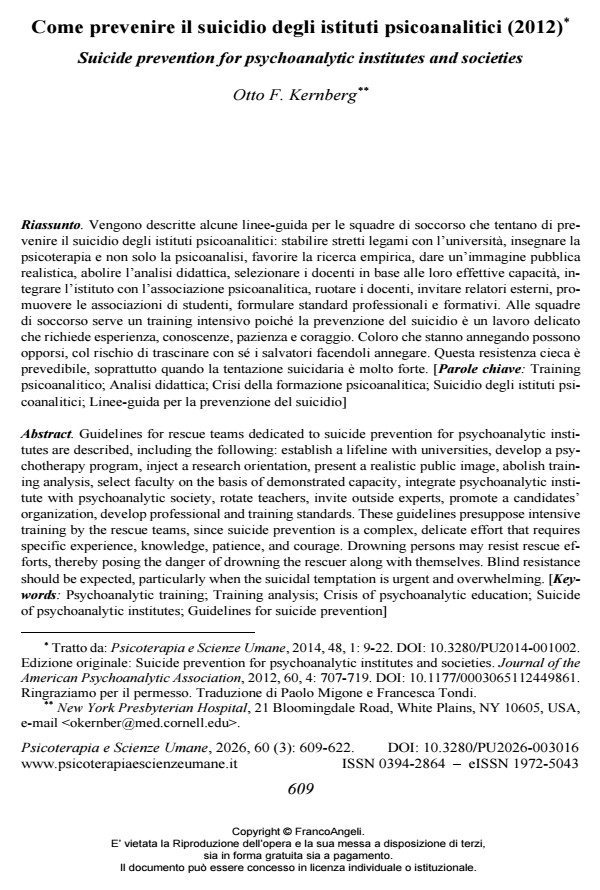
Guidelines for rescue teams dedicated to suicide prevention for psychoanalytic institutes are described, including the following: establish a lifeline with universities, develop a psychotherapy program, inject a research orientation, present a realistic public image, abolish training analysis, select faculty on the basis of demonstrated capacity, integrate psychoanalytic institute with psychoanalytic society, rotate teachers, invite outside experts, promote a candidates’ organization, develop professional and training standards. These guidelines presuppose intensive training by the rescue teams, since suicide prevention is a complex, delicate effort that requires specific experience, knowledge, patience, and courage. Drowning persons may resist rescue efforts, thereby posing the danger of drowning the rescuer along with themselves. Blind resistance should be expected, particularly when the suicidal temptation is urgent and overwhelming.
Keywords: Psychoanalytic training; Training analysis; Crisis of psychoanalytic education; Suicide of psychoanalytic institutes; Guidelines for suicide prevention
- Meyer L. (2003). Subservient analysis. International Journal of Psychoanalysis, 84, 5: 1241 1262. DOI: 10.1516/JAMPDAEEXYL4CJHD
- Michels R. (2007). Optimal education requires an academic context: Commentary on Wallerstein. Journal of the American Psychoanalytic Association, 55, 3: 985989. DOI: 10.1177/00030651070550031201
- Migone P., a cura di (2021). La terapia psicodinamica è efficace? Il dibattito e le evidenze empiriche. Milano: FrancoAngeli.
- Auchincloss E.L. & Michels R. (2003). A reassessment of psychoanalytic education: Controversies and changes. International Journal of Psychoanalysis, 84, 2: 387403. DOI: 10.1516/K1A5TBQ18J6LAQWH
- Balint M. (1947). On the psychoanalytic training system. International Journal of Psychoanalysis, 1948, 29, 2: 163173. Anche in: Balint, 1965, pp. 253274 (trad. it.: Il sistema didattico in psicoanalisi. In: Balint, 1965, pp. 1747. Anche in: Psicoterapia e Scienze Umane, 2026, 60, 3: 373392. DOI: 10.3280/PU2026003003)
- Balint M. (1953). Analytic training and training analysis. International Journal of Psychoanalysis, 1954, 35, 2: 157162. Anche in: Balint, 1965, pp. 275285 (trad. it.: Formazione analitica e analisi didattica. In: Balint, 1965, pp. 4964. Anche in: Psicoterapia e Scienze Umane, 2026, 60, 3: 417428. DOI: 10.3280/PU2026003005)
- Balint M. (1965). L’analisi didattica. Chi psicoanalizzerà gli psicoanalisti? Rimini: Guaraldi, 1974.
- Berman E. (2004). Impossible Training: A Relational View of Psychoanalytic Education. New York: Analytic Press.
- Bernfeld S. (1952). On psychoanalytic training. Psychoanalytic Quarterly, 1962, 31, 4: 453482.
- Bolko M. & Rothschild B. (2006). Una “pulce nell’orecchio”. Cronaca del controcongresso dell’International Psychoanalytic Association di Roma del 1969. Psicoterapia e Scienze Umane, 40, 3: 703718. Ristampe: 2015, 49, 3: 431446 (
- Cooper A.M. (1987). Changes in psychoanalytic ideas. Journal of the American Psychoanalytic Association, 35, 1: 7798. DOI: 10.1177/000306518703500104
- Cooper A.M. (1995). Discussion on empirical research. In: Shapiro T. & Emde R.N., editors, Research in Psychoanalysis: Process, Development, Outcome. Madison, CT: International Universities Press, 1995, pp. 381391.
- Cremerius J. (1982). Die Bedeutung des Dissidenten für die Psychoanalyse. Psyche, 36, 6: 481514 (trad. it.: L’importanza dei dissidenti per la psicoanalisi. Psicoterapia e Scienze Umane, 1983, 17, 3: 337).
- Cremerius J. (1986). Spurensicherung. Die “Psychoanalytische Bewegung” und das Elend der psychoanalytischen Institution. Psyche, 40, 12: 10361091 (relazione al primo convegno dell’Internationale Psychoanalytische Vernetzung, dal titolo “Istituzionalizzazione/Deistituzionalizzazione. Passato e presente della Sinistra psicoanalitica” [Institutionalisierung/Deinstitutionalisierung], Zurigo, 30 maggio1 giugno 1986) (trad. it.: Alla ricerca di tracce perdute. Il “Movimento psicoanalitico” e la miseria dell’istituzione psicoanalitica. Psicoterapia e Scienze Umane, 1987, 21, 3: 324).
- Cremerius J. (1987). Wenn wir als Psychoanalytiker die psychoanalytische Ausbildung organisieren, müssen wir sie psychoanalytisch organisieren! Psyche, 41, 12: 10671096 (trad. it.: Quando noi, psicoanalisti, organizziamo il training psicoanalitico, dobbiamo farlo in maniera psicoanalitica! Quaderni. Associazione di Studi Psicoanalitici, 1991, II, 3: 523 [I e II parte], 4: 2435 [III parte]. Anche in: Psicoterapia e Scienze Umane, 2026, 60, 3: 485516. DOI: 10.3280/PU2026003009)
- Cremerius J. (1988). Analisi didattica e potere. La trasformazione di un metodo di insegnamentoapprendimento in strumento di potere della psicoanalisi istituzionalizzata. Psicoterapia e Scienze Umane, 1989, 23, 3: 327 (versione ampliata della relazione tenuta al 3° Convegno del Collegamento Psicoanalitico Internazionale, Palazzo delle Stelline, Milano, 3 giugno 1988). Internet: https://priory.com/ital/riviste/psicouman/cremer89.htm. Ristampe: Psicoterapia e Scienze Umane, 2021, 55, 3: 487508 (
- Levy S.T. (2009). Psychoanalytic education then and now. Journal of the American Psychoanalytic Association, 57, 6: 12951309. DOI: 10.1177/0003065109354755
- Cremerius J. (1996). Die Begrenzung der analytischen Selbstaufklärung durch die Ausbildungshierarchie. LuziferAmor, 9, 17, 18: 6883 (trad. it.: I limiti dell’autorischiaramento analitico e la gerarchia della formazione istituzionalizzata. Psicoterapia e Scienze Umane, 1999, 33, 3: 522. Edizione su Internet: www.priory.com/ital/riviste/psicouman/cremerius99.htm).
- Fonagy P., editor (2001). An Open Door Review of Outcome Studies in Psychoanalysis. 2nd Edition (1st Edition: 1999). London: International Psychoanalytic Association.
- Galli P.F. (2013). From Basle to Milan to Zurich: On psychoanalytic training. International Journal of Psychoanalysis, 94, 6: 12091214.
- Garza Guerrero C. (2004). Reorganizational and educational demands of psychoanalytic training today: Our long and marasmic night of one century (with a rejoinder by Eglé Laufer). International Journal of Psychoanalysis, 85, 1: 325. DOI: 10.1516/218TE85E7RA803UX
- Garza Guerrero C. (2006). Crisis del psicoanálisis: Desafíos organizativos y educativos contemporaneos. Mexico City: Editores de Textos Mexicanos.
- Kernberg O.F. (1984). Institutional problems of psychoanalytic education. Journal of the American Psychoanalytic Association, 1986, 34, 4: 799834.
- Kernberg O.F. (1996). Thirty methods to destroy the creativity of psychoanalytic candidates. International Journal of Psychoanalysis, 77, 5: 10311040 (trad. it.: Trenta modi per distruggere la creatività dei candidati in psicoanalisi. Gli Argonauti, 1998, 76: 114. Anche in: Le relazioni nei gruppi. Ideologia, conflitto, leadership [1998]. Milano: Raffaello Cortina, 1999, cap. 14, pp. 259270. Internet: www.psychomedia.it/pm/modther/probpsiter/kernberg1.htm. Anche in: Psicoterapia e Scienze Umane, 2026, 60, 3: 543556. DOI: 10.3280/PU2026003012)
- Kernberg O.F. (1998). Ideology, Conflict, and Leadership in Groups and Organizations. New Haven, CT: Yale University Press (trad. it.: Le relazioni nei gruppi. Ideologia, conflitto, leadership. Milano: Raffaello Cortina, 1999).
- Kernberg O.F. (2001). “Some thoughts regarding innovations in psychoanalytic education”. Relazione all’Executive Council Meeting della International Psychoanalytic Association (IPA), Puerto Vallarta, Mexico, 7 gennaio 2001 (trad. it.: Alcuni pensieri sulle innovazioni nella formazione psicoanalitica. Psicoterapia e Scienze Umane, 2003, 37, 2: 3549).
- Kernberg O.F. (2004). Resistances to research in psychoanalysis. In: Contemporary Controversies in Psychoanalytic Theory, Techniques, and Their Applications. New Haven, CT: Yale University Press, 2004, chapter 6, pp. 8693.
- Kernberg O.F. (2006). The coming changes in psychoanalytic education: Part I. International Journal of Psychoanalysis, 87, 6: 16491673.
- Kernberg O.F. (2011). La formazione in psicoanalisi e psicoterapia dinamica oggi: conflitti e sfide. Psicoterapia e Scienze Umane, 40, 4: 460471.
- Kirsner D. (2000). Unfree Associations: Inside Psychoanalytic Institutes. London: Process Press (Updated edition: Lanham, MD: Aronson, 2009).
- Kirsner D. (2001). The future of psychoanalytic institutes. Psychoanalytic Psychology, 18: 195 212.
- Kirsner D. (2004). Psychoanalysis and its discontents. Psychoanalytic Psychology, 21, 3: 339 352. DOI: 10.1037/07369735.21.3.339
- LeuzingerBohleber M. & Kächele H., editors (2015). An Open Door Review of Outcome and Process Studies in Psychoanalysis. 3rd Edition (1st and 2nd Edition, edited by Peter Fonagy: 1999, 2001). London: International Psychoanalytic Association (a cura del Research Committee della International Psychoanalytic Association [IPA], Chair: Mark Solms).
- Paul R.A. (2007). Optimal education requires an academic context: Commentary on Wallerstein. Journal of the American Psychoanalytic Association, 55, 3: 991997. DOI: 10.1177/00030651070550031501
- Reeder J. (2004). Hate and Love in Psychoanalytical Institutions: The Dilemma of a Profession. New York: Other Press.
- Roustang F. (1982). Dire Mastery: Discipleship from Freud to Lacan. Baltimore, MD: Johns Hopkins University Press.
- Shedler J. (2010). The efficacy of psychodynamic therapy. American Psychologist, 65, 2: 98 109. 2021, cap. 2).
- Thomä H. & Kächele H. (1999). Memorandum on a reform of psychoanalytic education. International Psychoanalytic Association (IPA) Newsletter, 8, 2: 3335.
- Wallerstein R.S. (2007). The optimal structure for psychoanalytic education today: A feasible proposal? Journal of the American Psychoanalytic Association, 55, 3: 953984. DOI: 10.1177/00030651070550032201
- Wallerstein R.S. (2009). Psychoanalysis in the university: A fulltime vision. International Journal of Psychoanalysis, 90, 5: 11071121.
- Westen D., Novotny K. & ThompsonBrenner H. (2004). The empirical status of empirically supported psychotherapies: Assumptions, findings, and reporting in controlled clinical trials. Psychological Bulletin, 130, 4: 631663.
Otto F. Kernberg, Come prevenire il suicidio degli istituti psicoanalitici (2012) in "PSICOTERAPIA E SCIENZE UMANE" 3/2026, pp 609-622, DOI: 10.3280/PU2026-003016