Subjectivity-building yards. Intersectional perspectives on work in Genoa’s shipyards
Journal title MONDI MIGRANTI
Author/s Luca Daminelli
Publishing Year 2026 Issue 2026/2
Language Italian Pages 17 P. 59-75 File size 132 KB
DOI 10.3280/MM2026-002004
DOI is like a bar code for intellectual property: to have more infomation
click here
Below, you can see the article first page
If you want to buy this article in PDF format, you can do it, following the instructions to buy download credits
FrancoAngeli is member of Publishers International Linking Association, Inc (PILA), a not-for-profit association which run the CrossRef service enabling links to and from online scholarly content.
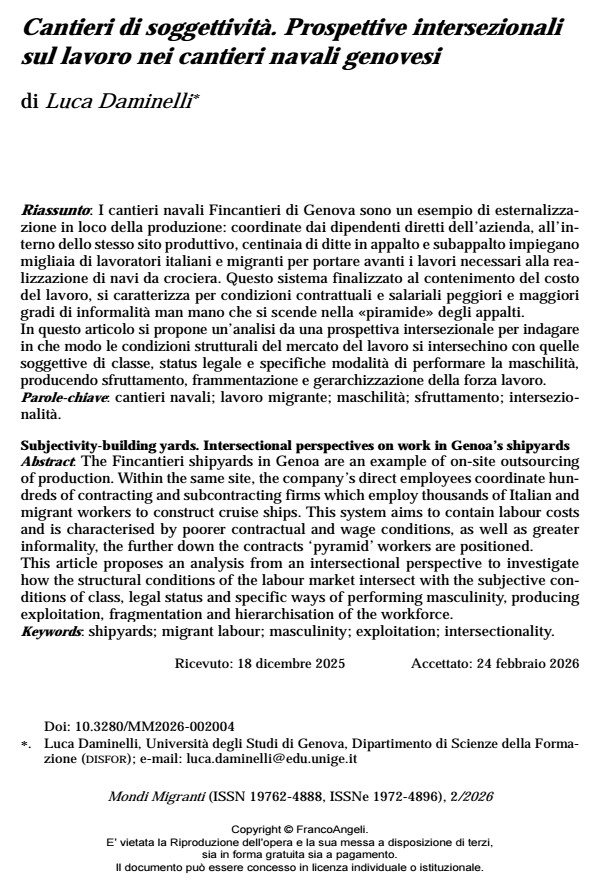
The Fincantieri shipyards in Genoa are an example of on-site outsourcing of production. Within the same site, the company’s direct employees coordinate hundreds of contracting and subcontracting firms which employ thousands of Italian and migrant workers to construct cruise ships. This system aims to contain labour costs and is characterised by poorer contractual and wage conditions, as well as greater informality, the further down the contracts ‘pyramid’ workers are positioned. This article proposes an analysis from an intersectional perspective to investigate how the structural conditions of the labour market intersect with the subjective conditions of class, legal status and specific ways of performing masculinity, producing exploitation, fragmentation and hierarchisation of the workforce.
Keywords: shipyards; migrant labour; masculinity; exploitation; intersectionality.
- Lewis H., Dwyer P., Hodkinson S. e Waite L. (2015). Hyper-precarious lives: Migrants, work and forced labour in the Global North. Progress in human geography, 39, 5: 580-600.
- Abbatecola E., Filippi D. e Omizzolo M. (2022). Introduzione: dal caporalato al padronato: riflessioni critiche sul sistema del grave sfruttamento lavorativo. Mondi Migranti, 2/2022: 9-36; DOI: 10.3280/MM2022-002001/
- Abbatecola E. e Filippi D. (2024). Regimi intersezionali di precarietà: Note a margine di una ricerca qualitativa sul grave sfruttamento del lavoro migrante in Liguria. Sociologia del lavoro, 169, 2: 173-191; https://inapp.infoteca.it/?ids=25666/.
- ADIR – L’Altro Diritto (2023). Inchieste in corso di analisi al 2023; https://www.adir.unifi.it/laboratorio/tabella.htm/.
- Anzaldúa G. (2012). Borderlands/la frontera: la nueva mestiza. San Francisco: Aunt Lute Books. 4th edition.
- Martin P.Y. (2003). “Said and done” versus “saying and doing” gendering practices, practicing gender at work. Gender & society, 17, 3: 342-366; DOI: 10.1177/0891243203017003002/
- Banca d’Italia (2025). Economie regionali. L’economia della Liguria. Rapporto annuale. Numero 7 – giugno 2025; https://www.bancaditalia.it/pubblicazioni/economie-regionali/2025/2025-0007/index.html/.
- Berdahl J.L., Cooper M., Glick P., Livingston R.W. e Williams J.C. (2018). Work as a masculinity contest. Journal of social issues, 74, 3: 422-448;
- Bourdieu P. (2015). Forme di capitale. Roma: Armando Editore.
- Butler J. (2012). Atti performativi e costituzione di genere: saggio di fenomenologia e teoria femminista. In: Arfini A.G. e Lo Iacono C., a cura di, Canone Inverso. Antologia di teoria queer. Pisa: Edizioni ETS.
- Caruso F. (2015). La politica dei subalterni. Organizzazione e lotte del bracciantato migrante del Sud Europa. Roma: DeriveApprodi.
- Cereseto G., e Ursano M. (2022). Caporalato nei cantieri navali, il caso spezzino e la vittoria della Cgil. Collettiva, 6/1/2022; https://www.collettiva.it/copertine/lavoro/caporalato-nei-cantieri-navali-il-caso-spezzino-e-la-vittoria-della-cgil-v97p0eu8/.
- Cillo R., e Perocco F. (2015). Outsourced racism in Italy: Discrimination at work and trade union responses in three sectors. Transfer: European Review of Labour and Research, 21, 1: 51-6; DOI: 10.1177/1024258914561412/
- Connell R.W. (2000). The men and the boys. Cambridge: Polity.
- Connell R.W. e Messerschmidt J.W. (2005). Hegemonic masculinity: Rethinking the concept. Gender & society, 19, 6: 829-859; DOI: 10.1177/0891243205278639/
- Crenshaw K. (1989). Demarginalizing the Intersection of Race and Sex: A Black Feminist Critique of Antidiscrimination Doctrine, Feminist Theory and Antiracist Politics. The University of Chicago Legal Forum: 139-167.
- Crenshaw K. (2015) Why intersectionality can’t wait. «The Washington Post», 24/9/2015; https://www.washingtonpost.com/news/in-theory/wp/2015/09/24/why-intersectionality-cant-wait/.
- Daminelli L., Marturano G., e Torre F. (2022). Governare le migrazioni: controllo, selezione e filtraggio delle persone in entrata e in uscita dall’Italia. In: Anderlini J., Filippi D. e Giliberti L., a cura di. Borderland Italia. Regime di Frontiera e Autonomia delle Migrazioni (pp. 93-126). Roma: DeriveApprodi.
- Davis A.Y. (2018). Donna, razza, classe. Roma: Edizioni Alegre.
- Dardot P. e Laval C. (2013). La nuova ragione del mondo: critica della razionalità neoliberista. Roma: DeriveApprodi.
- De Forcade R. (2023). Cantieristica, Liguria prima per valore aggiunto. «Il Sole 24 Ore», 4/9/2023; https://www.ilsole24ore.com/art/cantieristica-liguria-prima-valore-aggiunto-AFUzkGD/.
- De Genova N. (2013). Spectacles of migrant ‘illegality’: the scene of exclusion, the obscene of inclusion. Ethnic and Racial Studies, 36, 7: 1180-1198; DOI: 10.1080/01419870.2013.783710/
- Foucault M. (1994). Le jeu de Michel Foucault. In : Dits et écrits, 1954-1988, Tome III: 1976-1979. Gallimard.
- Franchi M. (2020). Gli yacht di lusso costruiti sfruttando gli operai migranti. «Il Manifesto», 10/11/2020; https://ilmanifesto.it/gli-yacht-di-lusso-costruiti-sfruttando-gli-operai-migranti/.
- Gaddi M. (2022). Sintesi Relazione Fincantieri-Cantiere di Marghera; https://www.fiom-cgil.it/net/attachments/article/9872/Fincantieri_Sintesi.pdf/.
- Iannuzzi F.E., Meardi G., Quondamatteo N. e Sacchetto D. (2024). European shipbuilding in a globalised market. Outsourcing and fragmentation in the Italian shipbuilding industry. Report 2024.07. Brussels: ETUI.
- Matsuda M. (1990). Beside My Sister, Facing the Enemy: Legal Theory Out of Coalition. Stanford Law Review, 43:183-1192.
- Mezzadra S. e Neilson B. (2014). Confini e frontiere. La moltiplicazione del lavoro nel mondo globale. Bologna: il Mulino.
- Morgan D. (2005). Class and masculinity. In: Id, Handbook of studies on men and masculinities (pp. 165-177). London: Sage.
- Quondamatteo N. (2022). Dentro le navi, il mondo intero. Un’analisi del sistema degli appalti nel caso Fincantieri. Quaderni di rassegna sindacale. Lavori, 2: 51-61; https://hdl.handle.net/11384/150016/.
- Rabby A.A. e Sacchetto D. (2025). Bangladeshi workers on the edge of the labour regime in Italian Fincantieri shipyards. Journal of Industrial Relations, 67, 1: 80-100; DOI: 10.1177/00221856251318421/
- Rodriguez J.K., Holvino E., Fletcher J.K. and Nkomo S.M. (2016). The Theory and Praxis of Intersectionality in Work and Organisations: Where Do We Go From Here?. Gender, Work & Organization, 23, 3: 201-222;
- Sasco A. (2017). The Evolution of the Industrial Relations System in the Italian Shipbuilding Industry. Italy: Adapt University Press.
- Slutskaya N., Simpson R., Hughes J., Simpson A. e Uygur S. (2016). Masculinity and class in the context of dirty work. Gender, Work & Organization, 23, 2: 165-182;
- Vandello J.A. e Bosson J.K. (2013). Hard won and easily lost: A review and synthesis of theory and research on precarious manhood. Psychology of men & masculinity, 14, 2. 101-113;
- Walker C. e Roberts S. (2017). Masculinity, labour and neoliberalism: Reviewing the field. In: Masculinity, labour, and neoliberalism: Working-class men in international perspective (pp. 1-28). Cham: Springer International Publishing.
- Zappino F. (2013). Il potere della melanconia. In: Butler J., La vita psichica del potere. Teorie del soggetto. Milano – Udine: Mimesis.
Luca Daminelli, Cantieri di soggettività. Prospettive intersezionali sul lavoro nei cantieri navali genovesi in "MONDI MIGRANTI" 2/2026, pp 59-75, DOI: 10.3280/MM2026-002004