Beyond Prisonization: Animal-Assisted Interventions (AAI) as a Salutogenic Device for the Reactivation of Agency and Responsibility
Journal title PSICOLOGIA DELLA SALUTE
Author/s Annalisa Castrechini, Emanuele Foglia
Publishing Year 2026 Issue 2026/3
Language Italian Pages 14 P. 28-41 File size 142 KB
DOI 10.3280/PDS2026-003004
DOI is like a bar code for intellectual property: to have more infomation
click here
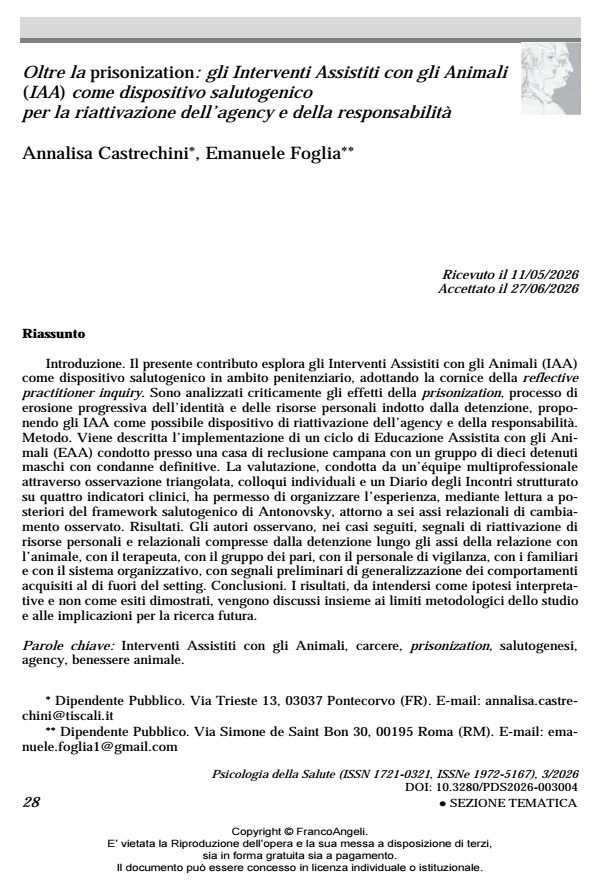
Below, you can see the article first page
If you want to buy this article in PDF format, you can do it, following the instructions to buy download credits
FrancoAngeli is member of Publishers International Linking Association, Inc (PILA), a not-for-profit association which run the CrossRef service enabling links to and from online scholarly content.
Introduction. This paper explores Animal-Assisted Interventions (AAI) as a salutogenic device in prison settings, drawing on the framework of reflective practitioner inquiry. The authors critically analyse the effects of prisonization, the progressive erosion of identity and personal resources induced by incarceration, proposing AAI as a possible device for the reactivation of agency and responsibility. Method. The paper describes the implementation of an Animal-Assisted Education (AAE) programme conducted in a correctional facility in southern Italy with a group of ten male inmates serving definitive sentences. The evaluation, conducted by a multi-professional team through triangulated observation, individual interviews, and a session diary structured around four clinical indicators, allowed the experience to be organised, through a retrospective application of Antonovsky’s salutogenic framework, around six relational axes of observed change. Results. The authors observe, in the cases followed, signs of reactivation of personal and relational resources suppressed by incarceration along the axes of the relationship with the animal, the therapist, the peer group, custodial staff, family members, and the organisational system, with preliminary signs of generalisation of acquired behaviours beyond the setting. Conclusions. Findings, intended as interpretive hypotheses rather than demonstrated outcomes, are discussed together with the methodological limitations of the study and implications for future research.
Keywords: Animal-Assisted Interventions, prison, prisonization, salutogenesis, agency, animal welfare.
- Antonovsky A. (1979). Health, Stress, and Coping. San Francisco: Jossey-Bass.
- Antonovsky A. (1987). Unraveling the Mystery of Health: How People Manage Stress and Stay Well. San Francisco: Jossey-Bass.
- Bennett-Levy J. (2006). Therapist skills: a cognitive model of their acquisition and refinement. Behavioural and Cognitive Psychotherapy, 34 (1): 57-78. DOI: 10.1017/S135246580500242
- Bottesi G., Ghisi M., Altoè G., Conforti E., Melli G., & Sica C. (2015). The Italian version of the Depression Anxiety Stress Scales-21: factor structure and psychometric properties in community and clinical samples. Comprehensive Psychiatry, 60: 170-181.
- Cavaleri P. (2000). Vivere con l’altro. Per una cultura della relazione [Living with the other. For a culture of relationship]. Roma: Città Nuova.
- Clemmer D. (1940). The Prison Community. Boston: Christopher Publishing House.
- Creswell J.W., & Plano Clark V.L. (2017). Designing and Conducting Mixed Methods Research. 3rd ed. Thousand Oaks: Sage.
- Deci E.L., & Ryan R.M. (2000). The «What» and «Why» of goal pursuits: human needs and the self-determination of behavior. Psychological Inquiry, 11 (4): 227-268. DOI: 10.1207/S15327965PLI1104_0
- Duindam H.M., Asscher J.J., Hoeve M., Stams G.J.J.M., & Creemers H.E. (2020). Are we barking up the right tree? A meta-analysis on the effectiveness of prison-based dog programs. Criminal Justice and Behavior, 47 (6): 749-767. DOI: 10.1177/009385482090987
- Frankl V.E. (1946). Ein Psychologe erlebt das Konzentrationslager [Man’s Search for Meaning]. Wien: Verlag für Jugend und Volk.
- Gibson M., Dell C.A., Chalmers D., Rath G., & Mela M. (2023). Unleashing compassionate care: canine-assisted intervention as a promising harm reduction approach to prisonization in Canada and its relevance to forensic psychiatry. Frontiers in Psychiatry, 14: 1219096.
- Gilbert P. (2009). The Compassionate Mind. London: Constable & Robinson.
- Gilbert P. (2010). Compassion Focused Therapy: Distinctive Features. London: Routledge.
- Gillespie W. (2003). Prisonization: Individual and Institutional Factors Affecting Inmate Conduct. New York: LFB Scholarly Publishing LLC.
- Giordano G. (1997). La casa vissuta. Percorsi e dinamiche dell’abitare [The lived home. Paths and dynamics of dwelling]. Milano: Giuffrè.
- Goffman E. (1961). Asylums: Essays on the Social Situation of Mental Patients and Other Inmates. New York: Anchor Books.
- Lovibond P.F., & Lovibond S.H. (1995). The structure of negative emotional states: comparison of the Depression Anxiety Stress Scales (DASS) with the Beck Depression and Anxiety Inventories. Behaviour Research and Therapy, 33 (3): 335-343. DOI: 10.1016/0005-7967(94)00075-
- Merenda A. (a cura di) (2014). Incontri terapeutici a quattro zampe. Gestalt Therapy e prospettive di zooantropologia clinica [Therapeutic encounters on four legs. Gestalt Therapy and perspectives of clinical zooanthropology]. Trapani: Il Pozzo di Giacobbe.
- Ministero della Salute (2015). Linee guida nazionali per gli interventi assistiti con gli animali (IAA) [National guidelines for Animal-Assisted Interventions (AAI)]. Accordo tra il Governo, le Regioni e le Province autonome di Trento e Bolzano, Rep. Atti n. 60/CSR del 25 marzo 2015. Retrieved from: https://www.izsvenezie.it/documenti/temi/interventi-assistiti-animali/normativa/nazionale/2015-accordo-stato-regioni-linee-guida.pdf
- Nussbaum M.C. (2001). Upheavals of Thought. The Intelligence of Emotions. Cambridge: Cambridge University Press.
- Perls F.S., Hefferline R.F., & Goodman P. (1951). Gestalt Therapy: Excitement and Growth in the Human Personality. New York: Julian Press (trad. it.: Teoria e pratica della terapia della Gestalt. Vitalità e accrescimento nella personalità umana. Roma: Astrolabio, 1997).
- Salonia G. (2011). L’errore di Perls. Intuizioni e fraintendimenti del postfreudismo gestaltico [Perls’s error. Insights and misunderstandings of Gestalt post-Freudianism]. GTK Rivista di Psicoterapia, 2: 49-66.
- Salonia G. (2015). Yes, we can. Il fascino del potere di creare o distruggere la relazione [Yes, we can. The fascination of the power to create or destroy the relationship]. Bologna: Messaggero Cappuccino.
- Schön D.A. (1983). The Reflective Practitioner. How Professionals Think in Action. New York: Basic Books.
- Schwarzer R., & Jerusalem M. (1995). Generalized Self-Efficacy Scale. In: Weinman J., Wright S., & Johnston M. (Eds.), Measures in Health Psychology: A User’s Portfolio. Causal and Control Beliefs. Windsor: NFER-Nelson, pp. 35-37.
- Sibilia L., Schwarzer R., & Jerusalem M. (1995). Italian Adaptation of the General Self-Efficacy Scale. Retrieved from: http://www.fu-berlin.de/health/italian.htm
- Ulrich R.S., Simons R.F., Losito B.D., Fiorito E., Miles M.A., & Zelson M. (1991). Stress recovery during exposure to natural and urban environments. Journal of Environmental Psychology, 11 (3): 201-230. DOI: 10.1016/S0272-4944(05)80184-
- Van der Kolk B. (2014). The Body Keeps the Score. Brain, Mind, and Body in the Healing of Trauma. New York: Viking.
- Villafaina-Domínguez B., Collado-Mateo D., Merellano-Navarro E., & Villafaina S. (2020). Effects of dog-based animal-assisted interventions in prison population: a systematic review. Animals, 10 (11): 2129.
- Wilson E.O. (1984). Biophilia. Cambridge, MA: Harvard University Press.
- Winnicott D.W. (1953). Transitional objects and transitional phenomena: a study of the first not-me possession. International Journal of Psycho-Analysis, 34: 89-97.
Annalisa Castrechini, Emanuele Foglia, Oltre la prisonization: gli Interventi Assistiti con gli Animali (IAA) come dispositivo salutogenico per la riattivazione dell’agency e della responsabilità in "PSICOLOGIA DELLA SALUTE" 3/2026, pp 28-41, DOI: 10.3280/PDS2026-003004