Southern Europe and United States: Spain and Portugal in the Mediterranean Cold War scenario (1967-1982)
Journal title VENTUNESIMO SECOLO
Author/s Maria Elena Cavallaro
Publishing Year 2026 Issue 2026/58
Language Italian Pages 22 P. 145-166 File size 106 KB
DOI 10.3280/XXI2026-058008
DOI is like a bar code for intellectual property: to have more infomation
click here
Below, you can see the article first page
If you want to buy this article in PDF format, you can do it, following the instructions to buy download credits
FrancoAngeli is member of Publishers International Linking Association, Inc (PILA), a not-for-profit association which run the CrossRef service enabling links to and from online scholarly content.
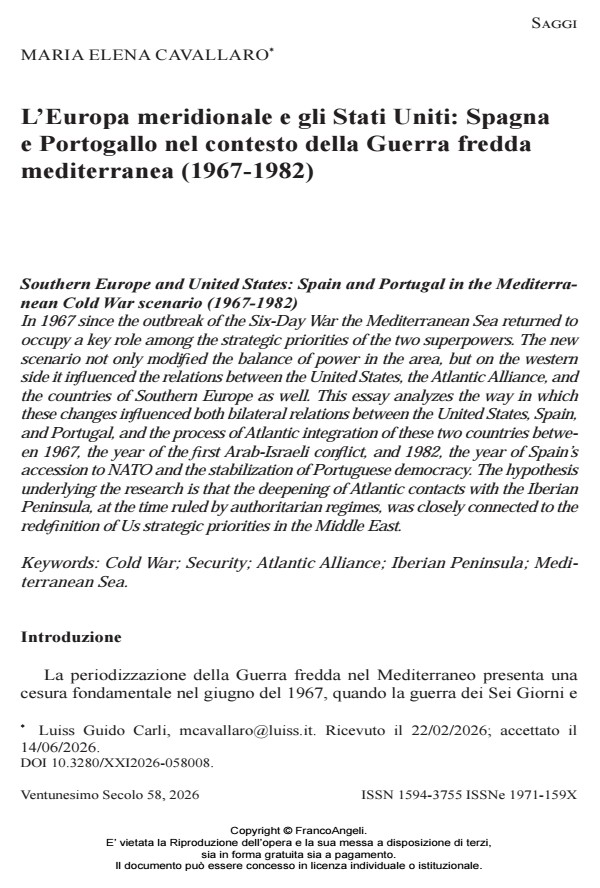
In 1967 since the outbreak of the Six-Day War the Mediterranean Sea returned to occupy a key role among the strategic priorities of the two superpowers. The new scenario not only modifi ed the balance of power in the area, but on the western side it infl uenced the relations between the United States, the Atlantic Alliance, and the countries of Southern Europe as well. This essay analyzes the way in which these changes infl uenced both bilateral relations between the United States, Spain, and Portugal, and the process of Atlantic integration of these two countries between 1967, the year of the fi rst Arab-Israeli confl ict, and 1982, the year of Spain’s accession to NATO and the stabilization of Portuguese democracy. The hypothesis underlying the research is that the deepening of Atlantic contacts with the Iberian Peninsula, at the time ruled by authoritarian regimes, was closely connected to the redefi nition of Us strategic priorities in the Middle East.
Keywords: Cold War; Security; Atlantic Alliance; Iberian Peninsula; Mediterranean Sea.
Maria Elena Cavallaro, L’Europa meridionale e gli Stati Uniti: Spagna e Portogallo nel contesto della Guerra fredda mediterranea (1967-1982) in "VENTUNESIMO SECOLO" 58/2026, pp 145-166, DOI: 10.3280/XXI2026-058008