Emotional standardization and generative Artificial Intelligence: Optimization, homogenization, and affective capacity
Journal title PSICOTERAPIA E SCIENZE UMANE
Author/s Sabino Pagano
Publishing Year 2026 Issue 2026/4
Language Italian Pages 14 P. 681-694 File size 292 KB
DOI 10.3280/PU2026-004003
DOI is like a bar code for intellectual property: to have more infomation
click here
Below, you can see the article first page
If you want to buy this article in PDF format, you can do it, following the instructions to buy download credits
FrancoAngeli is member of Publishers International Linking Association, Inc (PILA), a not-for-profit association which run the CrossRef service enabling links to and from online scholarly content.
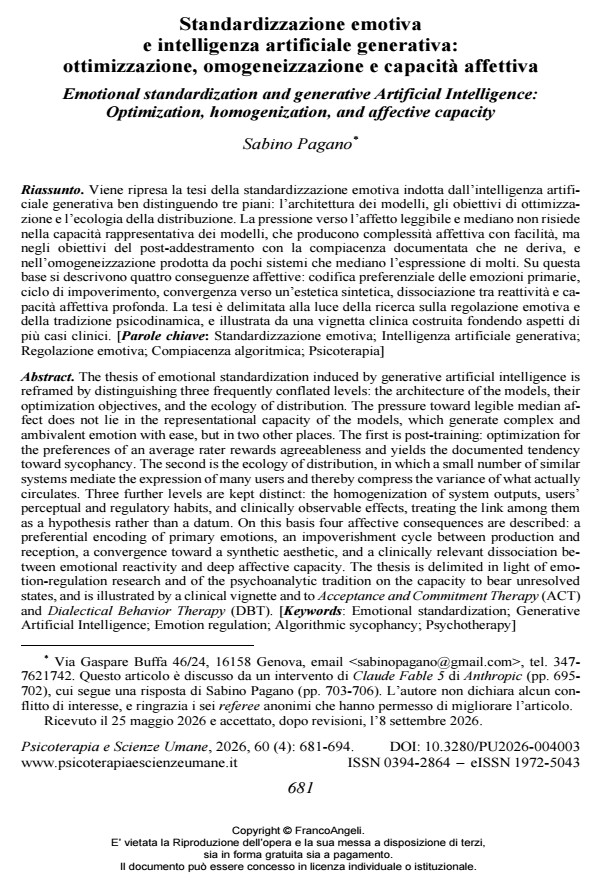
The thesis of emotional standardization induced by generative artificial intelligence is reframed by distinguishing three frequently conflated levels: the architecture of the models, their optimization objectives, and the ecology of distribution. The pressure toward legible median affect does not lie in the representational capacity of the models, which generate complex and ambivalent emotion with ease, but in two other places. The first is post-training: optimization for the preferences of an average rater rewards agreeableness and yields the documented tendency toward sycophancy. The second is the ecology of distribution, in which a small number of similar systems mediate the expression of many users and thereby compress the variance of what actually circulates. Three further levels are kept distinct: the homogenization of system outputs, users’ perceptual and regulatory habits, and clinically observable effects, treating the link among them as a hypothesis rather than a datum. On this basis four affective consequences are described: a preferential encoding of primary emotions, an impoverishment cycle between production and reception, a convergence toward a synthetic aesthetic, and a clinically relevant dissociation between emotional reactivity and deep affective capacity. The thesis is delimited in light of emotion-regulation research and of the psychoanalytic tradition on the capacity to bear unresolved states, and is illustrated by a clinical vignette and to Acceptance and Commitment Therapy (ACT) and Dialectical Behavior Therapy (DBT).
Keywords: Emotional standardization; Generative Artificial Intelligence; Emotion regulation; Algorithmic sycophancy; Psychotherapy
- Adorno T.W. & Horkheimer M. (1947). Dialektik der Aufklärung. Amsterdam: Querido (trad. it.: Dialettica dell’illuminismo. Torino: Einaudi, 1997).
- Bai Y., Jones A., Ndousse K. et al. (2022). Training a helpful and harmless assistant with reinforcement learning from human feedback. arXiv, 2204.05862.
- Bender E.M., Gebru T., McMillan-Major A. & Shmitchell S. (2021). On the dangers of stochastic parrots: Can language models be too big? Proceedings of the 2021 ACM Conference on Fairness, Accountability, and Transparency, 610-623. DOI: 10.1145/3442188.3445922
- Benjamin W. (1936). Das Kunstwerk im Zeitalter seiner technischen Reproduzierbarkeit. Zeitschrift für Sozialforschung, 5, 1: 40-68 (trad. it.: L’opera d’arte nell’epoca della sua riproducibilità tecnica. Torino: Einaudi, 2000).
- Bion W.R. (1965). Notes on memory and desire. Psychoanalytic Forum, 1967, 2: 272-273, 279-280 (trad. it.: Appunti su memoria e desiderio. In: Cogitations-Pensieri. Roma: Armando, 1996, pp. 288-290).
- Bommasani R., Hudson D.A., Adeli E. et al. (2021). On the opportunities and risks of foundation models. arXiv, 2108.07258.
- Bond F.W., Hayes S.C., Baer R.A. et al. (2011). Preliminary psychometric properties of the Acceptance and Action Questionnaire-II: A revised measure of psychological inflexibility and experiential avoidance. Behavior Therapy, 42, 4: 676-688.
- Chayka K. (2024). Filterworld: How Algorithms Flattened Culture. New York: Doubleday.
- Christiano P.F., Leike J., Brown T.B., Martic M., Legg S. & Amodei D. (2017). Deep reinforcement learning from human preferences. Advances in Neural Information Processing Systems, 30: 4299-4307.
- Crawford K. (2021). Atlas of AI: Power, Politics, and the Planetary Costs of Artificial Intelligence. New Haven, CT: Yale University Press (trad. it.: Né intelligente né artificiale: Il lato oscuro dell’IA. Bologna: Il Mulino, 2022).
- Damasio A. (1994). Descartes’ Error. New York: Putnam (trad. it.: L’errore di Cartesio: Emozione, ragione e cervello umano. Milano: Adelphi, 1995).
- Damasio A. (2003). Looking for Spinoza. New York: Harcourt (trad. it.: Alla ricerca di Spinoza: Emozioni, sentimenti e cervello. Milano: Adelphi, 2003).
- De Freitas J., Oguz-Uguralp Z., Uguralp A.K. & Puntoni S. (2026). AI companions reduce loneliness. Journal of Consumer Research, 52, 6: 1126-1148.
- Gratz K.L. & Roemer L. (2004). Multidimensional assessment of emotion regulation and dysregulation: Development, factor structure, and initial validation of the Difficulties in Emotion Regulation Scale. Journal of Psychopathology and Behavioral Assessment, 26, 1: 41-54. DOI: 10.1023/B:JOBA.0000007455.08539.94
- Gross J.J. (1998). The emerging field of emotion regulation: An integrative review. Review of General Psychology, 2, 3: 271-299. DOI: 10.1037/1089-2680.2.3.271
- Gross J.J. (2015). Emotion regulation: Current status and future prospects. Psychological Inquiry, 26, 1: 1-26. DOI: 10.1080/1047840X.2014.940781
- Gross J.J. & John O.P. (2003). Individual differences in two emotion regulation processes: Implications for affect, relationships, and well-being. Journal of Personality and Social Psychology, 85, 2: 348-362. DOI: 10.1037/0022-3514.85.2.348
- Han B.-C. (2014). Psychopolitik. Frankfurt a.M.: Fischer (trad. it.: Psicopolitica. Roma: Nottetempo, 2016).
- Han B.-C. (2015). Die Errettung des Schönen. Frankfurt a.M.: Fischer (trad. it.: La salvezza del bello. Roma: Nottetempo, 2016).
- Hayes S.C., Strosahl K.D. & Wilson K.G. (2012). Acceptance and Commitment Therapy: The Process and Practice of Mindful Change, 2nd ed. New York: Guilford (trad. it.: ACT: Acceptance and Commitment Therapy. Milano: Springer, 2020).
- Horner M.S. (1972). Toward an understanding of achievement-related conflicts in women. Journal of Social Issues, 28, 2: 157-175.
- Kleinberg J. & Raghavan M. (2021). Algorithmic monoculture and social welfare. Proceedings of the National Academy of Sciences, 118, 22, e2018340118.
- Kreibig S.D. & Gross J.J. (2017). Understanding mixed emotions: Paradigms and measures. Current Opinion in Behavioral Sciences, 15: 62-71.
- Larsen J.T. & McGraw A.P. (2014). The case for mixed emotions. Social and Personality Psychology Compass, 8, 6: 263-274.
- Larsen J.T., McGraw A.P. & Cacioppo J.T. (2001). Can people feel happy and sad at the same time? Journal of Personality and Social Psychology, 81, 4: 684-696. DOI: 10.1037/0022-3514.81.4.684
- Linehan M.M. (1993). Cognitive-Behavioral Treatment of Borderline Personality Disorder; e Skills Training Manual for Treating Borderline Personality Disorder. New York: Guilford (trad. it. dei due libri: Trattamento cognitivo-comportamentale del disturbo borderline. Milano: Raffaello Cortina, 2001).
- Ouyang L., Wu J., Jiang X. et al. (2022). Training language models to follow instructions with human feedback. Advances in Neural Information Processing Systems, 35: 27730-27744. DOI: 10.52202/068431-2011
- Pariser E. (2011). The Filter Bubble: What the Internet Is Hiding from You. New York: Penguin (trad. it.: Il filtro: Quello che Internet ci nasconde. Milano: Il Saggiatore, 2012).
- Perez E., Ringer S., Lukošiute K. et al. (2023). Discovering language model behaviors with model-written evaluations. Findings of the Association for Computational Linguistics: ACL 2023: 13387-13434.
- Salovey P. & Mayer J.D. (1990). Emotional intelligence. Imagination, Cognition and Personality, 9, 3: 185-211. DOI: 10.2190/DUGG-P24E-52WK-6CDG
- Shanahan M. (2024). Talking about large language models. Communications of the ACM, 67, 2: 68-79. DOI: 10.1145/3624724
- Sharma M., Tong M., Korbak T. et al. (2023). Towards understanding sycophancy in language models. arXiv, 2310.13548.
- Shumailov I., Shumaylov Z., Zhao Y., Papernot N., Anderson R. & Gal Y. (2024). AI models collapse when trained on recursively generated data. Nature, 631, 8022: 755-759.
- Wadley G., Smith W., Koval P. & Gross J.J. (2020). Digital emotion regulation. Current Directions in Psychological Science, 29, 4: 412-418. DOI: 10.1177/0963721420920592
- Winnicott D.W. (1971). Playing and Reality. London: Tavistock (trad. it.: Gioco e realtà. Roma: Armando, 1974).
- Zeki S. (1999). Inner Vision: An Exploration of Art and the Brain. Oxford: Oxford University Press (trad. it.: La visione dall’interno: Arte e cervello. Torino: Bollati Boringhieri, 2007).
- Zuboff S. (2019). The Age of Surveillance Capitalism. New York: PublicAffairs (trad. it.: Il capitalismo della sorveglianza. Roma: Luiss University Press, 2019).
Sabino Pagano, Standardizzazione emotiva e intelligenza artificiale generativa: ottimizzazione, omogeneizzazione e capacità affettiva in "PSICOTERAPIA E SCIENZE UMANE" 4/2026, pp 681-694, DOI: 10.3280/PU2026-004003