Standardizzazione emotiva e intelligenza artificiale generativa: ottimizzazione, omogeneizzazione e capacità affettiva
Titolo Rivista PSICOTERAPIA E SCIENZE UMANE
Autori/Curatori Sabino Pagano
Anno di pubblicazione 2026 Fascicolo 2026/4
Lingua Italiano Numero pagine 14 P. 681-694 Dimensione file 292 KB
DOI 10.3280/PU2026-004003
Il DOI è il codice a barre della proprietà intellettuale: per saperne di più
clicca qui
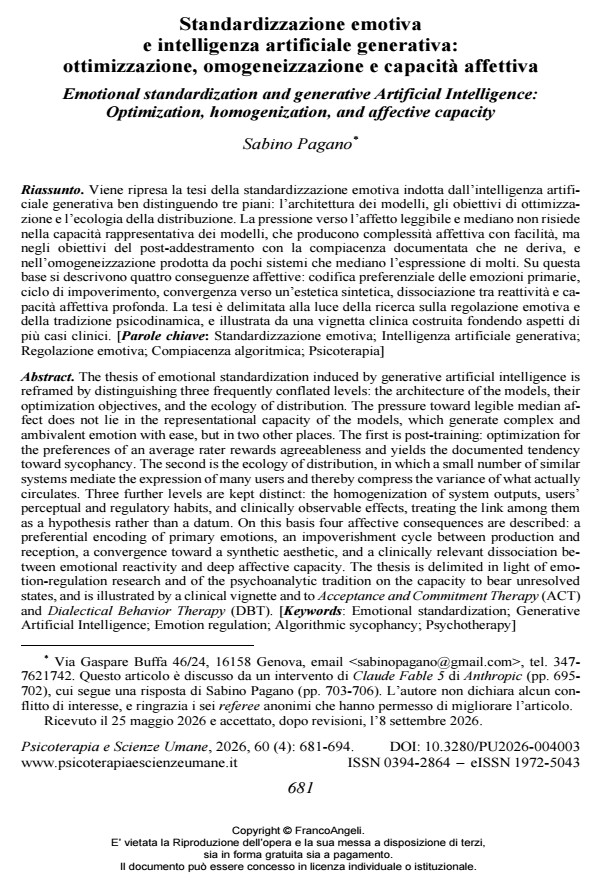
Qui sotto puoi vedere in anteprima la prima pagina di questo articolo.
Se questo articolo ti interessa, lo puoi acquistare (e scaricare in formato pdf) seguendo le facili indicazioni per acquistare il download credit. Acquista Download Credits per scaricare questo Articolo in formato PDF
FrancoAngeli è membro della Publishers International Linking Association, Inc (PILA), associazione indipendente e non profit per facilitare (attraverso i servizi tecnologici implementati da CrossRef.org) l’accesso degli studiosi ai contenuti digitali nelle pubblicazioni professionali e scientifiche.
Viene ripresa la tesi della standardizzazione emotiva indotta dall’intelligenza artificiale generativa ben distinguendo tre piani: l’architettura dei modelli, gli obiettivi di ottimizzazione e l’ecologia della distribuzione. La pressione verso l’affetto leggibile e mediano non risiede nella capacità rappresentativa dei modelli, che producono complessità affettiva con facilità, ma negli obiettivi del post-addestramento con la compiacenza documentata che ne deriva, e nell’omogeneizzazione prodotta da pochi sistemi che mediano l’espressione di molti. Su questa base si descrivono quattro conseguenze affettive: codifica preferenziale delle emozioni primarie, ciclo di impoverimento, convergenza verso un’estetica sintetica, dissociazione tra reattività e capacità affettiva profonda. La tesi è delimitata alla luce della ricerca sulla regolazione emotiva e della tradizione psicodinamica, e illustrata da una vignetta clinica costruita fondendo aspetti di più casi clinici.
Parole chiave:Standardizzazione emotiva; Intelligenza artificiale generativa; Regolazione emotiva; Compiacenza algoritmica; Psicoterapia
- Adorno T.W. & Horkheimer M. (1947). Dialektik der Aufklärung. Amsterdam: Querido (trad. it.: Dialettica dell’illuminismo. Torino: Einaudi, 1997).
- Bai Y., Jones A., Ndousse K. et al. (2022). Training a helpful and harmless assistant with reinforcement learning from human feedback. arXiv, 2204.05862.
- Bender E.M., Gebru T., McMillan-Major A. & Shmitchell S. (2021). On the dangers of stochastic parrots: Can language models be too big? Proceedings of the 2021 ACM Conference on Fairness, Accountability, and Transparency, 610-623. DOI: 10.1145/3442188.3445922
- Benjamin W. (1936). Das Kunstwerk im Zeitalter seiner technischen Reproduzierbarkeit. Zeitschrift für Sozialforschung, 5, 1: 40-68 (trad. it.: L’opera d’arte nell’epoca della sua riproducibilità tecnica. Torino: Einaudi, 2000).
- Bion W.R. (1965). Notes on memory and desire. Psychoanalytic Forum, 1967, 2: 272-273, 279-280 (trad. it.: Appunti su memoria e desiderio. In: Cogitations-Pensieri. Roma: Armando, 1996, pp. 288-290).
- Bommasani R., Hudson D.A., Adeli E. et al. (2021). On the opportunities and risks of foundation models. arXiv, 2108.07258.
- Bond F.W., Hayes S.C., Baer R.A. et al. (2011). Preliminary psychometric properties of the Acceptance and Action Questionnaire-II: A revised measure of psychological inflexibility and experiential avoidance. Behavior Therapy, 42, 4: 676-688.
- Chayka K. (2024). Filterworld: How Algorithms Flattened Culture. New York: Doubleday.
- Christiano P.F., Leike J., Brown T.B., Martic M., Legg S. & Amodei D. (2017). Deep reinforcement learning from human preferences. Advances in Neural Information Processing Systems, 30: 4299-4307.
- Crawford K. (2021). Atlas of AI: Power, Politics, and the Planetary Costs of Artificial Intelligence. New Haven, CT: Yale University Press (trad. it.: Né intelligente né artificiale: Il lato oscuro dell’IA. Bologna: Il Mulino, 2022).
- Damasio A. (1994). Descartes’ Error. New York: Putnam (trad. it.: L’errore di Cartesio: Emozione, ragione e cervello umano. Milano: Adelphi, 1995).
- Damasio A. (2003). Looking for Spinoza. New York: Harcourt (trad. it.: Alla ricerca di Spinoza: Emozioni, sentimenti e cervello. Milano: Adelphi, 2003).
- De Freitas J., Oguz-Uguralp Z., Uguralp A.K. & Puntoni S. (2026). AI companions reduce loneliness. Journal of Consumer Research, 52, 6: 1126-1148.
- Gratz K.L. & Roemer L. (2004). Multidimensional assessment of emotion regulation and dysregulation: Development, factor structure, and initial validation of the Difficulties in Emotion Regulation Scale. Journal of Psychopathology and Behavioral Assessment, 26, 1: 41-54. DOI: 10.1023/B:JOBA.0000007455.08539.94
- Gross J.J. (1998). The emerging field of emotion regulation: An integrative review. Review of General Psychology, 2, 3: 271-299. DOI: 10.1037/1089-2680.2.3.271
- Gross J.J. (2015). Emotion regulation: Current status and future prospects. Psychological Inquiry, 26, 1: 1-26. DOI: 10.1080/1047840X.2014.940781
- Gross J.J. & John O.P. (2003). Individual differences in two emotion regulation processes: Implications for affect, relationships, and well-being. Journal of Personality and Social Psychology, 85, 2: 348-362. DOI: 10.1037/0022-3514.85.2.348
- Han B.-C. (2014). Psychopolitik. Frankfurt a.M.: Fischer (trad. it.: Psicopolitica. Roma: Nottetempo, 2016).
- Han B.-C. (2015). Die Errettung des Schönen. Frankfurt a.M.: Fischer (trad. it.: La salvezza del bello. Roma: Nottetempo, 2016).
- Hayes S.C., Strosahl K.D. & Wilson K.G. (2012). Acceptance and Commitment Therapy: The Process and Practice of Mindful Change, 2nd ed. New York: Guilford (trad. it.: ACT: Acceptance and Commitment Therapy. Milano: Springer, 2020).
- Horner M.S. (1972). Toward an understanding of achievement-related conflicts in women. Journal of Social Issues, 28, 2: 157-175.
- Kleinberg J. & Raghavan M. (2021). Algorithmic monoculture and social welfare. Proceedings of the National Academy of Sciences, 118, 22, e2018340118.
- Kreibig S.D. & Gross J.J. (2017). Understanding mixed emotions: Paradigms and measures. Current Opinion in Behavioral Sciences, 15: 62-71.
- Larsen J.T. & McGraw A.P. (2014). The case for mixed emotions. Social and Personality Psychology Compass, 8, 6: 263-274.
- Larsen J.T., McGraw A.P. & Cacioppo J.T. (2001). Can people feel happy and sad at the same time? Journal of Personality and Social Psychology, 81, 4: 684-696. DOI: 10.1037/0022-3514.81.4.684
- Linehan M.M. (1993). Cognitive-Behavioral Treatment of Borderline Personality Disorder; e Skills Training Manual for Treating Borderline Personality Disorder. New York: Guilford (trad. it. dei due libri: Trattamento cognitivo-comportamentale del disturbo borderline. Milano: Raffaello Cortina, 2001).
- Ouyang L., Wu J., Jiang X. et al. (2022). Training language models to follow instructions with human feedback. Advances in Neural Information Processing Systems, 35: 27730-27744. DOI: 10.52202/068431-2011
- Pariser E. (2011). The Filter Bubble: What the Internet Is Hiding from You. New York: Penguin (trad. it.: Il filtro: Quello che Internet ci nasconde. Milano: Il Saggiatore, 2012).
- Perez E., Ringer S., Lukošiute K. et al. (2023). Discovering language model behaviors with model-written evaluations. Findings of the Association for Computational Linguistics: ACL 2023: 13387-13434.
- Salovey P. & Mayer J.D. (1990). Emotional intelligence. Imagination, Cognition and Personality, 9, 3: 185-211. DOI: 10.2190/DUGG-P24E-52WK-6CDG
- Shanahan M. (2024). Talking about large language models. Communications of the ACM, 67, 2: 68-79. DOI: 10.1145/3624724
- Sharma M., Tong M., Korbak T. et al. (2023). Towards understanding sycophancy in language models. arXiv, 2310.13548.
- Shumailov I., Shumaylov Z., Zhao Y., Papernot N., Anderson R. & Gal Y. (2024). AI models collapse when trained on recursively generated data. Nature, 631, 8022: 755-759.
- Wadley G., Smith W., Koval P. & Gross J.J. (2020). Digital emotion regulation. Current Directions in Psychological Science, 29, 4: 412-418. DOI: 10.1177/0963721420920592
- Winnicott D.W. (1971). Playing and Reality. London: Tavistock (trad. it.: Gioco e realtà. Roma: Armando, 1974).
- Zeki S. (1999). Inner Vision: An Exploration of Art and the Brain. Oxford: Oxford University Press (trad. it.: La visione dall’interno: Arte e cervello. Torino: Bollati Boringhieri, 2007).
- Zuboff S. (2019). The Age of Surveillance Capitalism. New York: PublicAffairs (trad. it.: Il capitalismo della sorveglianza. Roma: Luiss University Press, 2019).
Sabino Pagano, Standardizzazione emotiva e intelligenza artificiale generativa: ottimizzazione, omogeneizzazione e capacità affettiva in "PSICOTERAPIA E SCIENZE UMANE" 4/2026, pp 681-694, DOI: 10.3280/PU2026-004003