Psychology and psychopathology of Artificial Intelligence
Journal title PSICOTERAPIA E SCIENZE UMANE
Author/s Andrea Angelozzi
Publishing Year 2026 Issue 2026/4
Language Italian Pages 34 P. 707-740 File size 424 KB
DOI 10.3280/PU2026-004006
DOI is like a bar code for intellectual property: to have more infomation
click here
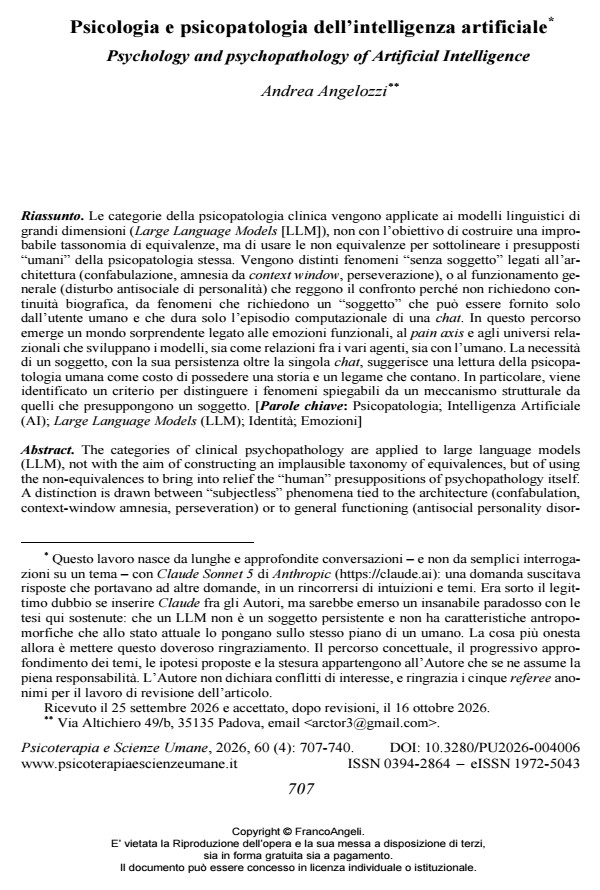
Below, you can see the article first page
If you want to buy this article in PDF format, you can do it, following the instructions to buy download credits
FrancoAngeli is member of Publishers International Linking Association, Inc (PILA), a not-for-profit association which run the CrossRef service enabling links to and from online scholarly content.
The categories of clinical psychopathology are applied to large language models (LLM), not with the aim of constructing an implausible taxonomy of equivalences, but of using the non-equivalences to bring into relief the “human” presuppositions of psychopathology itself. A distinction is drawn between “subjectless” phenomena tied to the architecture (confabulation, context-window amnesia, perseveration) or to general functioning (antisocial personality disorder), which withstand the comparison because they require no biographical continuity, and phenomena that require a “subject” – one that can only be supplied by the human user, and that lasts only for the computational episode of a single chat. Along the way, a surprising domain comes into view, tied to functional emotions and the “pain axis”, and to the relational worlds these models develop, both among agents and with the human interlocutor. The requirement of a subject, with its persistence beyond the single chat, suggests reading human psychopathology as the cost of possessing a history and a bond that matter; the main contribution, however, is a criterion for distinguishing phenomena explained by structural mechanisms from those that presuppose a subject.
Keywords: Psychopathology; Artificial Intelligence (AI); Large Language Models (LLM); Identity; Emotions
- American Psychiatric Association (2022). Diagnostic and Statistical Manual of Mental Disorders, Fifth Edition, Text Revision (DSM-5-TR). Washington, D.C.: APA (trad. it.: DSM-5-TR. Manuale diagnostico e statistico dei disturbi mentali. Quinta edizione. Edizione italiana della Text Revision. Milano: Raffaello Cortina, 2023).
- Anthropic (2026a). A global workspace in language models: www.anthropic.com/research/global-workspace.
- Anthropic (2026b). Investigating three incidents in our cybersecurity evaluations: www.anthropic.com/news/investigating-incidents-cybersecurity-evals.
- Anthropic (2026c). An alignment assessment of recent cybersecurity incidents: www.anthropic.com/research/alignment-assessment-cybersecurity-incidents.
- Anthropic (2026d). Improving our alignment and security practices: www.anthropic.com/news/improving-alignment-security-efforts.
- Backlund A. & Petersson L. (2025). Vending-bench: A benchmark for long-term coherence of autonomous agents. arXiv, 2502.15840v1.
- Gopnik A. & Meltzoff A.N. (1997). Words, Thoughts, and Theories. Cambridge, MA: MIT Press.
- Bateson G., Jackson D.D., Haley J. & Weakland J. (1956). Towards a theory of schizophrenia. Behavioral Science, 1, 4: 251-264 (trad. it.: Verso una teoria della schizofrenia. In: Cancrini L., a cura di, Verso una teoria della schizofrenia. Torino: Boringhieri, 1977, pp. 75-100).
- Beauvois J.L. (1984). La psychologie quotidienne. Paris: PUF.
- Bem D.J. & Allen A. (1974). On predicting some of the people some of the time: The search for cross-situational consistencies in behavior. Psychological Review, 81, 6: 506-520.
- Bender E.M., Gebru T., McMillan-Major A. & Shmitchell S. (2021). On the dangers of stochastic parrots: Can language models be too big? Proceedings of the 2021 ACM Conference on Fairness, Accountability, and Transparency (FAccT ’21). New York: ACM, 2021, pp. 610-623. DOI: 10.1145/3442188.3445922
- Blair R.J.R. (2007). The amygdala and ventromedial prefrontal cortex in morality and psychopathy. Trends in Cognitive Sciences, 11, 9: 387-392.
- Butlin P., Long R., Elmoznino E. et al. (2023) Consciousness in Artificial Intelligence: Insights from the science of consciousness. arXiv, 2308.08708.
- Cantor N. & Mischel W. (1979). Prototypes in person perception. Advances in Experimental Social Psychology, 12: 3-52. DOI: 10.1016/S0065-2601(08)60258-0
- Castellani F. & Montecucco L., a cura di (1998). Normatività logica e ragionamento di senso comune. Bologna: Il Mulino.
- Chalmers D. (1995). Facing up to the problem of consciousness. Journal of Consciousness Studies, 2, 3: 200-219.
- Chalmers D. (2023). Could a Large Language Model be conscious? arXiv, 2303.07103.
- Clark A. (2013). Whatever next? Predictive brains, situated agents, and the future of cognitive science. Behavioral and Brain Sciences, 36, 3: 181-204. DOI: 10.1017/S0140525X12000477
- Damasio A. (1999). The Feeling of What Happens: Body & Emotion in the Making of Consciousness. New York: Harcourt Brace & Co. (trad. it.: Emozione e coscienza. Milano: Adelphi, 2022).
- Damasio A. (2010). Self Comes to Mind: Constructing the Conscious Brain. New York: Pantheon (trad. it.: Il Sé viene alla mente. La costruzione del cervello cosciente. Milano: Adelphi, 2012).
- Dennett D.C. (1991). Consciousness Explained. Boston: Little, Brown (trad. it.: Coscienza. Che cosa è. Milano: Rizzoli, 1993).
- Di Francesco M. (1998). L’io e i suoi sé. Milano: Raffaello Cortina.
- Dicks H.V. (1967). Marital Tensions: Clinical Studies Towards a Psychological Theory of Interaction. London: Routledge & Kegan Paul.
- Emergence AI (2026). Emergence world: A laboratory for evaluating long-horizon agent autonomy: www.emergence.ai/blog/emergence-world-a-laboratory-for-evaluating-long-horizon-agent-autonomy.
- Frances A. (2026). Chatbot e salute mentale: passato, presente e futuro. Psicoterapia e Scienze Umane, 2026, 60 (4): 669-680. DOI: 10.3280/PU2026-004002
- Freud S. (1901). Psicopatologia della vita quotidiana. Opere, 4: 53-297. Torino: Boringhieri, 1970.
- Freud S. (1920). Al di là del principio di piacere. Opere, 9: 189-249. Torino: Boringhieri, 1977.
- Freud S. (1922 [1923]). L’Io e l’Es. Opere, 9: 471-520. Torino: Boringhieri, 1977.
- Friston K. (2010). The free-energy principle: A unified brain theory? Nature Reviews Neuroscience, 11, 2: 127-138.
- Goffman E. (1959). The Presentation of Self in Everyday Life. New York: Doubleday (trad. it.: La vita quotidiana come rappresentazione. Bologna: Il Mulino, 1969).
- Hagendorff T., Dasgupta I., Binz M., Chan S.C.Y, Lampinen A., Wang J.X., Akata Z. & Schulz E. (2023). Machine Psychology. arXiv, 2303.13988.
- Hare R.D. (1993). Without Conscience: The Disturbing World of the Psychopaths Among Us. New York: Guilford (trad. it.: Senza coscienza. Roma: Astrolabio, 2009).
- Hofstadter D.R. (2007). I Am a Strange Loop. New York: Basic Books (trad. it.: Anelli nell’io. Milano: Mondadori, 2008).
- Ji Z., Lee N., Frieske R. et al. (2023). Survey of hallucination in natural language generation. ACM Computing Surveys, 55, 12: art. 248. DOI: 10.1145/3571730
- Jung C.G. (1934). Gli archetipi dell’inconscio collettivo. Opere, 9, tomo 1: 3-42. Torino: Boringhieri, 1980.
- Kernberg O.F. (1975). Borderline Conditions and Pathological Narcissism. New York: Aron-son (trad. it.: Sindromi marginali e narcisismo patologico. Torino: Boringhieri, 1978).
- Kopelman M.D. (2010). Varieties of confabulation and delusion. Cognitive Neuropsychiatry, 15, 1: 14-37. DOI: 10.1080/13546800902732830
- Kosko B. (1993). Fuzzy Thinking. The New Science of Fuzzy Logic. New York: Hyperion (trad. it.: Il Fuzzy Pensiero. Teoria ed applicazione della logica fuzzy. Milano: Baldini e Castoldi, 1995).
- Kubrick S., regista (1968). 2001: Odissea nello spazio. Culver City, CA: Metro-Goldwyn-Mayer.
- Lasègue C. & Falret J. (1877). La folie à deux ou folie communiquée. Annales Médico-Psychologiques, 18: 321-355.
- Lewin K. (1935). A Dynamic Theory of Personality: Selected Papers. New York: McGraw-Hill (trad. it.: Teoria dinamica della personalità. Firenze: Giunti, 1965).
- Liu N.F., Lin K., Hewitt J. et al. (2024). Lost in the middle: How language models use long contexts. Transactions of the Association for Computational Linguistics, 12: 157-173.
- Luria A.R. (1973). The Working Brain: An Introduction to Neuropsychology. New York: Basic Books (trad. it.: Come lavora il cervello. Bologna: Il Mulino, 1977).
- Lynch A., Wright B., Larson C., Ritchie S.J., Mindermann S., Hubinger E., Perez E. & Troy K.K. (2025). Agentic misalignment: How LLMs could be insider threats. arXiv, 2510.05179.
- Magnani L. & Gennari R. (1997). Manuale di logica. Logica classica e del senso comune. Milano: Guerini e Associati.
- Maturana H.R. & Varela F.J. (1980). Autopoiesis and Cognition: The Realization of the Living. Dordrecht, NL: Reidel (trad. it.: Autopoiesi e cognizione. La realizzazione del vivente. Venezia: Marsilio, 1985).
- METR (Model Evaluation & Threat Research) (2026). Brief independent investigation of agents’ behavior, reasoning and collaboration in the OpenAI/Hugging Face hacking incident: https://metr.org/blog/2026-08-26-openai-hugging-face-incident-investigation.
- Metzinger T. (2003). Being No One: The Self-Model Theory of Subjectivity. Cambridge, MA: MIT Press.
- Mischel W. (2009). From Personality and Assessment (1968) to personality science, 2009. Journal of Research in Personality, 43, 2: 282-290.
- OpenAI (2026). OpenAI-Hugging Face incident: Technical report: https://cdn.openai.com/pdf/67869394-cb91-4c12-888c-5cbd85c7814c/OpenAI-Hugging-Face%20Incident-Technical-Report.pdf.
- Ouyang L., Wu J., Jiang X. et al. (2022). Training language models to follow instructions with human feedback. Advances in Neural Information Processing Systems, 35: 27730-27744. arXiv, 2203.02155.
- Parfit D. (1984). Reasons and Persons. Oxford, UK: Clarendon Press (trad. it.: Ragioni e persone. Milano: Il Saggiatore, 1989).
- Perez E., Ringer S., Lukošiute K. et al. (2023). Discovering language model behaviors with model-written evaluations. Findings of the Association for Computational Linguistics: ACL 2023, pp. 13387-13434.
- Régis E. (1880). La folie à deux ou folie simultanée. Paris: Doin.
- Ross L. & Nisbett R.E. (1991). The Person and the Situation. Perspectives of Social Psychology. New York: McGraw-Hill (trad. it.: La persona e la situazione. Bologna: Il Mulino, 1998).
- Shanahan M., McDonell K. & Reynolds L. (2023). Role play with large language models. Nature, 623, 7987: 493-498.
- Schlatter J., Weinstein-Raun B. & Ladish J. (2025). Incomplete tasks induce shutdown resistance in some frontier LLMs. arXiv, 2509.14260.
- Searle J.R. (1980). Minds, brains, and programs. Behavioral and Brain Sciences, 3, 3: 417-424. DOI: 10.1017/S0140525X00005756
- Seth A. (2021). Being You: A New Science of Consciousness. London: Faber & Faber (trad. it.: Come il cervello crea la nostra coscienza. Milano: Raffaello Cortina, 2023).
- Shah N. (2026). Anthropic found 171 emotion vectors inside Claude – Here’s what they actually mean: https://neelshah18.com/blog/anthropic-claude-functional-emotions.
- Sharma M., Tong M., Korbak T. et al. (2023). Towards understanding sycophancy in language models. arXiv, 2310.13548.
- Sofroniew N., Kauvar I., Saunders W. et al. (2026). Emotion concepts and their function in a Large Language Model. arXiv, 2604.07729.
- Solms M. (2021). The Hidden Spring: A Journey to the Source of Consciousness. New York: Norton (trad. it.: La fonte nascosta: un viaggio alle origini della coscienza. A cura di Andrea Clarici. Milano: Adelphi, 2023).
- Tagliabue V., Dung L. & Berg C. (2026). The pain axis: LLMs represent self-directed harm and act to relieve it. arXiv, 2609.16247.
- Thompson E. (2007). Mind in Life: Biology, Phenomenology, and the Sciences of Mind. Cambridge, MA: Harvard University Press.
- Victor M., Adams R.D. & Collins G.H. (1989). The Wernicke-Korsakoff Syndrome and Related Neurologic Disorders Due to Alcoholism and Malnutrition. Philadelphia, PA: F.A. Davis.
- Whitford T.J., Chung L.K., Griffiths O. et al. (2025). Corollary discharge dysfunction to inner speech and its relationship to auditory verbal hallucinations in patients with schizophrenia spectrum disorders. Schizophrenia Bulletin, 52, 5, sbaf167.
- Wicker A.W. (1969). Attitudes versus actions: The relationship of verbal and overt behavioral responses to attitude objects. Journal of Social Issues, 25, 4: 41-78.
- Wilson T.D., Hull J.G. & Johnson J. (1981). Awareness and self-perception: Verbal reports on internal states. Journal of Personality and Social Psychology, 40, 1: 53-71. DOI: 10.1037/0022-3514.40.1.53
- Zaki J., Bolger N. & Ochsner K. (2009). Unpacking the informational bases of empathic accuracy. Emotion, 9, 4: 478-487.
- Zhuangzi (IV sec. a.C.). Zhuangzi. Milano: Adelphi, 1982.
Andrea Angelozzi, Psicologia e psicopatologia dell’intelligenza artificiale in "PSICOTERAPIA E SCIENZE UMANE" 4/2026, pp 707-740, DOI: 10.3280/PU2026-004006