Labour and Performance in International Organizational Contexts: Migration Flows, Social Responsibility and Sustainability
Titolo Rivista QUADERNI DI ECONOMIA DEL LAVORO
Autori/Curatori Azio Barani
Anno di pubblicazione 2026 Fascicolo 2022/116
Lingua Inglese Numero pagine 15 P. 97-111 Dimensione file 110 KB
DOI 10.3280/QUA2022-116006
Il DOI è il codice a barre della proprietà intellettuale: per saperne di più
clicca qui
Qui sotto puoi vedere in anteprima la prima pagina di questo articolo.
Se questo articolo ti interessa, lo puoi acquistare (e scaricare in formato pdf) seguendo le facili indicazioni per acquistare il download credit. Acquista Download Credits per scaricare questo Articolo in formato PDF
FrancoAngeli è membro della Publishers International Linking Association, Inc (PILA), associazione indipendente e non profit per facilitare (attraverso i servizi tecnologici implementati da CrossRef.org) l’accesso degli studiosi ai contenuti digitali nelle pubblicazioni professionali e scientifiche.
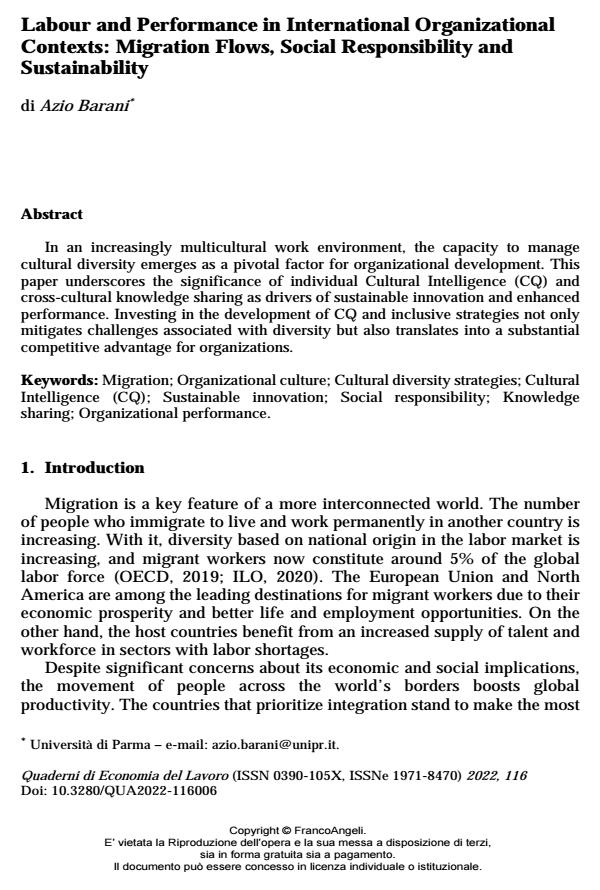
In an increasingly multicultural work environment, the capacity to manage cultural diversity emerges as a pivotal factor for organizational development. This paper underscores the significance of individual Cultural Intelligence (CQ) and cross-cultural knowledge sharing as drivers of sustainable innovation and enhanced performance. Investing in the development of CQ and inclusive strategies not only mitigates challenges associated with diversity but also translates into a substantial competitive advantage for organizations.
Parole chiave:Migration; Organizational culture; Cultural diversity strategies; Cultural Intelligence (CQ); Sustainable innovation; Social responsibility; Knowledge sharing; Organizational performance.
- Acar O.A., Tarakci M. & Van-Knippenberg D. (2019). Creativity and Innovation Under Constraints: A Cross-Disciplinary Integrative Review. Journal of Management, 45(1): 96-121. DOI: 10.1177/0149206318805832
- Afsar B. & Umrani W.A. (2020). Transformational leadership and innovative work behavior: The role of motivation to learn, task complexity and innovation climate. European Journal of Innovation Management, 23(3): 402-428.
- Ahmad F. (2019). Impacts of knowledge sharing: a review and directions for future research. Journal of Workplace Learning, 31(3): 207-230. DOI: 10.1108/JWL-07-2018-0096
- Al Ariss A. & Syed J. (2011). Capital Mobilization of Skilled Migrants: A Relational Perspective. British Journal of Management, 22(2): 286-304.
- Anderson N., Potocnik K. & Zhou J. (2014). Innovation and Creativity in Organizations: A State-of-the-Science Review, Prospective Commentary, and Guiding Framework. Journal of Management, 40(5): 1297-1333. DOI: 10.1177/0149206314527128
- Ang S., Van Dyne L. & Koh C. (2006). Personality correlates of the four-factor model of cultural intelligence. Group & Organization Management, 31(1): 100-123. DOI: 10.1177/1059601105275267
- Ang S., Van Dyne L., Koh C., Bhaskar-Shrinivas K. & Ling K.Y. (2007). Cultural Intelligence: Its Measurement and Effects on Cultural Judgment and Decision Making, Cultural Adaptation and Task Performance. Management and Organization Review, 3(03): 335-371.
- Avery D.R. (2020). Lessons from the Losing: Implications of the COVID-19 Pandemic for Organizational Diversity Scholarship and Practice. Journal of Management Studies, 57(8): 1746-1749.
- Bäckström I. & Bengtsson L. (2019). A mapping study of employee innovation: proposing a research agenda. European Journal of Innovation Management, 22(3): 468-492.
- Balaji N.N., Chen W. & Brake M.R.W. (2020). Traction-Based Multi-Scale Nonlinear Dynamic Model. Mechanical Systems and Signal Processing, 139.
- Bates R. & Khalil S.M. (2005). Organizational learning culture, learning transfer climate and perceived innovation in Jordanian organizations. International Journal of Training and Development, 9(2): 96-109.
- Bourdieu P. (2008). Political Interventions: Social Science and Political Action (F. Poupeau & T. Discepolo, Eds.; D. Fernbach, Trans.). Verso.
- Büschgens T., Bausch A. & Balkin D.B. (2013). Organizational Culture and Innovation: A Meta-Analytic Review. Journal of Product Innovation Management, 30(4): 763-781.
- Castles S. (2011). Migration, Crisis, and the Global Labour Market. Globalizations, 8(3): 311-324. DOI: 10.1080/14747731.2011.576847
- Cobbinah P.B., Erdiaw-Kwasie M.O. & Amoateng P. (2015). Africa’s urbanisation: implications for sustainable development. Cities, 47: 62-72.
- Cooke F.L. (2013). Human Resource Management in China: New Trends and Practices. London: Routledge.
- Cummings J.N. (2004). Work groups, structural diversity, and knowledge sharing in a global organization. Management Science, 50(3): 352-364.
- de Haas H. (2010). Migration and development: a theoretical perspective. International Migration Review, 44(1): 227-264.
- DeFillippi R.J. & Arthur M.B. (1994). The Boundaryless Career: A Competency-Based Perspective. Journal of Organizational Behavior, 15(4): 307-324.
- Deshingkar P. (2006). Internal Migration, Poverty and Development in Asia (ODI Briefing Paper 11). ODI.
- Dobbin F., Kim S. & Kalev A. (2011). You can’t always get what you need: Organizational determinants of diversity programs. American Sociological Review, 76(3): 386-411. DOI: 10.1177/0003122411409704
- Dwyer J., Members of the Steering Committee of the National Health and Nutrition Examination Survey (2003). Collection of Food and Dietary Supplement Intake Data What We Eat in America-NHANES. Journal of Nutrition, 133(5_suppl): 590S-600S.
- Earley P.C. & Ang S. (2003). Cultural intelligence: Individual interactions across cultures. Stanford University Press.
- Elia S., Messeni Petruzzelli A. & Piscitello L. (2019). The impact of cultural diversity on innovation performance of MNC subsidiaries in strategic alliances. Journal of Business Research, 98: 204-213.
- Farashah A.D. & Blomquist T. (2020). Exploring employer attitude towards migrant workers: Evidence from managers across Europe. Evidence-based HRM, 8(1): 18-37. DOI: 10.1108/EBHRM-04-2019-
- Findler L., Wind L.H. & Mor Barak M.E. (2007). The challenge of workforce management in a global society: Modeling the relationship between diversity, inclusion, organizational culture, and employee well-being, job satisfaction and organizational commitment. Administration in Social Work, 31(3): 63-94.
- Foss N.J., Husted K. & Michailova S. (2010). Governing Knowledge Sharing in Organizations: Levels of Analysis, Governance Mechanisms, and Research Directions. Journal of Management Studies, 47(3): 455-482.
- Gardner H. (1983). Frames of mind: The theory of multiple intelligences. Basic Books.
- Gavonel M.F., Adger W.N., de Campos R.S., Boyd E., Carr E.R., Fábos A., Fransen S., Jolivet D., Zickgraf C., Codjoe S.N.A., Abu M. & Siddiqui T. (2021). The migration-sustainability paradox: transformations in mobile worlds. Current Opinion in Environmental Sustainability, 49: 98-109.
- Guerrero L. & Rothstein M.G. (2012). Antecedents of underemployment: Job search of skilled immigrants in Canada. Applied Psychology: An International Review, 61(2): 323-346.
- Hewlett S.A., Marshall M. & Sherbin L. (2013). How diversity can drive innovation. Harvard Business Review, 91(12): 30.
- Holvino E. & Kamp A.M. (2009). Diversity management: Are we moving in the right direction? Reflections from both sides of the North Atlantic. Scandinavian Journal of Management, 25(4): 395-401.
- Hugo G. (1996). Environmental Concerns and International Migration. International Migration Review, 30(1): 105-131. DOI: 10.1177/019791839603000110
- International Labour Office (ILO) (2020). World Employment and Social Outlook: Trends 2020. ILO.
- Jankelova´ N., Jankurova´ A. & Prokopa M. (2020). Diversity Management as a Tool for Sustainable Development of Health Care Facilities. Sustainability, 12(13): 5226.
- Janssens M. & Zanoni P. (2005). Many diversities for many services: Theorizing diversity (management) in service companies. Human Relations, 58(3): 311-340. DOI: 10.1177/0018726705053424
- Jin L. & Sun H. (2010). The effect of researchers’ interdisciplinary characteristics on team innovation performance: evidence from university R & D teams in China. International Journal of Human Resource Management, 21(13): 2488-2502. DOI: 10.1080/09585192.2010.516599
- Jyoti J. & Kour S. (2017). Cultural intelligence and job performance: An empirical investigation of moderating and mediating variables. International Journal of Cross Cultural Management, 17(3): 305-326. DOI: 10.1177/1470595817718001
- Kim S. & Lee H. (2006). The impact of organizational context and information technology on employee knowledge-sharing capabilities. Public Administration Review, 66(3): 370-385.
- Li J., Wu N. & Xiong S. (2021). Sustainable innovation in the context of organizational cultural diversity: The role of cultural intelligence and knowledge sharing. PLoS ONE, 16(5), e0250878.
- Liu L.A., Lee S. & Tan C. (2018). Understanding intercultural dynamics. Cross Cultural & Strategic Management, 25(1): 2-31.
- Lu Y., Samaratunge R. & Härtel C.E. (2011). Acculturation strategies among professional Chinese immigrants in the Australian workplace. Asia Pacific Journal of Human Resources, 49(1): 71-87.
- Lukes M. & Stephan U. (2017). Measuring employee innovation: A review of existing scales and the development of the innovative behavior and innovation support inventories across cultures. International Journal of Entrepreneurial Behavior & Research, 23(1): 136-158.
- Luo S., Wang J. & Tong D.Y.K. (2020). Does Power Distance Necessarily Hinder Individual Innovation? A Moderated-Mediation Model. Sustainability, 12(6): 2526.
- MacKenzie R. & Forde C. (2009). The rhetoric of the ‘good worker’ versus the realities of employers’ use and the experiences of migrant workers. Work, Employment and Society, 23(1): 142-159. DOI: 10.1177/0950017008099783
- McKinsey Global Institute (MGI). (2016, December). People on the Move: Global Migration’s Impact and Opportunity.
- Metz D., Ilie? L. & Nistor R.L. (2020). The Impact of Organizational Culture on Customer Service Effectiveness from a Sustainability Perspective. Sustainability, 12(15), 6240.
- Montoya R.M. & Horton R.S. (2013). A two-dimensional model for the study of interpersonal attraction. Personality and Social Psychology Review, 17(4): 304-326. DOI: 10.1177/1088868313501887
- Naqshbandi M.M., Kaur S. & Ma P. (2014). What organizational culture types enable and retard open innovation? Quality & Quantity, 49(5): 2123-2144.
- Noon D. (2012). A Critical Consideration of the Business Case for Diversity. Equality and Human Rights Commission.
- Nordin M. & Rooth D.-O. (2009). The Ethnic Employment and Income Gap in Sweden: Is Skill or Labor Market Discrimination the Explanation? Scandinavian Journal of Economics, 111(3): 487-510.
- OECD (2019). International Migration Outlook 2019. OECD Publishing.
- Ortlieb R. & Sieben B. (2013). How to safeguard critical resources of professional and managerial staff: Exploration of a taxonomy of resource retention strategies. Group & Organization Management, 38(4): 480-511.
- Ott D.L. & Michailova S. (2018). Cultural Intelligence: A Review and New Research Avenues. International Journal of Management Reviews, 20(1): 99-119.
- Ozgen C., Nijkamp P. & Poot J. (2017). The elusive effects of workplace diversity on innovation. Papers in Regional Science, 96: S29-S49.
- Podsiadlowski A., Gröschke D., Kogler M., Springer C. & van der Zee K.I. (2013). Managing a culturally diverse workforce: Diversity perspectives in organizations. International Journal of Intercultural Relations, 37(2): 159-175.
- Rees W.E. (2006). Globalization, trade and migration: undermining sustainability. Ecological Economics, 59(2): 220-225.
- Roberson Q.M. (2006). Disentangling the Meanings of Diversity and Inclusion in Organizations. Group & Organization Management, 31(2): 212-236. DOI: 10.1177/1059601104273064
- Sarpong D. & Maclean M. (2019). Moving on up? Exploring the career journeys of skilled migrants in the professions. Work, Employment and Society, 33(6): 1018-1035.
- Schneider B., González-Romá V., Ostroff C. & West M.A. (2017). Organizational climate and culture: Reflections on the history of the constructs in the Journal of Applied Psychology. Journal of Applied Psychology, 102(3): 468-482.
- Schiller N.G. & Faist T. (2016). Migration, Development, and Transnationalization: A Critical Stance. Berghahn Books.
- Segarra-Cipres M., Escrig-Tena A. & Garcia-Juan B. (2019). Employees’ proactive behavior and innovation performance. Examining the moderating role of informal and formal controls. European Journal of Innovation Management, 22(5): 866-888.
- Shore L.M., Cleveland J.N. & Sanchez D. (2018). Inclusive Workplaces: A Review and Model. Human Resource Management Review, 28: 176-189.
- Shin S.J., Kim T.Y., Lee J.Y. & Bian L. (2012). Cognitive Team Diversity and Individual Team Member Creativity: A Cross-Level Interaction. Academy of Management Journal, 55(1): 197-212.
- Skeldon R. (2009). Of Skilled Migration, Brain Drains and Policy Responses. International Migration, 47(1): 3-29.
- Stahl G.K., Miska C., Lee H.J. & De Luque M.S. (2017). The upside of cultural differences: Towards a more balanced treatment of culture in cross-cultural management research. International Journal of Cross Cultural Management, 17(3): 241-254.
- Sternberg R.J. (1986). What Is Intelligence? Ablex.
- Thompson R., Payne S.C. & Taylor A.B. (2014). Applicant attraction to flexible work arrangements: Separating the influence of flextime and flexplace. Journal of Occupational and Organizational Psychology, 87(4): 629-652.
- Tran K.T., Nguyen P.V. & Nguyen L.M. (2018). The Role of Financial Slack, Employee Creative Self-Efficacy and Learning Orientation in Innovation and Organizational Performance. Administrative Sciences, 8(4), 82.
- Wang S. & Noe R.A. (2010). Knowledge sharing: A review and directions for future research. Human Resource Management Review, 20(2): 115-131.
- Warner M. & Zhu Y. (2018). The challenges of managing ‘new generation’ employees in contemporary China: setting the scene. Asia Pacific Business Review, 24(4): 429-436. DOI: 10.1080/13602381.2018.1451130
- Yun J.J., Lee M. & Park K. (2020). The Culture for Open Innovation Dynamics. Sustainability, 12(12), 5076.
Azio Barani, Labour and Performance in International Organizational Contexts: Migration Flows, Social Responsibility and Sustainability in "QUADERNI DI ECONOMIA DEL LAVORO" 116/2022, pp 97-111, DOI: 10.3280/QUA2022-116006