Bank transparency under scrutiny: Assessing the COVID-19 debt moratoria program

Titolo Rivista FINANCIAL REPORTING
Autori/Curatori Claudia Curi, Sara Longo
Anno di pubblicazione 2026 Fascicolo 2026/1
Lingua Inglese Numero pagine 30 P. 141-170 Dimensione file 626 KB
DOI 10.3280/fr202519968
Il DOI è il codice a barre della proprietà intellettuale: per saperne di più clicca qui

Qui sotto puoi vedere in anteprima la prima pagina di questo articolo.

Se questo articolo ti interessa, lo puoi acquistare (e scaricare in formato pdf) seguendo le facili indicazioni per acquistare il download credit. Acquista Download Credits per scaricare questo Articolo in formato PDF
Anteprima articolo

FrancoAngeli è membro della Publishers International Linking Association, Inc (PILA), associazione indipendente e non profit per facilitare (attraverso i servizi tecnologici implementati da CrossRef.org) l’accesso degli studiosi ai contenuti digitali nelle pubblicazioni professionali e scientifiche.

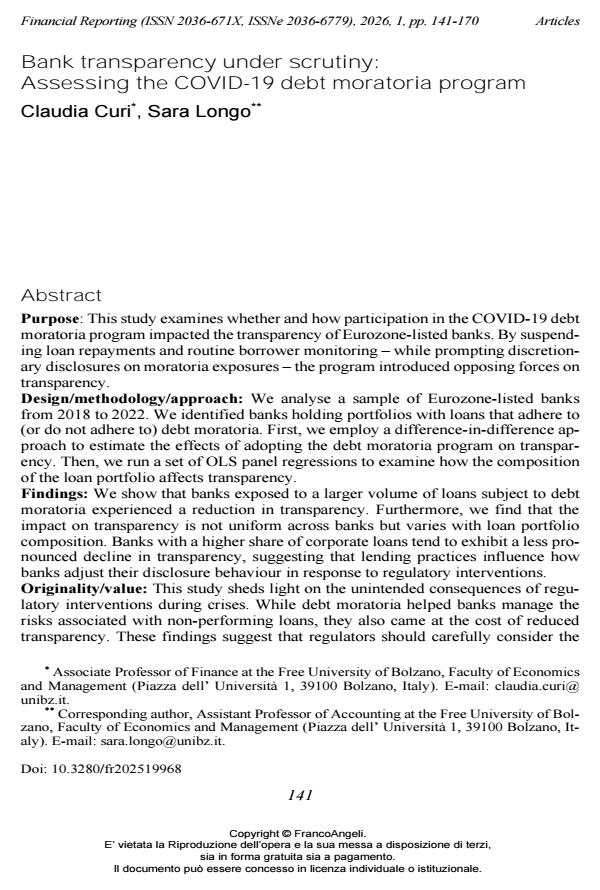
Purpose: This study examines whether and how participation in the COVID-19 debt moratoria program impacted the transparency of Eurozone-listed banks. By suspending loan repayments and routine borrower monitoring - while prompting discretionary disclosures on moratoria exposures - the program introduced opposing forces on transparency. Design/methodology/approach: We analyse a sample of Eurozone-listed banks from 2018 to 2022. We identified banks holding portfolios with loans that adhere to (or do not adhere to) debt moratoria. First, we employ a difference-in-difference approach to estimate the effects of adopting the debt moratoria program on transparency. Then, we run a set of OLS panel regressions to examine how the composition of the loan portfolio affects transparency. Findings: We show that banks exposed to a larger volume of loans subject to debt moratoria experienced a reduction in transparency. Furthermore, we find that the impact on transparency is not uniform across banks but varies with loan portfolio composition. Banks with a higher share of corporate loans tend to exhibit a less pronounced decline in transparency, suggesting that lending practices influence how banks adjust their disclosure behaviour in response to regulatory interventions. Originality/value: This study sheds light on the unintended consequences of regulatory interventions during crises. While debt moratoria helped banks manage the risks associated with non-performing loans, they also came at the cost of reduced transparency. These findings suggest that regulators should carefully consider the potential trade-offs between transparency and other objectives when crafting crisis-response measures. Data availability: Financial accounting data is retrieved from BankFocus Orbis BVD; loan amounts under moratoria measures have been collected from the Eurozone-listed bank’s annual reports for 2020-2022.

Parole chiave:transparency, COVID-19 debt moratoria, Eurozone-listed banks

Jel codes:G21, G28, M41

  1. Acharya, V. V., & Ryan, S. G. (2016). Banks’ financial reporting and financial system stability. Journal of Accounting Research, 54(2), 277-340. DOI: 10.1111/1475-679X.12114
  2. Acharya, V. V., & Steffen, S. (2020). The risk of being a fallen angel and the corporate dash for cash in the midst of COVID. The Review of Corporate Finance Studies, 9(3), 430-471.
  3. Allini, A., Zampella, A., Spagnuolo, F., & Meucci, F. (2023). What drives discretionary loan loss provisions? The role of banks’ business model, listing status and COVID-19 crisis in the European banking sector. Financial Reporting, 2, 71-96. DOI: 10.3280/FR2023-002003
  4. Artavanis, N., & Spyridopoulos, I. (2023). Determinants of strategic behavior: Evidence from a foreclosure moratorium. Journal of Financial Intermediation, 56, 101059.
  5. Beatty, A., & Liao, S. (2011). Do delays in expected loss recognition affect banks’ willingness to lend?. Journal of Accounting and Economics, 52(1), 1-20.
  6. Berger, A. N., & Demirgüç-Kunt, A. (2021). Banking research in the time of COVID-19. Journal of Financial Stability, 57, 100939.
  7. Bischof, J., Laux, C., & Leuz, C. (2021). Accounting for financial stability: Bank disclosure and loss recognition in the financial crisis. Journal of Financial Economics, 141(3), 1188-1217.
  8. Bruno, B., & De Marco, F. (2021). European banks’ response to COVID-19 “Quick Fix” regulation and other measures. -- https://hdl.handle.net/11565/4044474.
  9. Chen, Q., Goldstein, I., Huang, Z., & Vashishtha, R. (2022). Bank transparency and deposit flows. Journal of Financial Economics, 146(2), 475-501.
  10. Cordella, T., & Yeyati, E. L. (1998). Public disclosure and bank failures. Staff Papers, 45(1), 110-131. DOI: 10.2307/3867331
  11. Curi, C., Lozano-Vivas, A., & Murgia, M. (2025). Bank Technology M&As and Market Valuation: Lessons from the COVID-19 Shock. European Financial Management.
  12. Dal Maso, L., Kanagaretnam, K., Lobo, G. J., & Mazzi, F. (2020). Is accounting enforcement related to risk-taking in the banking industry? Journal of Financial Stability, 49, 100758.
  13. Dang, T. V., Gorton, G., Holmström, B., & Ordonez, G. (2017). Banks as secret keepers. American Economic Review, 107(4), 1005-1029.
  14. Demir, E., & Danisman, G. O. (2021). Banking sector reactions to COVID-19: The role of bank-specific factors and government policy responses. Research in International Business and Finance, 58, 101508.2021.101508.
  15. Demirgüç-Kunt, A., Pedraza, A., & Ruiz-Ortega, C. (2021). Banking sector performance during the COVID-19 crisis. Journal of Banking & Finance, 133, 106305.
  16. Diamond, D. W., & Rajan, R. G. (2001). Banks and liquidity. American Economic Review, 91(2), 422-425.
  17. Dobbie, W., & Song, J. (2020). Targeted debt relief and the origins of financial distress: Experimental evidence from distressed credit card borrowers. American Economic Review, 110(4), 984-1018.
  18. Ertan, A., Loumioti, M., & Wittenberg-Moerman, R. (2017). Enhancing loan quality through transparency: Evidence from the European Central Bank loan level reporting initiative. Journal of Accounting Research, 55(4), 877-918. DOI: 10.1111/1475-679X.12162
  19. Gallemore, J. (2023). Bank financial reporting opacity and regulatory intervention. Review of Accounting Studies, 28(3), 1765-1810.
  20. Goldstein, I., & Sapra, H. (2014). Should banks’ stress test results be disclosed? An analysis of the costs and benefits. Foundations and Trends in Finance, 8(1), 1-54. DOI: 10.1561/0500000038
  21. IFM (2020a). Global financial stability report: Markets in the time of COVID-19. -- https://www.imf.org/en/Publications/GFSR/Issues/2020/04/14/global-financialstability-report-april-2020.
  22. IFM (2020b). Global financial stability report update: Financial conditions have eased, but insolvencies loom large. -- https://www.imf.org/en/Publications/GFSR/Issues/2020/06/25/global-financial-stability-report-june-2020-update.
  23. Iyer, R., Puri, M., & Ryan, N. (2016). A tale of two runs: Depositor responses to bank solvency risk. The Journal of Finance, 71(6), 2687-2726.
  24. Kaplan, T. R. (2006). Why banks should keep secrets. Economic Theory, 27, 341-357.
  25. Leone, A. J., Minutti-Meza, M., & Wasley, C. E. (2019). Influential observations and inference in accounting research. The Accounting Review, 94(6), 337-364.
  26. López-Espinosa, G., Ormazabal, G., & Sakasai, Y. (2021). Switching from incurred to expected loan loss provisioning: Early evidence. Journal of Accounting Research, 59(3), 757-804. DOI: 10.1111/1475-679X.12354
  27. McMullin, J. L., & Schonberger, B. (2020). Entropy-balanced accruals. Review of Accounting Studies, 25(1), 84-119.
  28. Mechelli, A., Sforza, V., & Cimini, R. (2020). Is IFRS 9 better than IAS 39 for investors’ decisions? Evidence from the European context at the beginning of the transition year. Financial Reporting, 1, 125-148. DOI: 10.3280/FR2020-001004
  29. Mester, L. J., Nakamura, L. I., & Renault, M. (2007). Transactions accounts and loan monitoring. The Review of Financial Studies, 20(3), 529-556.
  30. Morgan, D. P. (2002). Rating banks: Risk and uncertainty in an opaque industry. American Economic Review, 92(4), 874-888. DOI: 10.1257/00028280260344506
  31. Nier, E. W. (2005). Bank stability and transparency. Journal of Financial Stability, 1(3), 342-354.
  32. Novak, A. (2014). Business model literature overview. Financial Reporting, 1, 79-130. DOI: 10.3280/FR2014-001004
  33. Quagli, A., Venuti, M., & Ramassa, P. (2021). Dialogue with standard setters: edited by Raffaele Fiume and Tiziano Onesti: COVID-19: the impact on IFRS. Financial Reporting, 2, 161-173, DOI: 10.3280/FR2021-002005
  34. Roberts, M. R., & Whited, T. M. (2013). Endogeneity in empirical corporate finance1. In: G. M. Constantinides, M. Harris & R. M. Stulz (Eds.), Handbook of the Economics of Finance (Vol. 2, pp. 493-572). Elsevier. DOI: 10.1016/B978-0-44-453594-8.00007-0
  35. Wittenberg-Moerman, R. (2008). The role of information asymmetry and financial reporting quality in debt trading: Evidence from the secondary loan market. Journal of Accounting and Economics, 46(2-3), 240-260.

Claudia Curi, Sara Longo, Bank transparency under scrutiny: Assessing the COVID-19 debt moratoria program in "FINANCIAL REPORTING" 1/2026, pp 141-170, DOI: 10.3280/fr202519968