Il clima di sicurezza: un fattore strategico per la sicurezza nei luoghi di lavoro
Titolo Rivista SICUREZZA E SCIENZE SOCIALI
Autori/Curatori Margherita Brondino, Margherita Pasini
Anno di pubblicazione 2015 Fascicolo 2015/1
Lingua Italiano Numero pagine 15 P. 50-64 Dimensione file 120 KB
DOI 10.3280/SISS2015-001005
Il DOI è il codice a barre della proprietà intellettuale: per saperne di più
clicca qui
Qui sotto puoi vedere in anteprima la prima pagina di questo articolo.
Se questo articolo ti interessa, lo puoi acquistare (e scaricare in formato pdf) seguendo le facili indicazioni per acquistare il download credit. Acquista Download Credits per scaricare questo Articolo in formato PDF
FrancoAngeli è membro della Publishers International Linking Association, Inc (PILA), associazione indipendente e non profit per facilitare (attraverso i servizi tecnologici implementati da CrossRef.org) l’accesso degli studiosi ai contenuti digitali nelle pubblicazioni professionali e scientifiche.
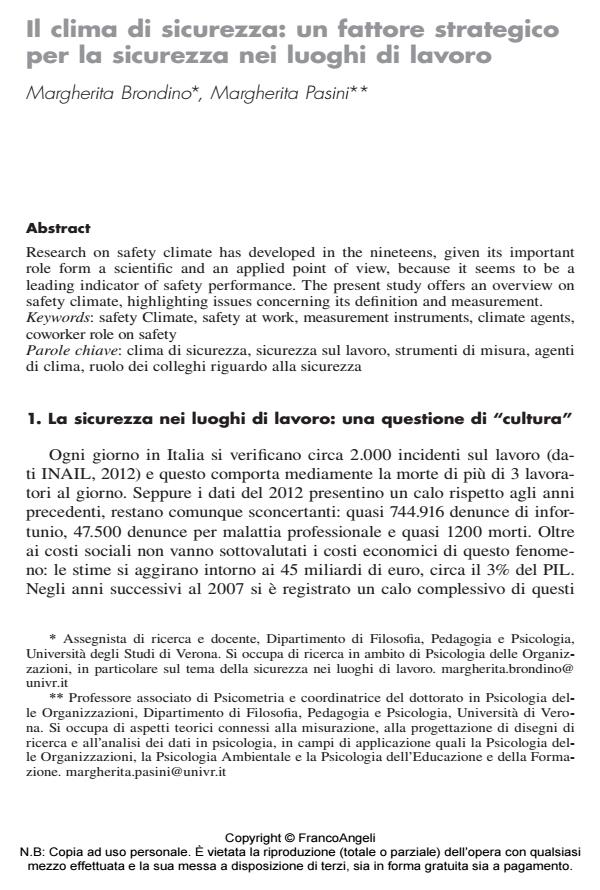
Research on safety climate has developed in the nineteens, given its important role form a scientific and an applied point of view, because it seems to be a leading indicator of safety performance. The present study offers an overview on safety climate, highlighting issues concerning its definition and measurement.
Parole chiave:Clima di sicurezza, sicurezza sul lavoro, strumenti di misura, agenti di clima, ruolo dei colleghi riguardo alla sicurezza
- Zohar D. (2000). A group-level model of safety climate: Testing the effect of group climate on micro-accidents in manufacturing jobs. Journal of Applied Psychologiy, 85: 587-596. DOI: 10.1037/0021-9010.85.4.587
- Zohar D. (2002). The effects of leadership dimensions, safety climate, and assigned priorities on minor injuries in work groups. Journal of Organizational Behavior, 23: 75-92. DOI: 10.1002/job.130
- Zohar D. (2010a). Safety climate. Conceptual and measurement issues. In: Quick J.C., Tetrick L.E., edited by, Handbook of occupational health psychology, 2nd edition, Washington, DC: American Psychology Association.
- Zohar D. (2010b). Thirty years of safety climate research: Reflections and future directions. Accident Analysis and Prevention, 42(5): 1517-22. DOI: 10.1016/j.aap.2009.12.019
- Zohar D., Luria G. (2004). Climate as a social-cognitive construction of supervisory safety practices: Scripts as proxy of behavior patterns. Journal of Applied Psychology, 89: 322-333. DOI: 10.1037/0021-9010.89.2.322
- Zohar D., Luria G. (2005). A multilevel model of safety climate: Cross-level relationships between organization and group-level climates. Journal of Applied Psychology, 90: 616-628. DOI: 10.1037/0021-9010.90.4.616
- Zohar D., Hofmann D.A. (2010). Organizational culture and climate. In: Kozlowski S.W.J., edited by, Oxford Handbook of Industrial and Organizational Psychology. Oxford: Oxford University Press.
- Borys D., Else D., Leggett S. (2009). The fifth age of safety: the adaptive age?, Journal of Health & Safety Research & Practice, (1)1: 19-27.
- Brondino M., Silva S.A., Pasini M. (2012). Multilevel approach to organizational and group safety climate and safety performance: Co-workers as the missing link. Safety science, 50(9): 1847-1856. DOI: 10.1016/j.ssci.2012.04.010
- Brondino M., Pasini M., Costa Agostinho da Silva S. (2013). Development and validation of an Integrated Organizational Safety Climate questionnaire with multilevel confirmatory analysis. Quality & Quantity, 47(4): 2191-2223. DOI: 10.1007/s11135-011-9651-6
- Burt C.D.B., Sepie B., McFadden G. (2008). The development of a considerate and responsible safety attitude in work teams. Safety Science, 46: 79-91. DOI: 10.1016/j.ssci.2006.10.005
- Cavazza N., Serpe A. (2009). Effects of safety climate on safety norm violations: exploring the mediating role of attitudinal ambivalence toward personal protective equipment. Journal of Safety Research, 40: 277-283. DOI: 10.1016/j
- jsr.2009.06.002. Chiaburu D.S., Harrison D.A. (2008). Do peers make the place? Conceptual synthesis and metaanalysis of coworker effects on perceptions, attitudes, OCBs, and performance. Journal of Applied Psychology, 93: 1082-1103. DOI: 10.1037/0021-9010.93.5.1082
- Christian M.S., Bradley J.C., Wallace J.C., Burke M.J. (2009). Workplace safety: A meta-analysis of the roles of person and situation factors. Journal of Applied Psychology, 94: 1103-1127. DOI: 10.1037/a0016172
- Clarke S. (2006). The relationship between safety climate and safety performance: A meta-analytic review. Journal of Occupational Health Psychology, 11: 315-327. DOI: 10.1037/1076-8998.11.4.315
- Clarke S. (2013). Safety leadership: A meta-analytic review of transformational and transactional leadership styles as antecedents of safety behaviours. Journal of Occupational and Organizational Psychology, 86: 22-49. DOI: 10.1111/j.2044-8325.2012.02064.x
- Curcuruto M., Guglielmi D., Mariuani M. (2013). Cittadinanza organizzativa per la sicurezza: processi psico-sociali di mediazione. Psicologia Sociale, 2: 229-248.
- Dal Corso L. (2008). Mediation effects of safety climate and safety motivation on the relation between organizational climate and safety performance in the workplace. Testing, Psychometrics, Methodology in Applied Psychology, 15 (2): 77-90.
- Dedobbeleer N., Beland F. (1991). A safety climate measure for construction sites. Journal of Safety Research, 22(2): 97-103. DOI: 10.1016/0022-4375(91)90017-P
- DeJoy D.M. (1996). Theoretical models of health behavior and workplace selfprotective behavior. Journal of Safety Research, 27: 61-72. DOI: 10.1016/0022-4375(96)00007-2
- Flin R., Mearns P., O’Connor R., Bryden R. (2000). Measuring safety climate: identifying the common features. Safety Science, 34: 177-192. DOI: 10.1016/S0925-7535(00)00012-6
- Glendon A.I., Clarke S., McKenna E.F. (2006). Human safety and risk management (2nd edn.). Boca Raton, FL: CRC Press/Taylor and Francis.
- Griffin M.A., Neal A. (2000). Perceptions of safety at work: A framework for linking safety climate to safety performance, knowledge, and motivation, Journal of Occupational Health Psychology, 5: 347-358. DOI: 10.1037/1076-8998.5.3.347
- Guldenmund F.W. (2000). The nature of safety culture: A review of theory and research. Safety Science, 34(1-3): 215-257. DOI: 10.1016/S0925-7535(00)00014-X
- Gyekye S.A., Salminen S. (2009). Educational status and organizational safety climate: Does educational attainment influence workers’ perceptions of workplace safety? Safety Science, 47: 20-28. DOI: 10.1016/j.ssci.2007.12.007
- Allen J.A., Baran B.E., Scott C.W. (2010). After-action reviews: a venue for the promotion of safety climate. Accident Analysis and Prevention, 42(3): 750-757. DOI: 10.1016/j.aap.2009.11.004
- Barling J., Loughlin C., Kelloway E.K. (2002). Development and test of a model linking safety-specific transformational leadership and occupational safety.
- Journal of Applied Psychology, 87: 488-496. DOI: 10.1037/0021-9010.87.3.488
- Blumer H. (1969). Symbolic interactionism; perspective and method. Englewood Cliffs, N.J.: Prentice-Hall.
- Hahn S.E., Murphy L.R. (2008). A short scale for measuring safety climate. Safety Science, 46 (7): 1047-1066. DOI: 10.1016/j.ssci.2007.06.002
- Hale A.R., Hovden J. (1998), Management and Culture: the third age of safety. A review of approaches to organizational aspects of safety, health and environment. In Feyer A.M., Williamson A., edited by, Occupational injury: Risk, Prevention and Intervention. London: Taylor & Francis. DOI: 10.1201/9780203212493.ch11
- Hofmann D.A., Jacobs R., Landy F.L. (1995). High reliability process industries: Individual, micro, and macro organizational influences on safety. Journal of Safety Research, 26: 131-149. DOI: 10.1016/0022-4375(95)00011-E.HoffmeisterK.,GibbonsA.M.,JohnsonS.K.,CigularovK.P.,ChenP.Y.,Rosecranc
- J.C. (2014). The differential effects of transformational leadership facets on employee safety. Safety Science, 62(2): 68-78. DOI: 10.1016/j.ssci.2013.07.004
- Hogan J., Roberts B.W. (1996). Issues and non-issues in the fidelity-bandwidth trade-off. Journal of Organizational Behavior, 17: 627-637. DOI: 10.1002/(SICI)1099-1379(199611)17:6<627::AID-JOB2828>3.0.CO;2-F
- HSC – Health And Safety Commission (1993). Third report: organizing for safety. ACSNI Study Group on Human Factors. London: HMSO.
- Jiang L., Yu G., Li Y., Li F. (2009). Perceived colleagues’ safety knowledge/behavior and safety performance: Safety climate as a moderator in a multilevel study. Accident Analysis and Prevention, 42(5): 1468-1476. DOI: 10.1016/j.aap.2009.08.017
- Johnson S.E. (2007). The predictive validity of safety climate. Journal of Safety Research, 38: 511-521. DOI: 10.1016/j.jsr.2007.07.001
- Kath L.M., Marks K.M., Ranney J. (2010). Safety climate dimensions, leadermember exchange, and organizational support as predictors of upward safety communication in a sample of rail industry workers. Safety Science, 48(5): 643-650. DOI: 10.1016/j.ssci.2010.01.016
- Kelley H.H., Thibaut J. (1978). Interpersonal relations: A theory of interdependence. New York: Wiley.
- Kozlowski S.W., Klein K.J. (2000). A multilevel approach to theory and research in organizations: Contextual, temporal, and emergent processes. In Kline
- K.J., Kozlowski S.W., edited by, Multilevel theory, research, and methods in organizations. San Francisco: Jossey-Bass.
- Luria G. (2008). Climate strength – How leaders form consensus. The Leadership Quarterly, 19: 42-53. DOI: 10.1016/j.leaqua.2007.12.004
- Mearns K., Whitaker S.M., Flin R. (2003). Safety climate, safety management practice and safety performance in offshore environments. Safety Science, 41(8): 641-680. DOI: 10.1016/S0925-7535(02)00011-5
- Melià J.L. (1998). A psychosocial causal model of work accidents. Anuario de Psicologia, 29: 25-43.
- Melià J.L., Becerril M. (2006). Safety climate dimensions from the “agent” point of view. In: Mondelo P., Mattila M., Karwowski W., Hale A., edited by, Proceedings of the Fourth International Conference on Occupational Risk Prevention. Seville.
- Melià J.L., Mearns K., Silva S., Lima M.L. (2008). Safety climate responses and the perceived risk of accidents in the construction industry. Safety Science, 46: 949-958. DOI: 10.1016/j.ssci.2007.11.004
- Morrow S.L., McGonagle A.K., Dove-Steinkampa M.L., Walker Jr. C.T., Marmeta M., Barnes-Farrella J.L. (2010). Relationships between psychological safety climate facets and safety behavior in the rail industry: A dominance analysis. Accident Analysis and Prevention, 42(5): 1460-1467. DOI: 10.1016/j.aap.2009.08.011
- Nahrgan J.D., Morgeson F.P., Hofmann D.A. (2007). Predicting safety performance: A meta-analysis of safety and organizational constructs. Poster session presented at the 22nd Annual Conference of the Society for Industrial and Organizational Psychology, New York. Neal A., Griffin M.A. (2004). Safety climate and safety at work. In: Barling J., Frone M.R., edited by, The psychology of workplace safety. Washington DC: American Psychological Association. DOI: 10.1037/10662-002
- Neal A., Griffin M.A. (2006). A study of the lagged relationships among safety climate, safety motivation, safety behavior, and accidents at the individual and group levels. Journal of Applied Psychology, 91: 946-953. DOI: 10.1037/0021-9010.91.4.946
- Newnam S., Griffin M.A., Mason C. (2008). Safety in work vehicles: A multilevel study linking safety values and individual predictors to work-related driving crashes. Journal of Applied Psychology, 93(3): 632-644. DOI: 10.1037/0021-9010.93.3.632
- Prati G., Pietrantoni L. (2012). Predictors of safety behaviour among emergency responders on the highways. Journal of Risk Research, 15: 405-415. DOI: 10.1080/13669877.2011.634519
- Probst T.M., Brubaker T.L., Barsotti A. (2008). Organizational under-reporting of injury rates: an examination of the moderating effect of organizational safety climate. Journal of Applied Psychology, 93 (5): 1147-1154. DOI: 10.1037/0021-9010.93.5.1147
- Probst T.M., Estrada A.X. (2010). Accident under-reporting among employees: Testing the moderating influence of psychological safety climate and supervisor enforcement of safety practices. Accident Analysis and Prevention, 42(5): 1438-1444. DOI: 10.1016/j.aap.2009.06.027
- Schein E.H. (1992). Organizational Culture and Leadership, 2nd Edition. San Francisco: Jossey-Bass.
- Schneider B., Reichers A.E. (1983). On the etiology of climates. Personnel Psychology, 36: 19-39. DOI: 10.1111/j.1744-6570.1983.tb00500.x
- Seo D., Torabi M.R., Blair E.H., Ellis N.T. (2004). A crossvalidation of safety climate scale using confirmatory factor analytic approach. Journal of Safety Research, 35: 427-445. DOI: 10.1016/j.jsr.2004.04.006
- Shannon H.S., Norman G.R. (2009). Deriving the factor structure of safety climate scales. Safety Science, 47: 327-329. DOI: 10.1016/j.ssci.2008.06.001
- Sinclair R.R., Martin J.E., Sears L.E. (2008). Labor unions and safety climate: Perceived union safety values and retail employee safety outcomes. Accident Analysis and Prevention, 42(5): 1477-1487. DOI: 10.1016/j.aap.2009.11.003
- Singer S., Meterko M., Baker L., Gaba D., Falwell A., Rosen A. (2007). Workforce Perceptions of Hospital Safety Culture: Development and Validation of the Patient Safety Climate in Healthcare Organizations Survey. Health Services Research, 42(5): 1999-2021. DOI: 10.1111/j.1475-6773.2007.00706.x
- Sollami A., Caricati L., Bianconcini M., Guidi C., Mancini T. (2011). Misurare la cultura della sicurezza: primo adattamento italiano del Safety Attitude Questionnaire (SAQ). Psicologia della salute, 19: 103-121.
- Tesluk P., Quigley N.R. (2003). Group and normative influences on health and safety. Perspectives from taking a broad view on team effectiveness. In: Hofmann D.A., Tetrick L.E., edited by, Health and safety in organizations. A multilevel perspective. San Francisco: Jossey-Bass.
- Turner N., Parker S.K. (2004). The effect of teamwork on safety process and outcomes. In: Barling J., Frone M.R., edited by, The psychology of workplace safety. Washington, DC: American Psychological Association. DOI: 10.1037/10662-003.WeickK.E.(1995).Sensemakinginorganizations.ThousandOaks,CA:Sage
- Zacharatos A., Barling J., Iverson D.I. (2005). High performance work systems and occupational safety. Journal of Applied Psychology, 90: 77-93.
Margherita Brondino, Margherita Pasini, Il clima di sicurezza: un fattore strategico per la sicurezza nei luoghi di lavoro in "SICUREZZA E SCIENZE SOCIALI" 1/2015, pp 50-64, DOI: 10.3280/SISS2015-001005