Narrazioni mediatiche intorno al cancro
Titolo Rivista SALUTE E SOCIETÀ
Autori/Curatori Sebastiano Benasso, Luisa Stagi
Anno di pubblicazione 2015 Fascicolo 2015/2
Lingua Italiano Numero pagine 16 P. 127-142 Dimensione file 88 KB
DOI 10.3280/SES2015-002010
Il DOI è il codice a barre della proprietà intellettuale: per saperne di più
clicca qui
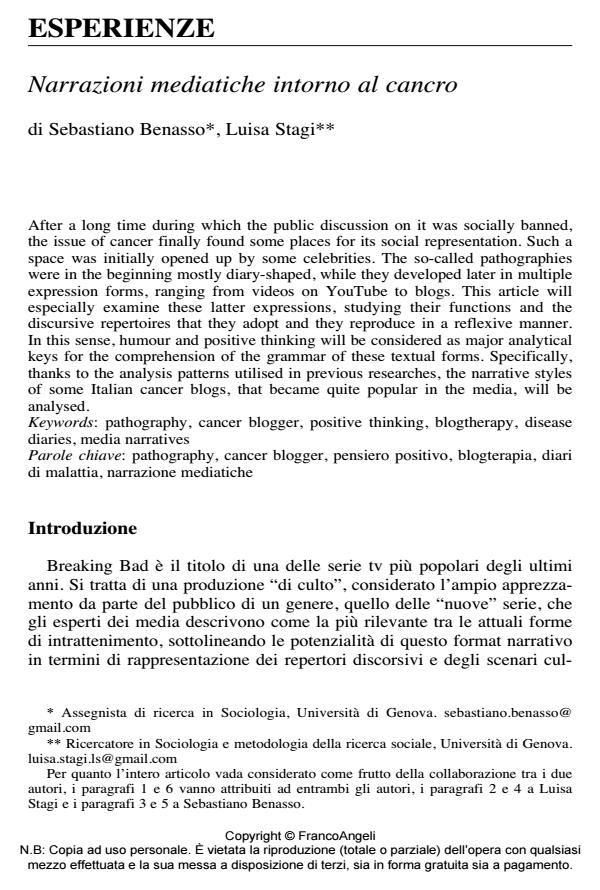
Qui sotto puoi vedere in anteprima la prima pagina di questo articolo.
Se questo articolo ti interessa, lo puoi acquistare (e scaricare in formato pdf) seguendo le facili indicazioni per acquistare il download credit. Acquista Download Credits per scaricare questo Articolo in formato PDF
FrancoAngeli è membro della Publishers International Linking Association, Inc (PILA), associazione indipendente e non profit per facilitare (attraverso i servizi tecnologici implementati da CrossRef.org) l’accesso degli studiosi ai contenuti digitali nelle pubblicazioni professionali e scientifiche.
After a long time during which the public discussion on it was socially banned, the issue of cancer finally found some places for its social representation. Such a space was initially opened up by some celebrities. The so-called pathographies were in the beginning mostly diary-shaped, while they developed later in multiple expression forms, ranging from videos on YouTube to blogs. This article will especially examine these latter expressions, studying their functions and the discursive repertoires that they adopt and they reproduce in a reflexive manner. In this sense, humour and positive thinking will be considered as major analytical keys for the comprehension of the grammar of these textual forms. Specifically, thanks to the analysis patterns utilised in previous researches, the narrative styles of some Italian cancer blogs, that became quite popular in the media, will be analysed.
Parole chiave:Pathography, cancer blogger, pensiero positivo, blogterapia, diari di malattia, narrazione mediatiche
- Good B. (1999). Narrare la malattia: lo sguardo antropologico sul rapporto medico-paziente. Torino: Edizioni Di Comunità
- Green J. (2012). Colpa delle stelle. Rizzoli
- Green M.C., Strange J.J., Brock T.C. (2002). Narrative impact: Social and cognitive foundations. New York: Erlbaum
- Gualtieri L., Akhtar F.Y. (2013). Cancer Patient Blogs: How Patients, Clinicians, and Researchers Learn from Rich Narratives of Illness, paper presentato al Convegno Int. Conf. on Information Technology Interfaces, Giugno 24-27, 2013, Cavtat, Croatia
- Henriksen N., Tjørnhøj-Thomsen T., Ploug Hansen H. (2011). Illness, everyday life and narrative montage: The visual aesthetics of cancer in Sara Bro’s Diary. Health, 15(3): 277-297. DOI: 10.1177/136345931039797
- Hinyard L.J., Kreuter M.W. (2007). Using Narrative Communication as a Tool for Health Behavior Change: A Conceptual, Theoretical, and Empirical Overview. Health Education & Behavior, 34(5): 777-792. DOI: 10.1177/109019810629196
- Holland J. (2000). The Human Side of Cancer: Living with Hope, Coping with Uncertainty. New York: HarperCollins Publishers
- Høybye M.T. (2002). Storytelling of Breast Cancer in Cyberspace. Online counteractions to the isolation and demeaning of illness experience. København: Københavns universitet, Videnskabsbutikken
- Kim S. (2009). Content analysis of cancer blog posts. Journal of the Medical Library Association, 97(4): 260-266. DOI: 10.3163/1536-5050.97.4.00
- Lupton D. (1994). Femininity, Responsibility, and the Technological Imperative: Discourses on Breast Cancer in the Australian Press. International Journal of Health Services, 24(1): 73-89. DOI: 10.2190/1B6J-1P5R-AXCR-MRNYMcQueenA.,KreuterM.W.,KalesanB.,AlcarazK.I.(2011).UnderstandingNarrativeEffects:TheImpactofBreastCancerSurvivorStoriesonMessageProcessing,Attitudes,andBeliefsAmongAfricanAmericanWomen.HealthPsichology,30(6):674-682.DOI:10.1037/a002539
- Pistrang N., Barker C. (1995). The partner relationship in psychological response to breast cancer. Social Science and Medicine, 40: 789-797. DOI: 10.1016/0277-9536(94)00136-
- Raisborough J., Frith H., Klein O. (2012). Media and Class-making: What Lessons Are Learnt When a Celebrity Chav Dies? Sociology, 47(2): 251-266. DOI: 10.1177/003803851244481
- Riggs N.A. (2013). Following Bud: Blogging at the End-of-Life. Qualitative Inquiry, 20(3): 376-384. DOI: 10.1177/107780041350553
- Seale C. (2002). Cancer heroics: a study of news reports with particular reference to gender. Sociology, 36(1): 107-126. DOI: 10.1177/003803850203600100
- Seale C. (2003). Health and media: an overview. Sociology of Health & Illness, 25(6): 513-531. DOI: 10.1111/1467-9566.t01-1-0035
- Seale C. (2005). New directions for critical internet health studies: representing cancer experience on the web. Sociology of Health & Illness, 27(4): 515-540. DOI: 10.1111/j.1467-9566.2005.00454
- Sontag S. (1978). Illness as Metaphor. New York: Farrar, Straus And Giroux
- Sontag S. (1989). AIDS and its Metaphors. New York: Farrar, Straus And Giroux
- Stiles W.B. (1987). “I have to talk to somebody”: A fever model of disclosure.
- In: Derlega V. e Berg J., a cura di, Self-disclosure: Theory, research, and therapy. New York: Plenum Press
- Sulik G. (2011). Pink ribbon blues: How breast cancer culture undermines women’s health. New York: Oxford University Press
- Sulik G. (2014). #Rethinkpink: Moving beyond Breast Cancer Awareness SWS Distinguished Feminist Lecture. Gender & Society, 28(5): 655-678. DOI: 10.1177/089124321454099
- Anderson A.G. (2014). Cancer Bloggers’ Styles of Humor While Coping with Cancer, University of Texas at Austin – http://repositories.lib.utexas.edu/bitstream/handle/2152/24788/ANDERSON-THESIS-2014.pdf?sequence=1
- Anderson J.O., Geist-Martin P. (2003). Narratives and healing: Exploring one family’s stories of cancer survivorship. Health Communication, 15: 133-143. DOI: 10.1207/S15327027HC1502_
- Armstrong-Coster A. (2005). In morte media jubilate: a study of cancer-related pathographies. Mortality, 10(2): 97-102. DOI: 10.1080/1357627050010288
- Baker J. (2010). Claiming volition and evading victimhood: Post-feminist obligations for young women. Feminism and Psychology, 20: 186-204. DOI: 10.1177/095935350935914
- Benasso S., Cossetta A. (2011). From geek to massive: le nuove forme di socializzazione in rete. In: Rauty R., a cura di, Il sapere dei giovani. Roma: Aracne Editrice
- Bingley A., McDermott E., Thomas C., Payne S., Seymour J., Clark, D. (2006). Making sense of dying: a review of narratives written since 1950 by people facing death from cancer and other disease. Palliative Medicine, 20(3): 183-195. DOI: 10.1191/0269216306pm1136o
- Boni F. (2005). Media, identità e globalizzazione. Luoghi, oggetti, riti. Milano: Carocci
- Cartwright L. (1998). Community and the public body in breast cancer media activism. Cultural Studies, 12(2): 117-138. DOI: 10.1080/09502389833550
- Charon R. (2006). Narrative Medicine: Honoring the Stories of Illness. Oxford: Oxford University Press
- Cipolla C., Maturo A., a cura di (2008). Scienze sociali e salute nel XXI secolo. Milano: FrancoAngeli
- Cipolla C., Maturo A., a cura di (2009). Con gli occhi del paziente. Una ricerca nazionale sul vissuto di cura dei malati oncologici. Milano: FrancoAngeli
- Cipolla C., Maturo A., a cura di (2014). Sociologia della salute e web society.
- Milano: FrancoAngeli Clarke J.N. (1999). Prostate cancer’s hegemonic masculinity in select print mass media depictions (1974-1995). Health Communication, 11(1): 59-74. DOI: 10.1207/s15327027hc1101_
- Coward R. (2014). How to die well: Aesthetic and ethical issues in confessional cancer diaries. Journalism, 15(5): 615-628. DOI: 10.1177/146488491452323
- Donovan-Kicken E., Caughlin J.P. (2010). A multiple goals perspective on topic avoidance and relationship satisfaction in the context of breast cancer. Communication Monographs, 77: 231-256. DOI: 10.1080/0363775100375821
- Donovan-Kicken E., Caughlin J.P. (2011). Breast cancer patients’ topic avoidance and psychological distress: The mediating role of coping. Journal of Health Psychology, 16: 596-606. DOI: 10.1177/135910531038360
- Ehrenreich B. (2010). Smile or Die. How Positive Thinking Fooled America and the World. London: Granta Books
- Giarelli G. (2005). Storie di cura: medicina narrativa e medicina delle evidenze: l’integrazione possibile. Milano: FrancoAngeli
- Giddens A. (1990). The Consequences of Modernity. Cambridge: Polity Press
- Goffman E. (1971). Modelli di Interazione. Bologna: il Mulino
- Goldenberg M. (2010). Working for the cure: Challenging pink ribbon activism. In: Roma H., Wathen N. e Wyatt S., a cura di, Configuring health consumers: Health work and the imperative of personal responsibility. Amsterdam: Palgrave Macmillan
- Goldsmith D.J., Miller L.E., Caughlin J.P. (2008). Openness and avoidance in couples communicating about cancer. In: Beck C.S., a cura di, Communication Yearbook, 31 (pp. 62-115). Hillsdale, NJ: Lawrence Erlbaum Associates
- Walter, T. (2009). Jade’s dying body: the ultimate reality show. Sociological Research Online, 14(5). DOI: 10.5153/sro.206
- Walter T. (2010). Jade and the journalists: Media coverage of a young British celebrity dying of cancer. Social Science & Medicine, 71: 853-860. DOI: 10.1016/j.socscimed.2010.06.00
- Woodthorpe K. (2010). Public dying: death in the media and Jade Goody.
- Sociology Compass, 4(5): 283-294. DOI: 10.1111/j.1751-9020.2010.00279
Sebastiano Benasso, Luisa Stagi, Narrazioni mediatiche intorno al cancro in "SALUTE E SOCIETÀ" 2/2015, pp 127-142, DOI: 10.3280/SES2015-002010