Multi-Cities, Co-Cities, Geo-urbanità in rete: sfide urbano-territoriali tra secoli
Titolo Rivista TERRITORIO
Autori/Curatori Manuel Gausa Navarro
Anno di pubblicazione 2025 Fascicolo 2024/108-109
Lingua Italiano Numero pagine 13 P. 30-42 Dimensione file 782 KB
DOI 10.3280/TR2024-108003
Il DOI è il codice a barre della proprietà intellettuale: per saperne di più
clicca qui
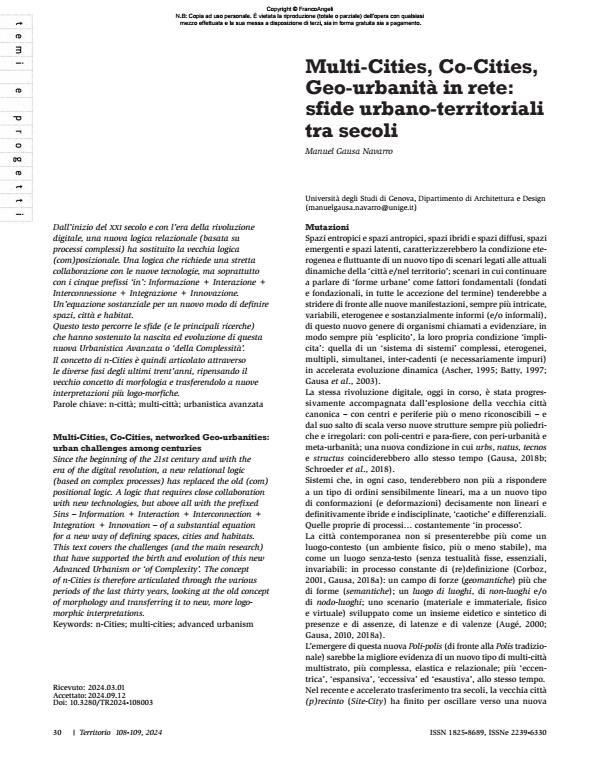
Qui sotto puoi vedere in anteprima la prima pagina di questo articolo.
Se questo articolo ti interessa, lo puoi acquistare (e scaricare in formato pdf) seguendo le facili indicazioni per acquistare il download credit. Acquista Download Credits per scaricare questo Articolo in formato PDF
FrancoAngeli è membro della Publishers International Linking Association, Inc (PILA), associazione indipendente e non profit per facilitare (attraverso i servizi tecnologici implementati da CrossRef.org) l’accesso degli studiosi ai contenuti digitali nelle pubblicazioni professionali e scientifiche.
Dall’inizio del xxi secolo e con l’era della rivoluzione digitale, una nuova logica relazionale (basata su processi complessi) ha sostituito la vecchia logica (com)posizionale. Una logica che richiede una stretta collaborazione con le nuove tecnologie, ma soprattutto con i cinque prefissi ‘in’: Informazione + Interazione + Interconnessione + Integrazione + Innovazione. Un’equazione sostanziale per un nuovo modo di definire spazi, città e habitat. Questo testo percorre le sfide (e le principali ricerche) che hanno sostenuto la nascita ed evoluzione di questa nuova Urbanistica Avanzata o ‘della Complessità’. Il concetto di n-Cities è quindi articolato attraverso le diverse fasi degli ultimi trent’anni, ripensando il vecchio concetto di morfologia e trasferendolo a nuove interpretazioni più logo-morfiche.
Parole chiave:n-città; multi-città; urbanistica avanzata
- Amann A., Delso R., 2016, «The conflict of Urban Synchronicity and its heterotemporalities». Parse Journal, 4: 92-107.
- Ascher F., 1995, Métapoles ou l’Avenir des villes. Paris: Odile Jacob. Augé M., 2015, Fictions fin de siècle. Paris: Fayard.
- Ballesteros J., Barahona M., 1998, «La ciudad que no se ve». Fisuras, 5: 60. Batty M., 1997, «The Fractal City. Architectural Design, 129: 74-83.
- Bonfantini B., 2017, Dentro l’Urbanistica. Milano: FrancoAngeli. Canessa N., 2020, GOA Resili(G)ent City. Barcelona: Actar.
- Carta M., 2007, Creative Cities. Trento: List Lab.
- Carta M., Lino B., Ronsivalle D., 2017, Re-Cyclical Urbanism. Trento: List Lab.
- Corboz A., 2001, Le Territoire comme palimpseste et autres essais. Paris: Les éditions de l’Imprimeur.
- D’Arienzo R., Younès C., 2018, Synergies Urbaines. Paris: Métiss Press. Fabian L., Munarin S., 2017, Re-cycle Italy, Atlante. Siracusa: Lettera Ventidue.
- Fargas J., Papazian R., 1994, «Territorio y Modelización». Quaderns d´Arquitectura i Urbanisme, 192: 90.
- Florida R., 2002, The rise of the creative class. New York: Basic Books. Gausa M., Guallart V., Müller W., 2003, HiperCatalunya, Territoris de
- Recerca. Barcelona: Actar.
- Gausa M., 2009, Multi-Barcelona, Hiper-Catalunya. Estrategias para una nueva Geo-Urbanidad. Trento: List Lab.
- Gausa M. 2010, Open, Space-Time-Information. Barcelona: Actar.
- Gausa M., 2011, Cap a un Habitatge Sostenible. Barcelona: Consell Assessor per el Desenvolupament Sostenible, Generalitat de Catalunya.
- Gausa M., 2012a, «The diagram as a map of battle and negotiation». In: Seonwook K. (ed.) Architectural and Program Diagrams. Construction and Design Manual. Berlino: DOM Publishers, 216-247.
- Gausa M., 2012c, «Land-Links & Re-Cyting: verso una nuova geourbanità in rete». In: Gausa M., Ricci M. (eds.), AUM 01, Atlante Urbano Mediterraneo. Barcelona: List Lab.
- Gausa M., 2018a, Open(ing), Space-Time-Information & Advanced Architecture 1900-2000. The Beginning of Advanced Architecture. Barcelona: Actar Publishers.
- Gausa M., 2018b, «Periphery–Peripherals, 1980-2015». In: Schroeder J., Carta M., Ferretti M., Lino B. (eds.), Dynamics of Periphery. Atlas for a Creative Resilient Habitats. Berlin: Jovis, 62-75.
- Gausa M., 2018c, «Mo(un)ment». Area, 160: 4-16.
- Gausa M., 2020, Resili(g)ence/ Intelligent Cities, Resilient Landscapes.
- Barcelona: Actar.
- Gausa M., Vivaldi J., 2021, The Threefold logic of Advanced Architecture. Barcelona: Actar.
- Gehl J., 2010. Cities for People. Washington dc: Island Press.
- Harvey D., 1985, The Urbanisation of Capital. Baltimore: Johns Hopkins University Press.
- Komninos N., 2008, Intelligent Cities and Globalization of Innovation Networks. London: Routledge.
- Krausse J., 1998, «Information at a glance: on the history of the diagram».
- OASE, 48: 3.
- Latour B., 2007, Reassembling the Social: An Introduction to Actor-Network-Theory. Oxford: Clarendon.
- Leach N., 2014, «Adaptation». IaaC Bits, 1: 1-2.
- Llop C., 2011, «De les solucions habitacionals a la construcció social de l’hàbitat. Del dret a l’habitatge al dret al plaer d’habitar». In: Gausa M. (a cura di), Cap a un Habitatge Sostenible. Barcelona: Consell Assessor per el Desenvolupament Sostenible, Generalitat de Catalunya, 113-115.
- Mandelbrot B., 1975, Les objets Fractals. Paris, Flammarion. Markopoulou A., 2014, «In(Form)ation-Architecture of Data & Code».
- IaaC Bits, 1: 18-20.
- Nel.lo O., 2001, Ciutat de ciutats, reflexió sobre el procés d´urbanització a Catalunya. Barcelona: Ampuries.
- Neutelings W.J., 1992, Patchwork City. Rotterdam: 010 Publishers. Offenhuber D., Ratti C., 2014, Decoding the City Urbanism in the Age of
- Big Data. Basel: Birkhauser.
- Puig Ventosa, I. 2011, «Polítiques econòmiques locals per avançar cap a formes més sostenibles d’habitatge i d’ocupació». In: Gausa M. (a cura di), Cap a un Habitatge Sostenible. Barcelona: Consell Assessor per el Desenvolupament Sostenible, Generalitat de Catalunya, 51-56.
- Ratti C., Claudel M., 2016, The City of Tomorrow: Sensors, Networks, Hackers, and the Future of Urban Life. New Haven: Yale University Press.
- Ricci M., 2012, Nuovi Paradigmi, Trento: List Lab.
- Ricci M., 2019, Habitat 5.0. L’architettura nel Lungo Presente. Lausane: Skira. Rifkin J., 2014, The Zero Marginal Cost Society: The Internet of Things, the Collaborative Commons, and the Eclipse of Capitalism. London:
- Palgrave Macmillan.
- Rueda S., 2011, «Models d’ordenació del territori més sostenibles (o un nou urbanisme per a abordar els reptes de la societat actual)». In: Gausa M. (a cura di), Cap a un habitat(ge) sostenible. Barcelona: Consell Assessor per el Desenvolupament Sostenible, Generalitat de Catalunya, 31-39.
- Schroeder J., Carta M., Ferretti M., Lino B., 2018, Dynamics of Periphery. Atlas for a Creative Resilient Habitats. Berlin: Jovis.
- Solà-Morales I., 1995, Diferencias, Topografías de la arquitectura contemporánea. Bacelona: Gustavo Gili.
- Soriano F., 2004, Sin_tesis. Barcelona: Gustavo Gili.
- Vera F., Larach C., 2017, Dialogos Impostergables. XX Bienal de Arquitectura y Urbanismo de Chile. Santiago de Chile: Metales Pesados. Young Joon K., Gausa M., 2019, Superground / Underground: Seoul
- New Groundscapes. Barcelona: Actar.
- Waldheim C., 2016, Landscape as Urbanism. A general Theory. New Jersey: Princeton University Press.
Manuel Gausa Navarro, Multi-Cities, Co-Cities, Geo-urbanità in rete: sfide urbano-territoriali tra secoli in "TERRITORIO" 108-109/2024, pp 30-42, DOI: 10.3280/TR2024-108003