Her-rare humanum est… Commento agli interventi di Riccardo Catanzaro e dell’Intelligenza Artificiale
Titolo Rivista PSICOTERAPIA E SCIENZE UMANE
Autori/Curatori Riccardo Marco Scognamiglio
Anno di pubblicazione 2025 Fascicolo 2025/3
Lingua Italiano Numero pagine 12 P. 451-462 Dimensione file 254 KB
DOI 10.3280/PU2025-003005
Il DOI è il codice a barre della proprietà intellettuale: per saperne di più
clicca qui
Qui sotto puoi vedere in anteprima la prima pagina di questo articolo.
Se questo articolo ti interessa, lo puoi acquistare (e scaricare in formato pdf) seguendo le facili indicazioni per acquistare il download credit. Acquista Download Credits per scaricare questo Articolo in formato PDF
FrancoAngeli è membro della Publishers International Linking Association, Inc (PILA), associazione indipendente e non profit per facilitare (attraverso i servizi tecnologici implementati da CrossRef.org) l’accesso degli studiosi ai contenuti digitali nelle pubblicazioni professionali e scientifiche.
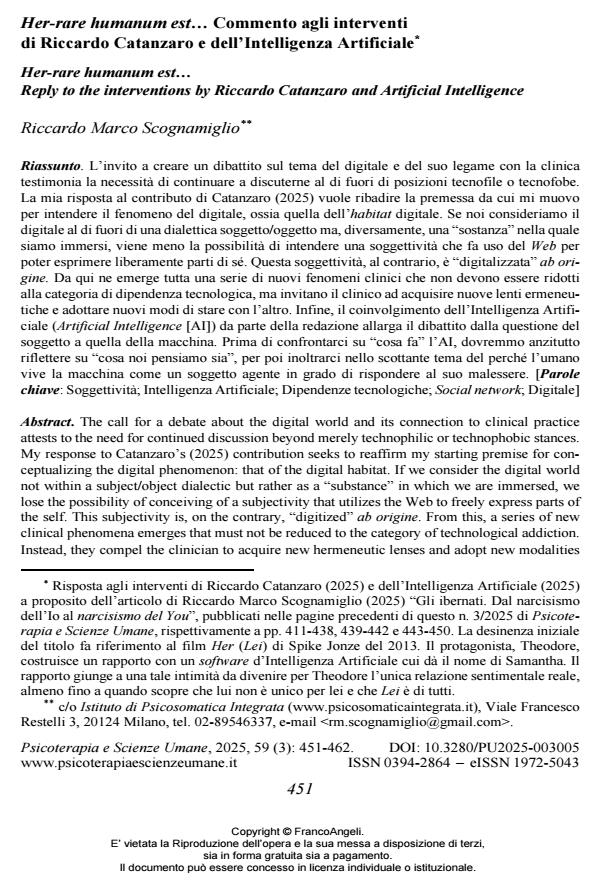
L’invito a creare un dibattito sul tema del digitale e del suo legame con la clinica testimonia la necessità di continuare a discuterne al di fuori di posizioni tecnofile o tecnofobe. La mia risposta al contributo di Catanzaro (2025) vuole ribadire la premessa da cui mi muovo per intendere il fenomeno del digitale, ossia quella dell’habitat digitale. Se noi consideriamo il digitale al di fuori di una dialettica soggetto/oggetto ma, diversamente, una “sostanza” nella quale siamo immersi, viene meno la possibilità di intendere una soggettività che fa uso del Web per poter esprimere liberamente parti di sé. Questa soggettività, al contrario, è “digitalizzata” ab origine. Da qui ne emerge tutta una serie di nuovi fenomeni clinici che non devono essere ridotti alla categoria di dipendenza tecnologica, ma invitano il clinico ad acquisire nuove lenti ermeneutiche e adottare nuovi modi di stare con l’altro. Infine, il coinvolgimento dell’Intelligenza Artificiale (Artificial Intelligence [AI]) da parte della redazione allarga il dibattito dalla questione del soggetto a quella della macchina. Prima di confrontarci su “cosa fa” l’AI, dovremmo anzitutto riflettere su “cosa noi pensiamo sia”, per poi inoltrarci nello scottante tema del perché l’umano vive la macchina come un soggetto agente in grado di rispondere al suo malessere.
Parole chiave:Soggettività; Intelligenza Artificiale; Dipendenze tecnologiche; Social network; Digitale
- Benasayag M. (2021). ¿Funcionamos o existimos? Una respuesta a la colonización algorítmica. Buenos Aires: Prometeo.
- Benasayag M. & Pennisi A. (2023). La inteligencia artificial no piensa (El cerebro tampoco). Buenos Aires: Prometeo (trad. it.: ChatGPT non pensa (e il cervello neppure). Santarcangelo di Romagna [RN]: Jaca Book, 2024).
- Bocci F., Ferrari A., Micalizzi A., Del Fante E. & Sarini M. (2024). Video Game Therapy. Teoria e pratica clinica. Torino: UTET.
- Catanzaro R. (2025). Commento all’articolo di Riccardo Marco Scognamiglio “Gli ibernati. Dal narcisismo dell’Io al narcisismo del You”. Psicoterapia e Scienze Umane, 59, 3: 439-442. DOI: 10.3280/PU2025-003003
- Cerbara L., Ciancimino G., Corsetti G. & Tintori A. (2025). Self-isolation of adolescents after COVID-19 pandemic between social withdrawal and Hikikomori risk in Italy. Scientific Reports, 15, 1: 1995.
- Degasperi L. (2023). La presentificazione come automatismo maladattivo in adolescenza: possibili manifestazioni psicologiche correlate. Psicoterapia e Scienze Umane, 57, 4: 615-638. DOI: 10.3280/PU2023-004004
- Eagle M.N. (2022). Toward a Unified Psychoanalytic Theory: Foundation in a Revised and Expanded Ego Psychology. London: Routledge (trad. it.: Verso una teoria psicoanalitica unificata. Le basi di una Psicologia dell’Io riveduta e ampliata. Milano: Raffaello Cortina, 2023. Una sintesi del libro è in: Psicoterapia e Scienze Umane, 2021, 55, 2: 191-204. DOI: 10.3280/PU2021-002001)
- Forleo C. & Migneco G. (2021). La pandemia da azzardo. Il gioco ai tempi del COVID: rischi, pericoli e proposte di riforma. Milano: Altreconomia.
- Gallese V., Moriggi S. & Rivoltella P.C. (2025). Oltre la tecnofobia. Il digitale dalle neuroscienze all’educazione. Milano: Raffaello Cortina.
- Ghielmetti E., Miscioscia M. & Stoppiello N. (2025). Dentro il rifugio psichico: ricerca Hikikomori 13-19. In: Da Re L. & Perulli L., a cura di, Il ritiro sociale in adolescenza. Attualità e prospettive. Milano: FrancoAngeli, 2025, pp. 118-134.
- Gualandi A., Morri L. & Genovesi G. (2023). Insegnare contro vento. Per la difesa della relazione educativa dalla religione del digitale: www.astrid-online.it/static/upload/inse/insegnare-contro-vento---astrid.pdf.
- Han B-C. (2021). Infocracy. Digitization and the Crisis of Democracy. Cambridge: Polity (trad. it.: Infocrazia. La digitalizzazione e la crisi della democrazia. Torino: Einaudi, 2023).
- Intelligenza Artificiale (ChatGPT, OpenAI) (2025). Lo sguardo dell’Intelligenza Artificiale sul narcisismo del You: una riflessione algoritmica sul testo di Riccardo Marco Scognamiglio. Psicoterapia e Scienze Umane, 59, 3: 443-450. DOI: 10.3280/PU2025-003004
- Jonze S., regista (2013). Her. Los Angeles: Annapurna Pictures (ediz. it.: Lei. Roma: BiM).
- Lasch C. (1979). The Culture of Narcissism: American Life in an Age of Diminishing Expectations. New York: Norton (trad. it.: La cultura del narcisismo. Milano: Bompiani, 1981).
- Lasch C. (1984). The Minimal Self. Psychic Survival in Troubled Times. New York: Norton (trad. it.: L’io minimo. La mentalità della sopravvivenza in un’epoca di turbamenti. Milano: Feltrinelli, 1985).
- Lichtenberg J.D. (1989). Psychoanalysis and Motivation. Hillsdale, NJ: Analytic Press (trad. it.: Psicoanalisi e sistemi motivazionali. Milano: Raffaello Cortina, 1995).
- Lichtenberg J.D. (2005). Craft and Spirit. A Guide to the Exploratory Psychotherapies. Hillsdale, NJ: Analytic Press (trad. it.: Mestiere e ispirazione. Guida alle psicoterapie esplorative. Milano: Raffaello Cortina, 2008).
- Lichtenberg J.D., Lachmann F.M. & Fosshage J.L. (1992). Self and Motivational Systems: Toward a Theory of Psychoanalytic Technique. Hillsdale, NJ: Analytic Press (trad. it.: Il Sé e i sistemi motivazionali. Verso una teoria della tecnica psicoanalitica. Roma: Astrolabio, 2000).
- Lichtenberg J.D., Lachmann F.M. & Fosshage J.L. (1996). The Clinical Exchange: Techniques Derived from Self and Motivational Systems. Hillsdale, NJ: Analytic Press (trad. it.: Lo scambio clinico. Milano: Raffaello Cortina, 2000).
- Missonier S. (2014). Hallucinations motrices, commémorations protoreprésentatives et jeux video. In: Brun A. & Roussillon R., editors, Formes primaires de symbolization. Paris: Dunod, 2014, pp. 125-138.
- Panksepp J. (2007). Neuroevolutionary sources of laughter and social joy: Modeling primal human laughter in laboratory rats. Behavioural Brain Research, 182, 2: 231-244.
- Panksepp J. & Biven L. (2012). The Archaeology of Mind: Neuroevolutionary Origins of Human Emotions. New York: Norton (trad. it.: Archeologia della mente: origini neuroevolutive delle emozioni umane. Milano: Raffaello Cortina, 2014).
- Quintarelli S. (2019). Capitalismo immateriale. Le tecnologie digitali e il nuovo conflitto sociale. Torino: Bollati Boringhieri.
- Quintarelli S. (2020). L’Intelligenza Artificiale. Cos’è davvero, come funziona, che effetti avrà. Torino: Bollati Boringhieri.
- Salvia M. (2022). Interregno. Iconografie del XXI secolo. Roma: Nero Edizioni.
- Scognamiglio R.M. (1991). L’istituzione psicoterapeutica: società a capitale debile? In: Psicoterapia e psicoanalisi (Numero speciale della rivista La Psicoanalisi. Studi internazionali del campo freudiano), 1992, pp. 80-97.
- Scognamiglio R.M. (2023). De tempore aut more? Riflessioni sull’articolo di Luca Degasperi [2023]. Psicoterapia e Scienze Umane, 57, 4: 639-648. DOI: 10.3280/PU2023-004005
- Scognamiglio R.M. (2025). Gli ibernati. Dal narcisismo dell’Io al narcisismo del You. Psicoterapia e Scienze Umane, 59, 3: 411-438. DOI: 10.3280/PU2025-003002
- Scognamiglio R.M. & Russo S.M. (2018). Adolescenti Digitalmente Modificati (ADM). Competenza somatica e nuovi setting terapeutici. Sesto San Giovanni (MI): Mimesis.
- Scognamiglio R.M., Russo S.M. & Fumagalli M. (2024). Il Narcisismo del You. Come orientarsi nella clinica digitalmente modificata. Sesto San Giovanni (MI): Mimesis.
- Tisseron S., Missonnier S. & Stora M. (2006). L’enfant au risque virtuel. Paris: Dunod (trad. it.: Il bambino e il rischio del virtuale. Roma: Borla, 2009).
- Vlachopoulou X. & Missonnier S. (2015). Psychologie des écrans. Paris: PUF.
- Weiser M. (1991). The computer for the 21st century. Scientific American, 265, 3: 94-105 (trad. it.: I calcolatori del XXI secolo. Le Scienze, 1991, 279: 46-56).
Riccardo Marco Scognamiglio, Her-rare humanum est… Commento agli interventi di Riccardo Catanzaro e dell’Intelligenza Artificiale in "PSICOTERAPIA E SCIENZE UMANE" 3/2025, pp 451-462, DOI: 10.3280/PU2025-003005