“I veri eroi erano uomini”. Proteste carcerarie, capitale seduttivo e differenze di genere nel movimento repubblicano nordirlandese
Titolo Rivista PSICOTERAPIA E SCIENZE UMANE
Autori/Curatori Elena Bergia
Anno di pubblicazione 2025 Fascicolo 2025/3
Lingua Italiano Numero pagine 14 P. 495-508 Dimensione file 236 KB
DOI 10.3280/PU2025-003007
Il DOI è il codice a barre della proprietà intellettuale: per saperne di più
clicca qui
Qui sotto puoi vedere in anteprima la prima pagina di questo articolo.
Se questo articolo ti interessa, lo puoi acquistare (e scaricare in formato pdf) seguendo le facili indicazioni per acquistare il download credit. Acquista Download Credits per scaricare questo Articolo in formato PDF
FrancoAngeli è membro della Publishers International Linking Association, Inc (PILA), associazione indipendente e non profit per facilitare (attraverso i servizi tecnologici implementati da CrossRef.org) l’accesso degli studiosi ai contenuti digitali nelle pubblicazioni professionali e scientifiche.
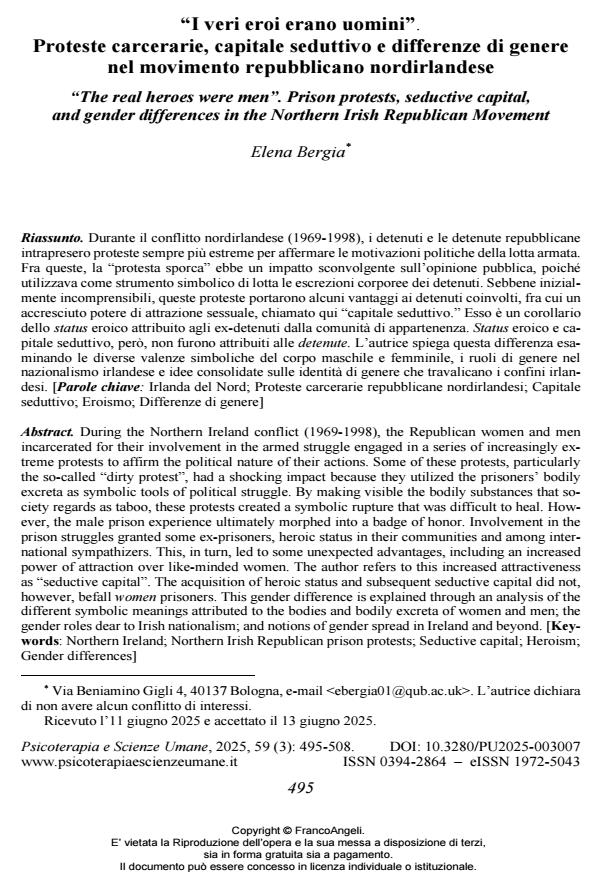
Durante il conflitto nordirlandese (1969-1998), i detenuti e le detenute repubblicane intrapresero proteste sempre più estreme per affermare le motivazioni politiche della lotta armata. Fra queste, la “protesta sporca” ebbe un impatto sconvolgente sull’opinione pubblica, poiché utilizzava come strumento simbolico di lotta le escrezioni corporee dei detenuti. Sebbene inizialmente incomprensibili, queste proteste portarono alcuni vantaggi ai detenuti coinvolti, fra cui un accresciuto potere di attrazione sessuale, chiamato qui “capitale seduttivo.” Esso è un corollario dello status eroico attribuito agli ex-detenuti dalla comunità di appartenenza. Status eroico e capitale seduttivo, però, non furono attribuiti alle detenute. L’autrice spiega questa differenza esaminando le diverse valenze simboliche del corpo maschile e femminile, i ruoli di genere nel nazionalismo irlandese e idee consolidate sulle identità di genere che travalicano i confini irlandesi.
Parole chiave:Irlanda del Nord; Proteste carcerarie repubblicane nordirlandesi; Capitale seduttivo; Eroismo; Differenze di genere
- Aretxaga B. (1995). Dirty protest: Symbolic overdetermination and gender in Northern Ireland ethnic violence. Ethos, XXIII, 2: 123-148.
- Aretxaga B. (1997). Shattering Silence: Women, Nationalism, and Political Subjectivity in Northern Ireland. Princeton, NJ: Princeton University Press.
- Bergia E. (2021). Unexpected rewards of political violence: Republican ex-prisoners, seductive capital, and the gendered nature of heroism. Terrorism and Political Violence, 33, 7: 1378-1398. DOI: 10.1080/09546553.2019.1629423.
- Bergia E. (2022). Storia di un successo simbolico: le lotte dei detenuti repubblicani nordirlandesi contro la stigmatizzazione carceraria. Questioni sociali, culturali e di genere. Studi sulla questione criminale, XVII, 2: 51-74. DOI: 10.7383/104701
- Bourdieu P. (1986). The forms of capital. In: Richardson J.J., editor, Handbook of Theory and Research for the Sociology of Education. Westport, CT: Greenwood, 1986, pp. 241-258. [trad. it.: Forme di capitale. A cura di Mauro Santoro. Roma: Armando, 2015).
- Bourdieu P. (1989). Social space and symbolic power. Sociological Theory, VII, 1: 14-25. DOI: 10.2307/202060
- Butler J. (1990). Gender trouble. Feminism and the subversion of identity. London: Routledge (trad. it.: Scambi di genere: identità, sesso e desiderio. Presentazione di Giulio Giorello. Milano: Sansoni, 2004; Questione di genere: il femminismo e la sovversione dell’identità. Bari: Laterza, 2013).
- Coogan T.P. (1980). On the Blanket: The H-Block Story. Dublin: Ward River Press.
- Douglas M. (1966). Purity and Danger. An Analysis of the Concepts of Pollution and Taboo. London: Routledge, 2002 (trad. it.: Purezza e pericolo: un’analisi dei concetti di contaminazione e tabù. Bologna: Il Mulino, 1975).
- Feldman A. (1991). Formations of Violence. The Narrative of the Body and Political Terror in Northern Ireland. Chicago, IL: University of Chicago Press.
- Gamella J.F. (2000). La población Gitana en Andalucía. Sevilla: Junta de AndalucÍa.
- Herdt G. (1994). Guardians of the Flutes. Volume 1: Idioms of Masculinity. Chicago, IL: University of Chicago Press.
- Morgan R. (1989). The Demon Lover. On the Sexuality of Terrorism. New York: Norton (trad. it.: Il demone amante: sessualità del terrorismo. Milano: La Tartaruga, 1998).
- Murphy B. (1989). A curse. In: De Salvo L., D’Arcy K.W. & Hogan K., editors, Territories of the Voice. Contemporary Stories by Irish Women Writers. Boston, MA: Beacon Press, 1989, pp. 226-227.
- Murphy B. & O’Connor D. (2011). A Night with George (opera teatrale).
- O’Keefe T. (2006), Menstrual blood as a weapon of resistance. International Feminist Journal of Politics, VIII, 4: 535-556. DOI: 10.1080/14616740600945123.
- Ortner S.B. (1974). Is female to male as nature is to culture? In: Rosaldo M.Z. & Lamphere L., editors, Woman, Culture, and Society. Stanford, CA: Stanford University Press, 1974, pp. 67-87.
- Rolston B. (2011). Review of Literature on Republican and Loyalists Ex-prisoners. Northern Ireland Executive Office: www.executiveoffice-ni.gov.uk/publications/review-literature-republican-and-loyalist-ex-prisoners.
- Ryan L. & Ward M., editors (2004). Irish Women and Nationalism. Dublin: Irish Academic Press.
- Wahidin A. & Powell J.L. (2017). “The Irish conflict” and the experiences of female ex combatants in the Irish Republican Army: Power, resistance and subjectivity. International Journal of Sociology and Social Policy, 37, 9/10: 555-571. DOI: 10.1108/IJSSP-05-2016-0052.
Elena Bergia, “I veri eroi erano uomini”. Proteste carcerarie, capitale seduttivo e differenze di genere nel movimento repubblicano nordirlandese in "PSICOTERAPIA E SCIENZE UMANE" 3/2025, pp 495-508, DOI: 10.3280/PU2025-003007