Gli Interventi Assistiti con gli Animali e salute mentale: efficacia transdiagnostica nel ciclo di vita
Titolo Rivista RIVISTA SPERIMENTALE DI FRENIATRIA
Autori/Curatori Caterina Ambrosi Zaiontz, Vittoria Ardino, Giovanni Bucci, Desirè Gaj
Anno di pubblicazione 2025 Fascicolo 2025/3
Lingua Italiano Numero pagine 32 P. 75-106 Dimensione file 783 KB
DOI 10.3280/RSF2025-003005
Il DOI è il codice a barre della proprietà intellettuale: per saperne di più
clicca qui
Qui sotto puoi vedere in anteprima la prima pagina di questo articolo.
Se questo articolo ti interessa, lo puoi acquistare (e scaricare in formato pdf) seguendo le facili indicazioni per acquistare il download credit. Acquista Download Credits per scaricare questo Articolo in formato PDF
FrancoAngeli è membro della Publishers International Linking Association, Inc (PILA), associazione indipendente e non profit per facilitare (attraverso i servizi tecnologici implementati da CrossRef.org) l’accesso degli studiosi ai contenuti digitali nelle pubblicazioni professionali e scientifiche.
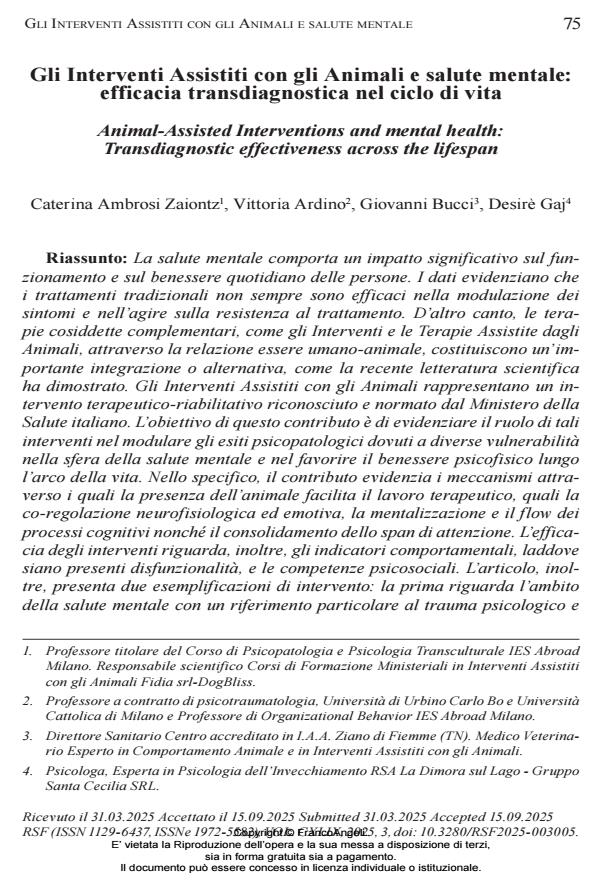
La salute mentale comporta un impatto significativo sul funzionamento e sul benessere quotidiano delle persone. I dati evidenziano che i trattamenti tradizionali non sempre sono efficaci nella modulazione dei sintomi e nell’agire sulla resistenza al trattamento. D’altro canto, le terapie cosiddette complementari, come gli Interventi e le Terapie Assistite dagli Animali, attraverso la relazione essere umanoanimale, costituiscono un’importante integrazione o alternativa, come la recente letteratura scientifica ha dimostrato. Gli Interventi Assistiti con gli Animali rappresentano un intervento terapeuticoriabilitativo riconosciuto e normato dal Ministero della Salute italiano. L’obiettivo di questo contributo è di evidenziare il ruolo di tali interventi nel modulare gli esiti psicopatologici dovuti a diverse vulnerabilità nella sfera della salute mentale e nel favorire il benessere psicofisico lungo l’arco della vita. Nello specifico, il contributo evidenzia i meccanismi attraverso i quali la presenza dell’animale facilita il lavoro terapeutico, quali la coregolazione neurofisiologica ed emotiva, la mentalizzazione e il flow dei processi cognitivi nonché il consolidamento dello span di attenzione. L’efficacia degli interventi riguarda, inoltre, gli indicatori comportamentali, laddove siano presenti disfunzionalità, e le competenze psicosociali. L’articolo, inoltre, presenta due esemplificazioni di intervento: la prima riguarda l’ambito della salute mentale con un riferimento particolare al trauma psicologico e alle sue sindromi e il secondo fa riferimento al contesto geriatico dove gli studi mostrano l’efficacia nella riduzione dei sintomi ansiosodepressivi, nello stimolare la capacità riflessiva e la memoria di lavoro favorendo un aumento delle interazioni sociali; la seconda riguarda il lavoro su problematiche transdiagnostiche legate alla compromissione della regolazione emotiva (trauma, disturbi di personalità, antisocialità).
Parole chiave:regolazione emotiva, relazione essere umanocane, alleanza terapeutica, trauma, gerontologia, neurobiologia, linee guida.
- [1.] Regione Lombardia. Interventi Assistiti con gli Animali (I.A.A.). Linee Guida Nazionali. D.g.r. 2016nX/5059: 154. Bollettino Ufficiale Serie Ordinaria 2016; n.16
- [2.] Topál J, Kis A, Oláh K. Dogs’ sensitivity to human ostensive cues: A unique adaptation? Birhwood M, Fowler D, Jackson C, ed. Early Intervention Psychosis. A guide to Concepts, Evidence and Intervention. Chichester: Wiley & Sons; 2000. 281314.
- [3.] CorreiaCaeiro C, Guo K, Mills DS. Perception of dynamic facial expressions of emotion between dogs and humans. Animal Cognition 2020; 23: 46577.
- [4.] Andics A, Gácsi M, Faragó T, Kis A, Miklósi Á. Voicesensitive regions in the dog and human brain are revealed by comparative fMRI. Current Biology 2014; 24(5):5748.
- [5.] Siniscalchi M, d’Ingeo S, Fornelli S, Quaranta A. Lateralized behavior and cardiac activity of dogs in response to human emotional vocalizations. Scientific Reports 2018; 8: 77.
- [6.] Huber L. How dogs perceive and understand us. Current Directions in Psychological Science 2016; 25:33944. DOI: 10.1177/0963721416656329
- [7.] Langner L, Žakelj S, Bolló H, Topál J, Kis A. The influence of voice familiarity and linguistic content on dogs’ ability to follow human voice direction. Scientific Reports 2023; 13:16137.
- [8.] Siniscalchi M, d’Ingeo S, Quaranta A. The dog nose “KNOWS” fear: Asymmetric nostril use during sniffing at canine and human emotional stimuli. Behavioural Brain Research 2016; 304: 3441.
- [9.] Siniscalchi M, Sasso R, Pepe AM, Dimatteo S, Vallortigara G, Quaranta A. Sniffing with the right nostril: Lateralization of response to odour stimuli by dogs. Animal Behaviour 2011; 82:399404.
- [10.] Powell L, Edwards KM, Michael S, McGreevy P, Bauman A, Guastella AJ, et al. Effects of human–dog interactions on salivary oxytocin concentrations and heart rate variability: A fourcondition crossover trial. Anthrozoös 2020; 33:3752. DOI: 10.1080/08927936.2020.1699033
- [11.] Powell L, Guastella AJ, McGreevy P, Bauman A, Edwards KM, Stamatakis E. The physiological function of oxytocin in humans and its acute response to humandog interactions: A review of the literature. Journal of Veterinary Behavior 2019; 30:2532.
- [13.] Chan HW, Wong DFK. Effects of companion dogs on adult attachment, emotion regulation, and mental wellbeing in Hong Kong. Society & Animals 2022; 30:66886.
- [14.] Daniels N, Prinsen J, Soriano JR, Alaerts K. Oxytocin enhances the recovery of eyecontact induced autonomic arousal: A treatment mechanism study with placebocontrolled design. European Neuropsychopharmacology 2020; 41:8393.
- [15.] Marchesini R. Pet Therapy. Manuale pratico. Prato: Giunti Editore; 2015. [16.] Marr C, French L, Thompson D, Drum L, Greening G, Mormon J, et al. Animalassisted therapy in psychiatric rehabilitation. Anthrozoös 2000; 13:18592. DOI: 10.2752/089279300786999950
- [17.] Matuszek S. Animalfacilitated therapy in various patient populations: Systematic literature review. Holistic Nursing Practice 2010; 24:187 203.
- [18.] Swift JK, Greenberg RP. Premature discontinuation in adult psychotherapy: a metaanalysis. Journal of Consulting and Clinical Psychology 2012; 80 (4): 54759.
- [19.] Correll CU, Solmi M, Veronese N, Bortolato B, Rosson S, Santonastaso P et al. Prevalence, incidence and mortality from cardiovascular disease in patients with pooled and specific severe mental illness: a largescale metaanalysis of 3,211,768 patients and 113,383,368 controls. World psychiatry 2017; 16 (2) 163180.
- [20.] James SL, Abate D, Abate KH, Abay SM, Abbafati C, Abbasi N et al. Global, regional, and national incidence, prevalence, and years lived with disability for 354 diseases and injuries for 195 countries and territories, 1990–2017: a systematic analysis for the Global Burden of Disease Study. The Lancet 2018; 392 (10159): 17891858.
- [21.] Bighelli I, Rodolico A, GarcíaMieres H, PitschelWalz G, Hansen WP, SchneiderThoma J et al Psychosocial and psychological interventions for relapse prevention in schizophrenia: a systematic review and network metaanalysis. The Lancet Psychiatry 2021; 8 (11): 96980.
- [22.] Krittanawong C, Maitra, NS, Qadeer YK, Wang Z, Fogg S, Storch EA et al. Association of depression and cardiovascular disease. The American journal of medicine 2023; 136(9): 881895.
- [23.] Leichsenring F, Sarrar L, Steinert C. Dropouts in psychotherapy: a change of perspective. World Psychiatry 2019; 18(1): 3233.
- [24.] Arsovski D. The Role of Animal Assisted Therapy in the Rehabilitation of Mental Health Disorders: A Systematic Literature Review. Perspectives on Integrative Medicine 2024; 3(3): 142151.
- [25.] Nepps P, Stewart CN, Bruckno SR. Animalassisted activity: effects of a complementary intervention program on psychological and physiological variables. Journal of EvidenceBased Complementary & Alternative Medicine 2014;19 (3): 211215. DOI: 10.1177/2156587214533570
- [26.] Beetz A, Julius H, Turner D, Kotrschal K. Effects of social support by a dog on stress modulation in male children with insecure attachment. Frontiers in Psychology 2012; 3:352.
- [27.] Shih CA, Yang MH. Effect of animalassisted therapy (AAT) on social interaction and quality of life in patients with Schizophrenia during the COVID19 pandemic: an experimental study. Asian Nursing Research 2023; 17(1):37-43.
- [28.] Pandey RP, Riya M, and ChungMing C. The role of animalassisted therapy in enhancing patients’ wellbeing: Systematic study of the qualitative and quantitative evidence. Jmirx med 2024; 5(1): e51787.
- [29.] Sahebalzamani M, Rezaei O, Moghadam LF. Animalassisted therapy on happiness and life quality of chronic psychiatric patients living in psychiatric residential care homes: a randomized controlled study. BMC Psychiatry 2020; 20(1):575.
- [30.] Anderson D, Brown S. The effect of animalassisted therapy on nursing student anxiety: A randomized control study. Nurse education in practice 2021; 52: 103042.
- [31.] Faucher C, Behler A, Campbell M, Thienel R. Effect of Brief DogAssisted Interventions on Stress Biomarkers: A Systematic Review. medRxiv 2023; 12. DOI: 10.1101/2023.12.10.23299796
- [32.] CharrySánchez JD, Pradilla I, TaleroGutiérrez C. Animalassisted therapy in adults: A systematic review. Complementary therapies in clinical practice 2018; 32: 169180.
- [33.] Hawkins EL, Hawkins RD, Dennis M, Williams JM, Lawrie SM. Animalassisted therapy for schizophrenia and related disorders: A systematic review. Journal of psychiatric research 2019; 115: 5160.
- [34.] Tyssedal MK, Johnsen E, Brønstad A, Skrede S. Dogassisted interventions for adults diagnosed with schizophrenia and related disorders: a systematic review. Frontiers in Psychiatry 2023; 14: 1192075.
- [35.] Hediger K, Wagner J, Künzi P, Haefeli A, Theis F et al. Effectiveness of animalassisted interventions for children and adults with posttrau ysis. European Journal of Psychotraumatology 2021; 12(1): 1879713. DOI: 10.1080/20008198.2021.1879713
- [54.] Heinrichs M, von Dawans B, Domes G. Oxytocin, vasopressin, and human social behavior. Frontiers in Neuroendocrinology 2009; 30(4): 548–57.
- [36.] Hertel B, Abel R. Effects of AnimalAssisted Therapy (AAT) compared to Progressive Muscle Relaxation (PMR) on stress and anxiety. The American Journal of Occupational Therapy 2019; 73 (4) Supplement 1: 7311520391p17311520391p1.
- [37.] Fine AH, Beck AM, Zenithson NG. The state of animalassisted interventions: Addressing the contemporary issues that will shape the future. International Journal of Environmental Research and Public Health 2019; 16 (20): 3997.
- [38.] Maoz I, Zubedat S, Dolev T, AgaMizrachi S, Bloch B, Michaeli Y et al. Dog training alleviates PTSD symptomatology by emotional and attentional regulation. European Journal of Psychotraumatology 2021; 12(1): 1995264. DOI: 10.1080/20008198.2021.1995264
- [39.] Hunjan UG, Reddy KG. Effect of animalassisted therapy on depression, memory, attention, and emotion regulation. Journal of Human Research in Rehabilitation 2023; 13(1): 12030.
- [40.] SchneiderMS.,LorahPilchakH.Howdogsinfluencetheevaluationofpsy chotherapists. 2006; 19(2): 12842. DOI: 10.2752/089279306785593784
- [41.] Wookey E. A systematic review of movementoriented mindbody interventions and psychoneuroimmunological outcomes for psychological stress and trauma. Unpublished Doctoral Thesis 2023; USA: Pepperdine University.
- [42.] Medicus AN, Alleyne AR, Graves TJ, Figliolini KT. Animalassisted therapy in mental health: Barriers to treatment. Unpublished Master’s thesis 2022; Brenau University.
- [43.] Teo JT, Johnstone SJ, Römer SS, Thomas SJ. Psychophysiological mechanisms underlying the potential health benefits of humandog interactions: A systematic literature review. International Journal of Psychophysiology 2022; 180: 2748.
- [44.] Blum K, Modestino EJ, Baron D, Brewer R, Thanos P, Elman I. et al. Endorphinergic enhancement attenuation of posttraumatic stress disorder (PTSD) via activation of neuroimmunological function in the face of a viral pandemic. Current Psychopharmacology 2021; 10(2): 86 97. DOI: 10.2174/2211556009999210104221215
- [45.] Porges SW. Polyvagal theory: A science of safety. Frontiers in Integrative Neuroscience 2022; 16: 871227.
- [46.] Nieforth LO, Rodriguez KE, Zhuang R, Miller EA, Sabbaghi A, Schwichtenberg AJ et al. The cortisol awakening response in a 3month clinical trial of service dogs for veterans with posttraumatic stress disorder. Scientific Reports 2024; 14(1): 1664. impact of humananimal interaction in trauma recovery. New Directions in Human Animal Bond 2019; 15: 1553.
- [48.] Yoon S, YongKu K. Neuroendocrinological treatment targets for posttraumatic stress disorder. Progress in NeuroPsychopharmacology and Biological Psychiatry 2019; 90: 212222.
- [49.] Olivo KM. How CanineAssisted Therapy Supplements Psychotherapy to Help Reduce Maladaptive Behaviors in Adolescents Who Have Experienced Trauma. Unpublished Doctoral Thesis 2023; Azusa Pacific University.
- [50.] McNicholas J, Collis G. Dogs as catalysts for social interactions: Robustness of the effect. British Journal of Psychology 2020; 91(1): 61–70. DOI: 10.1348/000712600161673
- [51.] Maayan E. The therapy zoo as a mirror to the psyche. ParishPlass N Ed. Animalassisted psychotherapy: Theory, issues, and practice 2013; 171–220. Purdue University Press.
- [52.] Jenkins S. The equiLateral protocol: The first EMDR protocol to integrate animal assisted therapy. Presentation at the 18th EMDR International Association Conference, Austin, TX 2013.
- [53.] Isenstein S. Man’s best friend is a therapist’s best friend: How the presence of a dog influences therapists and others’ perceptions of them. Unpublished masters thesis. University of Toronto, Toronto, Canada 2018.
- [55.] GonzálezRamírez T, Ortiz X, Landero Hernández R. Cognitive–behavioral therapy and animalassisted therapy: Stress management for adults. Alternative and Complementary Therapies 2013; 19(5): 270–75.
- [56.] ParishPlass N. Animalassisted psychotherapy for developmental trauma through the lens of interpersonal neurobiology of trauma: Creating connection with self and others. Journal of Psychotherapy Integration 2021; 31(3): 302.
- [57.] Gerwisch, K. “The humananimalrelationship between individuals with posttraumatic stress disorder and their assistance dogs: influence on the humans’ quality of life as well as on the dogs’ salivary cortisol levels”. Unpublished Masters Thesis, Faculty of Veterinary Medicine University of Vienna 2022.
- [58.] Delgado C, Toukonen M, Wheeler C. Effect of canine play interventions as a stress reduction strategy in 529 college students. Nurse Educator 2018; 43(3): 14953.
- [60.] KrauseParello CA, Friedmann E, Blanchard K, Payton M, Gee NR. Veterans and shelter dogs: Examining the impact of a dogwalking intervention on physiological and posttraumatic stress symptoms. Anthrozoös 2020; 33(2): 22541. DOI: 10.1080/08927936.2020.1719763
- [61.] Gee NR, Rodriguez KE, Fine AH, Trammell JP. Dogs supporting human health and wellbeing: A biopsychosocial approach. Frontiers in Veterinary Science 2021; 8: 630465.
- [62.] Binfet JT, TardifWilliams C, Draper ZA, Green FL, Singal A, Rousseau CX, Roma, R. Virtual canine comfort: A randomized controlled trial of the effects of a canineassisted intervention supporting undergraduate wellbeing. Anthrozoös 2022; 35(6): 80932. DOI: 10.1080/08927936.2022.2062866
- [63.] European Health Interview Survey (EHIS wave 3) Reediction 2020 Eurostat https://www.istat.it/it/archivio/277776.
- [64.] Carbone G. Epidemiologia dei disturbi comportamentali nei diversi tipi di demenza. Corso di aggiornamento sulle demenze. 2526 settembre 2009. Abbazia di Spineto, Sarteano (Si).
- [65.] Hodges JR. Frontotemporal dementia (Pick’s disease): Clinical features and assessment. Neurology 2001; 56(4): S6S10.
- [66.] Ruan Q, Yu Z, Chen M, Bao Z, Li J, He W. Cognitive frailty, a novel target for the prevention of elderly dependency. Ageing research reviews 2015; 20: 110.
- [67.] Kelaiditi E, Cesari M, Canevelli M, Van Kan GA, Ousset PJ, GilletteGuyonnet S. Cognitive frailty: Rational and definition from an (IANA/IAGG). The Journal of Nutrition, Health and Aging 2013; 17: 726–34.
- [68.] De Jager C, Blackwell AD, Budge MM, Sahakian BJ. Predicting cognitive decline in healthy older adults, The American Journal of Geriatric Psychiatry 2005; 13(8): 73540. DOI: 10.1097/000194422005080000014.
- [69.] Gallucci M, Di Battista ME, Battistella G, Falcone C, Bisiacchi PS, Di Giorgi E. Neuropsychological tools to predict conversion from amnestic mild cognitive impairment to dementia. The TREDEM Registry. Aging, Neuropsychology, and Cognition 2018; 25(4): 55060. DOI: 10.1080/13825585.2017
- [70.] Shinagawa S, Nakajima S, Plitman E, GraffGuerrero A, Mimura M, Nakayama K, Miller BL. NonPharmacological management for patients with frontotemporal dementia: a systematic review, Journal of Alzheimer’s Disease 2015; 45(1): 28393. DOI: 10.3233/JAD142109
- [71.] Hughes MJ, Verreynne ML, Harpur P, Pachana NA. Companion animals and health in older populations: a systematic review. Clinical Gerontologist 2020; JulSep(4): 36577. DOI: 10.1080/07317115.2019.1650863
- [72.] Friedman E, KrauseParello CA. Companion animals and human health: benefits, challenges, and the road ahead for humananimal interaction. Revue Scientifique et Technique (International Office of Epizootics 2018; 37(1): 7182.
- [73.] McDonough IM, Erwin HB, Sin NL, Allen RS. Ownership is associated with greater cognitive and brain health across the adult life span. Frontiers in Aging Neuroscience 2022; 14: 953889.
- [74.] Pino M. S., 20152017, NonPharmacological Management for Patients with Frontotemporal Dementia: A Systematic Review, Journal of Alzheimer’s Disease, vol. 45, no. 1, pp. 283293, https:// DOI: 10.3233/JA142109.
- [75.] Chu H, Yang CY, Lin Y, Ou KL, Lee TY, O’Brien AP, Chou KR. et al. The impact of group music therapy on depression and cognition in elderly persons with dementia: a randomized controlled study. Biological Research for Nursing 2014; 16: 20917. DOI: 10.1177/1099800413485410
- [76.] Klimova B, Toman J, Kuca K. Effectiveness of the dog therapy for patients with dementia a systematic review. BMC Psychiatry 2019; 19(1): 276 Lewis SC, Warlow CP. How to spot bias and other potential problems in randomized controlled trials. Journal of Neurology, Neurosurgery and Psychiatry 2004; 75(2): 18187.
- [77.] Ambrosi C, Zaiontz C, Peragine G, Sarchi S, Bona F, Randomized controlled study on the effectiveness of animalassisted therapy on depression, anxiety, and illness perception in institutionalized elderly. Psychogeriatrics 2019; 19: 5564.
- [78.] Sheikh JI, Yesavage JA. Geriatric Depression Scale (GDS): recent evidence and development of a shorter version. Clinical Gerontology 1986; 5(1/2):16573.
- [79.] Watson D, Clark LA, Tellegen A. Development and validation of brief measures of positive and negative affect: the PANAS scales. Journal of Personality and Social Psychology 1988; 54: 1063–70. DOI: 10.1037/00223514.54.6.1063
- [80.] Spitzer RL, Kroenke K, Williams JB, Lowe B. A brief measure for assessing generalized anxiety disorder: the GAD7. Archives of Internal Medicine 2006; 166(10): 109297.
- [81.] Breivik H, Borchgrevink PC, Allen SM, Rosseland LA, Romundstad L, Breivik Hals EK. Assessment of pain. British Journal of Anaesthesia
- [82.] MossMorris R, Weinman J, Petrie K, Horne R, Cameron DL, Buick D. The Revised Illness Perception Questionnaire (IPQR). Psychological Health 2002; 17(1): 1–16. DOI: 10.1080/08870440290001494
- [83.] Ambrosi C, Gaj DE, Gattuso V, Costa N, Zaiontz C. Positive outcomes of animal assisted therapy on behavioural and psychological vulnerabilities for institutionalized elderly with cognitive deficits: a randomized Controlled Study. Journal of Gerontology and Geriatric Medicine 2024; 8(3): 555740; DOI: 10.19080/OAJGGM.2024.08.555740
- [84.] Folstein MF, Folstein SE, McHugh PR. Mini Mental State: a practical method for grading the cognitive state of patients for the clinicians. Journal of Psychiatric Research 1975; 12(3): 189 – 98.
- [85.] Cummings JL. The Neuropsychiatric Inventory: comprehensive assessment of psychopathology in dementia. Neurology 1994;44: 32083214.
- [86.] Wear HJ, Wedderburn CJ, Mioshi E, WilliamsGray CH, Mason SL, Barker RA, Hodges JR. The Cambridge behavioural inventory revised. Dementia & Neuropsychologia 2008; 2: 10207. DOI: 10.1590/S198057642009DN20200005
- [87.] Zigmond AS, Snaith RP. The Hospital Anxiety and Depression Scale. Acta Psychiatrica Scandinavica 1983; 67:361–70.
- [88.] Maiorani CG, CesaBianchi G, Cristini C. Un’esperienza di “Dog assisted therapy” in RSA. Giornale di Gerontologia 2012; 60:5155
Caterina Ambrosi Zaiontz, Vittoria Ardino, Giovanni Bucci, Desirè Gaj, Gli Interventi Assistiti con gli Animali e salute mentale: efficacia transdiagnostica nel ciclo di vita in "RIVISTA SPERIMENTALE DI FRENIATRIA" 3/2025, pp 75-106, DOI: 10.3280/RSF2025-003005