Gli accordi di riconciliazione per i crimini del colonialismo: quale ruolo per le vittime?
Titolo Rivista SOCIETÀ E STORIA
Autori/Curatori Alessandro Bufalini
Anno di pubblicazione 2025 Fascicolo 2025/190
Lingua Italiano Numero pagine 23 P. 831-853 Dimensione file 217 KB
DOI 10.3280/SS2025-190004
Il DOI è il codice a barre della proprietà intellettuale: per saperne di più
clicca qui
Qui sotto puoi vedere in anteprima la prima pagina di questo articolo.
Se questo articolo ti interessa, lo puoi acquistare (e scaricare in formato pdf) seguendo le facili indicazioni per acquistare il download credit. Acquista Download Credits per scaricare questo Articolo in formato PDF
FrancoAngeli è membro della Publishers International Linking Association, Inc (PILA), associazione indipendente e non profit per facilitare (attraverso i servizi tecnologici implementati da CrossRef.org) l’accesso degli studiosi ai contenuti digitali nelle pubblicazioni professionali e scientifiche.
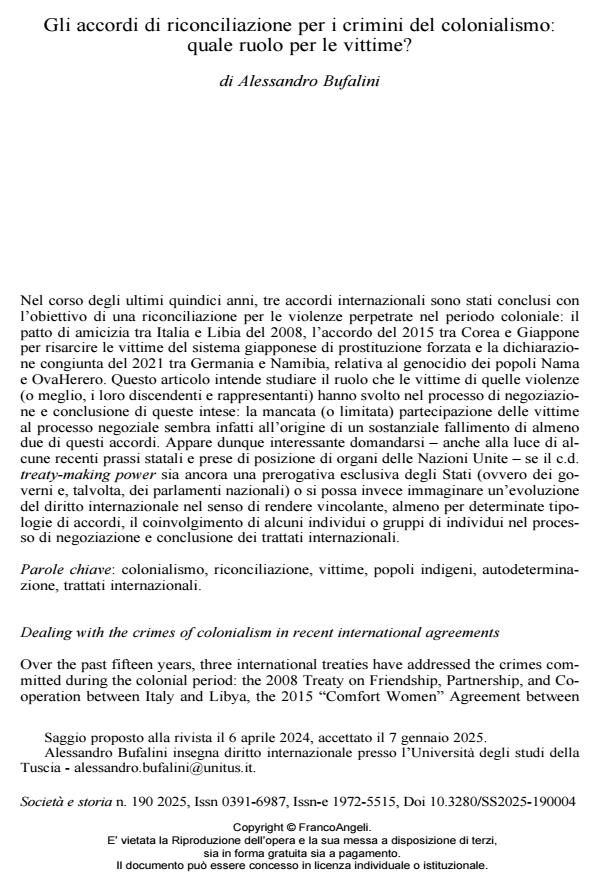
Nel corso degli ultimi quindici anni, tre accordi internazionali sono stati conclusi con l’obiettivo di una riconciliazione per le violenze perpetrate nel periodo coloniale: il patto di amicizia tra Italia e Libia del 2008, l’accordo del 2015 tra Corea e Giappone per risarcire le vittime del sistema giapponese di prostituzione forzata e la dichiarazione congiunta del 2021 tra Germania e Namibia, relativa al genocidio dei popoli Nama e OvaHerero. Questo articolo intende studiare il ruolo che le vittime di quelle violenze (o meglio, i loro discendenti e rappresentanti) hanno svolto nel processo di negoziazione e conclusione di queste intese: la mancata (o limitata) partecipazione delle vittime al processo negoziale sembra infatti all’origine di un sostanziale fallimento di almeno due di questi accordi. Appare dunque interessante domandarsi – anche alla luce di alcune recenti prassi statali e prese di posizione di organi delle Nazioni Unite – se il c.d. treatymaking power sia ancora una prerogativa esclusiva degli Stati (ovvero dei governi e, talvolta, dei parlamenti nazionali) o si possa invece immaginare un’evoluzione del diritto internazionale nel senso di rendere vincolante, almeno per determinate tipologie di accordi, il coinvolgimento di alcuni individui o gruppi di individui nel processo di negoziazione e conclusione dei trattati internazionali.
Parole chiave:colonialismo, riconciliazione, vittime, popoli indigeni, autodeterminazione, trattati internazionali.
- Barelli M. (2011), Shaping Indigenous selfdetermination: Promising or unsatisfactory solutions?, in «International Community Law Review», 13, pp. 413436.
- Anaya J. (1998), Indigenous Peoples and International Law Issues, in «American Society of International Law Proceedings», 92, pp. 9699.
- Anghie A. (2007), Imperialism, Sovereignty and the Making of International Law, Cambridge, Cambridge University Press.
- Arakavat M. (2001), A New Forum for Comfort Women: Fighting Japan in United States Federal. Court, in «Berkeley Women’s Law Journal», 16, pp. 174200.
- Barelli M. (2012), Free, Prior and Informed Consent in the Aftermath of the UN Declaration on the Rights of Indigenous Peoples: Developments and Challenges Ahead, in «The International Journal of Human Rights», 16, pp. 124.
- Barelli M. (2018), Free, Prior, and Informed Consent in the UNDRIP, in The UN Declaration on the Rights of Indigenous Peoples: A Commentary, a cura di J. Hohmann e M. Weller, Oxford, Oxford University Press, pp. 247272.
- Barsh R.L. (1994), Indigenous Peoples in the 1990s: From Object to Subject of International Law?, in «Harvard Human Rights Journal», 7, pp. 3386.
- Bhabha H.K. (1994), The Location of Culture, London, Routledge, 1994.
- Bilder R (2006), The Role of Apology in International Law and Diplomacy, in «Virginia Journal of International Law», 46, pp. 433473.
- Brölman C. e Zieck M. (1993), Indigenous Peoples, in Peoples and Minorities in International Law, a cura di C. Brölman, R. Lefeber e M. Zieck, Dordrecht/Boston, Martinus Nijhoff, pp. 187220.
- Bufalini A. (2021), Immunità degli Stati dalla giurisdizione e negoziazioni fra Stati: sulla vicenda delle comfort women coreane, in «Diritti Umani e Diritto Internazionale», 15, pp. 699708.
- Bufalini A. (2024), The Italian Nazi Crimes Reparations Fund and Judicial Protection: Navigating the Drawbacks of Judicial Responses to Mass Crimes, in «Italian Yearbook of International Law», 33, pp. 335345.
- Bufalini A. (2024), The Participation of Indigenous Peoples and Victims in Treatymaking for Reconciliation on Colonial Crimes: between Change and Stability, in «QILQuestions of International Law», 103, pp. 3156.
- Camponovo C.N. (2003), Disaster in Durban: The United Nations world conference against racism, racial discrimination, xenophobia, and related intolerance, in «The George Washington International Law Review», 34, pp. 659710.
- Cannizzaro E. (2015), Jurisdictional Immunity and Judicial Protection: The Decision of the Italian Constitutional Court No. 238 of 2014, in «Rivista di diritto internazionale», 98, pp. 126134.
- Castellino J. e Doyle C. (2018), Who Are “Indigenous Peoples”? An Examination of Concepts Concerning Group Membership in the UNDRIP in The UN Declaration on the Rights of Indigenous Peoples: A Commentary, a cura di J. Hohmann e M. Weller, Oxford, Oxford University Press, pp. 3236.
- Castellino J. e Gilbert J. (2003), SelfDetermination, Indigenous Peoples and Minorities, in «Macquarie Law Journal», 3, pp. 155178.
- Césaire A. (1955), Discours sur le colonialisme, Paris, Éditions Présence Africain. Chakma S. (2002), The Issue of Compensation for Colonialism and Slavery at the
- World Conference Against Racism: A fine Balance Between Rhetoric and Legality, in «Human Rights in Development», 7, pp. 5771.
- Chan S. Y. (2024), Expropriation as reparation, in «American Journal of Political Science», 68, pp. 115.
- Charters C. (2021), The Sweet Spot Between Formalism and Fairness: Indigenous Peoples’ Contribution to International Law, in «American Journal of International Law Unbound», 115, pp. 123128.
- Chavez L.E. (2009), The Declaration on the Rights of Indigenous Peoples Breaking the Impasse: the Middle Ground, in Making the Declaration Work: The UN Declaration on the Rights of Indigenous Peoples, a cura di C. Charters e R. Stavenhagen, Copenhagen, Transaction Publisher, pp. 96107.
- Daes EI. A. (2008), An Overview of the History of Indigenous Peoples: Selfdetermination and the United Nations, in «Cambridge Review of International Affairs», vol. 21, n.1, pp. 726.
- D’Argent P. (2009), Les réparations pour violations historiques, in La protection internationale des droits de l’homme et les droits des victimes, a cura di F. Flauss, Bruxelles, Bruylant, pp. 195220.
- De Cesari M. (2008), The Paradoxes of Colonial Reparation: Foreclosing memory and the 2008 ItalyLibya Friendship Treaty, in «Memory Studies», 5, pp. 316326.
- Del Boca A., Italiani, brava gente? Un mito duro a morire, Vicenza, Neri Pozza, 2005. De Sena P. (2014), The Judgment of the Italian Constitutional Court on State Immuni
- ty in Cases of Serious Violations of Human Rights or Humanitarian Law: A Tentative Analysis under International Law, in «QIL Questions of International Law», 2, pp. 17.
- De Vittor F. (2018), Responsabilità degli Stati e dell’Unione europea nella conclusione e nell’esecuzione di ‘accordi’ per il controllo extraterritoriale della migrazione, in «Diritti umani e diritto internazionale», 12, 1, pp. 528.
- Distretti E. (2021), The Life Cycle of the Libyan Coastal Highway: Italian Colonialism, Coloniality, and the Future of Reparative Justice in the Mediterranean, in «Antipode. A Radical Journal of Geography», 53, pp. 14211441.
- Engle K. (2011), On Fragile Architecture: The UN Declaration on the Rights of Indigenous Peoples in the Context of Human Rights, in «European Journal of International Law», 22, pp. 141163.
- Falk R. (1992), The Rights of People (in particular, Indigenous Peoples) in The Rights of Peoples, a cura di J. Crawford, Oxford, Oxford University Press, pp. 1738.
- Falk R. (20062007), What comes after Westphalia: The Democratic Challenge, in «Widener Law Review», 13, pp. 243254.
- Fitzmaurice M. (2013), The Question of Indigenous Peoples’ rights: A Time for Reappraisal, in Statehood and SelfDetermination, a cura di D. French, Cambridge, Cambridge University Press, pp. 349377.
- Fontanelli F. (2021), Sketches for a Reparation Scheme: How Could a GermanItalian Fund for the IMIs Work?, in Remedies against Immunity? Reconciling International and Domestic Law after the Italian Constitutional Court’s Sentenza 238/2014, a cura di V. Volpe, A. Peters e S. Battini, BerlinHeidelberg, Springer, 2021, pp. 159187.
- GarcíaGodos J. e Lid K.A. (2010), Transitional Justice and Victims’ Rights before the End of a Conflict: The Unusual Case of Colombia, in « Journal of Latin American Studies», 42, pp. 487516.
- Gibney M. (2022), State Apologies and International Law, in «Global Studies Quarterly», 2, pp. 111.
- Gilbert J. (2006), Indigenous Peoples’ Land Rights Under International Law: From Victims to Actors, New York, Transnational Publishers.
- Goldmann M. (2024), The Ambiguity of Colonial International Law: Three Approaches to the Namibian Genocide, in «Leiden Journal of International Law», 37, pp. 128.
- Gozzi G. (2021), Eredità coloniale e costruzione dell’Europa. Una questione irrisolta: il «rimosso» della coscienza europea, Il Mulino, Bologna.
- Higgins R. (1997), Time and the Law: International Perspectives on an Old Problem, in «International and Comparative Law Quarterly», 46, pp. 501520.
- Hollis D.B. (2005), Why State Consent Still Matters – NonState Actors, Treaties, and the Changing Sources of International Law, in «Berkeley Journal of International Law», 23, pp. 137155.
- HowardHassmann R.E. (2008), Reparations to Africa, Philadelphia, University of Pennsylvania Press, pp. 88105.
- Johnson N.I. (2001), Justice for Comfort Women: Will the Alien Tort Claims Act Bring Them the Remedies They Seek, in «Penn State International Law Review», 20, pp. 253273.
- Khan S.A. (2019), Rebalancing state and Indigenous sovereignties in international law: An Arctic lens on trajectories for global governance, in «Leiden Journal of International Law», 32, pp. 675693.
- Koivurova T. (2008), From High Hopes to Disillusionment: Indigenous Peoples’ Struggle to (re)Gain their Right to SelfDetermination, in «International Journal of Minority Group Rights», 15, pp. 126.
- Labanca N. (2011), Compensazioni, passato coloniale, crimini italiani: il generale e il particolare, in Memoria e rimozione: i crimini di guerra del Giappone e dell’Italia, a cura di G. Contini, M. Petricioli e F. Focardi, Viella, Roma, pp. 127161.
- Lantos T (2002), The Durban Debacle: An Insider’s View of the UN World Conference Against Racism, in «The Fletcher Forum of World Affairs», 26, pp. 3152
- Laplante L.J. (2017), Negotiating Reparation Rights: The Participatory and Symbolic Quotients, in «Buffalo Human Rights Law Rev», 19, pp. 217250.
- Lee S.R. (2003), Comforting the Comfort Women: Who Can Make Japan Pay, in «University of Pennsylvania Journal of International Law», 24, pp. 509547.
- Lollini A. (2011), Constitutionalism and Transitional Justice in South Africa, Oxford/New York, Berghahn Books,.
- Macklem P. (2008), Indigenous Recognition in International Law: Theoretical Observations, in «Michigan Journal of International Law», 30, pp. 177210.
- Mancini M. (2018), Italy’s New Migration Control Policy: Stemming the Flow of Migrants From Libya Without Regard for Their Human Rights, in «The Italian Yearbook of International Law Online», 27, pp. 259281.
- Mendez J.E. (2016), Victims as Protagonists in Transitional Justice, in «International Journal of Transitional Justice», 10, pp. 15.
- Nam, S. (2022), Court Decisions in the Republic of Korea on Japan’s Accountability for Sexual Slavery of the Comfort Women, in «Journal of International Criminal Justice», 20, pp. 459482.
- Pahuja S. (2011), Decolonizing International Law. Development, Economic Growth and the Politics of Universality, Cambridge, Cambridge University Press.
- Palchetti P. (2015), Judgment 238/2014 of the Italian Constitutional Court: In Search of a Way Out, in «QIL Questions of international Law», 2, pp. 4448.
- Pascale G. (2019), Is Italy internationally responsible for the gross human rights violations against migrants in Libya?, in «QIL Questions of International Law», 56, pp. 3558.
- Phuong Le T. (2019), Negotiating in Good Faith: Overcoming Legitimacy Problems in the JapanSouth Korea Reconciliation Process, in «Journal of Asian Studies», 78, pp. 621644.
- Roberts A. e Sivakumaran S. (2012), Lawmaking by NonState Actors: Engaging Armed Groups in the Creation of International Humanitarian Law, in «Yale Journal of International Law», 37, pp. 107152
- Said E. (1978), Orientalism, New York, First Vintage Books Edition.
- Salerno F. (2015), Giustizia costituzionale versus giustizia internazionale nell’applicazione del diritto internazionale generalmente riconosciuto, in «Quaderni costituzionali», fasc. 1, pp. 3358.
- Saliba A.T. e Lima L. (2021), The Law of State Immunity before the Brazilian Supreme Court: What is at Stake with the ‘Changrila’ Case?, in «Brazilian Journal of International Law», 18, pp. 5358.
- Sands P. (2022), The Last Colony. A Tale of Exile, Justice and Britain’s Colonial Legacy, London, The Orion Publishing Group.
- Schiff Berman P. (2015), NonState Lawmaking through the Lens of Global Legal Pluralism, in Negotiating State and NonState Law. The Challenge of Global and Local Legal Pluralism, a cura di M. A. Helfand, Cambridge, Cambridge University Press, pp. 1540.
- Soh C.S. (2003), Japan’s National/Asian Women’s Fund for ‘Comfort Women’”, in «Public Affairs», vol, 76, 2, pp. 209233.
- Stahn C. (2020), Confronting Colonial Amnesiac: Towards New Relational Engagement with Colonial Injustice and Cultural Colonial Objects in «Journal of International Criminal Justice», 18, pp. 793824.
- Stahn C. (2020), Reckoning with Colonial Injustice: International Law as Culprit and as Remedy? in «Leiden Journal of International Law», 33, pp. 823835.
- Tavernier P. (2010), Relevance of the Intertemporal Law, in The Law of International Responsibility, a cura di J. Crawford, A. Pellet e S. Olleson, Oxford, Oxford University Press, pp. 397404.
- Teitel R. (2015), The Law and Politics of Contemporary Transitional Justice, in «Cornell International Law», 38, pp. 837862.
- Tjønn M.H. e Jumbert M.G. (2024), Migration Across the Mediterranean: Shaping ItalyLibya Relations Over Time, in Migrations in the Mediterranean, a cura di R. ZapataBarrero e I. Awad, Cham Springer, pp. 5368.
- Van Boven T. (2009), The AntiRacism Durban Review Conference, in «Netherlands Quarterly of Human Rights», 27, pp. 325330.
- Von Arnauld A. (2021), How to Illegalize Past Injustice: Reinterpreting the Rules of Intertemporality, in «European Journal of International Law», 32, pp. 410432.
- Ward T. (2011), The Right to Free, Prior, and Informed Consent: Indigenous Peoples’ Participation Rights Within International Law, in «Northwestern Journal of International Human Rights», 10, pp. 5484.
- Waterhouse C. (2009), The Good, the Bad, and the Ugly: Moral Agency and the Role of Victims in Reparations Programs, in «University of Pennsylvania Journal of International Law», 31, pp. 257294.
- Wiessner S. (2008), Indigenous Sovereignty: a Reassessment in light of the UN Declaration on the Rights of Indigenous Peoples, in «Vanderbilt Journal of Transnational Law», 41, pp. 1141176.
- Yoshiaki Y. (2002), Comfort Women: Sexual Slavery in the Japanese Military During World War II, New York, Columbia University Press.
- Volpe V., Peters A., Battini S. (2021), Remedies against Immunity? Reconciling International and Domestic Law after the Italian Constitutional Court’s Sentenza 238/2014, Heidelberg/Berlin, Springer.
Alessandro Bufalini, Gli accordi di riconciliazione per i crimini del colonialismo: quale ruolo per le vittime? in "SOCIETÀ E STORIA " 190/2025, pp 831-853, DOI: 10.3280/SS2025-190004