Mafia ties and financial reporting quality spillovers: Evidence from private firms in Italy
Titolo Rivista FINANCIAL REPORTING
Autori/Curatori Pietro A. Bianchi Fedrigoni, Nicola Pecchiari
Anno di pubblicazione 2025 Fascicolo 2025/2
Lingua Inglese Numero pagine 31 P. 59-89 Dimensione file 200 KB
DOI 10.3280/fr202519624
Il DOI è il codice a barre della proprietà intellettuale: per saperne di più
clicca qui
Qui sotto puoi vedere in anteprima la prima pagina di questo articolo.
Se questo articolo ti interessa, lo puoi acquistare (e scaricare in formato pdf) seguendo le facili indicazioni per acquistare il download credit. Acquista Download Credits per scaricare questo Articolo in formato PDF
FrancoAngeli è membro della Publishers International Linking Association, Inc (PILA), associazione indipendente e non profit per facilitare (attraverso i servizi tecnologici implementati da CrossRef.org) l’accesso degli studiosi ai contenuti digitali nelle pubblicazioni professionali e scientifiche.
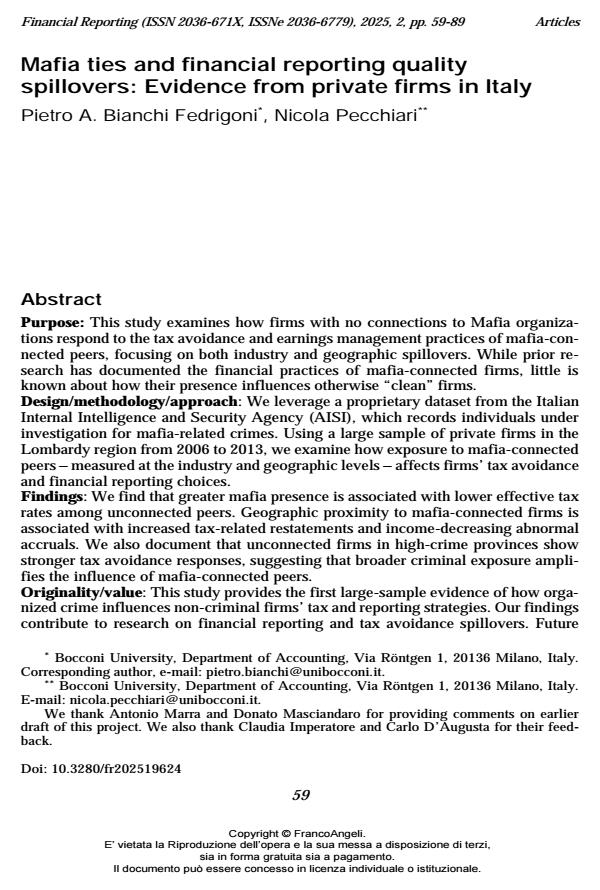
Purpose: This study examines how firms with no connections to Mafia organiza-tions respond to the tax avoidance and earnings management practices of mafia-con-nected peers, focusing on both industry and geographic spillovers. While prior re-search has documented the financial practices of mafia-connected firms, little is known about how their presence influences otherwise “clean” firms. Design/methodology/approach: We leverage a proprietary dataset from the Italian Internal Intelligence and Security Agency (AISI), which records individuals under investigation for mafia-related crimes. Using a large sample of private firms in the Lombardy region from 2006 to 2013, we examine how exposure to mafia-connected peers - measured at the industry and geographic levels - affects firms’ tax avoidance and financial reporting choices. Findings: We find that greater mafia presence is associated with lower effective tax rates among unconnected peers. Geographic proximity to mafia-connected firms is associated with increased tax-related restatements and income-decreasing abnormal accruals. We also document that unconnected firms in high-crime provinces show stronger tax avoidance responses, suggesting that broader criminal exposure ampli-fies the influence of mafia-connected peers. Originality/value: This study provides the first large-sample evidence of how orga-nized crime influences non-criminal firms’ tax and reporting strategies. Our findings contribute to research on financial reporting and tax avoidance spillovers. Future studies could explore broader implications, including investment and employment decisions. Practical implications: Regulators may benefit from enhanced anti-money launder-ing enforcement and transparency measures to curb organized crime’s economic in-fluence. Firms in high-risk regions should strengthen governance and auditing prac-tices to mitigate exposure.
Parole chiave:connections to organized crime, spillover, criminal investigations, tax avoidance, earnings management, private firms, Italian setting
Jel codes: G31, G32, G38, K42, K49
- Malloy, C. J. (2005). The geography of equity analysis. Journal of Finance, 60(2), 719-755.
- Amore, M. D., Garofalo, O., & Minichilli, A. (2014). Gender interactions within the family firm. Management Science, 60(5), 1083-1097.
- Bianchi, P. A. (2018). Auditors’ joint engagements and audit quality: Evidence from Italian private companies. Contemporary Accounting Research, 35(3), 1533-1577.
- Bianchi, P. A., Causholli, M., Minutti-Meza, M., & Sulcaj, V. (2023). Social net-works analysis in accounting and finance. Contemporary Accounting Research, 40(1), 577-623.
- Bianchi, P. A., Falsetta, D., Minutti-Meza, M., & Weisbrod, E. (2019). Joint audit engagements and client tax avoidance: Evidence from the Italian statutory audit regime. Journal of the American Taxation Association, 41(1), 31-58.
- Bianchi, P. A., Francis, J. R., Marra, A., & Pecchiari, N. (2025). Mafia-connected accountants and monitoring quality. SSRN. https://ssrn.com/abstract= 3957650.
- Bianchi, P. A., Marra, A., Masciandaro, D., & Pecchiari, N. (2022). Organized crime and firms’ financial statements: Evidence from criminal investigations in Italy. The Accounting Review, 97(3), 77-106.
- Bonacchi, M., Marra, A., & Zarowin, P. (2019). Organizational structure and earn-ings quality of private and public firms. Review of Accounting Studies, 24, 1066-1113.
- Burgstahler, D., Hail, L., & Leuz, C. (2006). The importance of reporting incentives: Earnings management in European private and public firms. The Accounting Re-view, 81(5), 983-1016.
- Cai, H., & Liu, Q. (2009). Competition and corporate tax avoidance: Evidence from Chinese industrial firms. The Economic Journal, 119, 764-795.
- Calamunci, F., & Drago, F. (2020). The economic impact of organized crime infil-tration in the legal economy: Evidence from the judicial administration of orga-nized crime firms. Italian Economic Journal, 6(2), 275-297.
- Chircop, J., Fabrizi, M., Malaspina, P., & Parbonetti, A. (2023). Anti-mafia police actions, criminal firms, and peer firm tax avoidance. Journal of Accounting Re-search, 61(1), 243-277.
- Di Martino, G., Dell’Atti, V., Vitelli, A., & Dicuonzo, G. (2020). Are tax incentives determinant and relevant for capitalizing R&D expenditures? Evidence from Eu-rope. Financial Reporting, 2.
- Eberhartinger, E. (1999). The impact of tax rules on financial reporting in Germany, France, and the UK. International Journal of Accounting, 34(1), 93-119.
- Gavana, G., Guggiola, G., & Marenzi, A. (2013). Evolving connections between tax and financial reporting in Italy. Accounting in Europe, 10(1), 43-70.
- Gómez-Mejía, L. R., Cruz, C., & Imperatore, C. (2014). Financial reporting and the protection of socioemotional wealth in family-controlled firms. European Ac-counting Review, 23(3), 387-402.
- Kedia, S., Koh, K., & Rajgopal, S. (2015). Evidence on contagion in earnings man-agement. The Accounting Review, 90(6), 2337-2373.
- Mazzi, F., Slack, R., & Tsalavoutas, I. (2018). The effect of corruption and culture on mandatory disclosure compliance levels: Goodwill reporting in Europe. Jour-nal of International Accounting, Auditing and Taxation, 31, 52-73.
- Mazzi, F., Slack, R., Tsalavoutas, I., & Tsoligkas, F. (2019). Country-level corrup-tion and accounting choice: R&D capitalization under IFRS. The British Ac-counting Review, 51, 100821.
- Menicacci, L. (2022). Financial reporting and book–tax conformity: A review of the issues. Financial Reporting, 1, 41-77.
- Mirenda, L., Mocetti, S., & Rizzica, L. (2022). The economic effects of Mafia: Firm-level evidence. American Economic Review, 112(8), 2748-2773.
- Paoli, L. (2004). Italian organized crime: Mafia associations and criminal enter-prises. Global Crime, 6(1), 19-31.
- Ravenda, D., Argilés-Bosch, J. M., & Valencia-Silva, M. M. (2015). Labor tax avoidance and its determinants: The case of Mafia firms in Italy. Journal of Busi-ness Ethics, 132(1), 1-22.
- Ravenda, D., Valencia-Silva, M. M., Argilés-Bosch, J. M., & Garcia-Blandon, J. (2018). Accrual management as an indication of money laundering through le-gally registered Mafia firms in Italy. Accounting, Auditing & Accountability Journal, 31(1), 286-317.
- Slutzky, P., & Zeume, S. (2024). Organized crime and firms: Evidence from anti-mafia enforcement actions. Management Science, 70(10).
- Tax Foundation (2022). Corporate tax rates around the world. https://taxfoundation. org/publications/corporate-tax-rates-around-the-world/
- Varese, F. (2006). How mafias migrate: The case of the ’Ndrangheta in northern Italy. Law & Society Review, 40(2), 411-444.
- Zimmerman, J., & Forrester, D. P. (2021). Relentless: The forensics of mobsters’ business practice. Willowcroft Publishing.
Pietro A. Bianchi Fedrigoni, Nicola Pecchiari, Mafia ties and financial reporting quality spillovers: Evidence from private firms in Italy in "FINANCIAL REPORTING" 2/2025, pp 59-89, DOI: 10.3280/fr202519624