Earnings management incentives: Are they the same for all private firms?
Titolo Rivista FINANCIAL REPORTING
Autori/Curatori Thomas Niederkofler, Lucie Courteau
Anno di pubblicazione 2025 Fascicolo 2025/2
Lingua Inglese Numero pagine 41 P. 123-163 Dimensione file 308 KB
DOI 10.3280/fr202519868
Il DOI è il codice a barre della proprietà intellettuale: per saperne di più
clicca qui
Qui sotto puoi vedere in anteprima la prima pagina di questo articolo.
Se questo articolo ti interessa, lo puoi acquistare (e scaricare in formato pdf) seguendo le facili indicazioni per acquistare il download credit. Acquista Download Credits per scaricare questo Articolo in formato PDF
FrancoAngeli è membro della Publishers International Linking Association, Inc (PILA), associazione indipendente e non profit per facilitare (attraverso i servizi tecnologici implementati da CrossRef.org) l’accesso degli studiosi ai contenuti digitali nelle pubblicazioni professionali e scientifiche.
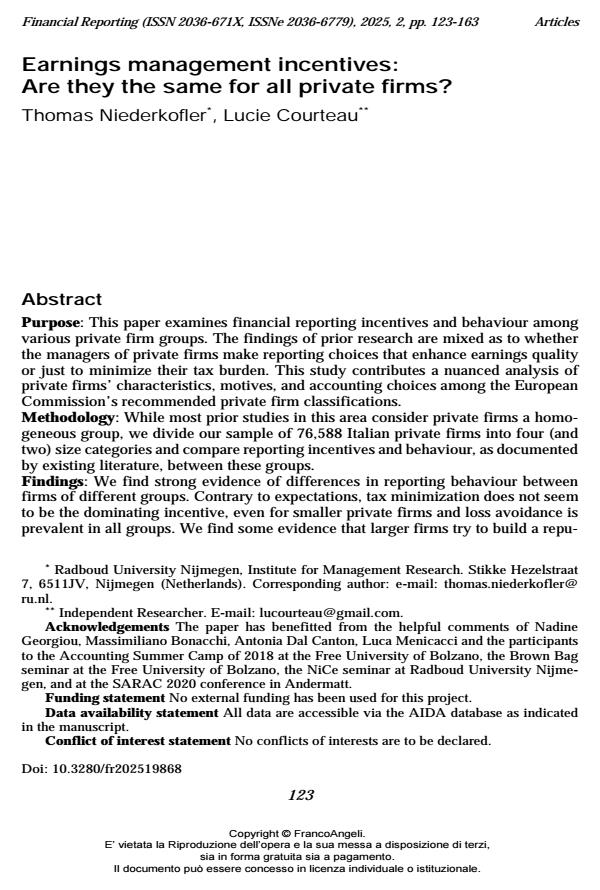
Purpose: This paper examines financial reporting incentives and behaviour among various private firm groups. The findings of prior research are mixed as to whether the managers of private firms make reporting choices that enhance earnings quality or just to minimize their tax burden. This study contributes a nuanced analysis of private firms’ characteristics, motives, and accounting choices among the European Commission’s recommended private firm classifications. Methodology: While most prior studies in this area consider private firms a homo-geneous group, we divide our sample of 76,588 Italian private firms into four (and two) size categories and compare reporting incentives and behaviour, as documented by existing literature, between these groups. Findings: We find strong evidence of differences in reporting behaviour between firms of different groups. Contrary to expectations, tax minimization does not seem to be the dominating incentive, even for smaller private firms and loss avoidance is prevalent in all groups. We find some evidence that larger firms try to build a reputation to respond to the demand for reporting quality from short-term creditors and minority shareholders but the pressure from long-term debt providers seems to mo-tivate managers to engage in opportunistic earnings management. We also find that smaller firms exhibit a more opportunistic reporting behaviour, although stakeholder pressures seem to affect them to a lower degree. Originality/value: These findings suggest that the diversity of private firms’ char-acteristics and incentives should be taken into consideration in future research on private firms. In other words, earnings management incentives differ notably be-tween private firms.
Parole chiave:earnings management, earnings quality, private firms, stakeholder de-mands, Italy
Jel codes:C1, K2, M4
- Atwood, T., Drake, M., Myers, J., & Myers, L. (2012). Home Country Tax System Characteristics and Corporate Tax Avoidance: International Evidence. The Ac-counting Review, 87(6), 1831-1860.
- Ball, R., & and Shivakumar, L. (2005). Earnings quality in UK private firms: com-parative loss recognition timeliness. Journal of Accounting and Economics, 39(1), 83-128.
- Ball, R., & Shivakumar, L. (2006). The Role of Accruals in Asymmetrically Timely Gain and Loss Recognition. Journal of Accounting Research, 44(2), 207-242.
- Ball, R., Kothari, S., & Robin, A. (2000). The effect of international institutional factors on properties of accounting earnings. Journal of Accounting and Eco-nomics, 29(1), 1-51. DOI: 10.1016/S0165-4101(01)00007-6
- Beatty, A., & Harris, D. (1999). The effects of taxes, agency costs and information asymmetry on earnings management: A comparison of public and private firms. Review of Accounting Studies, 4(3), 299-326. DOI: 10.1023/A:1009642403312
- Beatty, A., Ke, B., & Petroni, K. (2002). Earnings management to avoid earnings declines across publicly and privately held banks. The Accounting Review, 77(3), 547-570.
- Bernard, D., Burgstahler, D., & Kaya, D. (2018). Size management by European private firms to minimize proprietary costs of disclosure. Journal of Accounting and Economics, 66(1), 94-122.
- Berzins, J., Øyvind, B., & PåL, R. (2008). Corporate Finance and Governance in Firms with limited liability: Basic characteristics. Research Report No. 1, Centre for Corporate Governance Research, Norwegian Business School.
- Beuselinck, C., Elfers, F., Gassen, J., & Pierk, J. (2023). Private firm accounting: the European reporting environment, data and research perspectives. Accounting and Business Research. DOI: 10.1080/00014788.2021.1982670
- Bigus, J., & Hillebrand, C. (2017). Bank Relationships and Private Firms’ Financial Reporting Quality. European Accounting Review, 26(2), 379-409, DOI: 10.1080/09638180.2016.1152906
- Bigus, J., Georgiou, N., & Schorn, P. (2016). Legal Form and Earnings Properties. European Accounting Review, 25(3), 515-548. DOI: 10.1080/09638180.2015.1051566
- Blaylock, B., Gaertner, F., & Shevlin, T. (2015). Book-Tax Conformity and Capital Structure. Review of Accounting Studies, 20(1), 141-172.
- Bonacchi, M., Marra, A., & Zarowin, P. (2019). Organizational structure and earn-ings quality of private and public firms. Review of Accounting Studies. 24.
- Bonacchi, M., Cipollini, F., & Zarowin, P. (2018). Parents’ use of subsidiaries to “push down” earnings management: Evidence from Italy. Contemporary Ac-counting Research, 35(3), 1332-1362. DOI: 10.1111/1911-3846.1233
- Bowen, R., DuCharme, L., & Shores D. (1995). Stakeholders’ implicit claims and accounting method choice. Journal of Accounting and Economics, 20(3), 255-295.
- Breuer, M. (2021). How does financial-reporting regulation affect industry-wide re-source allocation?. Journal of Accounting Research, 59(1), 59-110.
- Burgstahler, D., Hail, L., & Leuz, C. (2006). The Importance of Reporting Incen-tives: EM in European Private and Public Firms. The Accounting Review, 81(5), 983-1016.
- Chen, W. E. I., Hribar, P., & Melessa, S. (2018). Incorrect inferences when using residuals as dependent variables. Journal of Accounting Research, 56(3), 751-796. DOI: 10.1111/1475-679X.12195
- CNA Interpreta (2011). Study on Accounting Requirements for SMEs: Final Report. European Commission, Brussels.
- Cole, R., & Wolken, J. (1995). Financial Services Used by Small Businesses: Evi-dence from the 1993 National Survey of Small Business Finances. Federal Re-serve Bulletin, 81(7), 629-667.
- Coppens, L., & Peek, E. (2005). An analysis of EM by European private firms. Jour-nal of International Accounting, Auditing and Taxation, 14, 1-17.
- Dechow, P., Richardson, S., & Tuna, I. (2003). Why are earnings kinky? An exam-ination of the earnings management explanation. Review of Accounting Studies, 8(2-3), 355-384. DOI: 10.1023/A:1024481916719
- Dechow, P., Sloan, R., & Sweeney, A. (1995). Detecting Earnings Management. The Accounting Review, 70(2), 193-225.
- Dedman, E., Kausar, A., & Lennox, C. (2013). The Demand for Audit in Private Firms: Recent Large-Sample Evidence from the UK. European Accounting Re-view, 23(1), 1-23. DOI: 10.1080/09638180.2013.776298
- European Union Commission (2003). Commission Recommendation of 6 May 2003 concerning the definition of micro, small and medium-sized enterprises. Com-mission Recommendation 2003/361/EC.
- European Union Commission (2020). User guide to the SME Definition Luxem-bourg: Publications Office of the European Union.
- Fama, E., & Jensen, M. (1983). Separation of Ownership and Control. The Journal of Law and Economics, 26(2), 301-325.
- Gassen, J., Fülbier, R., & Sellhorn, T. (2006). International Differences in Condi-tional Conservatism – The Role of Unconditional Conservatism and Income Smoothing. European Accounting Review, 15, 527-564.
- Gassen, J., & Fülbier, R. (2015). Do Creditors Prefer Smooth Earnings? Evidence from European Private Firms. Journal of International Accounting Research, 14(2), 151-180.
- Gilliam, T., Heflin, F., & Paterson, J. (2015). Evidence that the zero-earnings dis-continuity has disappeared. Journal of Accounting and Economics, 60, 117-132.
- Giunta, F. (2014). Detecting Earnings Manipulations: Time think about european SMEs. A call for a Joint International Research Project. Financial Reporting, 2-3-4, 5-15. DOI: 10.3280/FR2014-002001
- Givoly, D., Hayn, C., & Katz, S. (2010). Does public ownership of equity improve earnings quality?. The Accounting Review, 85(1), 195-225.
- Gunny, K. (2010). The Relation Between Earnings Management Using Real Activ-ities Manipulation and Future Performance: Evidence from Meeting Earnings Benchmarks. Contemporary Accounting Research, 27, 855-888.
- Haapamäki, E. (2018). Voluntary Auditing: A Synthesis of the Literature. Account-ing in Europe, 15(1), 81-104. DOI: 10.1080/17449480.2018.1430369
- Healy, P., & Wahlen, J. (1999). A Review of the EM Literature and Its Implications for Standard Setting. Accounting Horizons, 13(4), 365-383.
- Herrmann, D., & Inoue, T. (1996). Income smoothing and incentives by operating condition: An empirical test using depreciation changes in Japan. Journal of In-ternational Accounting, Auditing and Taxation, 5(2), 161-177. DOI: 10.1016/S1061-9518(96)90003-8
- Hope, O., Thomas, W., & Vyas, D. (2017). Stakeholder demand for accounting qual-ity and economic usefulness of accounting in U.S. private firms. Journal of Ac-counting Public Policy, 36, 1-13.
- Hope, O., & Vyas, D. (2017). Private company finance and financial reporting. Ac-counting and Business Research, 47(5), 506-537. DOI: 10.1080/00014788.2017.1303963
- Jones, E. (2012). Italy’s sovereign debt crisis. Survival, 54(1), 83-110. DOI: 10.1080/00396338.2012.657545
- Jones, J. (1991). Earnings Management During Import Relief Investigations. Jour-nal of Accounting Research, 29(2), 193-228. DOI: 10.2307/2491047
- Lisowsky, P., & Minnis, M. (2020). The Silent majority: Private US firms and fi-nancial reporting choices. Journal of Accounting Research, 58(3), 547-588. DOI: 10.1111/1475-679X.12306
- Liu, S., & Skerratt, L. (2018). Earnings quality across different reporting regimes: Listed, large private, medium-sized, small and micro companies in the UK. Jour-nal of Applied Accounting Research, 19, 2-19. DOI: 10.1108/JAAR-02-2015-0009
- MacLeod, B. (2007). Reputations, relationships, and contract enforcement. Journal of economic literature, 45(3), 595-628.
- Markarian, G., Pozza, L., & Prencipe, A. (2008). Capitalization of R&D costs and earnings management: Evidence from Italian listed companies. The International Journal of Accounting, 43(3), 246-267.
- Nobili, V., & Mafrolla, E. (2017). Discretionary accruals in Italian private firms and non-linear bank loan granting. Financial reporting, 1, 83-99.
- Peek, E., Cuijpers, R., & Buijink, W. (2010). Creditors’ and Shareholders’ Reporting Demands in Public Versus Private Firms: Evidence from Europe. Contemporary Accounting Research, 27(1), 49-91.
- Prencipe, A., Markarian, G., & Pozza, L. (2008). Earnings management in family firms: Evidence from R&D cost capitalization in Italy. Family Business Review, 21(1), 71-88.
- Roychowdhury, S. (2006). Earnings management through real activities manipula-tion. Journal of Accounting and Economics, 42(3), 335-370. DOI: 10.13140/RG.2.2.29089.97129
- Silverman, B. (1986). Density Estimation for Statistics and Data Analysis. Ohio: CRC Press. DOI: 10.1201/9781315140919
- Tang, T. (2015). Does Book-Tax Conformity Deter Opportunistic Book and Tax Reporting? An International Analysis. European Accounting Review, 24(3), 441-469. DOI: 10.1080/09638180.2014.932297
- Tucker, J., & Zarowin, P. (2006). Does Income Smoothing Improves Earnings In-formativeness? The Accounting Review, 81(1), 251-270.
- Vanstraelen, A., & Schelleman, C. (2017). Auditing private companies: what do we know? Accounting and Business Research, 47(5), 565-584. DOI: 10.1080/00014788.2017.1314104
- Vera, D., & Onji, K. (2010). Changes in the banking system and small business lending. Small Business Economics, 34(3), 293-308.
- Vorst, P. (2016). Real Earnings Management and Long-Term Operating Perfor-mance: The Role of Reversals in Discretionary Investment Cuts. Accounting Re-view, 91(4), 1219-1256.
Thomas Niederkofler, Lucie Courteau, Earnings management incentives: Are they the same for all private firms? in "FINANCIAL REPORTING" 2/2025, pp 123-163, DOI: 10.3280/fr202519868