Ownership structure and financial default risk in Italian private firms
Titolo Rivista FINANCIAL REPORTING
Autori/Curatori Velia Gabriella Cenciarelli
Anno di pubblicazione 2025 Fascicolo 2025/2
Lingua Inglese Numero pagine 28 P. 165-192 Dimensione file 247 KB
DOI 10.3280/fr202520028
Il DOI è il codice a barre della proprietà intellettuale: per saperne di più
clicca qui
Qui sotto puoi vedere in anteprima la prima pagina di questo articolo.
Se questo articolo ti interessa, lo puoi acquistare (e scaricare in formato pdf) seguendo le facili indicazioni per acquistare il download credit. Acquista Download Credits per scaricare questo Articolo in formato PDF
FrancoAngeli è membro della Publishers International Linking Association, Inc (PILA), associazione indipendente e non profit per facilitare (attraverso i servizi tecnologici implementati da CrossRef.org) l’accesso degli studiosi ai contenuti digitali nelle pubblicazioni professionali e scientifiche.
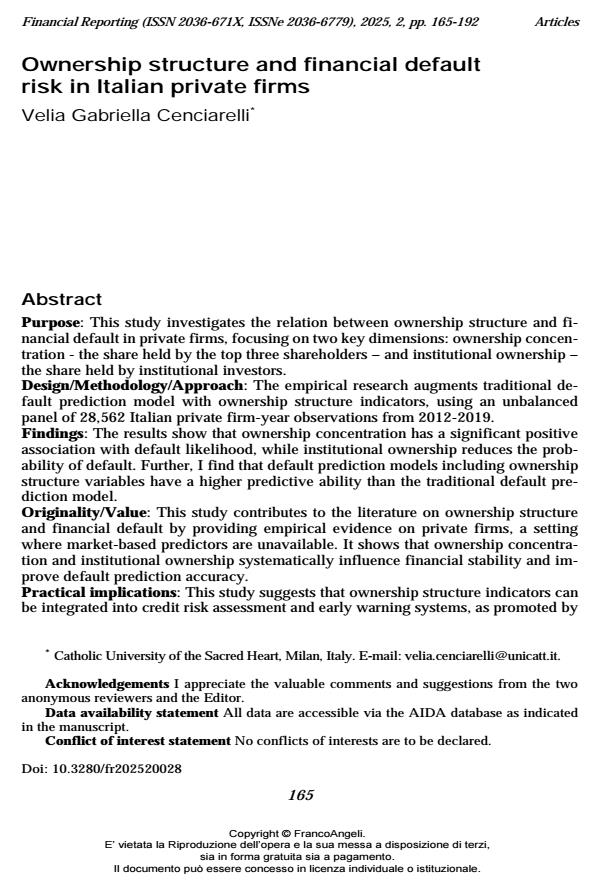
Purpose: This study investigates the relation between ownership structure and fi-nancial default in private firms, focusing on two key dimensions: ownership concen-tration - the share held by the top three shareholders – and institutional ownership – the share held by institutional investors. Design/Methodology/Approach: The empirical research augments traditional de-fault prediction model with ownership structure indicators, using an unbalanced panel of 28,562 Italian private firm-year observations from 2012-2019. Findings: The results show that ownership concentration has a significant positive association with default likelihood, while institutional ownership reduces the prob-ability of default. Further, I find that default prediction models including ownership structure variables have a higher predictive ability than the traditional default pre-diction model. Originality/Value: This study contributes to the literature on ownership structure and financial default by providing empirical evidence on private firms, a setting where market-based predictors are unavailable. It shows that ownership concentra-tion and institutional ownership systematically influence financial stability and im-prove default prediction accuracy. Practical implications: This study suggests that ownership structure indicators can be integrated into credit risk assessment and early warning systems, as promoted by recent European Union insolvency frameworks, to strengthen monitoring of finan-cially distressed private firms.
Parole chiave:ownership structure, ownership concentration, institutional ownership, bankruptcy risk, private firms
Jel codes:G2, G3, M2, M4
- Agarwal, V., & Taffler, R. (2008). Comparing the performance of market-based and accounting-based bankruptcy prediction models. Journal of Banking and Fi-nance, 32(8), 1541-1551.
- Altman, E. I. (1968). Financial ratios, discriminant analysis and the prediction of corporate bankruptcy. The Journal of Finance, 23(4), 589-609.
- Altman, E. I., & Hotchkiss, E. (2010). Corporate financial distress and bankruptcy: Predict and avoid bankruptcy, analyze and invest in distressed debt (Vol. 289). John Wiley & Sons.
- Altman, E. I., Iwanicz-Drozdowska, M., Laitinen, E. K., & Suvas, A. (2015). Finan-cial and non-financial variables as long-horizon predictors of bankruptcy. Available at SSRN 2669668.
- An, H., & Zhang, T. (2013). Stock price synchronicity, crash risk, and institutional investors. Journal of Corporate Finance, 21, 1-15.
- Arellano, M., & Bond, S. (1991). Some tests of specification for panel data: Monte Carlo evidence and an application to employment equations. The Review of Eco-nomic Studies, 58(2), 277-297.
- Arellano, M., & Bover, O. (1995). Another look at the instrumental variable estima-tion of error-components models. Journal of Econometrics, 68(1), 29-51. DOI: 10.1016/0304-4076(94)01642-D
- Barry, T. A., Lepetit, L., & Tarazi, A. (2011). Ownership structure and risk in pub-licly held and privately owned banks. Journal of Banking & Finance, 35(5), 1327-1340.
- Beaver, W. H., Cascino, S., Correia, M. M., & McNichols, M. F. (2019). Group affiliation and default prediction. Management Science, 65(8), 3559-3584.
- Beaver, W. H., Correia, M., & McNichols, M. F. (2012). Do differences in financial reporting attributes impair the predictive ability of financial ratios for bank-ruptcy?. Review of Accounting Studies, 17(4), 969-1010.
- Beck, T., Demirgüç-Kunt, A., & Maksimovic, V. (2008). Financing patterns around the world: Are small firms different?. Journal of Financial Economics, 89(3), 467-487.
- Bellovary, J. L., Giacomino, D. E., & Akers, M. D. (2007). A review of bankruptcy prediction studies: 1930 to present. Journal of Financial Education, 1-42. --https://www.jstor.org/stable/41948574.
- Ben-Amar, W., & André, P. (2006). Separation of ownership from control and ac-quiring firm performance: The case of family ownership in Canada. Journal of Business Finance & Accounting, 33(3-4), 517-543.
- Benmelech, E., Garmaise, M. J., & Moskowitz, T. J. (2005). Do liquidation values affect financial contracts? Evidence from commercial loan contracts and zoning regulation. Quarterly Journal of Economics, 120(3), 1121-1154. DOI: 10.1162/003355305774268200
- Bhagat, S., & Bolton, B. (2019). Corporate governance and firm performance: The sequel. Journal of Corporate Finance, 58, 142-168.
- Blundell, R., & Bond, S. (1998). Initial conditions and moment restrictions in dy-namic panel data models. Journal of Econometrics, 87(1), 115-143. DOI: 10.1016/S0304-4076(98)00009-8
- Blundell, R., & Bond, S. (2000). GMM estimation with persistent panel data: An application to production functions. Econometric Reviews, 19(3), 321-340. DOI: 10.1080/07474930008800475
- Boone, A. L., & White, J. T. (2015). The effect of institutional ownership on firm transparency and information production. Journal of Financial Economics, 117(3), 508-533.
- Boubakri, N., & Ghouma, H. (2010). Control/ownership structure, creditor rights protection, and the cost of debt financing: International evidence. Journal of Banking & Finance, 34(10), 2481-2499.
- Bushman, R. M., & Smith, A. J. (2001). Financial accounting information and cor-porate governance. Journal of Accounting and Economics, 32(1-3), 237-333. DOI: 10.1016/S0165-4101(01)00027-1
- Camacho-Miñano, M. D. M., Segovia-Vargas, M. J., & Pascual-Ezama, D. (2015). Which characteristics predict the survival of insolvent firms? An SME reorgani-zation prediction model. Journal of Small Business Management, 53(2): 340-354 Campbell, J. Y., Hilscher, J., & Szilagyi, J. (2008). In search of distress risk. The Journal of Finance, 63(6), 2899-2939.
- Cassar, G. (2011). Discussion of the value of financial statement verification in debt financing: Evidence from private US firms. Journal of Accounting Research, 49(2), 507-528.
- Chen, X. C., & Yur-Austin, J. (2007). Re-measuring agency costs: The effectiveness of blockholders. The Quarterly Review of Economics and Finance, 47(5), 588-601.
- Chen, G., Firth, M., & Xu, L. (2009). Does the type of ownership control matter? Evidence from China’s listed companies. Journal of Banking & Finance, 33(1), 171-181.
- Chen, W. E. I., Hribar, P., & Melessa, S. (2018). Incorrect inferences when using residuals as dependent variables. Journal of Accounting Research, 56(3), 751-796.
- Chiang, H.-T., Lin, M.-C., & Lin, P. (2013). The relationship between ownership structure and financial distress: Evidence from Taiwan’s listed firms. Emerging Markets Finance and Trade, 49(3), 20-32.
- Chung, K. H., & Zhang, H. (2011). Corporate governance and institutional owner-ship. Journal of Financial and Quantitative Analysis, 46(1), 247-273.
- Ciampi, F., Cillo, V., & Fiano, F. (2020). Combining Kohonen maps and prior pay-ment behavior for small enterprise default prediction. Small Business Economics, 54(4), 1007-1039.
- Cull, R., & Xu, L. C. (2005). Institutions, ownership, and finance: The determinants of profit reinvestment among Chinese firms. Journal of Financial Economics, 77(1), 117-146.
- Deman, R., Jorissen, A., & Laveren, E. (2018). Board monitoring in a privately held firm: When does CEO duality matter? The moderating effect of ownership. Jour-nal of Small Business Management, 56(2), 229-250
- Duffie, D., Saita, L., & Wang, K. (2007). Multi-period corporate default prediction with stochastic covariates. Journal of Financial Economics, 83(3), 635-665.
- Efretuei, E. (2025). International Financial Reporting Standards and sales manipu-lation in failed firms. Financial Reporting, 1.
- Eugster, N. (2019). Large blockholders and stock price crash risk. Available at SSRN 3428929.
- European Union (2014). Commission. Recommendation on a new approach to busi-ness failure and insolvency. -- https://eur-lex.europa.eu/legal-con-tent/EN/TXT/PDF/?uri=CELEX:32014H0135.
- Eurostat (2021). Non-financial corporations – Statistics on financial assets and lia-bilities. https://ec.europa.eu/eurostat/statistics-explained/index.php?title=Non-financial_corporations_statistics_on_financial_assets_and_liabilities.
- Ferrari, E., Garelli, R., Limon, A., Piazza, A., Simoni, L., & Verda, D. (2025). Early warning detection using Logic Learning Machine: Evidence from private firms. Financial Reporting, 1.
- Ferreira, M. A., & Matos, P. (2008). The colors of investors’ money: The role of institutional investors around the world. Journal of Financial Economics, 88(3), 499-533.
- ISTAT (2015). ATECO classification of industries. https://www.istat.it/it/ar-chivio/17888.
- ISTAT (2019). The financial wealth of Italian families and non-financial firms. --https://www.istat.it/it/archivio/230262.
- Jensen, T. L., Lando, D., & Medhat, M. (2016). Cyclicality and Firm-Size in Private Firm Defaults. Working paper.
- Jiang, F., & Kim, K. A. (2020). Corporate governance in China: A survey. Review of Finance, 24(4), 733-772.
- Jiang, W., & Kim, K. A. (2020). Corporate governance in the U.S.: Evidence from institutional investors. Journal of Accounting and Economics, 70(1), 101285.
- Jones, S., & Hensher, D. A. (2004). Predicting firm financial distress: A mixed logit model. The Accounting Review, 79(4), 1011-1038.
- La Porta, R., Lopez-de-Silanes, F., & Shleifer, A. (1999). Corporate ownership around the world. The Journal of Finance, 54(2), 471-517.
- Lewellen, J., & Lewellen, K. (2022). Institutional investors and corporate govern-ance: The incentive to be engaged. The Journal of Finance, 77(1), 213-264.
- Li, K., Lockwood, J., & Miao, H. (2017). Risk-shifting, equity risk, and the distress puzzle. Journal of Corporate Finance, 44, 275-288.
- Lin, C., Ma, Y., Malatesta, P., & Xuan, Y. (2011). Ownership structure and the cost of corporate borrowing. Journal of Financial Economics, 100(1), 1-23.
- Minnis, M. (2011). The value of financial statement verification in debt financing: Evidence from private US firms. Journal of Accounting Research, 49(2), 457-506.
- Nguyen, D. T. T., Diaz-Rainey, I., Roberts, H., & Le, M. (2021). Loans from my neighbours: East Asian commercial banks, financial integration, and bank default risk. International Review of Financial Analysis, 74, 101659.
- Ohlson, J. A. (1980). Financial ratios and the probabilistic prediction of bankruptcy. Journal of Accounting Research, 18(1), 109-131. DOI: 10.2307/2490395
- Ortiz-Molina, H., & Phillips, G. M. (2014). Real asset illiquidity and the cost of capital. Journal of Financial and Quantitative Analysis, 49(1), 1-32. DOI: 10.1017/S0022109014000210
- Platt, H. D., & Platt, M. B. (2002). Predicting corporate financial distress: Reflec-tions on choice-based sample bias. Journal of Economics and Finance, 26(2), 184-199.
- Raoli, E., & Daniele, M. (2024). Early Warning Systems for financial crises predic-tion in private companies: Evidence from the Italian context. Financial repor-ting: bilancio, controlli e comunicazione d’azienda, 2, 133-161.
- Robinson, D. T. (2009). Size, ownership and the market for corporate control. Jour-nal of Corporate Finance, 15(1), 80-84.
- Sánchez-Ballesta, J. P., & García-Meca, E. (2011). Ownership structure and the cost of debt. European Accounting Review, 20(2), 389-416.
- Sargan, J. D. (1958). The estimation of economic relationships using instrumental variables. Econometrica, 26(3), 393-415. DOI: 10.2307/1907619
- Schulze, W. S., Lubatkin, M. H., Dino, R. N., & Buchholtz, A. K. (2001). Agency relationships in family firms: Theory and evidence. Organization Science, 12(2), 99-116.
- Shleifer, A., & Vishny, R. W. (1997). A survey of corporate governance. The Jour-nal of Finance, 52(2), 737-783.
- Switzer, L. N., Tu, Q., & Wang, J. (2018). Corporate governance and default risk in financial firms over the post-financial crisis period: International evidence. Jour-nal of International Financial Markets, Institutions and Money, 52, 196-210.
- Villalonga, B., & Amit, R. (2006). How do family ownership, control and manage-ment affect firm value?. Journal of Financial Economics, 80(2), 385-417.
- World Bank (2021). SMEs finance. -- https://www.worldbank.org/en/topic/sme-finance.
- Zmijewski, M. E. (1984). Methodological issues related to the estimation of finan-cial distress prediction models. Journal of Accounting Research, 22, 59-82.
Velia Gabriella Cenciarelli, Ownership structure and financial default risk in Italian private firms in "FINANCIAL REPORTING" 2/2025, pp 165-192, DOI: 10.3280/fr202520028