Auditor choice in private firms: Evidence from first-time mandatory appointments in Italy
Titolo Rivista FINANCIAL REPORTING
Autori/Curatori Mara Cameran, Mario Daniele, Angela Pettinicchio
Anno di pubblicazione 2025 Fascicolo 2025/2
Lingua Inglese Numero pagine 28 P. 193-220 Dimensione file 195 KB
DOI 10.3280/fr202519853
Il DOI è il codice a barre della proprietà intellettuale: per saperne di più
clicca qui
Qui sotto puoi vedere in anteprima la prima pagina di questo articolo.
Se questo articolo ti interessa, lo puoi acquistare (e scaricare in formato pdf) seguendo le facili indicazioni per acquistare il download credit. Acquista Download Credits per scaricare questo Articolo in formato PDF
FrancoAngeli è membro della Publishers International Linking Association, Inc (PILA), associazione indipendente e non profit per facilitare (attraverso i servizi tecnologici implementati da CrossRef.org) l’accesso degli studiosi ai contenuti digitali nelle pubblicazioni professionali e scientifiche.
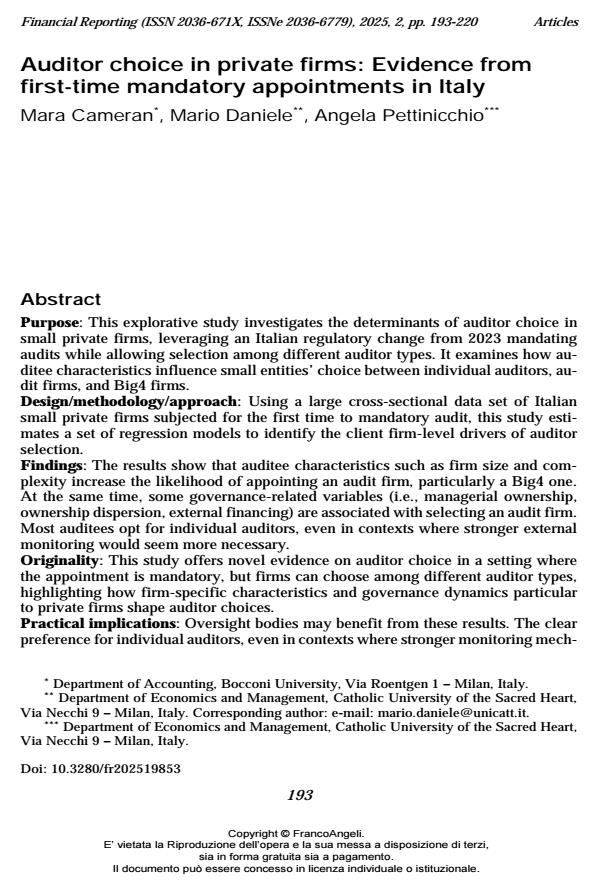
Purpose: This explorative study investigates the determinants of auditor choice in small private firms, leveraging an Italian regulatory change from 2023 mandating audits while allowing selection among different auditor types. It examines how au-ditee characteristics influence small entities’ choice between individual auditors, au-dit firms, and Big4 firms. Design/methodology/approach: Using a large cross-sectional data set of Italian small private firms subjected for the first time to mandatory audit, this study esti-mates a set of regression models to identify the client firm-level drivers of auditor selection. Findings: The results show that auditee characteristics such as firm size and com-plexity increase the likelihood of appointing an audit firm, particularly a Big4 one. At the same time, some governance-related variables (i.e., managerial ownership, ownership dispersion, external financing) are associated with selecting an audit firm. Most auditees opt for individual auditors, even in contexts where stronger external monitoring would seem more necessary. Originality: This study offers novel evidence on auditor choice in a setting where the appointment is mandatory, but firms can choose among different auditor types, highlighting how firm-specific characteristics and governance dynamics particular to private firms shape auditor choices. Practical implications: Oversight bodies may benefit from these results. The clear preference for individual auditors, even in contexts where stronger monitoring mechanisms could help in coping with agency problems, suggests that maintaining con-sistent quality standards across the market is important. Robust public oversight mechanisms applying uniformly to all auditors are essential to ensure audit quality and strengthen stakeholder confidence.
Parole chiave:auditor choice, private firms, mandatory audit, corporate governance, audit quality
Jel codes:M42, G32, K20
- Altman, E. I., Iwanicz-Drozdowska, M., Laitinen, E. K., & Suvas, A. (2017). Finan-cial distress prediction in an international context: A review and empirical anal-ysis of Altman’s Z-Score model. Journal of International. Financial Manage-ment and Accounting, 28, 131-171.
- Bellavite Pellegrini, C., Sironi, E., & Pellegrini, L. (2009). Le motivazioni dell’affi-damento volontario del controllo contabile al Collegio Sindacale o al revisore esterno nelle società per azioni non quotate in Italia: un'indagine empirica. Rivi-sta delle Società, 54(1), 181-210.
- Beuselinck, C., Elfers, F., Gassen, J., & Pierk, J. (2021). Private firm accounting: the European reporting environment, data and research perspectives. Accounting and Business Research, 53(1), 38-82. DOI: 10.1080/00014788.2021.1982670
- Bianchi, P. A. (2017). Auditors’ joint engagements and audit quality: Evidence from Italian private companies. Contemporary Accounting Research, 35(3), 1533-1577. DOI: 10.1111/1911-3846.12327
- Breesch, D., & Branson, J. (2009). The effects of auditor gender on audit quality. IUP Journal of Accounting Research & Audit Practices, 8(3), 78-107. --https://www.proquest.com/scholarly-journals/effects-auditor-gender-on-audit-quality/docview/888521555/se-2.
- Broye, G., & Weill, L. (2008). Does leverage influence auditor choice? A cross-country analysis. Applied Financial Economics, 18(9), 715-731. DOI: 10.1080/09603100701222325
- Buchetti, B., Parbonetti, A., & Pugliese, A. (2022). Covid-19, corporate survival and public policy: The role of accounting information and regulation in the wake of a systemic crisis. Journal of Accounting and Public Policy, 41(1), 106919.
- Cameran, M., & Prencipe, A. (2011). Qualità della revisione contabile e tipo di revi-sore. Il caso delle società italiane non quotate. Economia & Management, (1).
- Cano Rodríguez, M., & Sánchez Alegría, S. (2012). The value of audit quality in public and private companies: Evidence from Spain. Journal of Management & Governance, 16, 683-706.
- Carey, P., Knechel, W. R., & Tanewski, G. (2013). Costs and benefits of mandatory auditing of for-profit private and not-for-profit companies in Australia. Austral-ian Accounting Review, 23(1), 43-53.
- Collis, J. (2012). Determinants of voluntary audit and voluntary full accounts in mi-cro- and non-micro small companies in the UK. Accounting and Business Re-search, 42(4), 441-468. DOI: 10.1080/00014788.2012.667969
- Corten, M., Steijvers, T., & Lybaert, N. (2018). Auditor choice in private firms: A stakeholders perspective. Managerial Auditing Journal, 33(2), 146-170. DOI: 10.1108/MAJ-03-2017-1535
- DeAngelo, L. E. (1981). Auditor size and audit quality. Journal of Accounting and Economics, 3(3), 183-199.
- Dedman, E., & Kausar, A. (2012). The impact of voluntary audit on credit ratings: Evidence from UK private firms. Accounting and Business Research, 42(4), 397-418. DOI: 10.1080/00014788.2012.653761
- Di Pietra, R. (2017). The role and current status of IFRS in the completion of national accounting rules – Evidence from Italy. Accounting in Europe, 14(1-2), 121-130. DOI: 10.1080/17449480.2017.1302593
- Dyreng, S. D., Hanlon, M., & Maydew, E. L. (2008). Long-Run Corporate Tax Avoidance. The Accounting Review, 83(1), 61-82.
- Dong, T., Tylaite, M., & Wilson, R. (2022). Voluntary vs. mandatory: The role of auditing in constraining corporate tax avoidance in small private firms. Account-ing and Business Research, 53(7), 723-755. DOI: 10.1080/00014788.2022.2063105
- Duh, R., Knechel, W. R., & Lin, C. (2020). The effects of audit firms' knowledge sharing on audit quality and efficiency. Auditing: A Journal of Practice & The-ory, 39(2), 51-79.
- European Union (2013). Directive 2013/34/EU of the European Parliament and of the Council of 26 June 2013 on the annual financial statements, consolidated financial statements and related reports of certain types of undertakings, amend-ing Directive 2006/43/EC of the European Parliament and of the Council and repealing Council Directives 78/660/EEC and 83/349/EEC Official Journal of the European Union, L 182, 19-76. https://eur-lex.europa.eu/eli/dir/2013/ 34/oj/eng.
- European Union (2014). Directive 2014/56/EU of the European Parliament and of the Council of 16 April 2014 amending Directive 2006/43/EC on statutory audits of annual accounts and consolidated accounts. Official Journal of the European Union, L 158, 196-226. -- https://eur-lex.europa.eu/eli/dir/2014/56/oj/eng.
- Fan, J. P. H., & Wong, T. J. (2005). Do external auditors perform a corporate gov-ernance role in emerging markets? Evidence from East Asia. Journal of Account-ing Research, 43(1), 35-72.
- Fang, J., Pittman, J., Zhang, Y., & Zhao, Y. (2017). Auditor choice and its implica-tions for group-affiliated firms. Contemporary Accounting Research, 34(1), 39-82. DOI: 10.1111/1911-3846.12276
- Fasano, F., & Deloof, M. (2021). Local financial development and cash holdings in Italian SMEs. International Small Business Journal: Researching Entrepreneur-ship, 39(8), 781-799. DOI: 10.1177/02662426211011554
- Francis, J. R., Khurana, I. K., Martin, X., & Pereira, R. (2011). The relative im-portance of firm incentives versus country factors in the demand for assurance services by private entities. Contemporary Accounting Research, 28(2), 487-516.
- Francis, J. R., Richard, C., & Vanstraelen, A. (2009). Assessing France's joint audit requirement: Are two heads better than one?. Auditing: A Journal of Practice & Theory, 28(2), 35-63.
- Gul, F., Wu, D., & Yang, Z. (2013). Do individual auditors affect audit quality? Evidence from archival data. The Accounting Review, 88(6): 1993-2023.
- Habib, A., Wu, J., Bhuiyan, Md. B. U., & Sun, X. (Sean) (2019). Determinants of auditor choice: Review of the empirical literature. International Journal of Au-diting, 23(2), 308-335.
- Hainmueller, J. (2012). Entropy balancing for causal effects: A multivariate re-weighting method to produce balanced samples in observational studies. Politi-cal Analysis, 20(1), 25-46.
- Hardies, K., Breesch, D., & Branson, J. (2012). Male and female auditors’ overcon-fidence. Managerial Auditing Journal, 27(1), 105-118. DOI: 10.1108/02686901211186126
- Hay, D., & Davis, D. (2004). The voluntary choice of an audit of any level of quality. Auditing: A Journal of Practice & Theory, 23(2), 37-53.
- Hsu, W.-Y., Troy, C., & Huang, Y. (Rebecca). (2015). The determinants of auditor choice and audit pricing among property-liability insurers. Journal of Accounting and Public Policy, 34(1), 95-124.
- Italian Ministry of Economy and Finance (2023). Analisi della Composizione degli Iscritti. -- https://revisionelegale.rgs.mef.gov.it/area-pubblica/export/mef/re-sources/PDF/Analisi_della_composizione_degli_iscritti_2023_25.01.2024.pdf.
- Italian Republic (2019). Decreto legislativo 12 gennaio 2019, n. 14. Gazzetta Uffi-ciale della Repubblica Italiana. https://www.gazzettaufficiale.it/eli/id/2019/ 02/14/19G00007/sg.
- Ittonen, K., & Peni, E. (2012). Auditor’s gender and audit fees. International Journal of Auditing, 16(1), 1-18.
- Kausar, A., Shroff, N., & White, H. (2016). Real effects of the audit choice. Journal of Accounting and Economics, 62(1), 157-181.
- Knechel, W. R., Niemi, L., & Sundgren, S. (2008). Determinants of auditor choice: Evidence from a small client market. International Journal of Auditing, 12(1), 65-88.
- Lennox, C. S. (2005). Managerial ownership and audit firm size. Contemporary Ac-counting Research, 22(1), 205-227. DOI: 10.1506/K2CG-U6V0-NPTC-EQBK
- Lennox, C. S., & Pittman, J. A. (2011). Voluntary audits versus mandatory audits. The Accounting Review, 86(5), 1655-1678.
- Minnis, M. (2011). The value of financial statement verification in debt financing: Evidence from private U.S. firms. Journal of Accounting Research, 49(2), 457-506.
- Niskanen, M., Karjalainen, J., & Niskanen, J. (2011). Demand for audit quality in private firms: Evidence on ownership effects. International Journal of Auditing, 15(1), 43-65.
- Pettinicchio, A. (2014). Rotazione obbligatoria revisore contabile. Un’indagine em-pirica del panorama italiano. Egea Editore.
- Sundgren, S., & Svanström, T. (2014). Auditor-in-charge characteristics and going-concern reporting. Contemporary Accounting Research, 31(2) 531-550. DOI: 10.1111/1911-3846.12035
- Titman, S., & Trueman, B. (1986). Information quality and the valuation of new issues. Journal of Accounting and Economics, 8(2), 159-172.
- Van Tendeloo, B., & Vanstraelen, A. (2008). Earnings management and audit qual-ity in Europe: Evidence from the private client segment market. European Ac-counting Review, 17(3), 447-469. Doi. 10.1080/09638180802016684.
- Vanstraelen, A., & Schelleman, C. (2017). Auditing private companies: what do we know?. Accounting and Business Research, 47(5), 565-584. DOI: 10.1080/00014788.2017.1314104
Mara Cameran, Mario Daniele, Angela Pettinicchio, Auditor choice in private firms: Evidence from first-time mandatory appointments in Italy in "FINANCIAL REPORTING" 2/2025, pp 193-220, DOI: 10.3280/fr202519853