Proximity and Financial Distress: Evidence from Debt Renegotiations in Italian SMEs
Titolo Rivista FINANCIAL REPORTING
Autori/Curatori Carlotta Magri, Federico Bertacchini, Gianluca Gabrielli
Anno di pubblicazione 2025 Fascicolo 2025/2
Lingua Inglese Numero pagine 28 P. 221-248 Dimensione file 266 KB
DOI 10.3280/fr202519806
Il DOI è il codice a barre della proprietà intellettuale: per saperne di più
clicca qui
Qui sotto puoi vedere in anteprima la prima pagina di questo articolo.
Se questo articolo ti interessa, lo puoi acquistare (e scaricare in formato pdf) seguendo le facili indicazioni per acquistare il download credit. Acquista Download Credits per scaricare questo Articolo in formato PDF
FrancoAngeli è membro della Publishers International Linking Association, Inc (PILA), associazione indipendente e non profit per facilitare (attraverso i servizi tecnologici implementati da CrossRef.org) l’accesso degli studiosi ai contenuti digitali nelle pubblicazioni professionali e scientifiche.
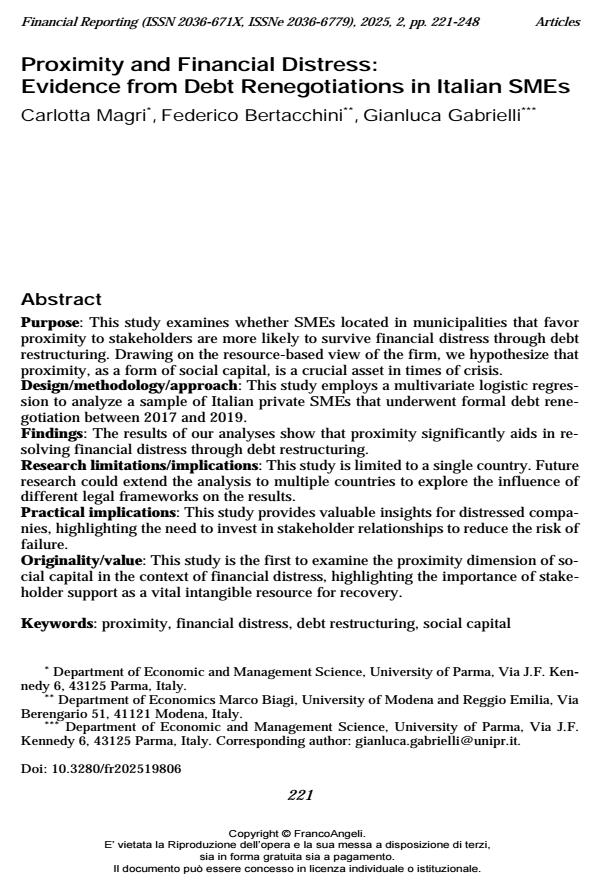
Purpose: This study examines whether SMEs located in municipalities that favor proximity to stakeholders are more likely to survive financial distress through debt restructuring. Drawing on the resource-based view of the firm, we hypothesize that proximity, as a form of social capital, is a crucial asset in times of crisis. Design/methodology/approach: This study employs a multivariate logistic regres-sion to analyze a sample of Italian private SMEs that underwent formal debt rene-gotiation between 2017 and 2019. Findings: The results of our analyses show that proximity significantly aids in re-solving financial distress through debt restructuring. Research limitations/implications: This study is limited to a single country. Future research could extend the analysis to multiple countries to explore the influence of different legal frameworks on the results. Practical implications: This study provides valuable insights for distressed compa-nies, highlighting the need to invest in stakeholder relationships to reduce the risk of failure. Originality/value: This study is the first to examine the proximity dimension of so-cial capital in the context of financial distress, highlighting the importance of stake-holder support as a vital intangible resource for recovery.
Parole chiave:proximity, financial distress, debt restructuring, social capital
Jel codes:M40, K20, R10
- Adjei, E. K., Eriksson, R. H., & Lindgren, U. (2016). Social proximity and firm performance: the importance of family member ties in workplaces. Regional Studies, Regional Science, 3(1), 303-319- DOI: 10.1080/21681376.2016.1189354
- Altman, E. I., & Hotchkiss, E. (2019). Corporate Financial Distress, Restructuring, and Bankruptcy: Analyze Leveraged Finance, Distressed Debt, and Bankruptcy. Fourth edition. Hoboken: Wiley.
- Amato, S., Basco, R., Gómez Ansón, S., & Lattanzi, N. (2020). Family-managed firms and employment growth during an economic downturn: does their location matter?. Baltic Journal of Management, 15(4), 607-630. DOI: 10.1108/BJM-07-2019-0260
- Amato, S., Patuelli, A., Basco, R., & Lattanzi, N. (2023). Family Firms Amidst the Global Financial Crisis: A Territorial Embeddedness Perspective on Downsiz-ing. Journal of Business Ethics, 183(1), 213-236.
- Appiah, K. O., & Amon, C. (2017). Board audit committee and corporate insol-vency. Journal of Applied Accounting Research, 18(3), 298-316. DOI: 10.1108/JAAR-03-2015-0024
- Arora, P. (2018). Financially Linked Independent Directors and Bankruptcy Reemergence: The Role of Director Effort. Journal of Management, 44(7), 2665-2689. DOI: 10.1177/0149206316648384
- Barney, J. B. (1991). Firm Resources and Sustained Competitive Advantage. Jour-nal of Management, 17(1), 99-120. DOI: 10.1177/014920639101700108
- Barniv, R., Agarwal, A., & Leach, R. (2002). Predicting Bankruptcy Resolution. Journal of Business Finance & Accounting, 29(3-4), 497-520. DOI: 10.1111/1468-5957.00440
- Baù, M., Chirico, F., Pittino, D., Backman, M., & Klaesson, J. (2019). Roots to Grow: Family Firms and Local Embeddedness in Rural and Urban Contexts. En-trepreneurship Theory and Practice, 43(2), 360-385. DOI: 10.1177/1042258718796089
- Bava, F., Cane, M., & Di Trana, M. G. (2020). Can a quantitative approach be miti-gated? Proposals for the application of the ‘early warnings’ required by the new Italian Insolvency Code. Financial Reporting, 2, 33-61. DOI: 10.3280/FR2020-002002
- Boschma, R. (2005). Proximity and Innovation: A Critical Assessment. Regional Studies, 39(1), 61-74. DOI: 10.1080/0034340052000320887
- Boschma, R., Frenken, K. (2010). The spatial evolution of innovation networks: a proximity perspective. In The handbook of evolutionary economic geography. Cheltenham: Edward Elgar.
- Bourdieu, P. (1986). The Forms of Capital. Handbook of Theory and Research for the Sociology of Education, 241-258. Westport: Greenwood.
- Camacho-Miñano, M., & Campa, D. (2014). Integrity of financial information as a determinant of the outcome of a bankruptcy procedure. International Review of Law and Economics, 37, 76-85,
- Campbell, S. V. (1996). Predicting Bankruptcy Reorganization for Closely Held Firms. Accounting Horizons, 10(3), 12-25.
- Carreira, C., Teixeira, P., & Nieto-Carrillo, E. (2022). Recovery and exit of zombie firms in Portugal. Small Business Economics, 59(2), 491-519.
- Carter, R., & Auken, H. V. (2006). Small Firm Bankruptcy. Journal of Small Busi-ness Management, 44(4), 493-512.
- Casey, C. J., McGee, V. E., & Stickney, C. P. (1986). Discriminating between Re-organized and Liquidated Firms in Bankruptcy. The Accounting Review, 61(2), 249-262.
- Cepec, J., Grajzl, P., & Zajc, K. (2017). Do liquidation trustee characteristics matter for firm liquidation outcomes? Evidence from Slovenia. Economic Systems, 41(4), 591-609.
- Chang, E. P. C., Memili, E., Chrisman, J. J., Kellermanns, F. W., & Chua, J. H. (2009). Family Social Capital, Venture Preparedness, and Start-Up Decisions: A Study of Hispanic Entrepreneurs in New England. Family Business Review, 22(3), 279-292. DOI: 10.1177/0894486509332327
- Chisholm, A. M., & Nielsen, K. (2009). Social Capital and the Resource-Based View of the Firm. International Studies of Management & Organization, 39(2), 7-32. DOI: 10.2753/IMO0020-8825390201
- Cocco, L. M., Cavezzali, E., Rigoni, U., & Simion, G. (2024). How does soft infor-mation on the causes of default affect debt renegotiation? The Italian evidence. Annals of Finance.
- Collett, N., Pandit, N. R., & Saarikko, J. (2014). Success and failure in turnaround attempts. An analysis of SMEs within the Finnish Restructuring of Enterprises Act. Entrepreneurship & Regional Development, 26(1-2), 123-141. DOI: 10.1080/08985626.2013.870236
- Cook, G. A. S., Pandit, N. R., & Milman, D. (2012). A resource-based analysis of bankruptcy law, SMEs and corporate recovery. International Small Business Journal: Researching Entrepreneurship, 30(3), 275-293. DOI: 10.1177/0266242611407409
- Cooke, P., Clifton, N., & Oleaga, M. (2005). Social capital, firm embeddedness and regional development. Regional Studies, 39(8), 1065-1077. DOI: 10.1080/00343400500328065
- Courrent, J., & Gundolf, K. (2009). Proximity and Micro-Enterprise Manager’s Eth-ics: A French Empirical Study of Responsible Business Attitudes. Journal of Business Ethics, 88(4), 749-762.
- Daniele, M., & Raoli, E. (2024). Early Warning Systems for financial crises predic-tion in private companies: Evidence from the Italian context. Financial Repor-ting, 2, 133-161. DOI: 10.3280/FR2024-002006
- Danovi, A., Giacomelli, S., Riva, P., & Rodano, G. (2018). Strumenti negoziali per la soluzione delle crisi d’impresa: il concordato preventivo. Roma: Banca d’Ita-lia.
- Decker, C. (2018). Stakeholders’ Impact on Turnaround Performance: The Case of German Savings Banks. Journal of Small Business Management, 56(4), 534-554.
- Denis, D. K., & Rodgers, K. J. (2007). Chapter 11: Duration, Outcome, and Post-Reorganization Performance. Journal of Financial and Quantitative Analysis, 42(1), 101-118. DOI: 10.1017/S0022109000002209
- Driscoll, C., Starik, M. (2004). The Primordial Stakeholder: Advancing the Concep-tual Consideration of Stakeholder Status for the Natural Environment. Journal of Business Ethics, 49(1), 55-73.
- Eggers, F. (2020). Masters of disasters? Challenges and opportunities for SMEs in times of crisis. Journal of Business Research, 116, 199-208.
- Elloumi, F., & Gueyié, J. (2001). Financial distress and corporate governance: an empirical analysis. Corporate Governance: The International Journal of Busi-ness in Society, 1(1), 15-23. DOI: 10.1108/14720700110389548
- Espinoza-Benavides, J., & Guerrero, M. (2024). Re-entrepreneurial experience and learning during challenging times. Small Business Economics.
- European Commission (2016). Study on a New Approach to Business Failure and Insolvency. Comparative Legal Analysis of the Member States’ Relevant Provi-sions and Practice.
- European Commission (2023). Entrepreneurship and small and medium-sized enter-prises (SMEs), available at: https://single-market-economy.ec.europa.eu/ smes_en.
- Fisher, T. C. G., Gavious, I., & Martel, J. (2019). Earnings Management in Chapter 11 Bankruptcy. Abacus, 55(2), 273-305.
- Fu, X., Fu, X., Ghauri, P., & Hou, J. (2022). International collaboration and innova-tion: Evidence from a leading Chinese multinational enterprise. Journal of World Business, 57(4), 101329.
- Gilson, S. C., John, K., Lang, L. H. P. (1990). Troubled debt restructurings: An em-pirical study of private reorganization of firms in default. Journal of Financial Economics, 27(2), 315-353. DOI: 10.1016/0304-405X(90)90059-9
- Godlewski, C. J. (2023). Language and private debt renegotiation. International Journal of Finance & Economics, ijfe.2907.
- Granovetter, M. (1985). Economic Action and Social Structure: The Problem of Em-beddedness. American Journal of Sociology, 91(3), 481-510.
- Halford, J. T., & Li, C. (2020). Political connections and debt restructurings. Journal of Corporate Finance, 65, 101497.
- Hansen, T. (2015). Substitution or Overlap? The Relations between Geographical and Non-spatial Proximity Dimensions in Collaborative Innovation Projects. Re-gional Studies, 49(10), 1672-1684. DOI: 10.1080/00343404.2013.873120
- Hotchkiss, E. S. (1995). Postbankruptcy Performance and Management Turnover. The Journal of Finance, 50(1), 3-21.
- Janis, I. L. (1972). Victims of groupthink: A psychological study of foreign-policy decisions and fiascoes. Boston: Houghton Mifflin.
- Jing, J., Leung, K., Ng, J., & Zhang, J. J. (2024). Fixing the Core, Earnings Manage-ment, and Sustainable Emergence From Financial Distress: Evidence From China’s Special Treatment System. Journal of Accounting, Auditing & Finance, 39(1), 107-132. DOI: 10.1177/0148558X211051169
- Kim, M., & Kim, M. (1999). A Note on the Determinants of the Outcomes of Bank-ruptcy Petitions: Evidence from Korea. Journal of Business Finance & Account-ing, 26(7-8), 997-1011. DOI: 10.1111/1468-5957.00283
- Lähdesmäki, M., Siltaoja, M., & Spence, L. J. (2019). Stakeholder Salience for Small Businesses: A Social Proximity Perspective. Journal of Business Ethics, 158(2), 373-385.
- Lefebvre, V. (2024). Layoffs in SMEs: The Role of Social Proximity. Journal of Business Ethics, 190(4), 801-820.
- Magri, C., & Marchini, P. L. (2024), “Audit quality and debt restructuring: evidence from Italy”, Managerial Auditing Journal, Vol. 39 No. 1, pp. 50-70, DOI: 10.1108/MAJ-01-2023-3794
- Malmberg, A., Maskell, P. (2006). Localized Learning Revisited. Growth and Change, 37(1), 1-18.
- Masiello, B., & Izzo, F. (2019). Interpersonal Social Networks and Internationaliza-tion of Traditional SMEs. Journal of Small Business Management, 57(sup2), 658-691.
- Mayr, S., Mitter, C., & Aichmayr, A. (2017). Corporate Crisis and Sustainable Re-organization: Evidence from Bankrupt Austrian SMEs: Corporate Crisis and Sustainable Reorganization: Evidence from Bankrupt Austrian SMEs. Journal of Small Business Management, 55(1), 108-127.
- Mehmood, A., & De Luca, F. (2023). Financial distress prediction in private firms: developing a model for troubled debt restructuring. Journal of Applied Account-ing Research. DOI: 10.1108/JAAR-12-2022-0325
- Melcarne, A., & Ramello, G. B. (2020). Bankruptcy delay and firms’ dynamics. Small Business Economics, 54(2), 405-419.
- Muttakin, M. B., Khan, A., Mihret, D. G. (2018). The Effect of Board Capital and CEO Power on Corporate Social Responsibility Disclosures. Journal of Business Ethics, 150(1), 41-56.
- Nahapiet, J., & Ghoshal, S. (1998). Social Capital, Intellectual Capital, and the Or-ganizational Advantage. The Academy of Management Review, 23(2), 242. DOI: 10.2307/259373
- Norton, R. D. (1992). Agglomeration and Competitiveness: From Marshall to Chinitz. Urban Studies, 29(2), 155-170. DOI: 10.1080/00420989220080241
- OECD (2022). Financing SMEs and Entrepreneurs 2022: An OECD Scoreboard.
- Orazalin, N., Kuzey, C., Uyar, A., & Karaman, A. S. (2024). Does CSR contribute to the financial sector’s financial stability? The moderating role of a sustainabil-ity committee. Journal of Applied Accounting Research, 25(1), 105-125. DOI: 10.1108/JAAR-12-2022-0329
- Palumbo, G., Giupponi, G., Nunziata, L., & Mora Sanguinetti, J. S. (2013). The Eco-nomics of Civil Justice: New Cross-Country Data and Empirics. OECD Eco-nomics Department Working Papers No. 1060, Vol. 1060.
- Pennings, J. M., Lee, K., & Van Witteloostuijn, A. (1998). Human Capital, Social Capital, and Firm Dissolution. Academy of Management Journal, 41(4), 425-440. DOI: 10.2307/257082
- Portes, A. (1998). Social Capital: Its Origins and Applications in Modern Sociology. In Annual Review of Sociology (Vol. 24, Issue Volume 24, pp. 1-24). Annual Reviews.
- Presutti, M., Boari, C., & Majocchi, A. (2011). The Importance of Proximity for the Start-Ups’ Knowledge Acquisition and Exploitation. Journal of Small Business Management, 49(3), 361-389.
- Pucci, T., Brumana, M., Minola, T., & Zanni, L. (2020). Social capital and innova-tion in a life science cluster: the role of proximity and family involvement. The Journal of Technology Transfer, 45(1), 205-227.
- Putnam, R. D. (1995). Bowling Alone: America’s Declining Social Capital. Journal of Democracy, 6(1), 65-78.
- Ragab, Y. M., & Saleh, M. A. (2022). Non-financial variables related to governance and financial distress prediction in SMEs-evidence from Egypt. Journal of Ap-plied Accounting Research, 23(3), 604-627. DOI: 10.1108/JAAR-02-2021-0025
- Ravid, S. A., & Sundgren, S. (1998). The Comparative Efficiency of Small-Firm Bankruptcies: A Study of the US and Finnish Bankruptcy Codes. Financial Ma-nagement, 27(4), 28. DOI: 10.2307/3666411
- Rico, M., Pandit, N. R., & Puig, F. (2021). SME insolvency, bankruptcy, and sur-vival: an examination of retrenchment strategies. Small Business Economics, 57(1), 111-126.
- Routledge, J., & Gadenne, D. (2000). Financial distress, reorganization and corpo-rate performance. Accounting & Finance, 40(3), 233-259. DOI: 10.1111/1467-629X.00046
- Sanchez-Famoso, V., Maseda, A., Iturralde, T., Danes, S. M., & Aparicio, G. (2020). The potential of internal social capital in organizations: An assessment of past research and suggestions for the future. Journal of Small Business Management, 58(1), 32-72. DOI: 10.1080/00472778.2019.1659672
- Sánchez-Vidal, F. J., García Marí, J. H., & Madrid-Guijarro, A. (2023). SMEs filing for bankruptcy in Spain: The best of luck!. BRQ Business Research Quarterly, 234094442311529. DOI: 10.1177/23409444231152962
- Schulze, W. S., Lubatkin, M. H., Dino, R. N., & Buchholtz, A. K. (2001). Agency Relationships in Family Firms: Theory and Evidence. Organization Science.
- Seghers, A., Manigart, S., & Vanacker, T. (2012). The Impact of Human and Social Capital on Entrepreneurs’ Knowledge of Finance Alternatives. Journal of Small Business Management, 50(1), 63-86.
- Sørensen, J. F. L. (2012). Testing the Hypothesis of Higher Social Capital in Rural Areas: The Case of Denmark. Regional Studies, 46(7), 873-891. DOI: 10.1080/00343404.2012.669471
- Uzzi, B. (1997). Social Structure and Competition in Interfirm Networks: The Para-dox of Embeddedness. Administrative Science Quarterly, 42(1), 35-67. DOI: 10.2307/2393808
- Verbano, C., & Venturini, K. (2013). Managing Risks in SMEs: A Literature Review and Research Agenda. Journal of Technology Management & Innovation, 8(3), 33-34. DOI: 10.4067/S0718-27242013000400017
- Westlund, H., Larsson, J. P., & Olsson, A. R. (2014). Start-ups and Local Entrepre-neurial Social Capital in the Municipalities of Sweden. Regional Studies, 48(6), 974-994. DOI: 10.1080/00343404.2013.865836
- Wruck, K. H. (1990). Financial distress, reorganization, and organizational effi-ciency. Journal of Financial Economics, 27(2), 419-444. DOI: 10.1016/0304-405X(90)90063-6
- Wu, W. (2008). Dimensions of Social Capital and Firm Competitiveness Improve-ment: The Mediating Role of Information Sharing. Journal of Management Stud-ies, 45(1), 122-146.
Carlotta Magri, Federico Bertacchini, Gianluca Gabrielli, Proximity and Financial Distress: Evidence from Debt Renegotiations in Italian SMEs in "FINANCIAL REPORTING" 2/2025, pp 221-248, DOI: 10.3280/fr202519806