Concezioni psicoanalitiche dell’agorafobia
Titolo Rivista PSICOTERAPIA E SCIENZE UMANE
Autori/Curatori Morris N. Eagle
Anno di pubblicazione 2026 Fascicolo 2026/1
Lingua Italiano Numero pagine 22 P. 43-64 Dimensione file 360 KB
DOI 10.3280/PU2026-001003
Il DOI è il codice a barre della proprietà intellettuale: per saperne di più
clicca qui
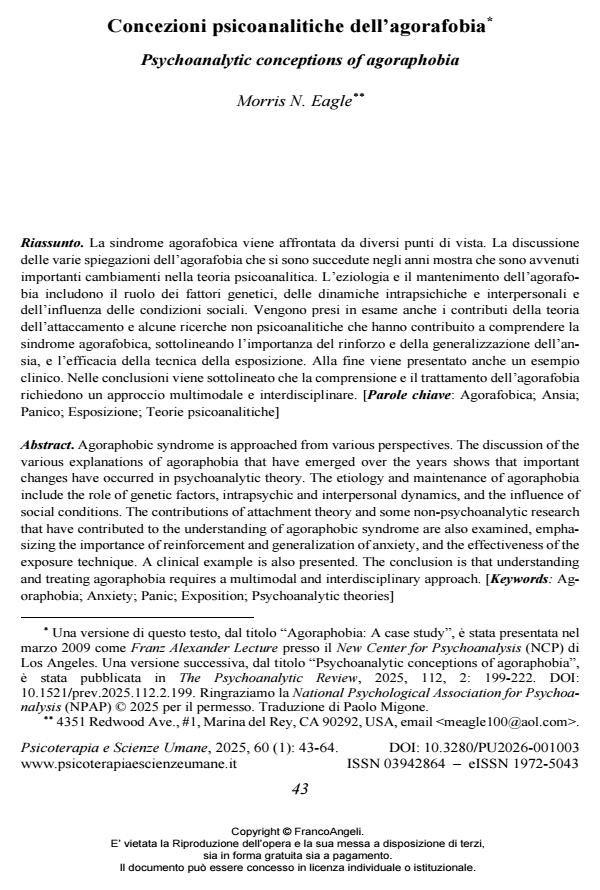
Qui sotto puoi vedere in anteprima la prima pagina di questo articolo.
Se questo articolo ti interessa, lo puoi acquistare (e scaricare in formato pdf) seguendo le facili indicazioni per acquistare il download credit. Acquista Download Credits per scaricare questo Articolo in formato PDF
FrancoAngeli è membro della Publishers International Linking Association, Inc (PILA), associazione indipendente e non profit per facilitare (attraverso i servizi tecnologici implementati da CrossRef.org) l’accesso degli studiosi ai contenuti digitali nelle pubblicazioni professionali e scientifiche.
La sindrome agorafobica viene affrontata da diversi punti di vista. La discussione delle varie spiegazioni dell’agorafobia che si sono succedute negli anni mostra che sono avvenuti importanti cambiamenti nella teoria psicoanalitica. L’eziologia e il mantenimento dell’agorafobia includono il ruolo dei fattori genetici, delle dinamiche intrapsichiche e interpersonali e dell’influenza delle condizioni sociali. Vengono presi in esame anche i contributi della teoria dell’attaccamento e alcune ricerche non psicoanalitiche che hanno contribuito a comprendere la sindrome agorafobica, sottolineando l’importanza del rinforzo e della generalizzazione dell’ansia, e l’efficacia della tecnica della esposizione. Alla fine viene presentato anche un esempio clinico. Nelle conclusioni viene sottolineato che la comprensione e il trattamento dell’agorafobia richiedono un approccio multimodale e interdisciplinare.
Parole chiave:Agorafobica; Ansia; Panico; Esposizione; Teorie psicoanalitiche
- Abraham K. (1913). A constitutional basis of locomotor anxiety. In: Selected Papers. New York: Basic Books, 1953, pp. 235-243 (trad. it.: Una base costituzionale dell’angoscia locomotoria.
- In: Opere, Volume 1. A cura di Johannes Cremerius. Torino: Boringhieri, 1975, pp. 62-70).
- Alexander F. (1940). Psychoanalysis revised. Psychoanalytic Quarterly, 9, 1: 1-36. DOI: 10.1080/21674086.1940.11925405
- Alexander F. (1942). Our Age of Unreason. A Study of the Irrational Forces in Social Life. Philadelphia, PA: Lippincott.
- Alexander, F. (1960). The Western Mind in Transition. An Eyewitness Story. New York: Random House.
- Alexander F., French T.M. et al. (1946). Psychoanalytic Therapy: Principles and Applications. New York: Ronald Press (trad. it. dei capitoli 2, 4 e 17: Alexander F., La esperienza emozionale correttiva. Psicoterapia e Scienze Umane, 1993, 27, 2: 85-101. Edizione su Internet: www.psychomedia.it/pm/modther/probpsiter/alexan-1.htm).
- American Psychiatric Association (2013). Diagnostic and Statistical Manual of Mental Disorders, Fifth Edition (DSM-5). Washington, D.C.: APA (trad. it.: DSM-5. Manuale diagnostico e statistico dei disturbi mentali. Quinta edizione. Milano: Raffaello Cortina, 2014).
- Balint M. & Balint E. (1959). Thrills and Regressions. London: Hogarth (trad. it.: Situazioni-brivido e regressioni. In: La regressione. Milano: Raffaello Cortina, 1983, pp. 1-115).
- Ballenger J.C. (1989). Toward an integrated model of panic disorder. American Journal of Orthopsychiatry, 59, 2: 284-293.
- Blatt S.J. (2006a). Una polarità fondamentale in psicoanalisi: implicazioni per lo sviluppo della personalità, la psicopatologia e il processo terapeutico. Psicoterapia e Scienze Umane, 40, 4: 743-764.
- Bowlby J. (1973). Attachment and Loss. Vol. 2: Separation: Anxiety and Anger. London: Hogarth Press (trad. it.: Attaccamento e perdita. Vol. 2: La separazione dalla madre. Torino: Boringhieri, 1975).
- Bowlby J. (1988). A Secure Base. London: Routledge (trad. it.: Una base sicura. Milano: Raffaello Cortina, 1989).
- Bruch H. (1980). Obesity and eating disorders. In: Sholevar G.P., Benson R.M. & Blinder B.J., editors, Emotional Disorders in Children and Adolescents. New York: Springer, 1980, pp. 353-361.
- Carter P. (2002). Repressed Spaces: The Poetics of Agoraphobia. London: Reaktion Books
- Chambless D.L. & Gracely E.J. (1989). Fear of fear and the anxiety disorders. Cognitive Therapy and Research, 13, 1: 9-20. DOI: 10.1007/BF01178486
- Collins G.R. & Collins C.C. (1986). Camillo Sitte: The Birth of Modern City Planning. New York: Rizzoli.
- Compton A. (1992). The psychoanalytic view of phobias: Part III: Agoraphobia and other phobias of adults. Psychoanalytic Quarterly, 61, 3: 400-425. DOI: 10.1080/21674086.1992.11927350
- Craske M.G., Antony M.M.& Barlow, D.H. (2006). Managing your Fears and Phobias: Therapist Guide. Second Edition. New York: Oxford University Press.
- Crowe R.R. (1985). The genetics of panic disorder and agoraphobia. Psychiatric Developments, 3, 2: 171-185.
- Da Costa Meyer E. (1996). La donna è mobile: Agoraphobia, women, and urban space. In: Agrest D., Conway P. & Kanes Wiseman L., editors, The Sex of Architecture. New York: Harry N. Abrams, 1996, pp. 141-156.
- Deutsch H. (1929). The genesis of agoraphobia. International Journal of Psychoanalysis, 10, 1: 51-69.
- Dymond S., Dunsmoor J.E., Vervliet B., Roche B. & Hermans D. (2015). Fear generalization in humans: Systematic review and implications for anxiety disorder research. Behavior Therapy, 46, 5: 561-582.
- Fairbairn W.R.D. (1952). Psychoanalytic Studies of the Personality. London: Tavistock (trad. it.: Studi psicoanalitici sulla personalità. Torino: Boringhieri, 1970, 1992).
- Fenichel O. (1945). The Psychoanalytic Theory of the Neurosis. New York: Norton (trad. it.: Trattato di psicoanalisi delle nevrosi e delle psicosi. Roma: Astrolabio, 1951).
- Fyer A.J., Mannuzza S., Chapman T.F., Martin L.Y. & Klein D.F. (1995). Specificity in familial aggregation of phobic disorders. Archives of General Psychiatry, 52, 7: 564-573.
- Freud S. (1895). A proposito di una critica della “nevrosi d’angoscia”. Opere, 2: 177-192. Torino: Boringhieri, 1968.
- Freud S. (1905). Tre saggi sulla teoria sessuale. Opere, 4: 443-546. Torino: Boringhieri, 1970.
- Freud S. (1912-13 [1913]). Totem e tabù. Opere, 7: 3-164. Torino: Boringhieri, 1975.
- Freud S. (1914). Introduzione al narcisismo. Opere, 7: 441-472. Torino: Boringhieri, 1975.
- Freud S. (1918 [1919]). Vie della terapia psicoanalitica. Opere, 9: 19-28. Torino: Boringhieri, 1977.
- Freud S. (1925 [1926]). Inibizione, sintomo e angoscia. Opere, 10: 231-317. Torino: Boringhieri, 1978.
- Freud S. (1932 [1933]). Introduzione alla psicoanalisi (nuova serie di lezioni). Lezione 32: Angoscia e vita pulsionale. Opere, 11: 191-218. Torino: Boringhieri, 1979.
- Fyer A.J., Mannuzza S., Chapman T.F., Martin L.Y. & Klein D.F. (1995). Specificity in familial aggregation of phobic disorders. Archives of General Psychiatry, 52, 7: 564-573.
- Hafner J.R. (1977). The husbands of agoraphobic women and their influence on treatment outcome. British Journal of Psychiatry, 13, 3: 289-294.
- Hafner J.R. (1979). Agoraphobic women married to abnormally jealous men. British Journal of Medical Psychology, 52, 2: 99-104.
- Hafner J.R. (1984). The marital repercussions of behavior therapy for agoraphobia. Psychotherapy: Theory, Research, Practice, Training, 21, 4: 530-542.
- Hafner J.R. & Ross M.W. (1983). Predicting the outcome of behavior therapy for agoraphobia. Behavior Research and therapy, 21, 4; 375-382. DOI: 10.1016/0005-7967(83)90006-2
- Hinton D. (2011). Agoraphobia, infinite space, and epistemic rupture: Europe at the end of the 19th Century. Journal of Analytical Psychology, 56, 3: 386.
- Horn L., Huber L. & Range F. (2013). The Importance of the secure base effect for domestic dogs: Evidence from a manipulative problem-solving task. Plos One, 8, 5: e65296. 10.1371/journal.pone.0065296.
- Kohut H. (1984). How Does Analysis Cure? Chicago, IL: University of Chicago Press (trad. it.: La cura psicoanalitica. Torino: Boringhieri, 1986).
- Kuch K. & Swinson R.P. (1992). Agoraphobia: What Westphal really said. Canadian Journal of Psychiatry, 37, 133-136. DOI: 10.1177/070674379203700212
- Lader M.H. & Wing L. (1966). Physiological Measures, Selective Drugs, and Morbid Anxiety (Maudsley Monographs, 14). London: Oxford University Press.
- Lange A. & van Dyck R. (1992). The function of agoraphobia in the marital relationship. Acta Psychiatrica Scandinavica, 85, 1: 89-93.
- Levy B. (2008). The European town space as an ideal place, or Camillo Sitte revisited. Environment, Land, Society, Archictectonics, 1, 2: 24-37.
- Liebowitz M.R. (1997). Panic disorder as a chronic illness. Journal of Clinical Psychiatry, 58 (Suppl. 13): 5-8.
- Mahler M.S., in collaboration with Manuel Furer (1968). On Human Symbiosis and the Vicissitudes of Individuation. Vol. I: Infantile Psychosis. New York: International Universities Press (trad. it.: Le psicosi infantili. Torino: Boringhieri, 1972).
- Milrod B., Busch F.N., Cooper A.M. & Shapiro T. (2017). Manual of Panic-Focused Psychodynamic Psychotherapy. Washington, D.C.: American Psychiatric Association.
- Milrod B., Leon A.C., Busch F.N., Rudden M., Schwalberg M., Clarkin J., Aronson A., Singer M., Turchin W., Klass, E.T., Graf E., Teres J.J. & Shear M.K. (2007). A randomized controlled clinical trial of psychoanalytic psychotherapy for panic disorder. American Journal of Psychiatry, 164, 2: 265-272.
- Milton F. & Hafner J.R. (1979). The outcome of behavior therapy for agoraphobia in relation to marital adjustment. Archives of General Psychiatry, 36, 7: 807-811.
- Moran B. & Andrews G. (2018). The familial occurrence of agoraphobia. British Journal of Psychiatry, 146, 3: 262-267.
- Nocon A., Wittchen H.U., Beesdo K., Brückl T., Hofler M., Pfister H., Zimmermann P. & Lieb R. (2008). Differential familial liability of panic disorder and agoraphobia. Depression and Anxiety, 25, 5: 422-434.
- Passman R.H. & Erck T.W. (1977). “Visual presentation of mothers for facilitating play in children: The effects of silent films of mothers”. Paper presented at the meeting of Society for Research in Child Development, New Orleans, LA, March 17-20, 1977.
- Passman R.H. & Longeway K.P. (1982). The role of vision in maternal attachment: Giving 2-year-olds a photograph of their mother during separation. Developmental Psychology, 18, 4: 530-533. DOI: 10.1037/0012-1649.18.4.530
- Rajecki D.W., Lamb M.E. & Obmascher P. (1978). Toward a general theory of infantile attachment: A comparative review of aspects of the social bond. Behavioral and Brain Sciences, 1, 3: 417-436. DOI: 10.1017/S0140525X00075816
- Schur M. (1953). The ego in anxiety. In: Loewenstein R.M., editor, Drives, Affects, Behavior. New York: International Universities Press, 1953, pp. 67-103.
- Stein M.B., Jang K.L. & Livesley W.J. (1999). Heritability of anxiety sensitivity: A twin study. American Journal of Psychiatry, 156, 2: 246-251.
- Wachtel P.L. (2024). My evolution as a psychotherapist. Journal of Contemporary Psychotherapy, 54, 4: 289-294.
- Weiss E. (1935). Agoraphobia and its relation to hysterical attacks and to traumas. International Journal of Psychoanalysis, 16, 1: 59-83.
- Weiss E. (1964). Agoraphobia in the Light of Ego Psychology. New York: Grune & Stratton
- Weiss J. (1993). How Psychotherapy Works. Process and Technique. New York: Guilford (trad. it.: Come funziona la psicoterapia. Presentazione di Paolo Migone e Giovanni Liotti. Torino: Bollati Boringhieri, 1999).
- Weiss J., Sampson H. & the Mount Zion Psychotherapy Research Group (1986). The Psychoanalytic Process: Theory, Clinical Observation, and Empirical Research. Foreword by Morris Eagle. New York: Guilford (trad. it. del cap. 1: Weiss J., Introduzione al lavoro del “San Fran¬cisco Psychotherapy Research Group”. Psicoterapia e Scienze Umane, 1993, 27, 2: 47-65).
- Westphal K.F.O. (1872). Die Agoraphobie, eine neuropathische Erscheinung [L’agorafobia, un fenomeno neuropatico]. Archiv für Psychiatrie und Nervenkrankheiten, 3, 1: 138-161.
- Winnicott D.W. (1958). The capacity to be alone. International Journal of Psychoanalysis, 39, 4: 416-420 (trad. it.: La capacità di essere solo. In: Sviluppo affettivo e ambiente. Roma: Armando, 1970, pp. 29-36).
Morris N. Eagle, Concezioni psicoanalitiche dell’agorafobia in "PSICOTERAPIA E SCIENZE UMANE" 1/2026, pp 43-64, DOI: 10.3280/PU2026-001003