Psychoanalytic conceptions of agoraphobia
Journal title PSICOTERAPIA E SCIENZE UMANE
Author/s Morris N. Eagle
Publishing Year 2026 Issue 2026/1
Language Italian Pages 22 P. 43-64 File size 360 KB
DOI 10.3280/PU2026-001003
DOI is like a bar code for intellectual property: to have more infomation
click here
Below, you can see the article first page
If you want to buy this article in PDF format, you can do it, following the instructions to buy download credits
FrancoAngeli is member of Publishers International Linking Association, Inc (PILA), a not-for-profit association which run the CrossRef service enabling links to and from online scholarly content.
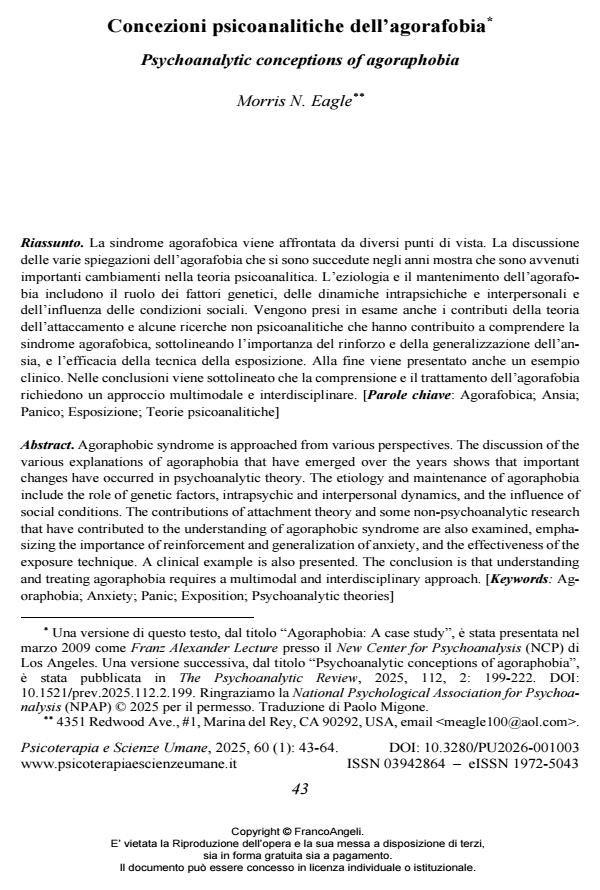
Agoraphobic syndrome is approached from various perspectives. The discussion of the various explanations of agoraphobia that have emerged over the years shows that important changes have occurred in psychoanalytic theory. The etiology and maintenance of agoraphobia include the role of genetic factors, intrapsychic and interpersonal dynamics, and the influence of social conditions. The contributions of attachment theory and some non-psychoanalytic research that have contributed to the understanding of agoraphobic syndrome are also examined, emphasizing the importance of reinforcement and generalization of anxiety, and the effectiveness of the exposure technique. A clinical example is also presented. The conclusion is that understanding and treating agoraphobia requires a multimodal and interdisciplinary approach.
Keywords: Agoraphobia; Anxiety; Panic; Exposition; Psychoanalytic theories
Morris N. Eagle, Concezioni psicoanalitiche dell’agorafobia in "PSICOTERAPIA E SCIENZE UMANE" 1/2026, pp 43-64, DOI: 10.3280/PU2026-001003