Sviluppo dell’abilità riassuntiva nei bambini della scuola primaria: primi risultati del progetto di ricerca “Oggi riassumo io”
Titolo Rivista CADMO
Autori/Curatori Angela Piu, Silvia Testa, Cinzia Angelini, Martin Dodman, Anastasia Marini
Anno di pubblicazione 2026 Fascicolo 2025/2
Lingua Italiano Numero pagine 17 P. 36-52 Dimensione file 223 KB
DOI 10.3280/CAD2025-002003
Il DOI è il codice a barre della proprietà intellettuale: per saperne di più
clicca qui
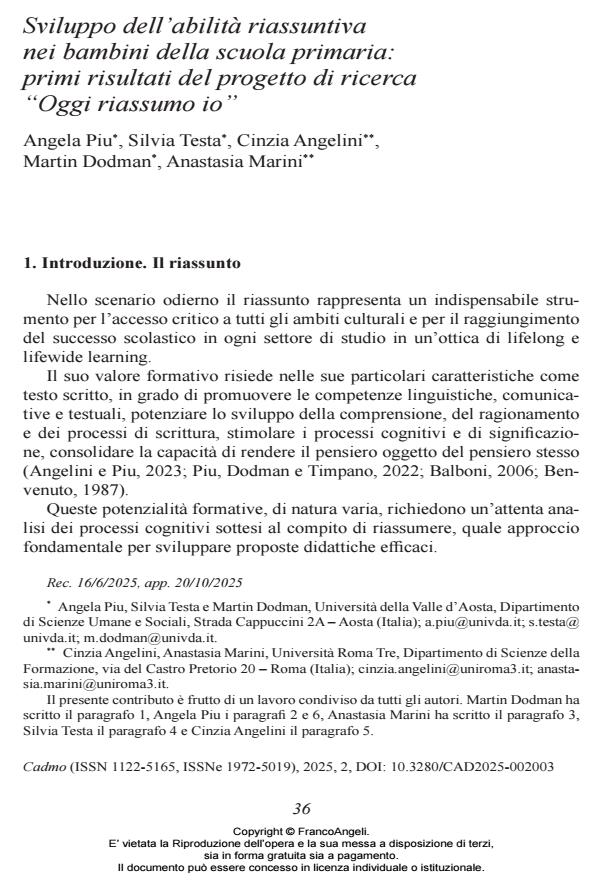
Qui sotto puoi vedere in anteprima la prima pagina di questo articolo.
Se questo articolo ti interessa, lo puoi acquistare (e scaricare in formato pdf) seguendo le facili indicazioni per acquistare il download credit. Acquista Download Credits per scaricare questo Articolo in formato PDF
FrancoAngeli è membro della Publishers International Linking Association, Inc (PILA), associazione indipendente e non profit per facilitare (attraverso i servizi tecnologici implementati da CrossRef.org) l’accesso degli studiosi ai contenuti digitali nelle pubblicazioni professionali e scientifiche.
The article presents the initial results of the research project “Today I Summarize” within which a didactic pathway aimed at developing the abi-lity to summarize narrative texts was designed and tested. The conceptual framework guiding the study is based on the cognitive load theory and the 4C/ID model. The experimentation involved 30 students from two primary school classes, an experimental and a control one, at the “Luigi Pirandello” institute in Fonte Nuova (Rome) during the 2022/2023 and 2023/2024 scho-ol years. The results showed a significant improvement in the summarizing ability of the experimental group compared to the control group in the pro-duction of a summary, although there was no difference in the scores of the Summarizing Test. Future developments will include expanding the research to larger samples and educational contexts, with the aim of generalizing the findings and exploring the application of summarization skills in everyday and professional situations.
Parole chiave:summarizing ability, cognitive load, primary school, reading comprehension, cognitive processes.
- Angelini, C., Piu, A. (2023), “La scrittura ristruttura il pensiero. L’abilità riassuntiva come atto di creatività scrittoria”, Cooperazione Educativa, 3, pp. 46-52.
- Balboni, E. (2006), Italiano lingua materna. Fondamenti di didattica. Torino: UTET. Bazzanella, C. (2014), Linguistica cognitiva. Un’introduzione. Roma-Bari: Laterza. Benvenuto, G. (1987), Insegnare a riassumere. Torino: Loescher.
- Bereiter, C., Scardamalia, M. (1987), The psychology of written composition. Hillsdale: Erlbaum.
- Boscolo, P. (2006), Psicologia dell’apprendimento scolastico. Aspetti cognitivi e motivazionali. Torino: UTET.
- Bruning, R., Horn, C. (2000), “Developing motivation to write”, Educational Psy-chologist, 35, pp. 25-37.
- Cardinale, U. (2015), L’arte di riassumere. Introduzione alla scrittura breve. Bolo-gna: il Mulino.
- De Mauro, T. (1986), “Appunti e spunti in tema di (in)comprensione”, Linguaggi, 2 (3), pp. 22-32.
- Eco, U. (1979), Lector in fabula. Milano: Bompiani.
- Hidi, S., Berndorff, D., Ainley, M. (2002), “Children’s argument writing, interest and self-efficacy: an intervention study”, Learning and Instruction, 12, pp. 429-446. Hayes, J. R., Nash J. G. (1996), On the nature of planning in writing. In Levy, C.
- M., Ransdell, S. (Eds), The science of writing. Theories, Methods, Individual differences and Application. Mahwah: Erlbaum, pp. 57-71.
- Kintsch W., van Dijk, T. A. (1978), “Toward a model of text comprehension and production”, Psychological Review, 85 (5), pp. 363-394.
- Kirschner, F., Paas, F., Kirschner, P. A. (2011), “Task complexity as a driver for col-laborative learning efficiency: The collective working-memory effect”, Applied Cognitive Psychology, 25, pp. 615-624,
- Levorato, M. C. (2000), Le emozioni della lettura. Bologna: il Mulino.
- Li, M., Wang, X. (2021), “Development and validation of a rating scale for sum-marization as an integrated task”, Asian-Pacific Journal of Second and Foreign Language Education, 6, art. 11,
- Menichetti, L. (2018), “Valutare la capacità di riassumere Il Summarizing Test, uno strumento per la scuola primaria”, Educational, Cultural and Psychological Stu-dies Journal, 18, pp. 369-396.
- Menichetti, L., Bertolini, C. (2019), La prova qualitativa per la valutazione della capacità di riassunto: il Summary Qualitative Assessment (SQA). In Calvani, A., Chiappetta Cajola, L., Strategie per la comprensione del testo. L’efficacia del Reciprocal Teaching. Firenze: SApIE, pp. 431-462.
- Pajares, F. (2003), “Self-efficacy beliefs, motivation and achievement in writing: A review of the literature”, Reading and Writing Quarterly, 19, pp. 139-158.
- Piu, A. (2017), “Making a summary is no easy task. A teaching-learning path for the development of summarizing skills in primary students”, Proceedings ICE-RI2017 10th annual International Conference of Education, Research and Inno-vation, Seville (Spain). 16th-18th of November, pp. 4613-4618.
- Piu, A. (2022), “Alla ricerca delle informazioni più importanti di un testo narrati-vo. Uno studio esplorativo nella scuola primaria”, Cadmo, 1, pp 82-97, DOI: 10.3280/CAD2022-001006
- Piu, A., Angelini, C. (2025), “Summarizing through the lens of cognitive load theo-ry. Implications for education and teaching methods”, Graphos. Rivista Interna-zionale di pedagogia e didattica della scrittura, 7, pp. 111-125.
- Piu, A., Angelini, C., Dodman, M., Testa, S., Scarpelli, G. (2024), “Simulation games for developing skills in summarizing at primary school. Analysing the co-construction of understanding a text”, QTimes – webmagazine, 14 (4),
- Piu, A., Dodman, M., Timpano, G. (2022), “Summary writing as cognition and com-munication. A process of mapping the territory”, Graphos. Rivista internazionale di Pedagogia e didattica della scrittura, 2 (2), pp. 69-79.
- Sweller, J., van Merriënboer, J. J. G., Paas, F. (2019), “Cognitive architecture and instructional design: 20 years later”, Educational Psychology Review, 31 (2), pp. 261-292,
- van Dijk, T. A., Kintsch, W. (1977), Cognitive Psychology and Discourse: Recalling and summarizing stories. In Dressler, W. (Ed), Current Trends in Textlinguistics. Berlin and New York: Waller de Gruyter, pp. 61-80.
- Vygotsky, L. S. (1962), Thought and language. Cambridge: MIT Press. vanMerriënboer, J. J. G. (2013), “Perspectives on problem solving and instruction”, Computers & Education, 64, pp. 153-160,
- van Merriënboer, J. J. G., Kirschner, P. A. (2018), Ten steps to complex learning: A systematic approach to four-component instructional design. New York: Routled-ge, 3rd ed.
- vanMerriënboer, J. J. G., Sweller, J. (2005), “Cognitive load theory and complex learning: recent developments and future directions”, Educational Psychology Review, 17, pp. 147-177.
- Zimmerman B., Bandura A. (1994), “Impact on self-regulatory influences on writing course attainment”, American Educational Research Journal, 31, pp. 845-862.
Angela Piu, Silvia Testa, Cinzia Angelini, Martin Dodman, Anastasia Marini, Sviluppo dell’abilità riassuntiva nei bambini della scuola primaria: primi risultati del progetto di ricerca “Oggi riassumo io” in "CADMO" 2/2025, pp 36-52, DOI: 10.3280/CAD2025-002003