L’impatto della brand crisis sulla clientela e l’effetto della fedeltà alla marca
Titolo Rivista MERCATI E COMPETITIVITÀ
Autori/Curatori Stefano Pace, Giacomo Gistri, Bernardo Balboni
Anno di pubblicazione 2015 Fascicolo 2015/3 Lingua Italiano
Numero pagine 19 P. 103-121 Dimensione file 504 KB
DOI 10.3280/MC2015-003006
Il DOI è il codice a barre della proprietà intellettuale: per saperne di più
clicca qui
Qui sotto puoi vedere in anteprima la prima pagina di questo articolo.
Se questo articolo ti interessa, lo puoi acquistare (e scaricare in formato pdf) seguendo le facili indicazioni per acquistare il download credit. Acquista Download Credits per scaricare questo Articolo in formato PDF
FrancoAngeli è membro della Publishers International Linking Association, Inc (PILA)associazione indipendente e non profit per facilitare (attraverso i servizi tecnologici implementati da CrossRef.org) l’accesso degli studiosi ai contenuti digitali nelle pubblicazioni professionali e scientifiche
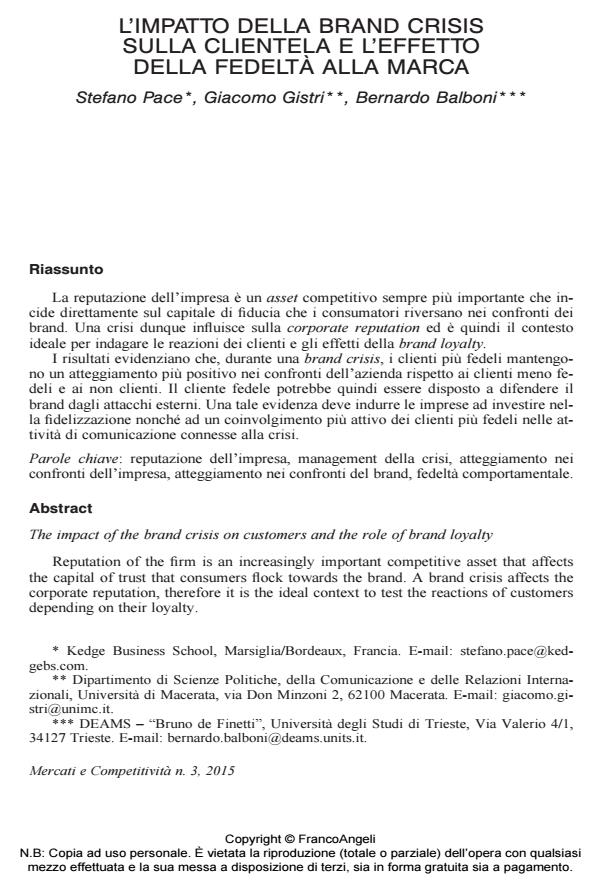
La reputazione dell’impresa è un asset competitivo sempre più importante che incide direttamente sul capitale di fiducia che i consumatori riversano nei confronti dei brand. Una crisi dunque influisce sulla corporate reputation ed è quindi il contesto ideale per indagare le reazioni dei clienti e gli effetti della brand loyalty. I risultati evidenziano che, durante una brand crisis, i clienti più fedeli mantengono un atteggiamento più positivo nei confronti dell’azienda rispetto ai clienti meno fedeli e ai non clienti. Il cliente fedele potrebbe quindi essere disposto a difendere il brand dagli attacchi esterni. Una tale evidenza deve indurre le imprese ad investire nella fidelizzazione nonché ad un coinvolgimento più attivo dei clienti più fedeli nelle attività di comunicazione connesse alla crisi.;
Keywords:Reputazione dell’impresa, management della crisi, atteggiamento nei confronti dell’impresa, atteggiamento nei confronti del brand, fedeltà comportamentale.
- Gandolfo A., Lupi L. (2014). Social network branding: la politica di marca nell’era delle reti sociali digitali. Mercati e Competitività, 2: 151-175, DOI: 10.3280/MC2014-002008
- Arsel Z., Thompson C.J. (2011). Demythologizing consumption practices: how consumers protect their field-dependent identity investments from devaluing marketplace myths. Journal of Consumer Research, 37(5): 791-806, DOI: 10.1086/656389
- Arvidsson A. (2005). Brands: A critical perspective. Journal of Consumer Culture, 5(2): 235-258, DOI: 10.1177/1469540505053093
- Arvidsson A. (2011). Ethics and value in customer co-production. Marketing Theory, 11(3): 261-278, DOI: 10.1177/1470593111408176
- Bowerman B.L., O’Connell R.T. (1990). Linear Statistical models: an applied approach (2nd edition). Belmont, CA: Duxbury.
- Carboniero V., Falco V. (2012). La reputazione aziendale come leva competitiva. Micro & Macro Marketing, 62(2): 381-390.
- Chun R. (2005). Corporate Reputation: Meaning and Measurement. International Journal of Management Reviews, 7: 91-109, DOI: 10.1111/j.1468-2370.2005.00109.x
- Coombs W.T. (2007). Protecting Organization Reputations during a Crisis: The Development and Application of Situational Crisis Communication Theory. Corporate Reputation Review, 10(3): 163-176, DOI: 10.1057/palgrave.crr.1550049
- Coombs W.T. (2012). Ongoing Crisis Communication. Thousand Oaks, CA: Sage.
- Coombs W.T., Holladay S.J (2001). An Extended Examination of the Crisis Situations: A Fusion of the Relational Management and Symbolic Approaches. Journal of Public Relations Research, 13(4): 321-340, DOI: 10.1207/S1532754XJPRR1304_03
- Coombs W.T., Holladay S.J. (2006). Unpacking the halo effect: reputation and crisis management. Journal of Communication Management, 10(2): 123-137, DOI: 10.1108/13632540610664698
- Dalli D., Corciolani M. (2008). Collective forms of resistance: the transformative power of moderate communities. Evidence from the Book Crossing case. International Journal of Market Research, 50(6): 757-775, DOI: 10.2501/s1470785308200195
- Davies G., Miles L. (1998). Reputation management: theory versus practice. Corporate Reputation Review, 2(1): 16-27, DOI: 10.1057/palgrave.crr.1540064
- Dawar N., Lei J. (2009). Brand crises: The roles of brand familiarity and crisis relevance in determining the impact on brand evaluations. Journal of Business Research, 62: 509-516, DOI: 10.1016/j.jbusres.2008.02.001
- Dawar N., Pillutla M. (2000). Impact of Product-Harm Crises on Brand-Equity: The Moderating Role of Consumer Expectations. Journal of Marketing Research, 36(5): 215-226, DOI: 10.1509/jmkr.37.2.215.18729
- Dean D. (2004). Consumer Reaction to Negative Publicity. Journal of Business Communication, 41: 192-211, DOI: 10.1177/0021943603261748.EllisonN.B.,SteinfieldC.,LampeC.(2007).TheBenefitsofFacebook‘Friends:’SocialCapitalandCollegeStudents’UseofOnlineSocialNetworkSites.JournalofComputerMediatedCommunication,12(4):1143-1168,doi:10.1111/j.1083-6101.2007.00367.x
- Festinger L. (1957). A Theory of Cognitive Dissonance. Stanford: Stanford University Press.
- Fombrun C., Gardberg N., Barnett M. (2000). Opportunity Platforms and Safety Nets: Corporate Citizenship and Reputational Risk. Business and Society Review, 105(1): 85-106, DOI: 10.1111/0045-3609.00066
- Fombrun C.J. (1996). Reputation: Realizing Value from the Corporate Image. Cambridge, MA: Harvard Business Review Press.
- Fombrun C.J., van Riel C.B.M. (1997). The reputational landscape. Corporate Reputation Review, 1(1/2): 6-13, DOI: 10.1057/palgrave.crr.1540024
- Grayson K. (2014). Morality and the Marketplace. Journal of Consumer Research, 41 (2): 7-8, DOI: 10.1086/676601
- Greyser S.A. (2009). Corporate brand reputation and brand crisis management, Management Decision, 47 (4): 590-602, DOI: 10.1108/00251740910959431
- Hall R. (1993). A Framework Linking Intangible Resources and Capabilities to Sustainable Advantage. Strategic Management Journal, 14(8): 607-618, DOI: 10.1002/smj.4250140804
- Harris L.C., Goode M.H. (2004). The four levels of loyalty and the pivotal role of trust: a study of online service dynamics. Journal of Retailing, 80(2): 139-158, DOI: 10.1016/j.jretai.2004.04.002
- Helm S. (2007). One Reputation or Many? Comparing Stakeholders’ Perceptions of Corporate Reputation. Corporate Communications, 12(3): 238-254, DOI: 10.1108/13563280710776842
- Helm S., Tolsdorf J. (2013). How does corporate reputation affect customer loyalty in a corporate crisis. Journal of Contingencies and Crisis Management, 21(3): 144-152, DOI: 10.1111/1468-5973.12020
- Herek G.M., McLemore K.A. (2011). The Attitudes Toward Lesbians and Gay Men (ATLG) Scale. In: T. Fisher, C.M. Davis, W.L. Yarber, and S.L. Davis (edited by).
- Handbook of Sexuality-related Measures, 3rd ed., 415-417. Oxford: Taylor & Francis.
- Holt D. (2002). Why Do Brands Cause Trouble? A Dialectical Theory of Consumer Culture and Branding. Journal of Consumer Research, 29 (1): 70-91, DOI: 10.1086/339922
- Kozinets R.V., Handelman J.M. (2004). Adversaries of Consumption: Consumer Movements, Activism, and Ideology. Journal of Consumer Research, 31 (3): 691-704, DOI: 10.1086/425104
- Luedicke M.K., Thompson C.J., Giesler M. (2010). Consumer Identity Work as Moral Protagonism: How Myth and Ideology Animate a Brand-Mediated Moral Conflict. Journal of Consumer Research, 36(6): 1016-1032, DOI: 10.1086/644761
- Melewar T.C., Karaosmanoglu E. (2006). Seven dimensions of corporate identity A categorisation from the practitioners’ Perspectives. European Journal of Marketing, 40(7/8): 846-869, DOI: 10.1108/03090560610670025
- Menard S. (1995). Applied logistic regression analysis. Sage university paper series on quantitative applications in the social science, 07-106. Thousand Oaks, CA: Sage. Myers R. (1990). Classical and modern regression with applications (2nd edition). Boston, MA: Duxbury.
- Pace S., Balboni B., Gistri G. (2014). The effects of social media on brand attitude and WOM during a brand crisis: the case of Barilla. Journal of Marketing Communications, DOI: 10.1080/13527266.2014.966478
- Page G., Fearn H. (2005). Corporate Reputation: What Do Consumers Really Care About? Journal of Advertising Research, September: 305-313, DOI: 10.1017/s0021849905050361
- Pope N.K., Voges K.E., Brown M.R. (2004). The Effect of Provocation in the Form of Mild Erotica on Attitude to the Ad and Corporate Image. Journal of Advertising, 33(1): 69-82, DOI: 10.1080/00913367.2004.10639154
- Scaraboto D., Fischer E. (2013). Frustrated Fatshionistas: An Institutional Theory Perspective on Consumer Quests for Greater Choice in Mainstream Markets. Journal of Consumer Research, 39(6): 1234-1257, DOI: 10.1086/668298
- Seeger M.W., Sellnow T.L., Ulmer .R. (1998). Communication, Organization and Crisis. In: Roloff M.E. (ed.). Communication Yearbook, Thousand Oaks, CA: Sage, pp. 231-275.
- Sengupta J., Johar G.V. (2002). Effects of Inconsistent Attribute Information on the Predictive Value of Product Attitudes: Toward a Resolution of Opposing Perspectives. Journal of Consumer Research, 29: 39-56, DOI: 10.1086/339920
- Shaw D., Riach K. (2011). Embracing ethical fields: constructing consumption in the margins. European Journal of Marketing, 45(7/8): 1051-1067, DOI: 10.1108/03090561111137606
- Siano A., Vollero A. (2013). Brand reputation online: tra consumer empowerment e reputational risk. Finanza, Marketing e Produzione, 31(1): 32-62.
- Thompson C.J., Haytko D.L. (1997). Speaking of Fashion: Consumers’ Uses of Fashion Discourses and the Appropriation of Countervailing Cultural Meanings. Journal of Consumer Research, 24 (June): 15-42, DOI: 10.1086/209491
- Tucker L., Melewar T. (2005). Corporate Reputation and Crisis Management: The Threat and Manageability of Anti-Corporatism. Corporate Reputation Review, 7(4): 377-387, DOI: 10.1057/palgrave.crr.1540233
- Social media strategies to protect brand image and corporate reputation in the digital era: a digital investigation of the Eni vs. Report case Riccardo Rialti, Lamberto Zollo, Alessandro Caliandro, Cristiano Ciappei, in MERCATI & COMPETITIVITÀ 4/2016 pp.65
DOI: 10.3280/MC2016-004005
Stefano Pace, Giacomo Gistri, Bernardo Balboni, L’impatto della brand crisis sulla clientela e l’effetto della fedeltà alla marca in "MERCATI E COMPETITIVITÀ" 3/2015, pp 103-121, DOI: 10.3280/MC2015-003006