A woman’s name. A psychoanalytic view for gender incongruence
Journal title PSICOBIETTIVO
Author/s Emanuela Mundo
Publishing Year 2020 Issue 2019/3
Language Italian Pages 20 P. 38-57 File size 174 KB
DOI 10.3280/PSOB2019-003003
DOI is like a bar code for intellectual property: to have more infomation
click here
Below, you can see the article first page
If you want to buy this article in PDF format, you can do it, following the instructions to buy download credits
FrancoAngeli is member of Publishers International Linking Association, Inc (PILA), a not-for-profit association which run the CrossRef service enabling links to and from online scholarly content.
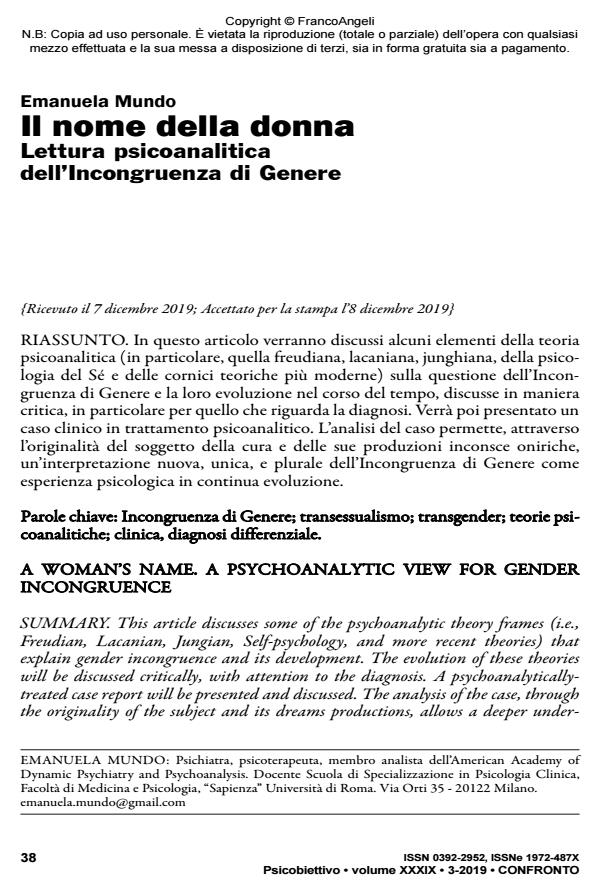
This article discusses some of the psychoanalytic theory frames (i.e., Freudian, Lacanian, Jungian, Self-psychology, and more recent theories) that explain gender incongruence and its development. The evolution of these theories will be discussed critically, with attention to the diagnosis. A psychoanalyticallytreated case report will be presented and discussed. The analysis of the case, through the originality of the subject and its dreams productions, allows a deeper under standing of the new, unique, and plural interpretation of the gender incongruence phenomenon as a psychological condition in progress.
Keywords: Gender Incongruence; Transexualism; Transgender; Psychoanalytic Theories; Clinical Approach; Differential Diagnosis.
- Laplanche J. (1987) Nuovi fondamenti di psicoanalisi, Borla, Roma, 1991
- Lingiardi V., McWilliams N. (eds.) (2017) Psychodynamic Diagnostic Manual
- Second Edition (PDM-2), Guilford Publications, New York
- American Psychiatric Association (1980) Diagnostic and Statistical Manual for Mental Disorders (DSMIII – 3rd Edition), American Psychiatric Association, American Psychiatric Association (2013) Diagnostic and Statistical Manual for Mental Disorders (DSMV – 5th Edition), American Psychiatric Association, Washington DC
- Bailey J.M., Zucker K.J. (1995) “Childhood sex-typed behavior and sexual orienta tion: a conceptual analysis and quantitative review”, Develop Psychology, 31: 43-55. DOI: 10.1037/0012-1649.31.1.4
- Bromberg G.M. (1998) Clinica del trauma e della dissociazione, Raffaello Cortina, Milano, 2007
- Chiland C. (1997) Changer de sexe, Editions Odile Jacob, Paris
- Chiland C. (2008) “La problématique de l’identité sexuée”, Neuropsychiatrie de l’Enfance et de l’Adolescence, 56: 328-334.
- Di Ceglie D. (1998) Straniero nel mio corpo, FrancoAngeli, Milano, 2003 Freud S. (1932) “Introduzione alla psicoanalisi”, in Opere, vol. 11, Bollati Boringhieri, Torino, 1989
- Freud S. (1937) “Analisi terminabile e interminabile”, in Opere, vol. 11, Bollati Boringhieri, Torino, 1989
- Galiani R. (2005) Un sesso invisibile, sul transessualismo in quanto questione, Liguori, Napoli
- Graves R. (1954) I miti greci, Longanesi, Milano, 1999
- Hillman J. (1972) Il Mito dell’analisi, Adelphi, Milano, 1991
- Jung C.G. (1917-1943) “Psicologia dell’Inconscio”, in Opere, vol. 7, Bollati Boringhieri, Torino, 1993
- Jung C.G. (1936) “Sull’archetipo con particolare riguardo al concetto di Anima”, in Opere, vol. 9, Bollati Boringhieri, Torino, 1980
- Kerenyi K. (1958, 1962) Gli dei e gli eroi della grecia, Il Saggiatore, Milano, 2002
- Klein M. (1932) La psicoanalisi dei bambini, Psycho, Firenze, 1998
- Lacan J. (1958) “Una questione preliminare ad ogni possibile trattamento della psicosi”, in Scritti, Einaudi, Torino, 1974
- Lacan J. (1971-1972) “Il Seminario, Libro XIX, ‘... ou pire’”, in La Psicoanalisi, vol. 13, Atrolabio, Roma, 1993
- Lacan J. (1972-1973) Il Seminario, Libro XX, Einaudi, Torino, 2011
- Mahler M. (1972) “On the First Three Subphases of the Separation-Individuation Process”, Int. J. Psychoanal., 53: 333-338
- Mitchell S.A. (1993) Influenza e autonomia in psicoanalisi Bollati Boringhieri, Torino, 1999
- Money J., Ehrhadt A. (1972) Man & Woman, Boy & Girl, John Hopkins University Press, Baltimore
- Neumann E. (1950) Il significato psicologico del rito. Conferenza tenuta alla Fondazione Eranos di Ascona, Canton Ticino (Svizzera), agosto 1950 Oppenheimer A. (1991) “The Wish for a Sex Change: A Challenge to Psychoanalysis?”, Int. J. Psychoanal., 72: 221-231
- Ovesey L., Person E.S. (1973) “Gender Identity and sexual psuchopathology in men: a psychodynamic analysis of homosexuality, transsexualism and travestitism”, J. Am. Acad. Psychoanal., 1(1): 53-72.
- Ovesey L., Person E.S. (1974a) “The Transsexual Syndrome in Males. Primary Transsexualism”, Am. J. Psychother., 28(1): 4-20.
- Ovesey L., Person E.S. (1974b) “The Transsexual Syndrome in Males. Secondary Transsexualism”, Am. J. Psychother., 28(1): 174-193.
- Steiner J. (1993) I rifugi della mente, Bollati Boringhieri, Torino, 1996
- Stryker S. (2008) Transgender History, Seal Press, Berkeley, CA
- Wilkinson M. (2006) Coming into mind. Undoing dissociation, Routledge, London e New York
- Winnicott D.W. (1962) Sviluppo affettivo e ambiente, Armando, Roma, 1970
Emanuela Mundo, Il nome della donna. Lettura psicoanalitica dell’Incongruenza di Genere in "PSICOBIETTIVO" 3/2019, pp 38-57, DOI: 10.3280/PSOB2019-003003