Guilt and shame in the cognitive-evolutionary perspective
Journal title PSICOBIETTIVO
Author/s Eleonora Pietropaoli, Maria Giuseppina Mantione
Publishing Year 2017 Issue 2017/2
Language Italian Pages 18 P. 125-142 File size 120 KB
DOI 10.3280/PSOB2017-002010
DOI is like a bar code for intellectual property: to have more infomation
click here
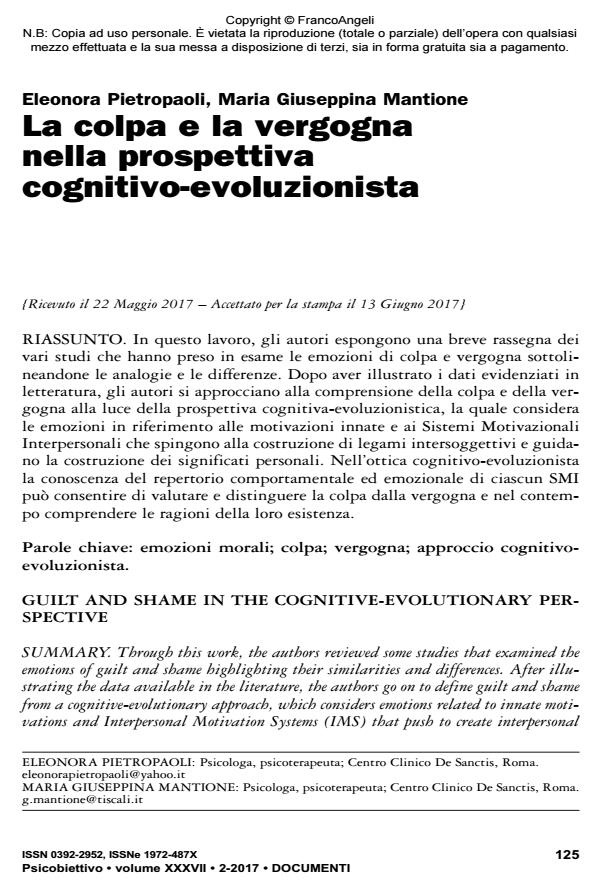
Below, you can see the article first page
If you want to buy this article in PDF format, you can do it, following the instructions to buy download credits
FrancoAngeli is member of Publishers International Linking Association, Inc (PILA), a not-for-profit association which run the CrossRef service enabling links to and from online scholarly content.
Through this work, the authors reviewed some studies that examined the emotions of guilt and shame highlighting their similarities and differences. After illustrating the data available in the literature, the authors go on to define guilt and shame from a cognitive-evolutionary approach, which considers emotions related to innate motivations and Interpersonal Motivation Systems (IMS) that push to create interpersonal bonding and determine how the individual interprets events. In the cognitive-evolutionary view, the knowledge of the behavioral and emotional reportorial of each IMS allows evaluating and distinguishing guilt from shame and at the same time understands the reason for their existence.
Keywords: Moral Emotions; Guilt; Shame; Cognitive-Evolutionary Approach.
- Gilbert P. (2007) “The evolution of shame as a marker for relationship security”, in: Tracy J.L., Robins R.W., Tangney J.P. (eds.), The Self-Conscious Emotions: Theory and Research, Guilford Press, New York, pp. 283-309
- Gilbert P., Allan S., Price J. (1997) “Social comparison, social attractiveness and evolution: How might they be related?”, New Ideas in Psychology, 13: 149-165. DOI: 10.1016/0732-118X(95)00002-
- Harder D.W., Lewis S.J. (1987) “The assessment of shame and guilt”, in: Spielberg C.D., Butcher J.N. (eds.), Advances in personality Assessment, vol. 6, pp. 89-114, Erlbaum, Hillsdale, NY
- Hrdy S.B. (1999) Mother Nature: A History of Mothers, Infant and Natural Selection, Pantheon, New York
- Keltner D., Haidt J. (2001) “Social functions of emotions”, in: Mayene T., Bonanno G.A. (eds.), Emotions: current isues and future directions, Guilford Press, New York, pp. 192-213
- Kroll J., Egan E. (2004) “Psychiatry, moral worry and moral emotions”, J. Psychiatr. Pract., 10: 352-360
- La Rosa C., Iannucci C. (2000) Il sistema motivazionale agonistico, Associazione di Psicologia Cognitiva, Roma
- Lewis H.B. (1971) Shame and guilt in neurosis, International Universities Press, New York
- Lewis M. (1992) Shame the exposed self, The Free Press, New York
- Liotti G. (2005) La dimensione interpersonale della coscienza, Carocci, Roma
- Liotti G., Monticelli F. (2008) I Sistemi Motivazionali nel dialogo clinico, Raffaello Cortina, Milano
- Mancini F. (1997) “Il senso di colpa: un’analisi cognitiva”, Psicoterapia, 3: 31-46
- Mancini F. (2008) “I sensi di colpa altruistico e deontologico”, Cognitivismo Clinico, 5, 2: 125-144
- Miller S.B. (1989) “Shame as an impetus to the creation of coscience”, Internatio-nal Journal of Psychoanalysis, 70: 273-287
- Mitani J.C., Watts D. (1997) “The evolution of non-maternal caretaking among anthropoid primates”, Behavioral Ecology and Sociobiology, 40: 213-40.
- Nathanson D.L. (1987) The many faces of shame, Guilford Press, New York
- Onofri A., Tombolini L. (2003) “La prospettiva cognitivo-evoluzionista, i sistemi motivazionali interpersonali e la psicoterapia cognitiva dei disturbi dell’umore”, Psicobiettivo, 1
- Ricci Bitti P.E., Boggi Cavallo P., Garotti P.L. (1994) “Antecedenti situazionali, espressione e regolazione del senso di colpa”, in: Castelfranchi C., D’Amico R., Poggi I. (a cura di), Sensi di colpa, Giunti, Firenze, pp. 203-217
- Scherer K.R. (2000) “Psychological Models of Emotion” in: Borod J. (ed.), The Neuropychological of Emotion, Oxford University Press, New York, pp. 137-162
- Sheikh S., Janoff-Bulman R. (2010) “The ‘Shoulds’ and ‘Should Nots’ of moral emotions: a self-regulatory perspective on shame and guilt”, Pers. Soc. Psychol., B 36: 213-224. DOI: 10.1177/014616720935678
- Storey A.E., Walsh C.J., Quinton R.L., Wynne-Edwards K.E. (2000) “Hormonal correlates of paternal responsiveness in new and expectant fathers”, Evolution and Human Behavior, 21: 79-95. DOI: 10.1016/S1090-5138(99)00042-
- Tangney J.P., Dearing R. (2002) Shame and guilt, Guilford, New York
- Tangney J.P., Fisher K.W. (1995) Self conscious emotions: shame, guilt, embarrassment and pride, Guilford Press, New York
- Tangney J.P., Marschall D.E., Rosenberg K., Barlow D.H., Wagner P.E. (1994) Children’s and adults’ autobiographical accounts of shame, guilt, and pride experiences: An analysis of situational determinants and interpersonal concerns, unpublished manuscript
- Tangney J.P., Miller R.S., Flicker L., Barlow D.H. (1996) “Are shame, guilt and embarrassment distinct emotions?”, Journal of Personality and Social Psychology, 70: 1256-1269. DOI: 10.1037/0022-3514.70.6.125
- Tangney J.P., Stuewig J., Mashek D.J. (2006) An emotional-cognitive framework for understanding moral behavior, George Mason University, Fairfax
- Taylor G.J., Bagby R.M., Parker J.D.A. (1997) I disordini della regolazione affettiva, Giovanni Fioriti, Roma
- Tracy J.L., Robins R.W. (2004) “Putting the self into self-conscious emotions: a theoretical model”, Psychological Inquiry, 15: 103-125.
- Tracy J.L., Robins R.W. (2007) “Self-conscious: Where self and emotion meet”, in Sedikides C., Spence S. (eds.), The Self in social psychology: frontiers of social psychology, Psychology Press, New York, pp. 187-209
- Trivers R.L. (1971) “The evolution of reciprocal altruism”, Quarterly Rewiew of Biology, 46: 35-57. DOI: 10.1086/40675
- Wallbott H., Sherer K.R. (1986) “How universal and specifici s emotional experience? Evidence from 27 countries on five continents”, Social Science Information, 25: 763-795. DOI: 10.1177/05390188602500400
- Webb T. (2003) Towards a mature shame culture: Theoretical and practical tools for personal and social growth, PhD Thesis, University of Western, Sydney. Retrieved September 7, 2015, from --http://handle.uws.edu.au:8081/1959.7/676.
- Williams B. (1993) Shame and necessity, University of California Press, Berkeley
- Averill P.M., Diefenbach G.J., Stanley M.A., Breckenridge J.K., Lusby B. (2002) “Assessment of shame and guilt in a psychiatric sample: A comparison of two measures”, Personality and Individual Differences, 32: 1365-1376. DOI: 10.1016/S0191-8869(01)00124-
- Barrett K.C. (1995) “A functionalist approach to shame and guilt”, in: Tangney J.P., Fisher K.W. (eds.), Self-conscious emotions: the psychology of shame, guilt, embarrassment and pride, Guilford Press, New York
- Battacchi M.W. (2000) Vergogna e senso di colpa. In psicologia e nella letteratura, Raffaello Cortina, Milano, 2002
- Baumeister R.F., Stillwell A.M., Heatherton T.F. (1994) “Guilt: an interpersonal approach”, Psycholocical Bulletin, 115: 243-267. DOI: 10.1037/0033-2909.115.2.24
- Berndsen M., Van der Pligt J., Doosje B., Manstead A.S.R. (2004) “Guilt and regret: the determining role of interpersonal and intrapersonal harm”, Cogn. Emot., 18: 55-70. DOI: 10.1080/0269993024400043
- Buber M. (2008) Colpa e sensi di colpa, Apogeo, Milano
- Catarino F., Gilbert P., McEwan K., Baião R. (2014) “Compassion motivations: Distinguishing submissive compassion From genuine compassion and its Association with shame, submissive Behavior, depression, anxiety and stress”, Journal of Social and Clinical Psychology, 33, 5: 399-412.
- Castelfranchi C. (1995) Le difese della mente, NIS, Roma
- Castelfranchi C., Poggi I. (1988) “Vergogna”, in: Castelfranchi C. (a cura di), Che figura. Emozioni e immagine sociale, Il Mulino, Bologna
- De Hooge I.E., Zeelenberg M., Breugelmans S.M. (2011) “A functionalist account of shame induced behavior”, Cogn. Emot., 25: 939-946. DOI: 10.1080/0269931.2010.51690
- Farina B., Liotti G. (2011) “L’incontro con la teoria dell’attaccamento e la svolta relazionale della psicoterapia cognitiva”, Psiche, 1
- Fontaine J.R.J., Luyten P., De Boeck P., Corveleyn J. (2001) “The Test of Self-Conscious Affect: Internal structure, differential scales and relationships with long-term affects”, European Journal of Personality, 15: 449-463.
- Gilbert P. (1989) Human Nature and Suffering, Erlbaum, London
- Gilbert P. (2003) “Evolution, social roles and the differences in shame and guilt”, Soc. Res., 70: 1205-1230
Eleonora Pietropaoli, Maria Giuseppina Mantione, La colpa e la vergogna nella prospettiva cognitivo-evoluzionista in "PSICOBIETTIVO" 2/2017, pp 125-142, DOI: 10.3280/PSOB2017-002010