Some epistemological observations on empathy

Journal title PSICOTERAPIA E SCIENZE UMANE
Author/s Andrea Angelozzi
Publishing Year 2025 Issue 2025/4
Language Italian Pages 10 P. 689-698 File size 253 KB
DOI 10.3280/PU2025-004007
DOI is like a bar code for intellectual property: to have more infomation click here

Below, you can see the article first page

If you want to buy this article in PDF format, you can do it, following the instructions to buy download credits
Article preview

FrancoAngeli is member of Publishers International Linking Association, Inc (PILA), a not-for-profit association which run the CrossRef service enabling links to and from online scholarly content.

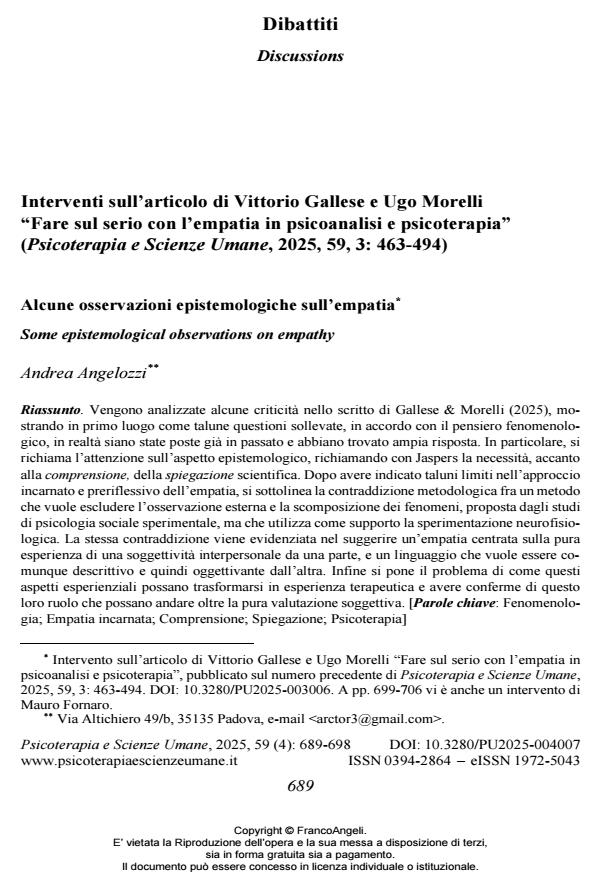
This intervention examines several critical issues in the paper by Gallese & Morelli (2025). It is argued that some of the questions raised by these authors, in line with phenomenological thought, have in fact long been present in the debate and have already received substantial responses. Special emphasis is placed on the epistemological dimension, recalling Jaspers’ view that scientific explanation must complement understanding. The limits of an embodied and pre-reflective approach to empathy are discussed, with attention to the methodological contradiction of a perspective that rejects external observation and the analytical decomposition of phenomena, while simultaneously relying on neurophysiological experimentation. A similar tension emerges in the proposal of an empathy grounded in the pure experience of interpersonal subjectivity yet expressed through a language that aims at being descriptive and therefore objectifying. Finally, the paper addresses the challenge of how such experiential dimensions may be transformed into therapeutic experience and empirically validated in this role.

Keywords: Phenomenology; Embodied empathy; Understanding; Explanation; Psychotherapy

  1. Angelozzi A. (2025). La questione dell’empatia. I tanti problemi di un qualcosa che tutti credono di conoscere. Psicoterapia e Scienze Umane, 59, 2: 209-250. DOI: 10.3280/PU2025-002002
  2. Anonimo (IV sec. a. C.). Huangdi Neijing Suwen. Le domande semplice dell’imperatore giallo. Milano: Jaca Book, 1993.
  3. Bloom P. (2016). Against Empathy: The Case for Rational Compassion. New York: HarperCollins (trad. it.: Contro l’empatia. In difesa della razionalità. Macerata: Liberilibri, 2023).
  4. Carnap R. (1938). Logical foundations of the unity of science. In: International Encyclopedia of Unified Science, Vol. 1. Chicago, IL: Chicago University Press, 1938, pp. 42-62 (trad. it., I fondamenti logici dell’unità della scienza. In: AA.VV., Neopositivismo e unità della scienza. Milano: Bompiani, 1973, pp. 53-75).
  5. Cuff B.M.P., Brown S.J., Taylor L. & Howat D.J. (2016). Empathy: A review of the concept. Emotion Review, 8, 2: 144-153. DOI: 10.1177/1754073914558466
  6. Decety J. & Jackson P.L. (2004). The functional architecture of human empathy. Behavioral and Cognitive Neuroscience Reviews, 3, 2: 71-100. DOI: 10.1177/1534582304267187
  7. Elliott R., Bohart A.C., Watson J.C. & Greenberg L.S. (2011). Empathy. Psychotherapy, 48, 1: 43-49.
  8. Gallagher S. (2005). How the Body Shapes the Mind. Oxford, UK: Oxford University Press.
  9. Gallese V. & Morelli U. (2025). Fare sul serio con l’empatia in psicoanalisi e psicoterapia. Psicoterapia e Scienze Umane, 59, 3: 463-494. DOI: 10.3280/PU2025-003006
  10. Greenberg L.S., Elliott R., Watson J.C. & Bohart A.C. (2001). Empathy. Psychotherapy: Theory, Research, Practice, Training, 38, 4: 380-384. DOI: 10.1037/0033-3204.38.4.380
  11. Hall J.A., Mast M.S. & West T.V., editors (2016). The Social Psychology of Perceiving Others Accurately. Cambridge, UK: Cambridge University Press.
  12. Hickok G. (2009). Eight problems for the mirror neuron theory of action understanding in monkeys and humans. Journal of Cognitive Neuroscience, 21, 7: 1229-1243.
  13. Hickok G. (2014). The Myth of Mirror Neurons. The Real Neuroscience of Communication and Cognition. New York: Norton (trad. it.: Il mito dei neuroni specchio. comunicazione e facoltà cognitive. La nuova frontiera. Torino: Bollati Boringhieri, 2015).
  14. Hodges S.D. & Wegner D.M. (1997). Automatic and controlled empathy. In: Ickes W., editor, Empathic Accuracy. New York: Guilford, 1997, pp. 311-339.
  15. Jaspers K. (1913). Allgemeine Psychopathologie. Berlin: Springer, VII ediz., 1959 (trad. it: Psicopatologia generale. Roma: Il Pensiero Scientifico, 1964; Nocera Inferiore [SA]: Orthotes, 2014).
  16. Katz S.T. (1978). Language, epistemology, and mysticism. In: Katz S.T., editor, Mysticism and Philosophical Analysis. New York: Oxford University Press, 1978, pp. 22-55
  17. Kohut H. (1959). Introspection, empathy, and psychoanalysis: An examination of the relationship between mode of observation and theory. Journal of the American Psychoanalytic Association, 7, 3: 459-483.
  18. Kohut H. (1959-81 [2003]). Introspezione ed empatia. Raccolta di scritti (1959-1981). A cura di A. Carusi. Torino: Bollati Boringhieri, 2003.
  19. Kohut H. (1981). On empathy. In: Ornstein P.H., editor, The Search of the Self. Selected Writings of Heinz Kohut: 1978-1981, Vol 4. London: Karnac, 2011, pp. 525-536. Anche in: Kohut, 1959-81, pp. 189-198.
  20. Kohut H. (1982). Introspection, empathy, and the semi-circle of mental health. International Journal of Psychoanalysis, 63, 4: 395-407 (trad. it.: Introspezione, empatia e il semicerchio della salute mentale. In: Le due analisi del Sig. Z. Roma: Astrolabio, 1989, pp. 77-101. Anche in: Kohut, 1959-81, pp. 199-223).
  21. Mahon B.Z. & Caramazza A. (2008). A critical look at the embodied cognition hypothesis and a new proposal for grounding conceptual content. Journal of Physiology, 102, 1/3: 59-70.
  22. Merleau-Ponty M. (1964). Le visible et l’invisible. Paris: Gallimard (trad. it.: Il visibile e l’invisibile. Milano: Bompiani, 1969).
  23. Metzinger T. (2004). Being No One: The Self-Model Theory of Subjectivity. Cambridge, MA: MIT Press.
  24. Moss J. (2007). The doctor and the pastry chef: Pleasure and persuasion in Plato’s Gorgias. Ancient Philosophy, 27, 2: 229-249. DOI: 10.5840/ANCIENTPHIL20072721
  25. Platone (390-385 a.C.). Gorgia. Milano: Mondadori, 1941.
  26. Platone (385-380 a.C.). Fedone. Bari: Laterza, 1971.
  27. Ricoeur P. (1990). Soi-même comme un autre. Paris: Seuil. (trad. it.: Sé come un altro. Milano: Jaca Book, 1993).
  28. Ryle G. (1949). The Concept of Mind. London: Hutchinson’s University Library; London: Penguin, 1990 (trad. it.: Il concetto di mente. Bari: Laterza, 2007).
  29. Shapiro T. (1974). The development and distortions of empathy. Psychoanalytic Quarterly, 43, 1: 4-25, DOI: 10.1080/21674086.1974.11926657
  30. Shapiro T. (1984). Empathy: A critical reevaluation. In: Lichtenberg J., Bornstein M. & Silver D., editors, Empathy I. London: Routledge, 1984, pp. 103-128.
  31. Smith J.L., Ickes W., Hall J.A. & Hodges S.D., editors (2011). Managing Interpersonal Sensitivity: Knowing When and When Not to Understand Others. New York: Nova Science.
  32. Spytska L. (2025). The use of artificial intelligence in psychotherapy: Development of intelligent therapeutic systems. BMC Psychology, 13, 1: 175.
  33. Watts A. (1975). Tao: The Watercourse Way. New York: Pantheon (trad. it.: Il Tao: la via dell’acqua che scorre. Roma: Astrolabio, 1977).
  34. Wispé L. (1986). The distinction between sympathy and empathy: To call forth a concept, a word is needed. Journal of Personality and Social Psychology, 50, 2: 314-321. DOI: 10.1037/0022-3514.50.2.314
  35. Wittgenstein, L. (1953). Philosophische Untersuchungen – Philosophical Investigations. Oxford, UK: Blackwell (trad. it.: Ricerche filosofiche. Torino: Einaudi, 1995).
  36. Zahavi D. (2017). Self and Other: Exploring Subjectivity, Empathy, and Shame. Oxford, UK: Oxford University Pres.
  37. Zaki J. (2014). Empathy: A motivated account. Psychological Bulletin, 140, 6: 1608-1647.

Andrea Angelozzi, Interventi sull’articolo di Vittorio Gallese e Ugo Morelli “Fare sul serio con l’empatia in psicoanalisi e psicoterapia” (Psicoterapia e Scienze Umane, 2025, 59, 3: 463-494) Alcune osservazioni epistemologiche sull’empatia in "PSICOTERAPIA E SCIENZE UMANE" 4/2025, pp 689-698, DOI: 10.3280/PU2025-004007