On the threshold: the oblique and the intermediary function in extended consultation and family therapy

Journal title INTERAZIONI
Author/s Giuseppe Saraò
Publishing Year 2025 Issue 2025/2
Language Italian Pages 14 P. 68-81 File size 59 KB
DOI 10.3280/INT2025-002008
DOI is like a bar code for intellectual property: to have more infomation click here

Below, you can see the article first page

If you want to buy this article in PDF format, you can do it, following the instructions to buy download credits
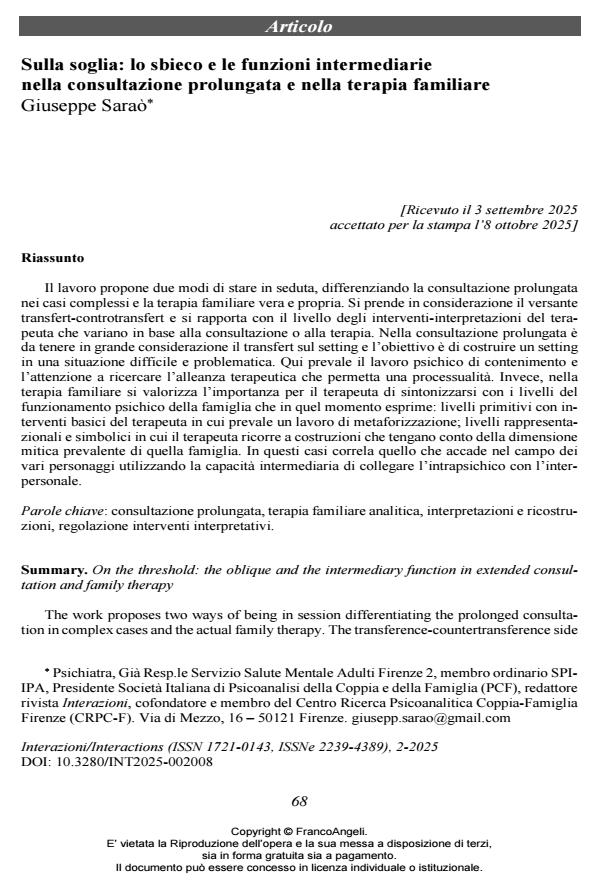
Article preview

FrancoAngeli is member of Publishers International Linking Association, Inc (PILA), a not-for-profit association which run the CrossRef service enabling links to and from online scholarly content.

The work proposes two ways of being in session differentiating the prolonged consultation in complex cases and the actual family therapy. The transference-countertransference side is taken into consideration and is related to the level of interventions-interpretations of the therapist that vary based on the consultation or therapy. In the prolonged consultation, the transference on the setting must be taken into great consideration and the objective is to build a setting in a difficult and problematic situation. Here, the psychic work of containment prevails and an attention to seeking the therapeutic alliance that allows a processuality. Instead, in family therapy, the importance for the therapist to tune into the levels of psychic functioning of the family that it expresses at that moment is valued: primitive levels with basic interventions of the therapist in which a work of metaphorization prevails; representational and symbolic levels in which the therapist uses constructions that take into account the prevailing mythical dimension of that family. In these cases, it correlates what happens in the field of the various characters using the intermediary capacity to connect the intrapsychic with the interpersonal.

Keywords: prolonged consultation, analytical family therapy, interpretations and reconstructions, regulation of interpretative interventions.

  1. Agamben G. (2002). L’aperto, l’uomo e l’animale. Torino: Bollati Boringhieri.
  2. Amati Sas S. (2020). Ambiguità, conformismo e adattamento alla violenza sociale. Milano: FrancoAngeli.
  3. Baranger W., Baranger M. (1962). La situazione psicoanalitica come campo bipersonale. Milano: Cortina.
  4. Benjamin J. (2019). Il riconoscimento reciproco, l’intersoggettività e il terzo. Milano: Cortina.
  5. Berenstein I. (2001). El sujeto y el otro. De la ausencia a la presencia. Buenos Aires: Paidos.
  6. Berenstein I. (2004). Devenir otro con otro(s). Buenos Aires: Paidos.
  7. Berestein I. (2006). Exspecificidad del psyicoanalis de los vinculos familiares. Borde entre teoria vincular y psicoanalisis. Conferencia Beunos Aires, Asociacion Argentine de Psicoanalisis de Pareja y Grupos.
  8. Bezoari M., Ferro, A. (1989). Ascolto, interpretazioni e funzioni trasformative nel dialogo analitico. Rivista di Psicoanalisi, 35, 4: 1015-1051.
  9. Bion W. (1962). Apprendere dall’esperienza. Roma: Astrolabio.
  10. Bleger J. (1967). Psicoanalisi del setting psicoanalitico. In Genovese C. (a cura di), Setting e processo. Saggi sulla teoria della tecnica. Milano: Cortina.
  11. Bollas C. (1992). The shadow of the object. London: Routledge.
  12. Boston Change Process Study Group (BCPSG) (2010). Il cambiamento in psicoterapia. Milano: Cortina.
  13. Civitarese G. (2023). Introduzione alla teoria del campo analitico. Milano: Cortina.
  14. Correale A. (2006). Area traumatica e campo istituzionale. Roma: Borla.
  15. Eiguer A. (2012). Interpretation in couple and family psychoanaytic therapies: the final touch. International Review of Psychoanalysis of Couple and Family, 11-1 (rivista online).
  16. Ferro A., Civitarese G. (2015). Il campo analitico e le sue trasformazioni. Milano: Cortina.
  17. Granjon E. (2018). Articolarsi del neo-gruppo in terapia psicoanalitica. Interazioni, 47, 1: 31-45. DOI: 10.3280/INT2018-00100
  18. Hautmann G. (2002). Funzione analitica e mente primitiva. Pisa: ETS.
  19. Jullien F. (2012). Cinque concetti proposti alla psicoanalisi. Brescia: La scuola.
  20. Kaës R. (1993): Il gruppo e il soggetto del gruppo. Roma: Borla.
  21. Kaës R. (2009). Le alleanze inconsce. Roma: Borla.
  22. Keogh T., Palacios E. (2019). Approaches to interpretation with couple and families. In Keogh T., Palacios E., Interpretration in couple and family psychoanalysis. Cross-cultural prespectives. London: Routledge.
  23. Lucarelli D., Tavazza G. (2012). La psychoanalyse familiale: le setting analytique et ses variantions: Revue Internationale de Psychanalyse de Couple et de Famille, 11, 1: 65-74.
  24. Meltzer D., Harris M. (1986). Il ruolo educativo della famiglia. Milano: Pgreco.
  25. Morin E. (2012). Pensare la complessità, per un umanesimo planetario. Milano: Mimesis.
  26. Morin E. (2017). La sfida della complessità. Firenze: Le lettere.
  27. Neri C. (2017). Gruppo. Milano: Cortina.
  28. Nicolò A.M. (1997). L’importanza diagnostica dell’interazioni nella valutazione della famiglia e delle sue difese transpersonali. Interazioni, 10, 2: 53-66.
  29. Nicolò A.M. (2012). Interpretare come un processo di costruzioni condivise in pazienti in deficit di simbolizzazione. Relazione presentata al Centro Psicoanalitico di Firenze, 19 ottobre 2012.
  30. Nicolò A.M. (2021). Metaphor and metaphorization. International Review of Couple and Family Psichoanalysis, 25, 2 (rivista online).
  31. Nicolò A.M. (2024). Modelli di psicoanalisi familiare. Consultabile sul sito PCF (Società Italiana di Psicoanalisi della Coppia e della Famiglia).
  32. Nicolò A.M., Norsa D. (2017). The italian approach to family and couple therapy. In Scharff D.E., Palacios E. (eds.), Family and couples pscyhoanalysis. A global perspective. London: Karnac.
  33. Ogden T.H. (1994). Il limite primigenio dell’esperienza. Roma: Astrolabio.
  34. Pichon Rivière E. (1979). Teoria del vinculo. Buenos Aires: Nueva Vision.
  35. Puget J. (2002). Què difìcil pensar. Incertidumbre y perplejidad. Revista de Psicoanalisis APdeBA, 24, 1/2: 129-146.
  36. Puget J. (2003). Intersubjetividad, crisis de la rapresentacion. Revista de Psicoanalisis APdeBA, 25, 1: 914-934.
  37. Puget J. (2005). Dialogue d’un certain genre avec Renè Kaës concernant le lien. Le Divan Familial, 15, 2: 59-71.
  38. Puget J. (2008). Cada vez nos conocemos menos. Revista de Psicoterapia Psicoanalitica, 3: 79-90.
  39. Puget J. (2018). Intervenir-Interpreter. Revue Internationale de Psychoanalyse du Couple et de Famille, 19, 2 (rivista online).
  40. Racamier P.-C. (1995). Incesto e incestuale. Milano: FrancoAngeli.
  41. Robert P. (2002). De la famille à la thèrapie familiale. Revue de Psychanalytique de Groupe, 37: 71-74.
  42. Robert P. (2018). Questions techniques en therapie familiale psychanalytique. Revue Internationale de Psychanalise du Couple et de Famille, 19, 2 (rivista online)
  43. Ruffiot A. (1981). Le gruope-famille en analyse. L’appareil psychique familial. In Ruffiot A. et al., La therapie familiale psychoanaltytique. Paris: Dunod.
  44. Saraò G., Zani L., Di Lillo M., Bigozzi M. (2013). Il setting variabile e il legame: due personaggi in cerca di autore. Interazioni, 37, 1: 81-92.
  45. Saraò G. (2018). Sul confine: la costruzione del setting e le teorie implicite nella consultazione terapeutica. Relazione presentata al Convegno nazionale Spi: “Dalla consultazione alla costruzione della relazione analitica”, Roma 23-25 novembre 2018.
  46. Saraò G., Tessari G. (2018). Editoriale. Interazioni, 47, 1: 7-17.
  47. Saraò G. (2024). Il pensiero clinico e la contemporaneità: la costruzione del setting nei casi difficili. Rivista Argo (rivista online).
  48. Searles H. (1960). L’ambiente non umano. Torino: Einaudi.
  49. Shapiro R.L., Zinner J. (1989). Family organitation and adolescent development. In Shaff J.S. (ed.), Foundations of object relation family therapy. Lanham, MD: Jason Aronson.
  50. Stern D.N. (2004). Il momento presente. In psicoterapia e nella vita. Milano: Cortina.
  51. Velotti P., Zavattini G.C. (a cura di) (2023). Teoria dell’azione terapeutica. Tra interpretazione e relazione. Bologna: Il Mulino.
  52. Zapparoli G.C. (2002). La follia e l’intermediario. Milano: Edizioni Dialogos.

Giuseppe Saraò, Sulla soglia: lo sbieco e le funzioni intermediarie nella consultazione prolungata e nella terapia familiare in "INTERAZIONI" 2/2025, pp 68-81, DOI: 10.3280/INT2025-002008