Winners and losers of technological innovation
Journal title QUADERNI DI ECONOMIA DEL LAVORO
Author/s Emanuele Castelli
Publishing Year 2026 Issue 2023/117
Language Italian Pages 22 P. 185-206 File size 84 KB
DOI 10.3280/QUA2023-117008
DOI is like a bar code for intellectual property: to have more infomation
click here
Below, you can see the article first page
If you want to buy this article in PDF format, you can do it, following the instructions to buy download credits
FrancoAngeli is member of Publishers International Linking Association, Inc (PILA), a not-for-profit association which run the CrossRef service enabling links to and from online scholarly content.
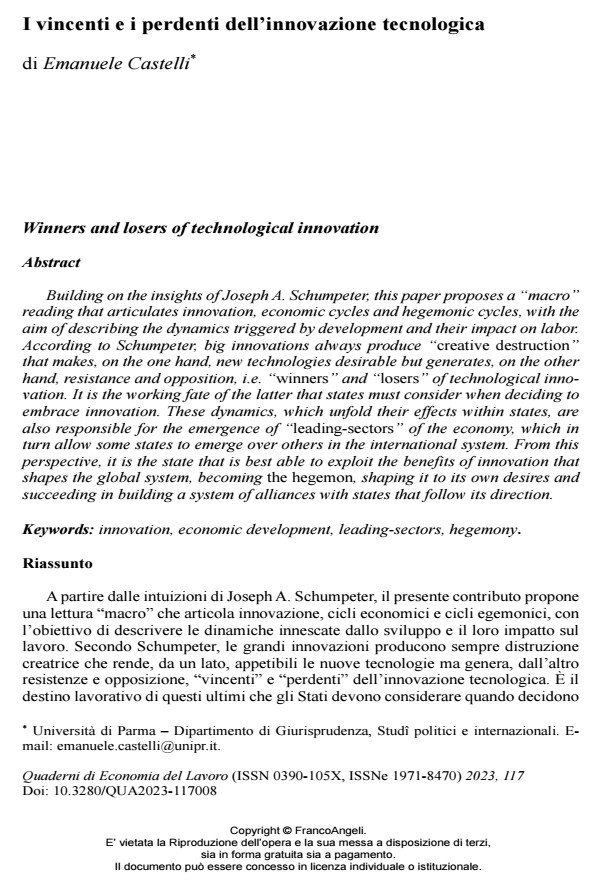
Building on the insights of Joseph A. Schumpeter, this paper proposes a “macro” reading that articulates innovation, economic cycles and hegemonic cycles, with the aim of describing the dynamics triggered by development and their impact on labor. According to Schumpeter, big innovations always produce “creative destruction” that makes, on the one hand, new technologies desirable but generates, on the other hand, resistance and opposition, i.e. “winners” and “losers” of technological innovation. It is the working fate of the latter that states must consider when deciding to embrace innovation. These dynamics, which unfold their effects within states, are also responsible for the emergence of “leading-sectors” of the economy, which in turn allow some states to emerge over others in the international system. From this perspective, it is the state that is best able to exploit the benefits of innovation that shapes the global system, becoming the hegemon, shaping it to its own desires and succeeding in building a system of alliances with states that follow its direction.
Keywords: innovation, economic development, leading-sectors, hegemony.
- Acemoglu D., Robinson J.A. (2000). Political losers as a barrier to economic development. American Economic Review, 90(2): 126-130.
- Acemoglu D., Robinson J.A. (2012). Why nations fail: the origins of power, prosperity, and poverty. New York: Crown Business (trad. it: Perché le nazioni falliscono. Alle origini di potenza, prosperità e povertà. Milano: Il Saggiatore, 2013).
- Allison G. (2017). Destined for war. Can America and China Escape Thucydides’s Trap. Boston: Houghton Mifflin Harcourt (trad. it: Destinati alla guerra, Roma: Fazi, 2018).
- Arrighi G. (1994). The long twentieth century: Money, power, and the origins of our times. Londra: Verso (trad. it: Il lungo XX secolo, Milano: Il Saggiatore, 2014).
- Arrighi G. (2007). Adam Smith in Beijing: lineages of the 21st century. Londra: Verso (trad. it: Adam Smith a Pechino, Milano: Feltrinelli, 2008).
- Banca Mondiale (2022). Four Decades of Poverty Reduction in China: Drivers, Insights for the World, and the Way Ahead. Washington, DC: World Bank. Testo disponibile al sito: https://thedocs.worldbank.org/en/doc/bdadc16a4f5c1c88a839c0f905cde802-0070012022/original/Poverty-Synthesis-Report-final.pdf.
- Coker C. (2019). The rise of the civilizational state. New York: John Wiley & Sons. (trad. it: Lo scontro degli Stati-civilità, Roma; Fazi, 2020).
- Dian M. (2021). La Cina, gli Stati Uniti e il futuro dell’ordine internazionale. Bologna: il Mulino.
- Gat A. (2017). The Causes of War and the Spread of Peace: But Will War Rebound?. Oxford: Oxford University Press.
- Gilpin R. (1981). War and Change in World Politics. Cambridge: Cambridge University Press.
- Greif A. (2006). Institutions and the path to the modern economy: Lessons from medieval trade. Cambridge: Cambridge University Press.
- Greif A. (2008). Commitment, Coercion and Markets: The Nature and Dynamics of Institutions Supporting Exchange. In: Ménard C. e Shirley M.M., a cura di, Handbook of New Institutional Economics. Berlino: Springer.
- Greif A., Kiesling L., Nye J.V., a cura di (2015). Institutions, innovation, and industrialization: Essays in economic history and development. Princeton: Princeton University Press.
- Harari Y. N. (2017). Sapiens. Da animali a dèi: Breve storia dell’umanità. Roma: Giunti.
- Inglehart R., Welzel C. (2005). Modernization, cultural change, and democracy: the human development sequence. Cambridge: Cambridge University Press.
- Kennedy A.B., Lim D.J. (2018). The innovation imperative: technology and US – China rivalry in the twenty-first century. International Affairs, 94(3): 553-572.
- Kindleberger C.P. (1996). World economic primacy: 1500-1990. Oxford: Oxford University Press (trad. it: I primi del mondo: l’egemonia economica dalla Venezia del Quattrocento al Giappone di oggi. Milano: Donzelli, 1997).
- Kuznets S.S. (1934). National Income, 1929-1932. In: National Income, 1929-1932, pp. 1-12. NBER.
- Kuznets S.S. (1965). Toward a theory of economic growth. New York: Norton & Co. (trad. it Verso una teoria dello sviluppo economico: riflessioni sullo sviluppo economico delle nazioni moderne. Torino: ISEDI, 1973).
- Lucarelli S. (2020). Cala il sipario sull’ordine liberale? Crisi di un sistema che ha cambiato il mondo. Milano: Vita & Pensiero.
- Mazzucato M. (2013). The Entrepreneurial State: Debunking Public vs. Private Sector Myths. Londra: Anthem Press (trad. it: Lo stato innovatore, Roma-Bari: Laterza, 2014).
- Modelski G., Thompson W.R. (1996). Leading sectors and world powers: the coevolution of global politics and economics. Columbia: Univ of South Carolina Press.
- Mokyr J. (1992). The lever of riches: Technological creativity and economic progress. Oxford: Oxford University Press (trad. it: La leva della ricchezza. Creatività tecnologica e progresso economico. Bologna: il Mulino 1995).
- North D.C. (1981). Structure and change in economic history. New York: Norton.
- North D.C. (1990). Institutions, institutional change, and economic performance. Cambridge: Cambridge University Press (trad. it: Istituzioni, cambiamento istituzionale, evoluzione dell’economia. Bologna: il Mulino, 1994).
- Olson M. (1982). The Rise and Decline of Nations: Economic Growth, Stagflation, and Social Rigidities. New Haven: Yale University Press (trad. it: Ascesa e declino delle nazioni. Bologna: il Mulino, 1984).
- Olson M. (2000). Power and prosperity: outgrowing communist and capitalist dictatorships. New York: Basic Books (trad. it: Potere e mercati: regimi politici e crescita economica. Milano: UBE, 2001).
- Parsi V.E. (2022). Titanic. Naufragio o cambio di rotta per l’ordine liberale. Bologna: il Mulino.
- Perez C. (2002). Technological Revolutions and Financial Capital: The Dynamics of Bubbles and Golden Ages. Northampton: Edward Elgar Publishing.
- Pollard S. (1973). Industrialization and the European economy. The Economic History Review, 26(4): 636-648.
- Rostow W.W. (1960). The stages of economic growth. Cambridge: Cambridge University Press (trad. it: Gli stadi dello sviluppo economico, Torino: Einaudi, 1962).
- Schumpeter J.A. (1939). Business cycles. New York: McGraw-Hill (trad. it: Il processo capitalistico: i cicli economici, Torino: Bollati Boringhieri, 1977).
- Schumpeter J.A. (1942). Socialism, capitalism and democracy. New York: Harper and Brothers.
- Schumpeter J.A. (1947). The creative response in economic history. The journal of economic history, 7(2): 149-159.
- Thompson W.R. (1990). Long waves, technological innovation, and relative decline. International Organization, 44(2): 201-233.
- Väyrynen R. (1983). Economic fluctuations, technological innovations and the arms race in a historical perspective. Cooperation and Conflict, 18(3): 135-159.
- Wijnberg N.M. (1992). The Industrial Revolution and Industrial Economics. Journal of European Economic History, 21 (1): 153-167.
Emanuele Castelli, I vincenti e i perdenti dell’innovazione tecnologica in "QUADERNI DI ECONOMIA DEL LAVORO" 117/2023, pp 185-206, DOI: 10.3280/QUA2023-117008