From Newton to the Gravity Model in Economics and Social Sciences

Titolo Rivista HISTORY OF ECONOMIC THOUGHT AND POLICY
Autori/Curatori Luigi Capoani
Anno di pubblicazione 2025 Fascicolo 2025/2
Lingua Inglese Numero pagine 39 P. 57-95 Dimensione file 255 KB
DOI 10.3280/SPE2025-002003
Il DOI è il codice a barre della proprietà intellettuale: per saperne di più clicca qui

Qui sotto puoi vedere in anteprima la prima pagina di questo articolo.

Se questo articolo ti interessa, lo puoi acquistare (e scaricare in formato pdf) seguendo le facili indicazioni per acquistare il download credit. Acquista Download Credits per scaricare questo Articolo in formato PDF
Anteprima articolo

FrancoAngeli è membro della Publishers International Linking Association, Inc (PILA)associazione indipendente e non profit per facilitare (attraverso i servizi tecnologici implementati da CrossRef.org) l’accesso degli studiosi ai contenuti digitali nelle pubblicazioni professionali e scientifiche

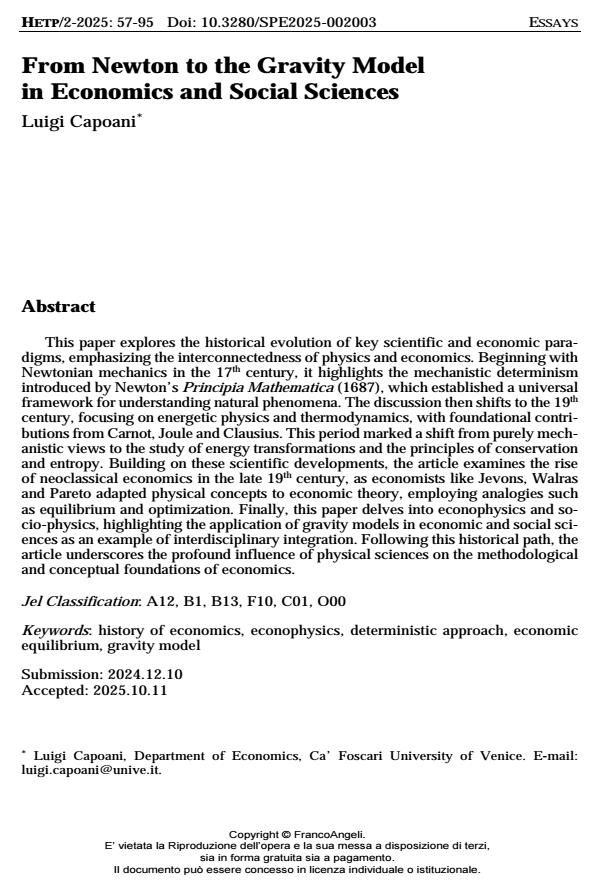
This paper explores the historical evolution of key scientific and economic paradigms, emphasizing the interconnectedness of physics and economics. Beginning with Newtonian mechanics in the 17th century, it highlights the mechanistic determinism introduced by Newton’s Principia Mathematica (1687), which established a universal framework for understanding natural phenomena. The discussion then shifts to the 19th century, focusing on energetic physics and thermodynamics, with foundational contributions from Carnot, Joule and Clausius. This period marked a shift from purely mechanistic views to the study of energy transformations and the principles of conservation and entropy. Building on these scientific developments, the article examines the rise of neoclassical economics in the late 19th century, as economists like Jevons, Walras and Pareto adapted physical concepts to economic theory, employing analogies such as equilibrium and optimization. Finally, this paper delves into econophysics and socio-physics, highlighting the application of gravity models in economic and social sciences as an example of interdisciplinary integration. Following this historical path, the article underscores the profound influence of physical sciences on the methodological and conceptual foundations of economics.

Parole chiave:history of economics, econophysics, deterministic approach, economic equilibrium, gravity model

Jel codes:A12, B1, B13, F10, C01, O00

  1. Anderson P. W. 1972. More is different: broken symmetry and the nature of the hierarchical structure of science. Science, 177(4047), 393-396.
  2. Arthur W. B. 2013. Complexity Economics: A Different Framework for Economic Thought. SFI Working paper.
  3. Arthur W. B. 2021. Foundations of complexity economics. Nature Physics,136-145.
  4. Bachelier L. 1900. Théorie de la spéculation, Annales Scientifiques de l’École Normale Supérieure, 3(17), 21-86,
  5. Bahreini J. Monfared M. and Razmi H. 2020. An Analytical and Philosophical Investigation of the Concept of Determinism in Physics,
  6. Baier S. L. and Bergstrand J. H. 2009. Estimating the effects of free trade agreements on international trade flows using matching econometrics. Journal of International Economics, 77(1), 63-76.
  7. Barabasi A. L. 2002. Linked: The new science of networks. Perseus Books.
  8. Bianchi P. and Labory S. 2022. Dynamic gravitation and structural dynamics: From Smith to Modern theory, Structural Change and Economic Dynamics, 60(C), 90-98.
  9. Blaug M. 1980. The Methodology of Economics. Cambridge, CUP.
  10. Boccaletti S., Latora V., Moreno Y., Chavez M. and Hwang D. 2006. Complex networks: Structure, robustness and function. Physics Reports, 424(4-5), 175-308.
  11. Bohr N. 1913. On the Constitution of Atoms and Molecules. Philosophical Magazine, 26(151), 1-25.
  12. Bohr N. 1949. Discussions with Einstein on Epistemological Problems in Atomic Physics. In Einstein A. (ed). The Value of Knowledge: A Miniature Library of Philosophy. Marxists Internet Archive. -- https://www.example.com/marxists-internet-archive.
  13. Bozsaky D. 2010. The Historical Development of Thermodynamics. Acta Technica Jaurinensis, 3, 3-15.
  14. Bouchaud J. P. 2008. Economics needs a scientific revolution. Nature, 455(7217), 1181-118,
  15. Bouchaud J. P. 2009. The (unfortunate) complexity of the economy. Physics World, 22(04), 28, DOI: 10.1088/2058-7058/22/04/39
  16. Buchanan M. 2018. Witness the fitness. Doctoral dissertation, Nature Publishing Group,
  17. Carrothers G. A. P. 1955. An Historical Review of the Gravity and Potential Concepts of Human Interaction, Journal of the American Institute of Planners, 22(2), 94-10, DOI: 10.1080/01944365608979229
  18. Cassirer E. 1942. Galileo: A New Science and a New Spirit. The American Scholar, 12(1), 5-19, -- http://www.jstor.org/stable/41203634.
  19. Chakrabarti B. 2005. Econophys-Kolkata: A Short Story. Springer, Milano, DOI: 10.1007/88-470-0389-X_26
  20. Comte A. 1822. Plan des travaux scientifiques nécessaires pour réorganiser la société. Paris, Sociological Publishing.
  21. Comte A. 1854. System of Positive Polity, or Treatise on Sociology, Vol. 4: Instituting the Religion of Humanity, New York, Burt Franklin, 1966.
  22. Cournot A. A. 1838. Recherches sur les principes mathématiques de la théorie des richesses. L. Hachette, Paris.
  23. Cournot A. A. 1843. Exposition de la théorie des chances et des probabilités. L. Hachette, F. Didot, Paris
  24. Cugliandolo L. F. 2013. Out of equilibrium dynamics of classical and quantum complex systems. Comptes Rendus de Physique, 14(8), 685-699,
  25. De Oliveira M. J. 2018. Elementary concepts and fundamental laws of the theory of heat. Brazilian Journal of Physics, 48(3), 299-313.
  26. Dehmamy N., Buldyrev S. V. Havlin S., Stanley H. E. and Vodenska I. 2014. Classical mechanics of economic networks. arXiv, Risk Management.
  27. Dornbusch R., Fischer S. and Startz R. 1978. Macroeconomics. McGraw-Hill.
  28. Dosi G. and Roventini, A., 2019. More is different ... and complex!: The case for agent-based macroeconomics. LEM Working Paper Series, 01, 1-37.
  29. Dostaler G. 2008. Les lois naturelles en économie. Émergence d’un débat. L’Homme et la société, (4), 71-92.
  30. Encyclopédie Larousse Auguste Comte. -- https://www.larousse.fr/encyclopedie/personnage/Auguste_Comte/114286.
  31. Estrada N. 2014. The structure of complex networks: Theory and applications. Oxford University Press.
  32. Foley D. K. 1990. Recent Developments in Economic Theory. Social Research, 57(3), 665-87 -- http://www.jstor.org/stable/40970608.
  33. Foley V. 1975. Smith and the Greeks: A Reply to Professor McNulty’s Comments, History of Political Economy, 7, 379-89.
  34. Fullbrook E. 2012. To observe or not to observe: Complementary pluralism in physics and economics. Real-World Economics Review, 62(4), 20-28.
  35. Galam S. 1982. Sociophysics: A review of Galam models. Journal of Mathematical Sociology, 9(1), 1-13.
  36. Galam S. 2012. Sociophysics: A Physicist’s Modeling of Psycho-political Phenomena. Springer, New York.
  37. Gallegati M., Keen S., Lux T. and Ormerod P. 2006. Worrying trends in econophysics. Physica A: Statistical Mechanics and its Applications, 370(1), 1-6.
  38. Gay P. 1954. The Enlightenment in the History of Political Theory. Political Science Quarterly, 69(3), 374-389, DOI: 10.2307/2145276
  39. Gould P. 1985. The Geographer at Work. London, Routledge.
  40. Halley E. 1693. An estimate of the degrees of the mortality of mankind; drawn from curious tables of the births and funerals at the city of Breslaw; with an attempt to ascertain the price of annuities upon lives. Philosophical Transactions of the Royal Society of London, 17(196), 596-610,
  41. Hausmann R. and Hidalgo C. A. 2013. The atlas of economic complexity: mapping paths to prosperity. The MIT Press. -- https://growthlab.cid.harvard.edu/
  42. files/growthlab/files/atlas_2013_partpdf.
  43. Herfindahl O. 1950. Concentration in the U.S. Steel Industry, Dissertation. New York, Columbia University
  44. Hetherington N. S. 1983. Isaac Newton’s Influence on Adam Smith’s Natural Laws in Economics. Journal of the History of Ideas, 44(3), 497-505, DOI: 10.2307/2709178
  45. Hidalgo C. A. 2021. Economic complexity theory and applications. Nature Reviews Physics, 3(2), 92-113.
  46. Hidalgo C. A. and Haussman R. 2009. The building blocks of economic complexity. Proceedings of the National Academy of Sciences 106(26), 10570-10575. Si veda il sito curato dagli autori: -- https://atlas.cid.harvard.edu/.
  47. Hillier B. 2005. Between social physics and phenomenology. In: (Proceedings) Fifth Space Syntax Symposium. Delft, The Netherlands.
  48. Hirschman A. O. 1958. The Strategy of Economic Developmen. Yale University Press.
  49. Holcombe R. G. 2009. A reformulation of the foundations of welfare economics. Rev Austrian Econ, 22, 209-224,
  50. Hume D. 1711-1776. A treatise of human nature: being an attempt to introduce the experimental method of reasoning into moral subjects. London, printed for John Noon.
  51. Ingrao B. and Israel G. 1987. La mano invisibile. Bari, Laterza.
  52. Isard W. 1954. Location Theory and Trade Theory: Short-Run Analysis. The Quarterly Journal of Economics, 68(2), 305-20, DOI: 10.2307/1884452
  53. Isard W. 1956. Location and space-economy: A general theory relating to industrial location, market areas, land use, trade, and urban structure. MIT Press.
  54. Isard W. 1960. Methods of Regional Analysis: an Introduction to Regional Science. Cambridge, MIT Press.
  55. Isard W. and Capron W. M. 1949. The Future Locational Pattern of Iron and Steel Production in the United States. Journal of Political Economy, 57(2), 118-133. -- http://www.jstor.org/stable/1825186.
  56. Isard W. and Freutel G. 1954. Regional and National Product Projections and Their Interrelations. In NBER (ed.). Long-Range Economic Projection (Volume 16, pp 427-72). Princeton University Press, DOI: 10.1515/9781400876174-01
  57. Isard W. and Peck M. J. 1954. Location Theory and International and Interregional Trade Theory. The Quarterly Journal of Economics, 68(1), 97, DOI: 10.2307/1881920
  58. Isard W., Smith T., Isard P., Hsiung Tung T. and Dacey M. 1969. The General Theory: Social, Political, Economic, and Regional with Particular Reference to Decision-Making Analysis. Cambridge, MIT Press, DOI: 10.1086/260025
  59. Isard W. 1986. Reflections on the relevance of integrated multi-region models: Lessons from Physics. Regional Science and Urban Economics, 16(2), 165-180.
  60. Isard W. 1999, Regional science: Parallels from physics and chemistry. Papers in Regional Science, 78(1), 5-20.
  61. Jahoda G. 2015. Quetelet and the emergence of the behavioral sciences. SpringerPlus 4(473), 1-10,
  62. Jovanovic F. 2022. Econophysics: An introduction. Cambridge University Press.
  63. Jovanovic F. and Schinckus C. 2017. Econophysics and sociophysics and financial economics: An emerging dialogue. Oxford University Press.
  64. Justin Y. L. 2014. Industrial Policy Revisited: A New Structural Economical perspective. China Economics Perspective, 7(3), 382-396.
  65. Jusup M. et al. 2022. Social physics. Physics Reports, 948, 1-148,
  66. Keen S. 2011. Debunking Economics: The Naked Emperor Dethroned? Zed Books.
  67. Keynes J. M. 1924. Alfred Marshall, 1842-1924, The Economic Journal, 34 (135), 321-32.
  68. Koyré A. 1965. Newtonian Studies. Harvard University Press,
  69. Koyré A. 1978. Galileo studies (J. Mepham, Trans.). Harvester Press. (Original work published 1939).
  70. Kutner R., Ausloos M., Grech D., Di Matteo T., Schinckus C. and Stanley H.E. 2019. Econophysics and sociophysics: Their milestones & challenges. Physica A: Statistical Mechanics and its Applications, 516, 240-253.
  71. Kutner R., Schinckus C. and Stanley H. E. 2022. Three Risky Decades: A Time for Econophysics and sociophysics? Entropy, 24, 627,
  72. Labini F. S. 2016. Rischio e previsione: cosa può dirci la scienza sulla crisi. Bari-Roma, Laterza.
  73. Labini F. S. 2021. Fisica ed economia: da Newton ai sistemi complessi. Kritica Economica. -- Retrieved from https://kriticaeconomica.com/fisica-ed-economia-sistemi-complessi/?fbclid=IwAR1qKJt4z-QZkZdCNQhtufkUT9j64OG7nm5JJ0jqbD9PE_k8LZfaafA9mmg.
  74. Louth J. 2011. From Newton to Newtonianism: Reductionism and the development of the social sciences. Emergence: Complexity and Organization. 13. 63-83. -- https://www.researchgate.net/publication/286867966_From_Newton_to_Newtonianism_Reductionism_and_the_development_of_the_social_sciences.
  75. Majorana E. 1942. Il valore delle leggi statistiche nella fisica e nelle scienze sociali. Scientia, 36(71).
  76. Majorana E. and Mantegna R. N. 2006. The value of statistical laws in physics and social sciences. In Bassani G. F. and Council of the Italian Physical Society (eds.). Ettore Majorana Scientific Papers. Springer, Berlin, Heidelberg, DOI: 10.1007/978-3-540-48095-2_11
  77. Mäki U. and Marchionni C. 2010. Is geographical economics imperializing economic geography? Journal of Economic Geography, 11(4), 645-665,
  78. Mirowski P. 1984. Physics and the ‘marginalist revolution.’ Cambridge Journal of Economics, 8(4), 361-379.
  79. Mirowski P. and Cook P. 1990. Walras’ “Economics and Mechanics”: Translation, Commentary, Context. In W. J. Samuels (Ed.), Economics As Discourse (pp. 189-224). Springer Science+Business Media.
  80. Mokyr J. 2003. Mercantilism, the Enlightenment, and the Industrial Revolution, -- https://faculty.wcas.northwestern.edu/jmokyr/stockholm.PDF.
  81. Newman M. E. J. 2003. The Structure and Function of Complex Networks. SIAM Review, 45(2), 167-256, DOI: 10.1137/S003614450342480
  82. Newman M. E. J. 2010. Networks: An introduction. Oxford University Press.
  83. Newton I. 1675. Letter from Sir Isaac Newton to Robert Hooke. Historical Society of Pennsylvania.
  84. Newton I. 1687. Philosophiae naturalis principia mathematica.
  85. Pantaleoni M. 1908. Leone Walras – Autobiografia, Giornale degli Economisti, 37, 603-610 -- http://www.jstor.org/stable/23222037.
  86. Pareto V. and Flux A. W 1896. Cours d’Economie Politique, tome premier, The Economic Journal, 6(22), 249-253, DOI: 10.2307/2956507
  87. Philbrick A. T. 1973. A Short History of the Development of the Gravity Model. Australian Road Research 5(4), 40-5. -- Retrieved from https://trid.trb.org/view/140675.
  88. Quetelet A. 1835. A Treatise on Man and the Development of his Faculties. Cambridge, Cambridge University Press.
  89. Rahman J. and Dimand R. 2021. The Emergence of Geographical Economics: at the Contested Boundaries of Economics, Geography and Regional Science, Journal of the History of Economic Thought, 43(2), 241-261.
  90. Ricardo D. 1817. On the Principles of Political Economy and Taxation. London, John Murray.
  91. Rosenberg A. 1992. Economics: Mathematical politics or science of less-developed societies?. University of Chicago Press.
  92. Saint-Simon de C. H. 1803. Lettres d’un habitant de Genève à ses contemporains. Paris, Hachette Livre.
  93. Saint-Simon de C. H. 1814. Réorganisation de la société européenne ou De la nécessité et des moyens. Paris, Hachette Livre.
  94. Savoiu G. and Iorga-Siman I. 2008. Some relevant econophysics’ moments of history, definitions, methods, models and new trends. Romanian Economic and Business Review, 3(3), 29-41.
  95. Sussan R. 2011. L’économie comme science “complexe”, Le Monde, -- https://www.lemonde.fr/technologies/article/2011/04/01/l-economie-comme-science-complexe_1502008_651865.html.
  96. Sbardella A., Zaccaria A. et al. 2021. “Behind the Italian Regional Divide: An Economic Fitness and Complexity Perspective”. LEM Papers Series 2021/30, Laboratory of Economics and Management (LEM), Sant’Anna School of Advanced Studies, Pisa, Italy.
  97. Schiemann G. 2007. Physics and magic. Disenchanting nature.
  98. Schumpeter J. A. L’essenza e i principi fondamentali dell’economia teorica.
  99. Serrano M. A., Boguna M. and Vespignani A. 2003. Topology of the world trade web. Physical Review E, 68(1), 01510.
  100. Simini F., González M. C., Maritan A. and Barabási A. L. 2012. A universal model for mobility and migration patterns. Nature, 484(7392), 96-100, nature10856.
  101. Smith A. 1776. An Inquiry into the Nature and Causes of the Wealth of Nations. London, W. Strahan and T. Cadell.
  102. Sornette D. 2004. Why stock markets crash: Critical events in complex financial systems. Princeton University Press.
  103. St. John J. A. (ed.) 1913. The Philosophical Works of John Locke St. John. London, G. Bell and Sons.
  104. Stanley H. E. and Mantegna R. N. 2000. Introduction to Econophysics: Correlations and Complexity in Finance. Cambridge University Press.
  105. Stauffer D. and Aharony A. 2011. Introduction to percolation theory. Taylor & Francis.
  106. Stewart J. Q. 1941. An inverse distance variation for certain social influences. Science, 93(2404), 89-90,
  107. Stewart J. Q. 1947. Empirical Mathematical Rules concerning the Distribution and Equilibrium of Population. Geographical Review, 37(3), 461-485, DOI: 10.2307/211132
  108. Stewart J. Q. 1948. Demographic Gravitation: Evidence and Applications. Sociometry, 11(1-2), 31-58, DOI: 10.2307/2785468
  109. Stewart J.Q. 1950. The Development of Social Physics. American Journal of Physics, 18, 239-53, DOI: 10.1119/1932559
  110. Stigler G. J. 1948. Review of Foundations of Economic Analysis, by P. A. Samuelson. Journal of the American Statistical Association, 43(244), 603-605, DOI: 10.2307/2280713
  111. Tacchella A., Cristelli et al. 2012. A New Metrics for Countries’ Fitness and Products’ Complexity. Scientific Reports.
  112. Taqqu M. S. 2001. Bachelier and his times: a conversation with Bernard Bru. Finance and Stochastics, 5, 3-32.
  113. Torre A. and Wallet F. (eds.). 2014. Regional development and proximity relations. Cheltenham, Edward Elgar.
  114. Tusset G. 2018. From Galileo to modern economics: The Italian Origins of Econophysics and sociophysics. Springer International Publishing.
  115. Van Noorden R. 2015. Physicists make ‘weather forecasts’ for economies. Nature, 1038, 16963,
  116. Von Linné C. 1752. Principles of Oikonomia.
  117. Walras L. 1874. Eléments d’économie politique pure ou théorie de la richesse sociale, Lausanne, Corbaz.
  118. Weaver W. 1948. Science and complexity. Sigma Xi, The Scientific Research Honor Society, 36, 536-544.

Luigi Capoani, From Newton to the Gravity Model in Economics and Social Sciences in "HISTORY OF ECONOMIC THOUGHT AND POLICY" 2/2025, pp 57-95, DOI: 10.3280/SPE2025-002003