Descartes on Indignation, Envy, and Anger
Titolo Rivista RIVISTA DI STORIA DELLA FILOSOFIA
Autori/Curatori Simone Guidi
Anno di pubblicazione 2026 Fascicolo 2026/1
Lingua Italiano Numero pagine 28 P. 91-118 Dimensione file 194 KB
DOI 10.3280/SF2026-001007
Il DOI è il codice a barre della proprietà intellettuale: per saperne di più
clicca qui
Qui sotto puoi vedere in anteprima la prima pagina di questo articolo.
Se questo articolo ti interessa, lo puoi acquistare (e scaricare in formato pdf) seguendo le facili indicazioni per acquistare il download credit. Acquista Download Credits per scaricare questo Articolo in formato PDF
FrancoAngeli è membro della Publishers International Linking Association, Inc (PILA), associazione indipendente e non profit per facilitare (attraverso i servizi tecnologici implementati da CrossRef.org) l’accesso degli studiosi ai contenuti digitali nelle pubblicazioni professionali e scientifiche.
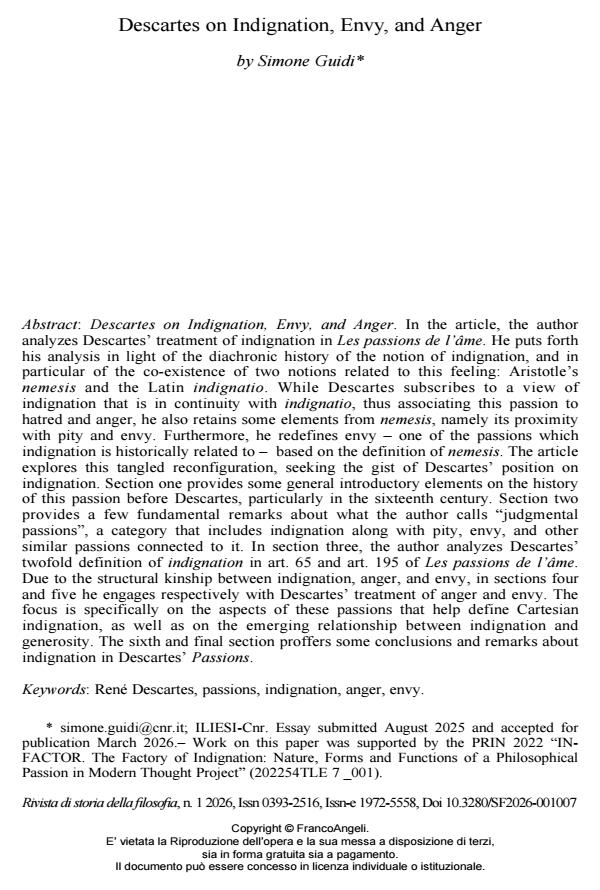
In the article, the author analyzes Descartes’ treatment of indignation in Les passions de l’âme. He puts forth his analysis in light of the diachronic history of the notion of indignation, and in particular of the co-existence of two notions related to this feeling: Aristotle’s nemesis and the Latin indignatio. While Descartes subscribes to a view of indignation that is in continuity with indignatio, thus associating this passion to hatred and anger, he also retains some elements from nemesis, namely its proximity with pity and envy. Furthermore, he redefines envy – one of the passions which indignation is historically related to – based on the definition of nemesis. The article explores this tangled reconfiguration, seeking the gist of Descartes’ position on indignation. Section one provides some general introductory elements on the history of this passion before Descartes, particularly in the sixteenth century. Section two provides a few fundamental remarks about what the author calls “judgmental passions”, a category that includes indignation along with pity, envy, and other similar passions connected to it. In section three, the author analyzes Descartes’ twofold definition of indignation in art. 65 and art. 195 of Les passions de l’âme. Due to the structural kinship between indignation, anger, and envy, in sections four and five he engages respectively with Descartes’ treatment of anger and envy. The focus is specifically on the aspects of these passions that help define Cartesian indignation, as well as on the emerging relationship between indignation and generosity. The sixth and final section proffers some conclusions and remarks about indignation in Descartes’ Passions.
Parole chiave:René Descartes, passions, indignation, anger, envy
Simone Guidi, Descartes on Indignation, Envy, and Anger in "RIVISTA DI STORIA DELLA FILOSOFIA" 1/2026, pp 91-118, DOI: 10.3280/SF2026-001007