Le Web survey. Aspetti metodologici per una ricerca di qualità
Titolo Rivista SALUTE E SOCIETÀ
Autori/Curatori Linda Lombi
Anno di pubblicazione 2014 Fascicolo 2014/3
Lingua Italiano Numero pagine 16 P. 39-54 Dimensione file 524 KB
DOI 10.3280/SES2014-003004
Il DOI è il codice a barre della proprietà intellettuale: per saperne di più
clicca qui
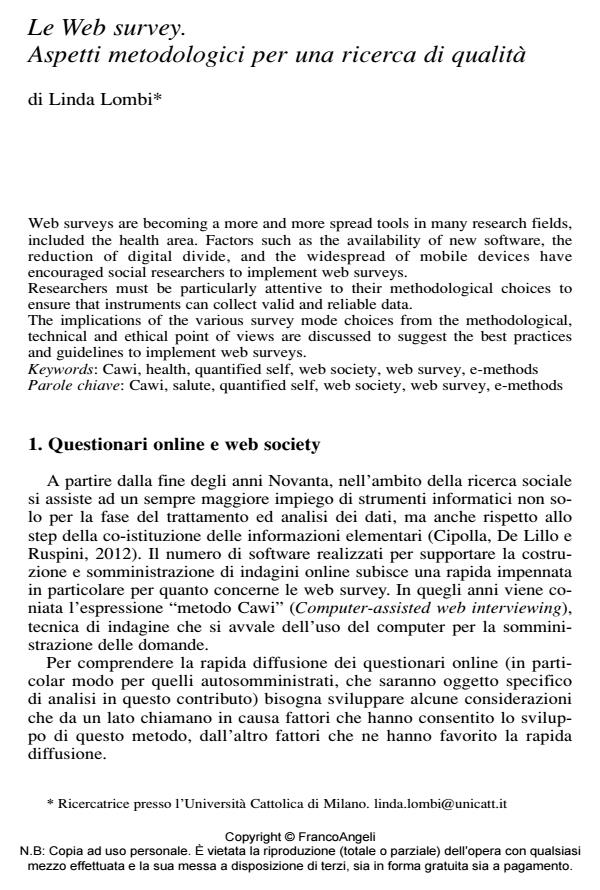
Qui sotto puoi vedere in anteprima la prima pagina di questo articolo.
Se questo articolo ti interessa, lo puoi acquistare (e scaricare in formato pdf) seguendo le facili indicazioni per acquistare il download credit. Acquista Download Credits per scaricare questo Articolo in formato PDF
FrancoAngeli è membro della Publishers International Linking Association, Inc (PILA), associazione indipendente e non profit per facilitare (attraverso i servizi tecnologici implementati da CrossRef.org) l’accesso degli studiosi ai contenuti digitali nelle pubblicazioni professionali e scientifiche.
Web surveys are becoming a more and more spread tools in many research fields, included the health area. Factors such as the availability of new software, the reduction of digital divide, and the widespread of mobile devices have encouraged social researchers to implement web surveys. Researchers must be particularly attentive to their methodological choices to ensure that instruments can collect valid and reliable data. The implications of the various survey mode choices from the methodological, technical and ethical point of views are discussed to suggest the best practices and guidelines to implement web surveys.
Parole chiave:Cawi, salute, quantified self, web society, web survey, e-methods
- Giarelli for the European Society for Health and Medical Sociology, eds. (2010). Comparative Research Methodologies in Health and Medical Sociology. Salute e Società, suppl. n. 2, IX
- Goritz A.S. (2006). Incentives in web studies: Methodological issues and a review. International Journal of Internet Science, 1: 58-70, DOI: 10.1177/0893930202000300
- Greene J., Speizer H. e Wiitala W. (2008). Telephone and web: mixed-mode challenge. Health services research, 43 (1 Pt 1), 230-48, DOI: 10.1111/j.1475-6773.2007.00747
- Heerwegh D., Loosveldt G. (2002). An Evaluation of the Effect of Response Formats on Data Quality in Web Surveys. Social Science Computer Review, 20(4): 471-484, DOI: 10.1177/08944393000180040
- Kaczmirek L. (2008). Internet Survey Software. In: Fielding N., Lee R.M., Blank R. eds., The Sage Handbook of Online Research Methods. Sage, London: 236-254
- Lupton D. (2013). Quantifying the body: monitoring and measuring health in the age of mHealth technologies. Critical Public Health, 23: 4: 393-403, DOI: 10.1080/09581596.2013.79493
- Manfreda K.L., Bosnjak M., Berzelak J., Haas I. e Vehovar V. (2008). Web surveys versus other survey modes. International Journal of Market Research, 50: 79-104
- Maturo A. (2007). Sociologia della malattia. Un’introduzione. Milano: FrancoAngeli
- Maturo A. (2012), La società bionica. Saremo sempre più belli, felici e artificiali? Milano: FrancoAngeli
- Moruzzi M. (2012), L’azienda ad Alta Comunicazione. Reti, fascicoli elettronici, emozioni e de-materializzazioni. Milano: FrancoAngeli
- Naithani P. (2012). Guidelines for developing a robust web survey. Advances in Information Technology and Management, 1(1), 20-23
- Niero M. (2008). La personalizzazione nella ricerca quantitativa. Milano: FrancoAngeli
- Rogers R. (2013). Digital Methods. Cambridge: The MIT Press
- Rolfson O., Salomonsson R., Dahlberg L.E., Garellick G. (2011). Internet-Based Follow-Up Questionnaire for Measuring Patient-Reported Outcome after Total Hip Replacement Surgery-Reliability and Response Rate. Value in Health, Vole lume 14, Issue 2, March-April 2011: 316-321, DOI: 10.1016/j.jval.2010.08.00
- Tourangeau R., Couper M.P., Steiger D.M. (2003). Humanizing self-administered surveys: Experiments on social presence in web and IVR surveys. Computers in Human Behavior, 19, 1-24, DOI: 10.1016/S0747-5632(02)00032-
- Vicente P., Reis E. (2010). Using Questionnaire Design to Fight Nonresponse Bias in Web Surveys. Social Science Computer Review, 28(2), 251-267, DOI: 10.1177/089443930934075
- Zuidgeest M., Hendriks M., Koopman L., Spreeuwenberg P., Rademakers J. (2011). A Comparison of a Postal Survey and Mixed-Mode Survey Using a Questionnaire on Patients’ Experiences With Breast Care. J Med Internet Res, Sep 27; 13(3): e68, DOI: 10.2196/jmir.124
- Bethlehem J., Biffignandi S. (2012). Handbook of Web Surveys. New Jersey: Wiley Best S.J., Brian S.K. (2008). Internet Survey Design. In: Fielding N., Lee R.M., Blank R., eds., The Sage Handbook of Online Research Methods. Sage, London: 217-235
- Braithwaite D., Emery J., De Lusignan S., Sutton S. (2003). Using the Internet to conduct surveys of health professionals: a valid alternative? Family Practice. Vol. 20, No. 5: 545-551, DOI: 10.1093/fampra/cmg50
- Christian L.M. e Dillman D.A. (2004). The influence of symbolic and graphical language manipulations on answers to self-administered questionnaires. Public Opinion Quarterly, 68: 57-80, DOI: 10.1093/poq/nfh004CipollaC.,acuradi(1998).Ilciclometodologicodellaricercasociale.FrancoAngeli:Milan
- Cipolla C., De Lillo A., Ruspini E., a cura di (2012). Il sociologo, le sirene e gli avatar. FrancoAngeli: Milano
- Cipolla C., Lombi L. (2013). Post-fazione. Mixed research ed e-methods: una prospettiva quasi obbligata verso il futuro. In: Cipriani R., Cipolla C., Losacco G., a cura di, La ricerca qualitativa fra tecniche tradizionali e e-method. Milano: FrancoAngeli: 236-252
- Cipolla C., Maturo A., a cura di (2014). Sociologia della salute e web society. Milano: FrancoAngeli
- Corposanto C. (2002). Il ciclo statistico della ricerca sociale. Milano: FrancoAngeli
- Corposanto C., Valastro A. (2014). Una questione di metodo. In: Corposanto C.,
- Valastro A., a cura di, Blog, Fb e TW. Fare ricerca quali-quantitativa online. Milano: Giuffrè
- Corposanto C., Molinari B. (2014). Survey e questionari online. In: Corposanto C., Valastro A., a cura di, op. cit.
- Couper M.P. (2000). Web surveys – A review of issues and approaches. Public Opinion Quarterly, 64: 464-494
- Denscombe M. (2006). Web-Based Questionnaires and the Mode Effect: An Evaluation Based on Completion Rates and Data Contents of Near-Identical Questionnaires Delivered in Different Modes. Social Science Computer Review, 24(2): 246-254. DOI: 10.1177/089443930528452
- Dillman D. A., Phelps G., Tortora R., Swift K., Kohrell J., Berck J. e Messer B. L. (2009). Response rate and measurement differences in mixed-mode surveys using mail, telephone, interactive voice response (IVR) and the Internet. Social Science Research, 38(1): 1-18, DOI: 10.1016/j.ssresearch.2008.03.00
- Eynon R., Fry J., Schroeder R. (2008). The Ethics of Internet research. In: Fielding N., Lee R.M., Blank R., eds., The Sage Handbook of Online Research Methods. Sage, London: 23-41
- Eysenbach G., Wyatt J. (2002), Using the Internet for Surveys and health research. Journal of Medical Internet Research, 4(2): e13, DOI: 10.2196/jmir.4.2.e13FanW.eYanZ.(2010).ComputersinHumanBehaviorFactorsaffectingresponseratesofthewebsurvey:Asystematicreview.ComputersinHumanBehavior,26(2):132-139,doi:10.1016/j.chb.2009.10.01
- Fricker R.D. (2008). Sampling Methods for Web and E-mail Surveys. In: Fielding N., Lee R.M., Blank R., eds., The Sage Handbook of Online Research Methods. Sage, London: 195-216
- Frippiat D., Marquis N. (2010). Web Survey in the Social Sciences: An Overview. Population-E, 65 (2), 285-312, DOI: 10.3917/pope.1002.028
- Fuchs M. (2009). Differences in the Visual Design Language of Paper-and-Pencil Surveys Versus Web Surveys: A Field Experimental Study on the Length of Response Fields in Open-Ended Frequency Questions. Social Science Computer Review, 27(2), 213-227, DOI: 10.1177/089443930832520
- Ganassali S. (2008). The Influence of the Design of Web Survey Questionnaires on the Quality of Responses. Survey Research Methods, 2(1): 21-32.
- Sport e devianza: uno studio esplorativo sul consumo di farmaci nello sport amatoriale Rosalba Altopiedi, Daniele Scarscelli, in SOCIOLOGIA DEL DIRITTO 3/2017 pp.185
DOI: 10.3280/SD2017-003008
Linda Lombi, Le Web survey. Aspetti metodologici per una ricerca di qualità in "SALUTE E SOCIETÀ" 3/2014, pp 39-54, DOI: 10.3280/SES2014-003004