Unintended consequences of tax incentives on the accounting quality of private firms
Titolo Rivista FINANCIAL REPORTING
Autori/Curatori Massimiliano Bonacchi, Luca Menicacci
Anno di pubblicazione 2025 Fascicolo 2025/2
Lingua Inglese Numero pagine 22 P. 91-132 Dimensione file 342 KB
DOI 10.3280/fr202519445
Il DOI è il codice a barre della proprietà intellettuale: per saperne di più
clicca qui
Qui sotto puoi vedere in anteprima la prima pagina di questo articolo.
Se questo articolo ti interessa, lo puoi acquistare (e scaricare in formato pdf) seguendo le facili indicazioni per acquistare il download credit. Acquista Download Credits per scaricare questo Articolo in formato PDF
FrancoAngeli è membro della Publishers International Linking Association, Inc (PILA), associazione indipendente e non profit per facilitare (attraverso i servizi tecnologici implementati da CrossRef.org) l’accesso degli studiosi ai contenuti digitali nelle pubblicazioni professionali e scientifiche.
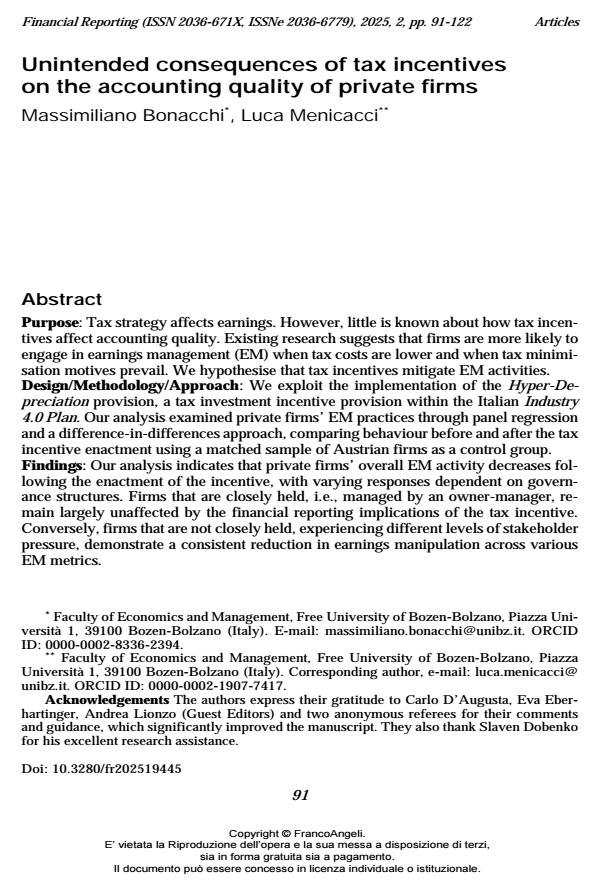
Purpose: Tax strategy affects earnings. However, little is known about how tax incen-tives affect accounting quality. Existing research suggests that firms are more likely to engage in earnings management (EM) when tax costs are lower and when tax minimi-sation motives prevail. We hypothesise that tax incentives mitigate EM activities. Design/Methodology/Approach: We exploit the implementation of the Hyper-De-preciation provision, a tax investment incentive provision within the Italian Industry 4.0 Plan. Our analysis examined private firms’ EM practices through panel regression and a difference-in-differences approach, comparing behaviour before and after the tax incentive enactment using a matched sample of Austrian firms as a control group. Findings: Our analysis indicates that private firms’ overall EM activity decreases fol-lowing the enactment of the incentive, with varying responses dependent on govern-ance structures. Firms that are closely held, i.e., managed by an owner-manager, re-main largely unaffected by the financial reporting implications of the tax incentive. Conversely, firms that are not closely held, experiencing different levels of stakeholder pressure, demonstrate a consistent reduction in earnings manipulation across various EM metrics. Originality/value: We provide novel insights into how tax incentives can influence accounting quality, an important yet understudied aspect of corporate taxation. We contribute to the accounting literature by demonstrating how governance structures can significantly influence firms’ responses to tax incentives in terms of EM. Practical implications: By highlighting the unintended consequences of tax invest-ment incentives, these findings have implications for policymakers when designing tax stimulus measures.
Parole chiave:tax incentives, earnings management, private firms, ownership structure
Jel codes:H25, H26, M41, M48, G32
- Hribar, P., & Collins, D. W. (2002). Errors in estimating accruals: Implications for empirical research. Journal of Accounting Research, 40(1), 105-34. DOI: 10.1111/1475-679X.00041
- Hulse, D. S., & Livingstone, J. R. (2010). Incentive effects of bonus depreciation. Journal of Accounting and Public Policy, 29, 578-603.
- André, P., & Di Pietra, R. (2023). The Evolution of Financial Statements Regula-tions in the Main European Countries. In Incollingo, A., & Lionzo, A. (Eds.), The European Harmonization of National Accounting Rules, Springer. DOI: 10.1007/978-3-031-42931-6_1
- Ashbaugh, H., Lafond, R., & Mayhew, B. W. (2003). Do Non-audit Services Com-promise Auditor Independence? Further Evidence. The Accounting Review, 78, 611-640.
- Badertscher, B. A., Katz, S. P., Rego, S. O., & Wilson, R. J. (2019). Conforming tax avoidance and capital market pressure. The Accounting Review, 94(6), 1-30.
- Ball, R. & Shivakumar, L. (2005). Earnings quality in UK private firms: comparative loss recognition timeliness. Journal of Accounting and Economics, 39(1), 83-128,
- Bar-Yosef, S., D’Augusta, C., & Prencipe, A. (2019). Accounting research on pri-vate firms: state of the art and future directions. The International Journal of Accounting, 54(02). DOI: 10.1142/S1094406019500070
- Beatty, A., & Harris, D. G. (1999). The effects of taxes, agency costs and information asymmetry on earnings management: A comparison of public and private firms. Review of Accounting Studies, 4(3), 299-326. DOI: 10.1023/A:1009642403312
- Bedendo, M., Garcia-Appendini, E., & Siming, L. (2020). Cultural preferences and firm financing choices. Journal of Financial and Quantitative Analysis, 55(3), 897-930. DOI: 10.1017/S0022109019000103
- Bedendo, M., Garcia-Appendini, E., & Siming, L. (2023). Managers’ cultural origin and corporate response to an economic shock. Journal of Corporate Finance, 80, 102412.
- Beuselinck, C., & Deloof, M. (2014). Earnings management in business groups: Tax incentives or expropriation concealment?. The International Journal of Account-ing, 49(1), 27-52.
- Beuselinck, C., Elfers, F., Gassen, J., & Pierk, J. (2021). Private firm accounting: the European reporting environment, data and research perspectives. Accounting and Business Research, 53(1), 38-82. DOI: 10.1080/00014788.2021.1982670
- Bonacchi, M., Marra, A. & Zarowin, P. (2019). Organisational Structure and Earn-ings Quality of Private and Public Firms. Review of Accounting Studies, 24(3), 1066-1113,
- Bratta, B., Romano, L., Acciari, P., & Mazzolari, F. (2020). The Impact of Digitali-sation Policies. Evidence from Italy’s Hyper-depreciation of Industry 4.0 Invest-ments. DF Working Paper n. 6 (June 2020).
- Burgstahler, D., & Dichev, I. (1997). Earnings management to avoid earnings de-creases and losses. Journal of Accounting and Economics, 24(1), 99-126.
- Burgstahler, D.C., Hail, C. & Leuz, C. (2006). The Importance of Reporting Incen-tives: Earnings management in European Private and Public Firms. The Account-ing Review, 81(5), 983-1016.
- Calegari, M. J. (2000). The effect of tax accounting rules on capital structure and discretionary accruals. Journal of Accounting and Economics, 30(1), 1-31. DOI: 10.1016/S0165-4101(00)00027-6
- Carey, P., & Simnett, R. (2006). Audit Partner Tenure and Audit Quality. The Ac-counting Review, 81, 653-676.
- Chen, S., Chen, X., Cheng, Q., & Shevlin, T. (2010). Are family firms more tax aggressive than non-family firms?. Journal of Financial Economics, 95(1), 41-61.
- Chen, S., Chen, X., & Cheng, Q. (2014). Conservatism and equity ownership of the founding family. European Accounting Review, 23(3), 403-430. DOI: 10.1080/09638180.2013.814978
- Cohen, D. S., Hansen, D.P., & Hassett, K. A. (2002). The effects of temporary partial expensing on investment allowances in the United States. National Tax Journal, 55, 457-466.
- Cohen, D. S., & Cummins, J. (2006). A retrospective evaluation of the effects of temporary partial expensing. Finance and Economics Discussion Series, Divi-sions of Research & Statistics and Monetary Affairs, Federal Reserve Board, Washington, DC.
- Cohen, D. A., Dey, A., & Lys, T. Z. (2008). Real and accrual-based earnings man-agement in the pre-and post-Sarbanes-Oxley periods. The Accounting Review, 83(3), 757-787.
- Coppens, L. & Peek, E. (2005), An analysis of earnings management by European private firms. Journal of International Accounting, Auditing and Taxation, 14(1), 1-17,
- D’Augusta C. (2023). Accrual quality, investor reaction to earnings, and the con-firmatory role of sales news. Financial Reporting, 2, 97-121. DOI: 10.3280/FR2023-002004
- Dalla Via, N. (2024). The dynamics of cost behavior: Unveiling sticky costs in pri-vate companies. Financial Reporting, 2, 13-46. DOI: 10.3280/FR2024-002002
- Dargenidou, C., McLeay, S., & Raonic, I. (2007). Ownership, investor protection and earnings expectations. Journal of Business Finance and Accounting, 34(1-2), 247-268.
- De Simone, L., Nickerson, J., Seidman, J. K., & Stomberg, B. (2020). How reliably do empirical tests identify tax avoidance? Contemporary Accounting Research, 37(3), 1536-1561. DOI: 10.1111/1911-3846.12573
- Dechow, P. M., Sloan, R. G., & Sweeney, A. P. (1995). Detecting earnings manage-ment. The Accounting Review, 70(2), 193-225.
- Dechow, P. M., Richardson, S. A., & Tuna, I. (2003). Why are earnings kinky? An examination of the earnings management explanation. Review of accounting studies, 8, 355-384. DOI: 10.1023/A:1024481916719
- House, C. L., & Shapiro, M. D. (2008). Temporary investment tax allowances: The-ory with evidence from bonus depreciation. American Economic Review, 98, 737-768.
- Dechow, P., Ge, W., & Schrand, C. (2010). Understanding earnings quality: A re-view of the proxies, their determinants and their consequences. Journal of Ac-counting and Economics, 50(2-3), 344-401.
- Desai, M. A., & Dharmapala, D. (2006). Corporate tax avoidance and high-powered incentives. Journal of Financial Economics, 79(1), 145-179.
- Doukakis, L. C. (2014). The effect of mandatory IFRS adoption on real and accrual-based earnings management activities. Journal of Accounting and Public Policy, 33(6), 551-572.
- Dyreng, S. D., Hanlon, M., & Maydew, E. L. (2012). Where do firms manage earn-ings?. Review of Accounting Studies, 17, 649-687.
- Eberhartinger, E. L. (1999). The impact of tax rules on financial reporting in Ger-many, France, and the UK. The International Journal of Accounting, 34(1), 93-119. DOI: 10.1016/S0020-7063(99)80005-3
- Edgerton, J. (2010). Investment incentives and corporate tax asymmetries. Journal of Public Economics, 94(11-12), 936-952. DOI: 10.3386/w18472.
- Eichfelder, S., Jacob, M. & Schneider, K. (2023). Do tax incentives affect invest-ment quality? Journal of Corporate Finance, 80.
- EY (2019). Worldwide Corporate Tax Guide 2019, available at: https://www.ey.com/content/dam/ey-unified-site/ey-com/en-gl/technical/tax/ documents/ey-worldwide-corporate-tax-guide-2019.pdf (accessed 9 May 2025).
- Fama, E. F., & Jensen, M. C. (1983). Agency problems and residual claims. The Journal of Law and Economics, 26(2), 327-349. DOI: 10.1086/467038
- Frank, M. M., Lynch, L. J., & Rego, S. O. (2009). Tax reporting aggressiveness and its relation to aggressive financial reporting. The Accounting Review, 84(2), 467-496.
- Garrod, N., Kosi, U. & Valentincic, A. (2008). Asset write-offs in the absence of agency problems. Journal of Business Finance and Accounting, 35(3-4), 307-330.
- Givoly, D., Hayn, C. K., & Katz, S. P. (2010). Does public ownership of equity improve earnings quality?. The Accounting Review, 85(1), 195-225.
- Goncharov, I., & Zimmermann, J. (2006). Earnings management when incentives compete: the role of tax accounting in Russia. Journal of International Account-ing Research, 5(1), 41-65.
- Graham, J. R., Harvey, C. R., & Rajgopal, S. (2005). The economic implications of corporate financial reporting. Journal of Accounting and Economics, 40(1-3), 3-73.
- Grote, G. (2012). The South Tyrol question, 1866-2010: From national rage to re-gional state. Peter Lang International Academic Publishers. DOI: 10.3726/978-3-0353-0303-2
- Guenther, D. A. (1994). Earnings management in response to corporate tax rate changes: Evidence from the 1986 Tax Reform Act. The Accounting Review, 69(1), 230-243.
- Hall, R., & Jorgenson, D. (1967). Tax policy and investment behaviour. American Economic Review, 57, 391-414.
- Hanlon, M., & Heitzman, S. (2010). A review of tax research. Journal of Accounting and Economics, 50, 127-178.
- Hainmueller, J. (2012). Entropy Balancing for Causal Effects: A Multivariate Re-weighting Method to Produce Balanced Samples in Observational Studies. Po-litical Analysis, 20(1), 25-46.
- Healy, P. M., & Wahlen, J. M. (1999). A review of the earnings management litera-ture and its implications for standard setting. Accounting Horizons, 13(4), 365-383.
- Henry, E. & Sansing, R. (2018). Corporate tax avoidance: Data truncation and loss firms. Review of Accounting Studies, 23(3), 1042-1070.
- Hope, O. K., Langli, J. C., & Thomas, W. B. (2013). Agency conflicts and auditing in private firms. Accounting, Organisations and Society, 38(5), 413-426.
- Huston, G. R. (2010). The implications of increased depreciation allowances on firms’ capital expenditures and leasing transactions (Working Paper). Florida State University.
- Incollingo, A., & Lionzo, A., (2023). Private Firm Accounting in the EU: Still and Incomplete and Fragmented Picture. In Incollingo, A., & Lionzo, A., (Eds.). The European Harmonization of National Accounting Rules. Springer. DOI: 10.1007/978-3-031-42931-6_16
- Istituto Provinciale di statistica/Landesinstitut für Statistik (2023). Annuario stati-stico della Provincia di Bolzano/Statistisches Jahrbuch für Südtirol.
- Jacob, M. (2022). Real effects of corporate taxation: A review. European Account-ing Review, 31(1), 269-296. DOI: 10.1080/09638180.2021.1934055
- Jensen, M. C., & Meckling, W. H. (1976). Theory of the firm: Managerial behavior, agency costs and ownership structure. Journal of Financial Economics, 3(4), 305-360.
- Jog, V., Tang, J. (2001). Tax Reforms, Debt Shifting and Tax Revenues: Multina-tional Corporations in Canada. International Tax and Public Finance, 8, 5-25. DOI: 10.1023/A:1008749415492
- Klassen, K. J. (1997). The impact of inside ownership concentration on the trade-off between financial and tax reporting. The Accounting Review, 72, 445-474.
- Lester, R. (2019). Made in the U.S.A.? A study of firm responses to domestic pro-duction incentives. Journal of Accounting Research, 57(4), 1059-1114. DOI: 10.1111/1475-679X.12269
- Lester, R., & Olbert, M. (2025). Firms’ Real and Reporting Responses to Taxation: A Review (1 February 2025). Available at SSRN: https://ssrn.com/ab-stract=4779893.
- Mattei M. M. (2013), Comunicazione d’impresa, book-tax conformity e tax avoi-dance. Milan: FrancoAngeli.
- Mazzi, F., Slack, R., & Tsalavoutas, I. (2018). The effect of corruption and culture on mandatory disclosure compliance levels: Goodwill reporting in Europe. Jour-nal of International Accounting, Auditing and Taxation, 31, 52-73.
- Mazzi, F., Slack, R., Tsalavoutas, I., & Tsoligkas, F. (2019). Country-level corrup-tion and accounting choice: Research & development capitalisation under IFRS. The British Accounting Review, 51(5), 100821.
- Maydew, E. (1997), Tax-induced earnings management by firms with net operating losses. Journal of Accounting Research, 35(1), 83-96. DOI: 10.2307/2491468
- Menicacci, L. (2022). Financial reporting and book-tax conformity: A review of the issues. Financial Reporting, 1, 41-77. DOI: 10.3280/FR2022-001002
- Menicacci, L. (2025). Real effects of investment tax incentives: evidence from Ital-ian private firms. Journal of Management and Governance, 1-43.
- Peek, E., Cuijpers, R. & Buijink, W. (2010). Creditors’ and Shareholders’ Reporting Demands in Public Versus Private Firms: Evidence from Europe. Contemporary Accounting Research, 27(1), 49-91.
- Prencipe, A., & Bar-Yosef, S. (2011). Corporate governance and earnings manage-ment in family-controlled companies. Journal of Accounting, Auditing and Fi-nance, 26(2), 199-227. DOI: 10.1177/0148558X11401212
- PwC (2025). Worldwide Tax Summaries, available at: https://taxsummar-ies.pwc.com/ (accessed 9 May 2025).
- Richardson, G., & Troost, W. (2009). Monetary intervention mitigated banking pan-ics during the great depression: Quasi-experimental evidence from a federal re-serve district border, 1929-1933. Journal of Political Economy, 117(6), 1031-1073. DOI: 10.1086/649603
- Szczesny, A. & Valentincic, A. (2013). Asset write-offs in private firms - the case of German SMEs. Journal of Business Finance and Accounting, 40(3-4), 285-317,
- Scholes, M., & Wolfson, M. (1992). Taxes and Business Strategy: A Planning Ap-proach, first ed. Upper Saddle River, NJ: Pearson Prentice-Hall.
- Scholes, M., Wolfson, M., Erickson, M., Maydew, E., & Shevlin, T. (2014). Taxes and Business Strategy: A Planning Approach. Fifth Edition - Global Edition, Pearson Prentice Hall.
- Shackelford, D., & Shevlin, T. (2001). Empirical tax research in accounting. Journal of Accounting and Economics, 31, 321-387. DOI: 10.1016/S0165-4101(01)00022-2
- Shao, L., Kwok, C. & Zhang, R. (2013). National culture and corporate investment. Journal of International Business Studies, 44, 745-763.
- Watrin, C., Ebert, N., & Thomsen, M. (2014). One-Book Versus Two-Book System: Learnings from Europe. The Journal of the American Taxation Association, 36(2), 55-89.
- Wielhouwer L., & Wiersma E. (2017). Investment Decisions and Depreciation Choices under a Discretionary Tax Depreciation Rule. European Accounting Re-view, 26(3), 603-627. DOI: 10.1080/09638180.2017.1286250
- Wysocki, P. D. (2004). Discussion of ultimate ownership, income management, and legal and extra-legal institutions. Journal of Accounting Research, 42(2), 463-474. -- http://www.jstor.org/stable/3542369.
- Zwick, E. & Mahon, J. (2017). Tax Policy and Heterogeneous Investment Behavior. American Economic Review, 107(1), 217-248.
Massimiliano Bonacchi, Luca Menicacci, Unintended consequences of tax incentives on the accounting quality of private firms in "FINANCIAL REPORTING" 2/2025, pp 91-132, DOI: 10.3280/fr202519445