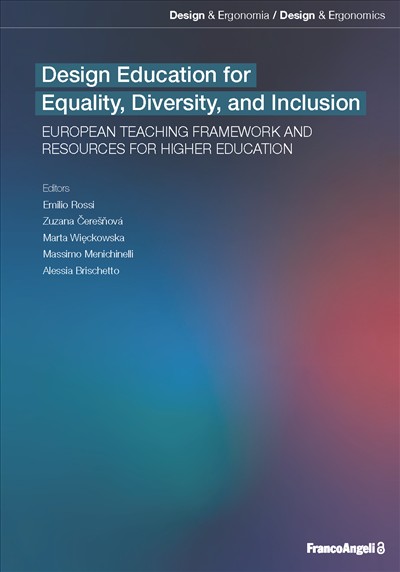
Design Education for Equality, Diversity, and Inclusion

A cura di: Emilio Rossi, Zuzana Cerešnová, Marta Wieckowska, Massimo Menichinelli, Alessia Brischetto

Design Education for Equality, Diversity, and Inclusion

European Teaching Framework and Resources for Higher Education

This volume presents the main research outcomes of the EDIDesK project, developed through a collaborative European process involving higher education institutions, design researchers, educators, students, professional communities, and international NGOs. The volume investigates how Equality, Diversity, and Inclusion can be embedded more systematically within design education, moving beyond isolated or occasional approaches towards structured, transferable, and critically informed teaching practices.

Pages: 350

ISBN: 9788835199700

Edizione:1a ediz 2026

Publisher code: 10327.1
Info about Open Access books

Design Education for Equality, Diversity, and Inclusion presents the main research outcomes of the EDIDesK project, developed through a collaborative European process involving higher education institutions, design researchers, educators, students, professional communities, and international NGOs. The volume investigates how Equality, Diversity, and Inclusion can be embedded more systematically within design education, moving beyond isolated or occasional approaches towards structured, transferable, and critically informed teaching practices.
The book combines theoretical reflection, comparative analysis, teaching experimentation, and the development of educational resources. It examines current approaches to Design for EDI across different disciplinary and institutional contexts, documents the testing of teaching modules in European higher education, and translates the evidence gathered into the European Teaching Framework on Design for EDI. The volume also presents the EDIDesK digital platform, conceived as an open and collaborative environment for sharing methodologies, resources, learning itineraries, and concepts related to EDI.
Bringing together critical perspectives and practical tools, the book is intended for educators, researchers, students, programme leaders, and institutions interested in developing more inclusive, accessible, and socially responsible approaches to design education. Its structure supports both sequential reading and thematic consultation, connecting conceptual foundations with methods, experimentation, digital resources, and recommendations for future teaching and research.

CONTRIBUTIONS BY
Ainoa Abella Garcia, Erminia Attaianese, Alessia Brischetto, Elisabetta Carattin, Julia Carrasco Parodi, Zuzana Cerešnová, Sarah Jane Cipressi, Giuseppe Di Bucchianico, Alessio D’Onofrio, Rossana Gaddi, Lorenzo Imbesi, Ester Iacono, Michal Kacej, Klára Machácová, Antonio Marano, Raffaella Massacesi, Massimo Menichinelli, Alexa Mottram, Claudia Porfirione, Emilio Rossi, Patrycja Rudnicka, Marta Wieckowska.

This volume was developed within EDIDesK, an Erasmus+ KA220-HED Cooperation Partnership project in Higher Education funded by the European Union under Grant No. 2023-1-IT02-KA220-HED-000153774.

The content of this publication does not reflect the official position of the European Union. Responsibility for the information and views expressed therein lies entirely with the authors.

Antonio Marano, Preface

Emilio Rossi, Introduction

Context and Rationale
The EDIDesK Project
How to navigate this book
Credits

Emilio Rossi, Design for Equality, Diversity, and Inclusion: Epistemological Scaffolding and Systemic Challenges in Higher Education

  • The Multidimensional Nature of the EDI in Design Studies
  • Endogenous and Exogenous Threats

Patrycja Rudnicka, Marta Wieckowska, The Analysis of Current Teaching Offerings and Pedagogical Methodologies

  • Patrycja Rudnicka, Marta Wieckowska, Teaching Design for EDI: A Reasoned Introduction with Scope
  • Patrycja Rudnicka, Marta Wieckowska, Analysis of Undergraduate and Postgraduate Teaching Modules
  • Alessia Brischetto, Ester Iacono, Analysis of Teaching Methodologies, Tools, and Educational Resources for Design for EDI
  • Patrycja Rudnicka, Marta Wieckowska, Combined Analysis and Virtuous Contents

Patrycja Rudnicka, Marta Wieckowska, Alessia Brischetto, Overcoming Aleatory Approaches through Teaching Experimentation

  • Patrycja Rudnicka, Marta Wieckowska, Alessia Brischetto, Setting up parallel teaching experimentations
  • Rossana Gaddi, Teaching Design for EDI in the Field of System Design
  • Patrycja Rudnicka, Marta Wieckowska, Teaching Design for EDI in the Field of Industrial Design
  • Julia Carrasco Parodi, Massimo Menichinelli, Teaching Design for EDI in the Field of Product Design
  • Alessia Brischetto, Teaching Design for EDI in the Field of Digital Design
  • Zuzana Cerešnová, Klára Machácová, Teaching Design for EDI in the Field of Architecture and Urban Design
  • Alessia Brischetto, From Teaching Experimentation to Framework Development

Zuzana Cerešnová, Emilio Rossi, European Teaching Framework on Design for EDI

  • Zuzana Cerešnová, The Benefit of a Multi-Layer European Teaching Framework on Design for Equality, Diversity and Inclusion (EDI)
  • Alessio D’Onofrio, Teaching Framework on Design for EDI in the Field of System Design
  • Patrycja Rudnicka, Marta Wieckowska, Teaching Framework on Design for EDI in the Field of Industrial Design
  • Julia Carrasco Parodi, Teaching Framework on Design for EDI in the Field of Product Design
  • Alessia Brischetto, Teaching Framework on Design for EDI in the Field of Digital Design
  • Zuzana Cerešnová, Teaching Framework on Design for EDI in the Field of Architecture and Urban Design
  • Emilio Rossi, A Cross-Disciplinary Perspective on the Teaching Framework

Massimo Menichinelli, Digital Teaching and Learning Platform for EDI

  • Patrycja Rudnicka, Marta Wieckowska, Digital Education, Systemic Intelligence, and the Benefit of Open Contents
  • Alessia Brischetto, Digital Platforms and Digital Learning Environments in Design Studies
  • Julia Carrasco Parodi, Massimo Menichinelli, Design and Development of the first Digital Learning Platform for Design for EDI
  • Julia Carrasco Parodi, Massimo Menichinelli, Architecture of the EDIDesK Digital Teaching Platform and User Profiles
  • Michal Kacej, Itineraries as a Means for Inclusive Active Learning and Innovative Content Sharing
  • Sarah Jane Cipressi, The First Set of Unbiased Open-Access Contents on Design for EDI

Alessia Brischetto, Implications and Recommendations across the EDIDesK Project Results

  • Patrycja Rudnicka, Marta Wieckowska, Critical Review of the Teaching Landscape
  • Alessia Brischetto, Critical Review of Teaching Methods and Methodologies
  • Klára Machácová, Critical Review of Student-Facing Teaching Practices
  • Sarah Jane Cipressi, Critical Review of Framework Standardisation
  • Ainoa Abella, Julia Carrasco Parodi, Critical Review of Platform-Based Teaching Modalities

Emilio Rossi, Outlines for Academic and Professional Community

  • Lorenzo Imbesi, Academic Community Perspective
  • Giuseppe Di Bucchianico, Design for EDI and Professional Communities: Building the Conditions for Shared Social Transformation
  • Claudia Porfirione, Alexa Mottram, Elisabetta Carattin, Erminia Attaianese, External Advisory Board Perspective

References & Web References
Acknowledgements
Contributors

Annex A

  • Best Practices and Interpretative Map

Annex B

  • Tools, Methodologies and Digital Resources for Design for EDI

Contributors: Ainoa Abella Garcia, Erminia Attaianese, Elisabetta Carattin, Julia Carrasco Parodi, Sarah Jane Cipressi, Alessio D’Onofrio, Giuseppe Di Bucchianico, Rossana Gaddi, Ester Iacono, Lorenzo Imbesi, Michal Kacej, Klára Machácová, Antonio Marano, Raffaella Massacesi, Alexa Mottram, Claudia Porfirione, Patrycja Rudnicka

Subjects: Architecture, Design, Art, Urban and Regional Studies

You could also be interested in