The Khan-Godley case and the long shadow of the ancestors
Journal title PSICOTERAPIA E SCIENZE UMANE
Author/s Giorgio Meneguz
Publishing Year 2025 Issue 2025/4
Language Italian Pages 20 P. 629-648 File size 385 KB
DOI 10.3280/PU2025-004004
DOI is like a bar code for intellectual property: to have more infomation
click here
Below, you can see the article first page
If you want to buy this article in PDF format, you can do it, following the instructions to buy download credits
FrancoAngeli is member of Publishers International Linking Association, Inc (PILA), a not-for-profit association which run the CrossRef service enabling links to and from online scholarly content.
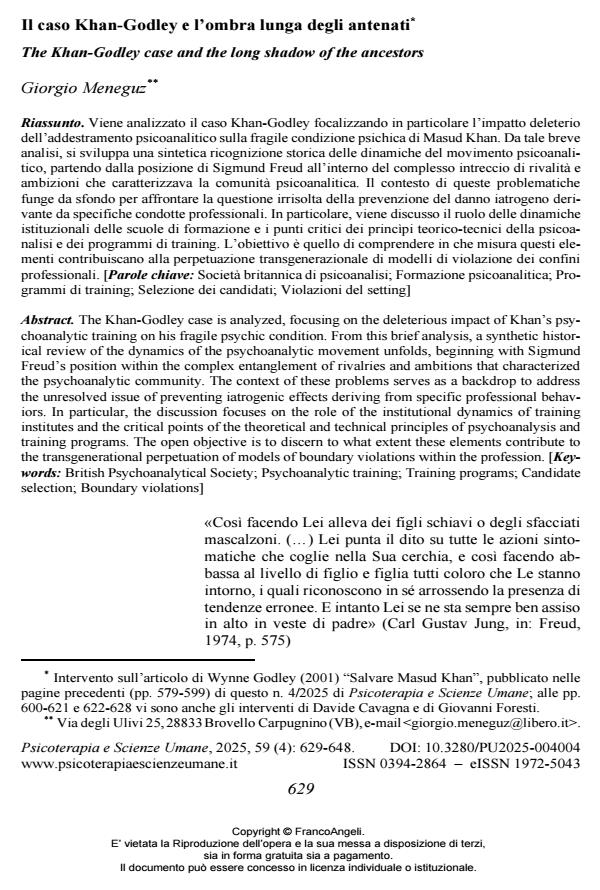
The Khan-Godley case is analyzed, focusing on the deleterious impact of Khan’s psychoanalytic training on his fragile psychic condition. From this brief analysis, a synthetic historical review of the dynamics of the psychoanalytic movement unfolds, beginning with Sigmund Freud’s position within the complex entanglement of rivalries and ambitions that characterized the psychoanalytic community. The context of these problems serves as a backdrop to address the unresolved issue of preventing iatrogenic effects deriving from specific professional behaviors. In particular, the discussion focuses on the role of the institutional dynamics of training institutes and the critical points of the theoretical and technical principles of psychoanalysis and training programs. The open objective is to discern to what extent these elements contribute to the transgenerational perpetuation of models of boundary violations within the profession.
Keywords: British Psychoanalytical Society; Psychoanalytic training; Training programs; Candidate selection; Boundary violations
- Akhtar S. (2007). Four roadblocks in approaching Masud Khan. Psychoanalytic Quarterly, 76, 3: 991-995.
- Albarella C. & Donadio M., a cura di (1986). Il controtransfert. Napoli: Liguori.
- Appignanesi L. & Forrester J. (1992). Freud’s Women. New York: Basic Books (trad. it.: Sigmund Freud e le sue donne. Milano: La Tartaruga, 2007).
- Balint M. (1947). On the psycho-analytic training system. International Journal of Psychoanalysis, 1948, 29, 2: 163-173. Anche in: Primary Love and Psychoanalytic Technique. Second Edition. London: Tavistock, 1965, pp. 253-274 (trad. it.: Il sistema didattico in psicoanalisi. In: Balint, 1974, pp. 17-47). Anche in: Balint, 1965, pp. 253-274.
- Balint M. (1953). Analytic training and training analysis. International Journal of Psychoanalysis, 1954, 35, 2: 157-162. Anche in: Primary Love and Psychoanalytic Technique. Second Edition. London: Tavistock, 1965, pp. 275-285 (trad. it.: Formazione analitica e analisi didattica. In: Balint, 1974, pp. 49-64). Anche in: Balint, 1965, pp. 275-285.
- Balint M. (1965 [1974]). L’analisi didattica, Chi psicoanalizzerà gli psicoanalisti? Rimini: Guaraldi, 1974.
- Balint M. & Balint E. (1968). The Basic Fault. London: Tavistock (trad. it.: Il difetto fondamentale. In: La regressione. Milano: Raffaello Cortina, 1983, pp. 117-319).
- Bernfeld S. (1952). On psychoanalytic training. Psychoanalytic Quarterly, 1962, 31, 4: 453-482. DOI: 10.1080/21674086.1962.11926258
- Bordi S. (1999). L’insegnamento della psicoanalisi in un’epoca di declino delle quattro-cinque sedute settimanali. In: Scritti. Milano: Raffaello Cortina, 2009, pp. 67-76.
- Borgogno F. (2001). Che cosa trasmettiamo e come: pensieri sparsi e, forse, un po’ irriverenti. Gli Argonauti, 90: 233-248.
- Boynton R.S. (2002). Return of the Repressed. The strange case of Masud Khan. The Boston Review, 27, 6: 23-29 (www.bostonreview.net/articles/robert-s-boynton-return-repressed).
- Buechler S. (2004). Clinical Values: Emotions that Guide Psychoanalytic Treatment. New York: Routledge (trad. it.: Valori clinici. Milano: Raffaello Cortina, 2012).
- Castiello d’Antonio A. (2008). Sulla selezione degli psicoanalisti. Psicoterapia e Scienze Umane, 41, 3: 357-394.
- Cremerius J. (1986). Spurensicherung: Die “Psychoanalytische Bewegung” und das Elend der psychoanalytischen Institution. Psyche, 40, 12: 1063-1091 (trad. it.: Alla ricerca di tracce perdute. Il “movimento psicoanalitico” e la miseria della istituzione psicoanalitica. Psicoterapia e Scienze Umane, 1987, 21, 3: 3-34).
- Cremerius J. (1987a). Die Einrichtung des Zulassungsverfahrens 1923-1926 als machtpolitisches Instrument der “Psychoanalytischen Bewegung”. In: Brede K. et al., editors, Befreiung zum Widerstand. Frankfurt a.M.: Fischer, 1987, pp. 36-53 (trad. it.: L’istituzione, tra il 1923 e il 1926, del sistema di selezione come strumento della politica di potere del “movimento psicoanalitico”. Psicoterapia e Scienze Umane, 1990, 24, 4: 28-44.
- Cremerius J. (1987b). Wenn wir als Psychoanalytiker die psychoanalytische Ausbildung organisieren, müssen wir sie psychoanalytisch organisieren! Psyche, 41, 12: 1067-1096 (trad. it.: Quando noi, psicoanalisti, organizziamo il training psicoanalitico, dobbiamo farlo in maniera psicoanalitica! Quaderni. Associazione di Studi Psicoanalitici, 1991, II, 3: 5-23 [I e II parte], 4: 24-35 [III parte]).
- Cremerius J. (1988). Analisi didattica e potere. La trasformazione di un metodo di insegnamento-apprendimento in strumento di potere della psicoanalisi istituzionalizzata. Psicoterapia e Scienze Umane, 1989, 23, 3: 3-27 (versione ampliata della relazione tenuta al 3° Convegno del Collegamento Psicoanalitico Internazionale, Palazzo delle Stelline, Milano, 3 giugno 1988). (https://priory.com/ital/riviste/psicouman/cremer89.htm). Ristampa: 2021, 55, 3: 487-508. DOI: 10.3280/PU2021-003005
- Cremerius J. (1996). Die Begrenzung der analytischen Selbstaufklärung durch die Ausbildungshierarchie. Luzifer-Amor, 9, 17/18: 68-83 (trad. it.: I limiti dell’autorischiaramento analitico e la gerarchia della formazione istituzionalizzata. Psicoterapia e Scienze Umane, 1999, 23, 3: 5-22). Internet: www.priory.com/ital/riviste/psicouman/cremerius99.htm.
- Cremerius J. (1989-98 [2000]). Il futuro della psicoanalisi. Resoconti e problemi di psicoterapia. A cura di Giorgio Meneguz. Roma: Armando, 2000.
- DeKoven M. (2003). Psychoanalysis and sixties utopianism. Journal for the Psychoanalysis of Culture and Society, 8, 2: 263-272.
- Gegasperi L. (2025). Collaborazione e distruttività. Il complesso fraterno tra psicoterapeuti e in ambito peritale. Psicoterapia e scienze umane, 59, 2: 251.276.
- Dimen M. (2011). Lapsus linguae, or a slip of the tongue? A sexual violation in an analytic treatment and its personal and theoretical aftermath. Contemporary Psychoanalysis, 47, 1: 35-79. DOI: 10.1080/00107530.2011.10746441
- Eagle M.N. (2015). Il controtransfert rivisitato. Psicoterapia e Scienze Umane, 49, 4: 535-572.
- Eagle M. (2000). Some Taboo implications of current fashions in psychoanalysis (Lettura magistrale, dal titolo “Some Taboo Implications of Current Fashions in Psychoanalysis”, tenuta al convegno internazionale Taboo or not taboo? Forbidden Thoughts, Forbidden Acts, Niagara on the Lake, Ontario, Canada, 30 giugno-2 luglio 2000) (trad.it. Alcuni tabù nelle mode psicoanalitiche attuali. Psicoterapia e scienze umane, 2004, 38, 2: 171-188).
- Eisold K. (1994). The intolerance of diversity in psychoanalytic institutes. International Journal of Psychoanalysis, 75, 4: 785-798 (trad. it.: L’intolleranza della diversità negli istituti psicoanalitici. In: La psicoanalisi e le sue istituzioni. Roma: Fioriti, 2015, pp. 45-66).
- Ferenczi S. (1927-28). L’elasticità della tecnica psicoanalitica. Opere, 1927-1933, vol. IV. Milano: Raffaello Cortina, 2002
- Ferenczi S. (1932 [1985]). Journal clinique: janvier-octobre 1932. Paris: Payot, 1985 (trad. it.: Diario clinico. Gennaio-Ottobre 1932. Milano: Raffaello Cortina, 1988).
- Freud A. (1938). Probleme der Lehranalyse. In: Max Eitingon in Memoriam. Jerusalem: Israel Psychoanalytic Society, 1950, pp. 80-94 (trad. it.: Problemi dell’analisi didattica. In: Opere di Anna Freud. Vol. 1: 1922-1943. Torino: Boringhieri, 1978, pp. 267-280).
- Freud S. (1897). Lettera del 16 maggio 1897. In: The Complete Letters of Sigmund Freud to Wilhelm Fliess, 1887-1904 (Masson J.M., editor). Cambridge, MA: Belknap Press of Harvard University Press, 1985 (trad. it.: Lettere a Wilhelm Fliess, 1887-1904. Torino: Bollati Boringhieri, 1986, pp. 274-277).
- Freud S. (1908 [1909]). Analisi della fobia di un bambino di cinque anni (Caso clinico del piccolo Hans). Opere, 5: 481-589. Torino: Boringhieri, 1970.
- Freud S. (1912). Tecnica della psicoanalisi. Consigli al medico nel trattamento psicoanalitico. Opere, 6: 532-541. Torino: Boringhieri, 1974.
- Freud S. (1912-13). Totem e tabù. Opere, 7: 3-164. Torino: Boringhieri, 1975.
- Freud S. (1937). Analisi terminabile e interminabile. Opere, 11: 497-535. Torino: Boringhieri, 1979.
- Freud S. & Andreas-Salomé L. (1966). Sigmund Freud-Lou Andreas-Salomé Briefwechsel. Frankfurt a.M.: Fischer (trad. it.: Eros e conoscenza. Lettere tra Freud e Lou Andreas Salomé, 1912-1936. Torino: Boringhieri, 1978).
- Freud S. & Groddeck G. (1917-34 [1970]). Briefwechsel Groddeck-Freud. Wiesbaden: Limes Verlag, 1970 (trad. it.: Carteggio Freud-Groddeck. Milano: Adelphi, 1973).
- Gabbard G.O. & Lester E.P. (1995). Boundaries and Boundary Violations in Psychoanalysis. New York: Basic Books. Second Edition: Arlington, VA: American Psychiatric Association, 2016 (trad. it.: Violazioni del setting. Milano: Raffaello Cortina, 1999, 2017).
- Gay P. (1988). Freud: A Life for Our Time. London: J.M. Dent & Sons (trad. it.: Freud: una vita per i nostri tempi. Milano: Bompiani, 1988).
- Gitelson M. (1948). Problems of psychoanalytic training. Psychoanalytic Quarterly, 17, 2: 198-211.
- Gitelson M. (1954). Therapeutic problems in the analysis of the “normal” candidate. International Journal of Psychoanalysis, 35, 2: 174-183. Anche in: Gitelson, 1973 (trad. it.: Problemi terapeutici nell’analisi del candidato “normale”, cap. 11, pp. 171-190).
- Gitelson M. (1973). Psychoanalysis: Science and Profession. New York: International Universities Press (trad. it.: Psicoanalisi: scienza e professione. Torino: Boringhieri, 1980).
- Godley W. (2001). Saving Masud Khan. London Review of Books, 23, 4: 3-7 (trad. it.: Salvare Masud Khan. Con una Nota introduttiva di Paolo Migone. Psicoterapia e Scienze Umane, 2025, 59, 4: 579-599. DOI: 10.3280/PU2025-004001)
- Godley W. (2004). Commentary. International Journal of Psychoanalysis, 85, 1: 42-43.
- Heimann P. (1942-80 [1989]). About Children and Children-No-Longer. Collected papers 1942-80. London: The New Psychoanalytical Library, 1989 (trad. it.: trad. it.: Bambini e non più bambini. Roma: Borla, 1992).
- Heimann P. (1950). On countertransference. International Journal of Psychoanalysis, 31, 1: 81-84 (trad. it.: Sul controtransfert. In: Albarella & Donadio, 1986, pp. 81-86. Anche in: Heimann, 1942-80, pp. 95-102).
- Heimann P. (1959). Counter-transference. British Journal of Medical Psychology, 33, 1: 9-15.
- Heimann P. (1967-68). The evalutation of applicants for psychoanalytic training. International Journal of Psychoanalysis, 49: 527-39. Anche in: Heimann, 1942-80 (trad. it.: La valutazione degli aspiranti al training psicoanalitico, pp. 188-200).
- Holzman P.S. (1975). The future of psychoanalysis and its institutes. Psychoanalytic Quarterly, 45, 2: 250-73. DOI: 10.1080/21674086.1976.11926756
- Jamis R. (2003). Ce qui me gêne avec les psys. Paris: Lattès (trad. it.: Alice nel paese degli psicoanalisti. Roma: La Lepre, 2008).
- Jones E. (1953-57). The Life and Work of Sigmund Freud (3 vol.). New York: Basic Books, 1953 (vol. I), 1955 (vol. II), 1957 (vol. III) (trad. it.: Vita e opere di Freud. Milano: Il Saggiatore, 1962, 3 volumi).
- Jung C. G. (1934-39 [2008]). Nietzsche’s “Zarathustra”. Notes of the Seminar Given in 1934-1939 by C.G. Jung. Zürich: Stiftung der Werke C.G. Jung, 2008 (trad. it.: Lo “Zarathustra” di Nietzsche. Seminario tenuto nel 1934-39. Vol. 1: maggio 1934-marzo 1935. Torino: Bollati Boringhieri, 2011).
- Kahr B. (2000). Masud Khan’s analysis with Donald Winnicott: On the hazards of befriending a patient. Free Association, 10: 190-222.
- Kahr B. (2004). Ethical dilemmas of the psycho-analytical biographer: The case of Donald Winnicott, www.psychoanalysis-and-therapy.com/human_nature/free-associations/kahr.html.
- Kernberg O.F. (1986). Institutional problems of psychoanalytic education. Journal of the American Psychoanalytic Associaton, 34, 4: 799-834.
- Kernberg O.F. (1996). Thirty methods to destroy the creativity of psychoanalytic candidates. International Journal of Psychoanalysis, 77, 5: 1031-1040 (trad. it.: Trenta metodi per distruggere la creatività dei candidati in psicoanalisi. Gli Argonauti, 1998, 76: 1-14. Anche in: Kernberg, 1998, cap. 14, pp. 259-270. Internet: www.psychomedia.it/pm/modther/probpsiter/kernberg-1.htm).
- Kernberg O.F. (1998). Ideology, Conflict, and Leadership in Groups and Organizations. New Haven, CT: Yale University Press (trad. it.: Le relazioni nei gruppi. Ideologia, conflitto, leadership. Milano: Raffaello Cortina, 1999).
- Van der Leeuw P.J. (1962). Symposium: Selection criteria for the training of psycho-analytic students. International Journal of Psychoanalysis, 43, 3: 277-281.
- Kernberg O.F. (2001). “Some thoughts regarding innovations in psychoanalytic education”. Presentation at the International Psychoanalytic Association (IPA) Executive Council Meeting in Puerto Vallarta, Mexico, January 7, 2001 (trad. it.: Alcuni pensieri sulle innovazioni nella formazione psicoanalitica. Psicoterapia e Scienze Umane, 2003, 37, 2: 35-49).
- Kirsner D. (2001). The future of psychoanalytic institutes. Psychoanalytic Psychology, 18, 2: 195-212.
- Klein M. (1946). Notes on some schizoid mechanisms. International Journal of Psychoanalysis, 27: 99-110 (una versione del 1952 è stata tradotta negli Scritti, 1921-1950. Torino: Boringhieri, 1978, pp. 409-434).
- Knight R.P. (1953). The present status of organized psychoanalysis in the United States. Journal of the American Psychoanalytic Association, 1, 2: 197-221.
- Kohon G., editor (2018). British Psychoanalysis: New Perspectives in the Independent Tradition. London: Routledge.
- Levine H. (2006). Book review: “F. Robert Rodman, Winnicott: Life and work. Cambridge, MA: Perseus Publishing, 2003”. Psychoanalytic Quarterly, 2006, 75, 2: 585-591.
- Makari G. (2008). Revolution in Mind. The Creation of Psychoanalysis. New York: HarperCollins (trad. it. di una versione modificata della prefazione: La rivoluzione nella mente: sulla storia della psicoanalisi, 1870-1945. Psicoterapia e Scienze Umane, 2009, 43, 4: 455-462).
- Marhaba S. & Armezzani M. (1988). Quale psicoterapia? Gli indirizzi psicoterapici in Italia: Confronto e analisi. Padova: Liviana Editrice.
- Masson J.M. (1990). Final Analysis. The Making and Unmaking of a Psychoanalyst. Reading, MA: Addison-Wesley Publishing Company (trad. it.: Analisi finale. Costruzione e distruzione di uno psicoanalista. Torino: Bollati Boringhieri, 1993).
- Meneguz G. (2009). Politica della psicoanalisi, mistica del ruolo e clinica della colleganza. Psicoterapia e Scienze Umane, 43, 3: 313-342.
- Meneguz G. (2011). Il mondo degli psicoanalisti. Napoli: Liguori.
- Meneguz G. (2016). Vicissitudini e trasformazioni della psicoanalisi: dall’American Dream alla nascita del neoliberismo. Psicoterapia e Scienze Umane, 50, 1: 49-76.
- Migone P. (2025). Nota introduttiva [alla traduzione italiana dell’articolo di Wynne Godley, 2001]. Psicoterapia e Scienze Umane, 59 4: 580-586. DOI: 10.3280/PU2025-004001
- Racker H. (1960). Estudios sobre la tecnica psicoanalitica. Buenos Aires: Paidos (trad. it.: Studi sulla tecnica psicoanalitica. Roma: Armando, 1970).
- Reik Th. (1948). Listening with the Third Ear. New York: Grove Press.
- Rodman R.F. (2003). Winnicott: Life and work. Cambridge, MA: Perseus Publishing (trad. it.: Winnicott. Vita e opere, Milano: Raffaello Cortina, 2004).
- Roustang F. (2000). La fine de le plainte. Paris: Odile Jacob.
- Sachs H. (1944). Freud, Master and Friend. New York: Books for Libraires Press (trad. it.: Freud, maestro e amico. Roma: Astrolabio, 1973).
- Sachs H. (1947). Observations of a training analyst. Psychoanalytic Quarterly, 16, 2: 157-168. DOI: 10.1080/21674086.1947.11925675
- Sandler A.-M. (2004). Institutional responses to boundary violations: The case of Masud Khan. International Journal of Psychoanalysis, 85, 1: 27-42. DOI: 10.1516/LP8G-5A70-9FFR-U62Q
- Spock B. (1946). The Common Sense Book of Baby and Child Care. New York: Duell, Sloan and Pearce (trad. it.: Il bambino: come si cura e come si alleva. Milano: Longanesi, 1954).
- Waelder R. (1962). Symposium: Selection criteria for the training of psycho-analytic students. International Journal of Psychoanalysis, 43, 3: 283-286.
Giorgio Meneguz, Il caso Khan-Godley e l’ombra lunga degli antenati in "PSICOTERAPIA E SCIENZE UMANE" 4/2025, pp 629-648, DOI: 10.3280/PU2025-004004