The pain of growing up and the necessary disobedience. A suggested reading of The Adventures of Pinocchio. The story of a puppet
Journal title PSICOTERAPIA PSICOANALITICA
Author/s Elena Bonassi
Publishing Year 2025 Issue 2025/2
Language Italian Pages 10 P. 193-202 File size 56 KB
DOI 10.3280/PSP2025-002013
DOI is like a bar code for intellectual property: to have more infomation
click here
Below, you can see the article first page
If you want to buy this article in PDF format, you can do it, following the instructions to buy download credits
FrancoAngeli is member of Publishers International Linking Association, Inc (PILA), a not-for-profit association which run the CrossRef service enabling links to and from online scholarly content.
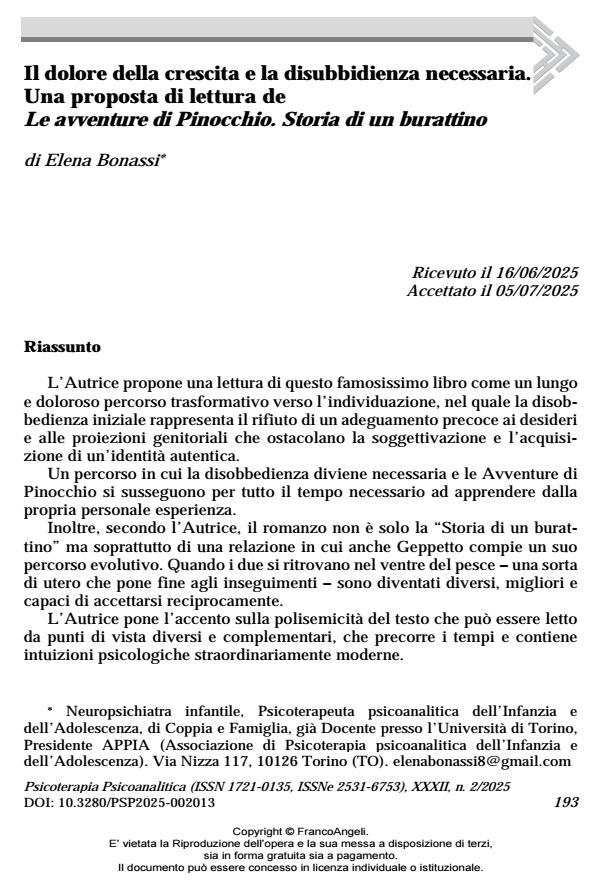
The Author proposes a reading of this famous book as long and painful transformative journey toward individuation, in which initial disobedience represents the refusal to prematurely adapt to parental desires and projections that hider subjectivation and the acquisition of authentic identity. A journey in which disobedience becomes necessary, and the Adventures of Pinocchio unfold for as long necessary to learn from one’s own personal experience. Furthermore, according to the Author, the novel is not just the “Story of a Puppet” but above all of a relationship in which Geppetto also undergoes his own evolutionary journey. When the two find themselves in the belly of the fish – a sort of womb that puts an end their pursuits – they have become different, better, and capable of accepting one another. The Author also emphasizes the text’s polysemic nature, which can be read from diverse and complementary perspectives, which is ahead of its time and contains extraordinarily modern psychological insights.
Keywords: growth, disobedience, learning from experience, transformation, subjectivation.
- Andreoli V. (2019). Vittorino Andreoli riscrive Pinocchio di Carlo Collodi. Milano: Rizzoli-Bur.
- Bion W.R. (1962). Apprendere dall’esperienza. Roma: Armando, 1972.
- Bion W.R. (1965). Trasformazioni. Il passaggio dall’apprendimento alla crescita. Roma: Armando, 1973.
- Bucci W. (1997). Psicoanalisi e scienza cognitiva. Una teoria del codice multiplo. Roma: Fioriti, 2016.
- Collodi C. (1883). Le avventure di Pinocchio. Storia di un burattino. Milano: Rizzoli, 1976.
- Ferrari A. (1992). L’eclissi del corpo. Un’ipotesi psicoanalitica. Roma: Borla.
- Klein M. (1946). Note su alcuni meccanismi schizoidi. In: Scritti 1921-1958. Torino: Bollati Boringhieri, 1978.
- Lombardi R. (2008). The body in the analytic session: Focusing on the body-mind link. The International Journal of Psychoanalysis, 89, 1: 89-110.
- Lombardi R. (2016). Metà prigioniero, metà alato. La dissociazione corpo-mente in psicoanalisi. Torino: Bollati Boringhieri.
- Widmann C. (2015). Pinocchio siamo noi. Saggio di psicologia del narcisismo. Roma: Magi.
- Winnicott D.W. (1984). Il bambino deprivato. Le origini della tendenza antisociale. Milano: Raffaello Cortina, 1986.
Elena Bonassi, Il dolore della crescita e la disubbidienza necessaria. Una proposta di lettura de Le avventure di Pinocchio. Storia di un burattino in "PSICOTERAPIA PSICOANALITICA" 2/2025, pp 193-202, DOI: 10.3280/PSP2025-002013