Exploring digital disconnection. Una proposta di rilettura del dibattito internazionale sulla disconnessione digitale

Titolo Rivista SOCIOLOGIA DELLA COMUNICAZIONE
Autori/Curatori Francesca Pasquali, Piermarco Aroldi, Barbara Scifo
Anno di pubblicazione 2023 Fascicolo 2022/64
Lingua Italiano Numero pagine 18 P. 80-97 Dimensione file 302 KB
DOI 10.3280/SC2022-064005
Il DOI è il codice a barre della proprietà intellettuale: per saperne di più clicca qui

Qui sotto puoi vedere in anteprima la prima pagina di questo articolo.

Se questo articolo ti interessa, lo puoi acquistare (e scaricare in formato pdf) seguendo le facili indicazioni per acquistare il download credit. Acquista Download Credits per scaricare questo Articolo in formato PDF
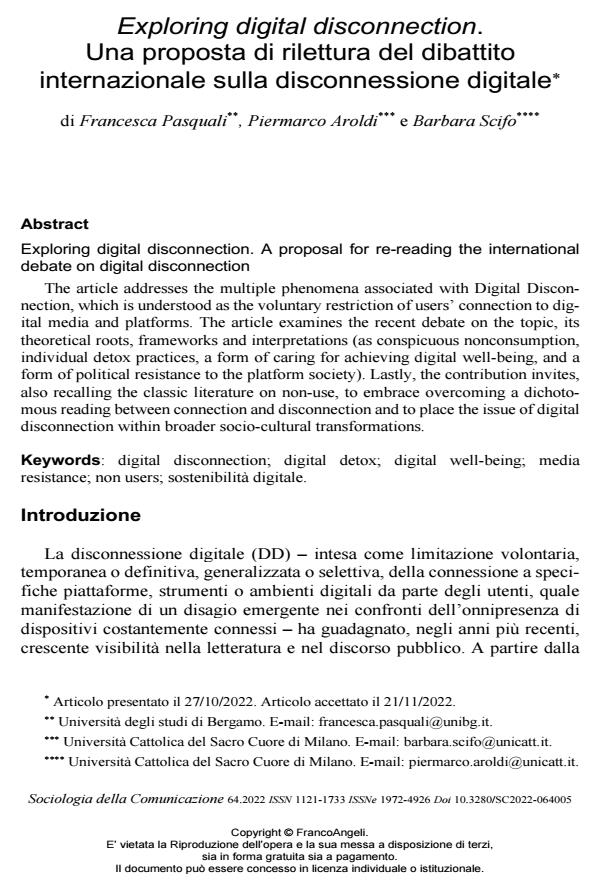
Anteprima articolo

FrancoAngeli è membro della Publishers International Linking Association, Inc (PILA)associazione indipendente e non profit per facilitare (attraverso i servizi tecnologici implementati da CrossRef.org) l’accesso degli studiosi ai contenuti digitali nelle pubblicazioni professionali e scientifiche

The article addresses the multiple phenomena associated with Digital Disconnection, which is understood as the voluntary restriction of users’ connection to digital media and platforms. The article examines the recent debate on the topic, its theoretical roots, frameworks and interpretations (as conspicuous nonconsumption, individual detox practices, a form of caring for achieving digital well-being, and a form of political resistance to the platform society). Lastly, the contribution invites, also recalling the classic literature on non-use, to embrace overcoming a dichotomous reading between connection and disconnection and to place the issue of digital disconnection within broader socio-cultural transformations.

Parole chiave:digital disconnection; digital detox; digital well-being; media resistan-ce; non users; sostenibilità digitale.

  1. Sutton T. (2020), Digital harm and addiction: An anthropological view, in «Anthropology Today», 36(1), pp. 17-22. DOI: 10.1111/1467-8322.12553
  2. Swanlund D. (2021), Disconnection and Reconnection as resistance to Geosurveillance, in A. Jansson A., P.C. Adams (eds), Disentangling. The Geographies of Digital Disconnection, Oxford University Press, Oxford, pp. 23-40.
  3. Syvertsen T. (2017), Media Resistance. Protest, Dislike, Abstention, Palgrave Macmillan, Basingstoke.
  4. Syvertsen T. (2020), Digital Detox: The Politics of Disconnecting, Emerald, Bingley (UK).
  5. Syvertsen T. (2022), Framing digital disconnection: Problem definitions, values, and actions among digital detox organisers, in «Convergence», online first, pp. 1-17. DOI: 10.1177/13548565221122910
  6. Syvertsen T., Enli G. (2020), Digital detox: Media resistance and the promise of authenticity, in «Convergence», 26(5-6), pp. 1269-1283. 519847325. DOI: 10.1177/135485
  7. Thorén C., Kitzmann A. (2015), Replicants, Imposters and the Real Deal: Issues of Non-use and Technology Resistance in Vintage and Software Instruments, in «First Monday», 20(11).
  8. Treré E. (2021), Intensification, discovery and abandonment: Unearthing global ecologies of dis/connection in pandemic times, in «Convergence», 27(6), pp. 1663-1677. DOI: 10.1177/13548565211036804
  9. Treré E., Mattoni A. (2016), Media ecologies and protest movements: Main perspectives and key lessons, in «Information, Communication & Society», 19(3), pp. 290-306. DOI: 10.1080/1369118X.2015.1109699
  10. Treré E., Natale S., Keightley E., Punathambekar A. (2020), The limits and boundaries of digital disconnection, in «Media, Culture and Society», 42(4), pp. 605-609. DOI: 10.1177/0163443720922054
  11. Vanden Abeele M.M.P., Nguyen M.H. (2022), Digital well-being in an age of mobile connectivity: An introduction to the Special Issue, in «Mobile Media & Communication», 10(2), pp. 174-189. DOI: 10.1177/20501579221080899
  12. Woodstock L., The news-democracy narrative and the unexpected benefits of limited news consumption: The case of news resisters, in «Journalism», 15, 7, 2014, pp. 834-849. DOI: 10.1177/146488491350426
  13. Wyatt S. (2003), Non-Users also Matter: The Construction of Users and Non-Users of the Internet, in N. Oudshoorn e T. Pinch, How Users Matter, The MIT Press: Cambridge, MA, pp. 67-80.
  14. Wyatt S., Thomas, G., Terranova T. (2002), They came, they surfed, they went back to the beach: Conceptualising use and non-use of the Internet, in S. Woolgar (ed), Virtual society?, Oxford University Press, Oxford, pp. 23-40.
  15. Yu Z., Treré E., Bonini T., The emergence of algorithmic solidarity: Unveiling mutual aid practices and resistance among Chinese delivery workers, in «Media International Australia», 183, 1, 2022, pp. 107-123. DOI: 10.1177/1329878X221074793
  16. Baumer E.P.S., Adams P., Khovanskaya V.D., Liao T.C., Smith M.E., Schwanda Sosik V., Williams K. (2013), Limiting, leaving, and (re)lapsing: An exploration of Facebook non-use practices and experiences, paper presentato alla SIGCHI Conference on Human Factors in Computing Systems, Paris, France.
  17. Baumer E.P.S., Ames M.G., Burrell J., Brubaker J.R., Dourish P. (2015), Why study technology non-use? Guest editors’ introduction to special issue on non-use of technology: Perspectives and approaches, in «First Monday», 20(11).
  18. Baym N.K., Wagman K B., Persaud C.J. (2020), Mindfully scrolling: Rethinking Facebook after time deactivated, in «Social Media + Society», 6(2). DOI: 10.1177/2056305120919105
  19. Berker T., Hartmann M., Punie Y. (2005), Domestication of media and technology. McGraw-Hill Education, London.
  20. Boccia Artieri G., Gemini L., Pasquali F., Carlo S., Farci M., Pedroni M. (2017), Fenomenologia dei social network. Presenza, relazioni e consumi mediali degli italiani online, Guerini, Milano.
  21. Bonini T., Treré E., Murtula F. (2022), Resistenza e solidarietà algoritmica nelle piattaforme digitali: un’indagine etnografica dei gruppi di engagement su Instagram, in «Studi Culturali» 2/2022, pp. 77-206, DOI: 10.1405/104691
  22. Brennen B. (2019), Opting Out of Digital Media, Routledge, London.
  23. Büchi M. (2021), Digital weel-being theory and research, in «New Media & Society», online first, pp. 1-18. DOI: 10.1177/14614448211056851
  24. Casemajor N., Couture S., Delfin M., Goerzen M., Delfanti A. (2015), Non- participation in Digital Media: Toward a Framework of Mediated Political Action, in «Media, Culture & Society», 37(6), pp. 860-863. DOI: 10.1177/0163443715584
  25. Chia A., Jorge A., Karppi T. (eds) (2021), Reckoning with Social Media, Rowman & Littlefield, Lanham (MD).
  26. Colombo F. (2020), Ecologia dei media. Manifesto per una comunicazione gentile, Vita e Pensiero, Milano.
  27. Doerr N.M. (2021), Digital Disconnection as Othering, in Jansson A., Adams P.C. (eds), Disentangling. The Geographies of Digital Disconnection, Oxford University Press, Oxford, pp. 92-111.
  28. Drotner K. (1999), Dangerous Media? Panic Discourses and Dilemmas of Modernity, in «Paedagogica Historica», 35(3), pp. 593-619. DOI: 10.1080/003092399
  29. 350303.
  30. Enli G., Syvertsen T. (2021), Disconnect to Reconnect! Self- help to Regain an Authentic Sense of Space Through Digital Detoxing, in Jansson A., Adams P.C. (eds), Disentangling. The Geographies of Digital Disconnection, Oxford University Press, Oxford, pp. 227-252.
  31. Fast K. (2021), The disconnection turn: Three facets of disconnective work in post-digital capitalism, in «Convergence», 27(6), pp. 1615-1630. DOI: 10.1177/13548565211033382
  32. Fast K., Lindell J., Jansson A. (2021), Disconnection as Distinction, in Jansson A., Adams P.C. (eds), Disentangling. The Geographies of Digital Disconnection, Oxford University Press, Oxford, pp. 61-90.
  33. Figueiras R., Brites M.J. (2022), Connecting the individual and the other in disconnection studies, in «Media, Culture & Society», 44(4), pp. 837-847. DOI: 10.1177/01634437221096788
  34. Fish A. (2017), Technology retreats and the politics of social media, in «TripleC», 15(1), pp. 355-369.
  35. Gui M., Büchi M. (2021), From Use to Overuse: Digital Inequality in the Age of Communication Abundance, in «Social Science Computer Review», 39(1), pp. 3-19. DOI: 10.1177/0894439319851163
  36. Helsper E. (2021), The Digital Disconnect: The Social Causes and Consequences of Digital Inequalities, Sage, Thousand Oaks (CA).
  37. Hesselberth P. (2018), Discourses on disconnectivity and the right to disconnect, in «New Media & Society», 20(5), pp. 1994-2010. DOI: 10.1177/14614448177114
  38. Hesselberth P. (2021), Retreat Culture and Therapeutic Disconnection, in Jansson A., Adams P.C. (eds), Disentangling. The Geographies of Digital Disconnection, Oxford University Press, Oxford, pp. 253-272.
  39. Hila A. (2016), Analog Photography in a Digital World: The Phenomenology and Contemporary Status of the Single Lens Reflex Camera, in «The iJournal: Student Journal of the Faculty of Information», 2(1).
  40. Hoyng R., Es M. (2017), Conspiratorial Webs: Media Ecology and Parallel Realities in Turkey in «International Journal of Communication», 11, pp. 4219-4238.
  41. Jansson A., Adams P.C. (eds) (2021), Disentangling. The Geographies of Digital Disconnection, Oxford University Press, Oxford.
  42. Jorge A. (2019), Social media, interrupted: Users recounting temporary disconnection on Instagram, in «Social Media + Society», 5(4), pp. 1-19. DOI: 10.1177/205630511988169
  43. Jorge A., Pedroni M. (2021), “Hey! I’m back after a 24h #DigitalDetox!”: Influencers posing disconnection, in Chia A., Jorge A., Karppi T. (eds), Reckoning with Social Media, Rowman & Littlefield, Lanham.
  44. Karppi T. (2018), Disconnect: Facebook’s Affective Bonds, University of Minnesota Press, Minneapolis (MN).
  45. Karppi T., Stäheli U., Wieghorst C., Zierott L.P. (2021), Undoing networks, Meson press, Lüneburg.
  46. Karsay K., Vandenbosch L. (2021), Endlessly Connected: Moving Forward with Agentic Perspectives of Mobile Media (Non-)Use, in «Mass Communication and Society», 24(6), pp. 779-794. DOI: 10.1080/15205436.2021.1974785
  47. Kaun A. (2021), Ways of seeing digital disconnection: A negative sociology of digital culture, in «Convergence», 27(6), pp. 1571-1583. 5535. DOI: 10.1177/135485652110
  48. Kaun A., Treré E. (2020), Repression, resistance and lifestyle: Charting (dis)connection and activism in times of accelerated capitalism, in «Social Movement Studies», 19(5-6), pp. 697-715. DOI: 10.1080/14742837.2018.1555752
  49. Kline R. (2003), Resisting consumer technology in rural America: The telephone and electrification, in Oudshoorn N., Pinch T. (eds), How Users Matter, MIT Press, London and Cambridge, pp. 51-79.
  50. Kuntsman A., Miyake E. (2019), The paradox and continuum of digital disengagement: Denaturalising digital sociality and technological connectivity, in «Media, Culture & Society», 41(6), pp. 901-913. DOI: 10.1177/0163443719853732
  51. Light B., Cassidy E. (2014), Strategies for the suspension and prevention of connection: Rendering disconnection as socioeconomic lubricant with Facebook, in «New Media & Society», 16(7), pp. 1169-1184. 02. DOI: 10.1177/1461444814544
  52. Lim M. (2020), The politics and perils of dis/connection in the Global South, in «Media, Culture & Society», 42(4), pp. 618-625. DOI: 10.1177/0163443720914032
  53. Lomborg S. (2020), Disconnection is futile – Theorizing resistance and human flourishing in an age of datafication, in «European Journal of Communication», 35(3), pp. 301-305. DOI: 10.1177/0267323120922094
  54. Lomborg S., Ytre-Arne B. (2021), Advancing digital disconnection research: Introduction to the special issue, in «Convergence», 27(6), pp. 1529-1535. DOI: 10.1177/13548565211057518
  55. Lupton D. (2016), The quantified self: A sociology of self-tracking, Polity Press, Cambridge, UK.
  56. Mariek M.P., Vanden Abeele M.M.P., Halfmann E., Lee W.J. (2022), Drug, demon, or donut? Theorizing the relationship between social media use, digital well-being and digital disconnection, in «Current Opinion in Psychology», 45.
  57. Moe H., Madsen O.J. (2021), Understanding digital disconnection beyond media studies, in «Convergence», 27(6), pp. 1584-1598. 8969. DOI: 10.1177/135485652110
  58. Natale S., Treré E. (2020), Vinyl won’t save us: Reframing disconnection as engagement, in «Media, Culture & Society», 42(4), pp. 626-633. 720914027. DOI: 10.1177/016344
  59. Pennington N. (2021), Quitting social media: a qualitative exploration of communication outcomes, in «Qualitative Research Reports in Communication», 22(1), pp. 30-38. DOI: 10.1080/17459435.2020.1817140
  60. Peterson M.A. (2011), Egypt’s media ecology in a time of revolution, in «Arab media & society», 13.
  61. Picone I., Kleut J., Pavlíčková T., Romic B., Hartley J.M., De Ridder S. (2019), Small acts of engagement: Reconnecting productive audience practices with everyday agency, in «New Media & Society», 21(9), pp. 2010-2028.
  62. Portwood-Stacer L. (2013), Media refusal and conspicuous Non-consumption: the performative and political dimensions of Facebook abstention, in «New Media & Society», 15(7), pp. 1041-1057. DOI: 10.1177/1461444812465139
  63. Schoenebeck S.Y. (2014), Giving up twitter for Lent: How and why we take breaks from social media, in Proceedings of the SIGCHI Conference on Human Factors in Computing Systems, Toronto, 26 April/1 May 2014, pp. 773-782.
  64. Silverstone R., Hirsch E. (eds) (1992), Consuming technologies: Media and information in domestic spaces, Routledge, London.
  65. Skågeby J. (2011), Slow and fast music media: Comparing values of cassettes and playlists, in «Transformations», 20.
  66. Skovsgaard M., Andersen K. (2020), Conceptualizing News Avoidance: Towards a Shared Understanding of Different Causes and Potential Solutions, in «Journalism Studies», 21(4), pp. 459-476. DOI: 10.1080/1461670X.2019.1686410
  67. Stäheli U. (2021), Undoing Networks, in T. Karppi, U. Stäheli, C. Wieghorst, L.P. Zierott, Undoing Networks, Meson press, Lüneburg, pp. 1-30.
  68. Sutton T. (2017), Disconnect to reconnect: The food/technology metaphor in digital detoxing, in «First Monday», 22(6).

  • Per una fenomenologia della disconnessione digitale in Italia. Pratiche, motivazioni, ostacoli Piermarco Aroldi, Francesca Pasquali, Barbara Scifo, in SOCIOLOGIA DELLA COMUNICAZIONE 69/2025 pp.5
    DOI: 10.3280/SC2025-069001
  • Genitori zerosei anni e tecnologie tra percezione d’uso e datificazione: i trend nei Rapporti Cisf 2017, 2019, 2022 e 2024 Stefano Pasta, Marco Rondonotti, in Media Education /2025 pp.11
    DOI: 10.36253/me-17306

Francesca Pasquali, Piermarco Aroldi, Barbara Scifo, Exploring digital disconnection. Una proposta di rilettura del dibattito internazionale sulla disconnessione digitale in "SOCIOLOGIA DELLA COMUNICAZIONE " 64/2022, pp 80-97, DOI: 10.3280/SC2022-064005