Introduction to the Third Edition of the Psychodynamic Diagnostic Manual (PDM-3)

Journal title PSICOTERAPIA E SCIENZE UMANE
Author/s Vittorio Lingiardi, Nancy McWilliams
Publishing Year 2025 Issue 2025/4
Language Italian Pages 26 P. 649-674 File size 441 KB
DOI 10.3280/PU2025-004005
DOI is like a bar code for intellectual property: to have more infomation click here

Below, you can see the article first page

If you want to buy this article in PDF format, you can do it, following the instructions to buy download credits
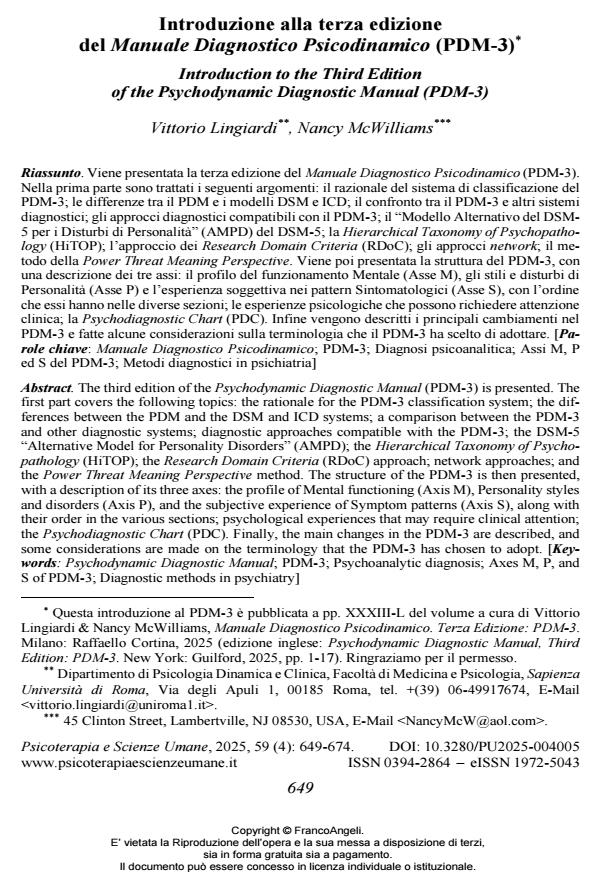
Article preview

FrancoAngeli is member of Publishers International Linking Association, Inc (PILA), a not-for-profit association which run the CrossRef service enabling links to and from online scholarly content.

The third edition of the Psychodynamic Diagnostic Manual (PDM-3) is presented. The first part covers the following topics: the rationale for the PDM-3 classification system; the differences between the PDM and the DSM and ICD systems; a comparison between the PDM-3 and other diagnostic systems; diagnostic approaches compatible with the PDM-3; the DSM-5 “Alternative Model for Personality Disorders” (AMPD); the Hierarchical Taxonomy of Psychopathology (HiTOP); the Research Domain Criteria (RDoC) approach; network approaches; and the Power Threat Meaning Perspective method. The structure of the PDM-3 is then presented, with a description of its three axes: the profile of Mental functioning (Axis M), Personality styles and disorders (Axis P), and the subjective experience of Symptom patterns (Axis S), along with their order in the various sections; psychological experiences that may require clinical attention; the Psychodiagnostic Chart (PDC). Finally, the main changes in the PDM-3 are described, and some considerations are made on the terminology that the PDM-3 has chosen to adopt.

Keywords: Psychodynamic Diagnostic Manual; PDM-3; Psychoanalytic diagnosis; Axes M, P, and S of PDM-3; Diagnostic methods in psychiatry

  1. Aftab A., Banicki,K., Ruffalo M.L. & Frances A. (2024). Psychiatric diagnosis: A clinical guide to navigating diagnostic pluralism. Journal of Nervous and Mental Disease, 212, 8: 445-454. DOI: 10.1097/NMD.0000000000001791
  2. Aggarwal N.K. (2017). Culture, communication, and DSM-5 diagnostic reliability. Journal of the National Medical Association, 109, 3: 150-152.
  3. Aggarwal N.K. (2023). The evolving culture concept in psychiatric cultural formulation: Implications for anthropological theory and psychiatric practice. Culture, Medicine, and Psychiatry, 47, 2: 555-575.
  4. Aggarwal N.K., Jarvis G.E., Gómez-Carrillo A., Kirmayer L.J. & Lewis-Fernández R. (2020). The Cultural Formulation Interview since DSM-5: Prospects for training, research, and clinical practice. Transcultural Psychiatry, 57, 4: 496-514. DOI: 10.1177/1363461520940481
  5. American Psychiatric Association (2013). Diagnostic and Statistical Manual of Mental Disorders, Fifth Edition (DSM-5). Washington, D.C.: APA (trad. it.: DSM-5. Manuale diagnostico e statistico dei disturbi mentali. Quinta edizione. Milano: Raffaello Cortina, 2014).
  6. American Psychiatric Association (2022). Diagnostic and Statistical Manual of Mental Disorders, Fifth Edition, Text Revision (DSM-5-TR). Washington, D.C.: APA (trad. it.: DSM-5-TR. Manuale diagnostico e statistico dei disturbi mentali. Quinta edizione, Text Revision. Milano: Raffaello Cortina, 2023).
  7. American Psychological Association (2002). Guidelines on multicultural education, training, research, practice, and organizational change for psychologists: https:// www.apa.org/about/policy/multicultural-guidelines-archived.pdf.
  8. American Psychological Association (2021). APA Guidelines on Evidence-based Psychological Practice in Health Care. Washington, D.C.: American Psychological Association Publications (www.apa.org/about/policy/psychological-practice-health-care.pdf).
  9. Arnett J.J. (2023). Emerging Adulthood: The Winding Road from the Late Teens Through the Twenties. Third Edition. New York: Oxford University Press.
  10. Aron L. (1991). Working through the past-working toward the future. Contemporary Psychoanalysis, 27, 1: 81-108. DOI: 10.1080/00107530.1991.10746694
  11. Bach B. & Tracy M. (2022). Clinical utility of the alternative model of personality disorders: A 10th year anniversary review. Personality Disorders, 13, 4: 369-379.
  12. Bach B., Hopwood C.J., Simonsen E. & Krueger R.F. (2025). Practitioner’s Guide to the Alternative Model for Personality Disorders. New York: Guilford.
  13. Biberdzic M. & Grenyer B.F. (2023). How much training do we need? Assessing the validity and interrater reliability of the PDM-2’s Psychodiagnostic Chart among less experienced clinicians. Journal of Personality Assessment, 105, 3: 436-444. DOI: 10.1080/00223891.2022.2086133
  14. Bizzi F., Locati F., Parolin L., Yael S.G. & Brusadelli E. (2022). Advancement in the child attachment interview and the child and adolesent reflective functioning scale using a PDM-2 framework. Research in Psychotherapy: Psychopathology, Process, and Outcome (RIPPPO), 25, 1: 57-71.
  15. Blankers M., Smits M.L., Feenstra D.J., Horn E.K., Kamphuis J.H., Bales D.L., Lucas Z., Remeeus M.G.A, Dekker J.J.M., Verheul R., Busschbach J.J.V. & Luyten P. (2023). Economic evaluation of day hospital versus intensive outpatient mentalization-based treatment alongside a randomized controlled trial with 36-month follow-up. Personality Disorders, 14, 2: 207-215.
  16. Blatt S.J. (2006). Una polarità fondamentale in psicoanalisi: implicazioni per lo sviluppo della personalità, la psicopatologia e il processo terapeutico. Psicoterapia e Scienze Umane, 40, 4: 743-764.
  17. Blatt, S.J. (2008). Polarities of Experience: Relatedness and Self-definition in Personality Development, Psychopathology, and the Therapeutic Process. Washington, D.C.: American Psychological Association.
  18. Bornstein R.F. (2015). Personality assessment in the diagnostic manuals: On mindfulness, multiple methods, and test score discontinuities. Journal of Personality Assessment, 97, 5: 446-455. DOI: 10.1080/00223891.2015.1027346
  19. Bornstein R.F. & Becker-Materro N. (2011). Reconnecting psychoanalysis to mainstream psychology: Metaphor as glue. Psychoanalytic Inquiry, 31, 2: 172-184. DOI: 10.1080/07351690.2010.515874
  20. Borsboom D. (2017). A network theory of mental disorders. World Psychiatry, 16, 1: 5-13.
  21. Borsboom D. & Cramer A.O. (2013). Network analysis: An integrative approach to the structure of psychopathology. Annual Review of Clinical Psychology, 9: 91-121.
  22. Bowlby J. (1969). Attachment and Loss. Vol. 1: Attachment. London: Hogarth Press (2nd edition: New York: Basic Books, 1982) (trad. it.: Attaccamento e perdita. Vol. 1: L’attacca¬mento alla madre. Torino: Boringhieri, 1972 [1a ediz.], 1989 [2a ediz.]).
  23. Bucci W. (1997). Psychoanalysis and Cognitive Science: A Multiple Code Theory. New York: Guilford (trad. it.: Psicoanalisi e scienza cognitiva. Una teoria del codice multiplo. Roma: Fioriti, 1999).
  24. Cain N.M., Solomon J., Sowislo J. & Clarkin J.F. (2024). A multimethod examination of the validity of the Psychodiagnostic Chart-2. Psychoanalytic Psychology, 41, 4: 161-170.
  25. Caligor E., Kernberg O.F., Clarkin J.F. & Yeomans F.E. (2018). Psychodynamic Therapy for Personality Pathology: Treating Self and Interpersonal Functioning. Washington, D.C.: American Psychiatric Association.
  26. Chmielewski M., Clark L.A., Bagby R.M. & Watson D. (2015). Method matters: Understanding diagnostic reliability in DSM-IV and DSM-5. Journal of Abnormal Psychology, 124, 3: 764-769.
  27. Conway C.C., Kotov R., Krueger R.F. & Caspi A. (2023). Translating the hierarchical taxonomy of psychopathology (HiTOP) from potential to practice: Ten research questions. American Psychologist, 78, 7: 873-885.
  28. Cuthbert B.N. & Insel T.R. (2013). Toward the future of psychiatric diagnosis: The seven pillars of RDoC. BMC Medicine, 11: 126. DOI: 10.1186/1741-7015-11-126
  29. Dahl H. (1988). Frames of mind. In: Dahl H., Kächele H. & Thomä H., editors, Psychoanalytic Process Research Strategies. Berlin: Springer, 1988, pp. 51-66.
  30. Davis K.L. & Panksepp J. (2018). The Emotional Foundations of Personality: A Neurobiological and Evolutionari Approach. New York: Norton (trad. It.: I fondamenti emotivi della personalità. Un approccio neurobiologico ed evoluzionistico. Milano: Raffaello Cortina, 2020).
  31. de Girolamo G. & Migone P. (1995). Il DSM-IV e i problemi della diagnosi in psichiatria (con una intervista a Robert R. Spitzer, pp. 81-85). Psicoterapia e Scienze Umane, 29, 1: 41-85.
  32. Eaton N.R., Bringmann L.F., Elmer T., Fried E.I., Forbes M.K., Greene A.L., Krueger R.F., Kotov R., McGorry P.D., Mei C. & Waszczuk, M.A. (2023). A review of approaches and models in psychopathology conceptualization research. Nature Reviews Psychology, 2, 10: 622-636.
  33. Ehrenthal J.C. & Benecke C. (2019). Tailored treatment planning for individuals with personality disorders: The Operationalized Psychodynamic Diagnosis (OPD) approach. In: Kramer U., editor, Case Formulation for Personality Disorders. New York Academic Press, 2019, pp. 291-314
  34. Fairbairn W.R.D. (1954). An Object-Relations Theory of the Personality. New York: Basic Books (trad. it.: Studi psicoanalitici della personalità. Torino: Boringhieri, 1977).
  35. First M.B., Williams J.B.W., Karg R.S. & Spitzer R.L (2016). Structured Clinical Interview for DSM-5 Disorders, Clinician Version (SCID-5-CV). Arlington, VA: American Psychiatric Association (trad. it.: SCID-5-CV Starter kit. Intervista clinica strutturata per i disturbi del DSM-5. Versione per il clinico. Milano: Raffaello Cortina 2017).
  36. Flückiger C., Del Re A.C., Wampold B.E., Horvath A.O. (2018). The alliance in adult psychotherapy: A meta-analytic synthesis. Psychotherapy, 55, 4: 316-340.
  37. Fors M. (2018). A Grammar of Power in Psychotherapy: Exploring the Dynamics of Privilege. Washington, D.C.: American Psychological Association.
  38. Fortunato A., Tanzilli A., Lingiardi V. & Speranza A.M. (2022). Psychodiagnostic Chart-Child (PDC-C): A valid and clinically sensitive diagnostic tool for patient-tailored intervention planning. Research in Psychotherapy: Psychopathology, Process, and Outcome (RIPPPO), 25, 1: 73-87.
  39. Frances A. (2018). Commentary on the Psychodynamic Diagnostic Manual, Second Edition: The PDM-2 as an effort to enhance the psychiatric diagnosis. Psychoanalytic Psychology, 35, 3: 296-299.
  40. French T. (1958). The Integration of Behavior. Vol. 3: The Reintegrative Process in a Psychoanalytic Treatment. Chicago, IL: University of Chicago Press.
  41. Gabbard G.O., Litowitz B.R. & Williams P., editors (2024). Textbook of Psychoanalysis, Third Edition Arlington, VA: American Psychiatric Publishing (trad. it. della prima edizione: Person E.S., Cooper A.M. & Gabbard G.O., a cura di, Psicoanalisi: teoria, clinica, ricerca [2005]. Milano: Raffaello Cortina, 2006).
  42. Gelso C.J., Kivlighan D.M. & Markin R.D. (2018). The real relationship and its role in psychotherapy outcome: A meta-analysis. Psychotherapy, 55, 4: 434-444.
  43. Gordon R.M. (2009). Reactions to the Psychodynamic Diagnostic Manual (PDM) by psychodynamic, CBT, and other non-psychodynamic psychologists. Issues in Psychoanalytic Psychiatry, 31, 1: 53-59.
  44. Gordon R.M. & Bornstein R.F. (2018). Construct validity of the Psychodiagnostic Chart: A transdiagnostic measure of personality organization, personality syndromes, mental functioning, and symptomatology. Psychoanalytic Psychology, 34, 1: 280-288.
  45. Hayes J.A., Owen J. & Bieschke K.J. (2015). Therapist differences in symptom change with racial/ethnic minority clients. Psychotherapy, 52, 3: 308-314.
  46. Hayes K., Blashki G., Wiseman J., Burke S. & Reifels L. (2018). Climate change and mental health: Risks, impacts and priority actions. International Journal of Mental Health Systems, 12: 28.
  47. Hinrichs, J., Dauphin V.B., Munday C.C., Porcerelli J.H., Kamoo R. & Christian-Kliger P. (2019). Assessing level of personality organization with the Psychodiagnostic Chart: A validity study. Journal of Personality Assessment, 101, 2: 181-190. DOI: 10.1080/00223891.2018.1436062
  48. Høglend P. (2014). Exploration of the patient-therapist relationship in psychotherapy. American Journal of Psychiatry, 171, 10: 1056-1066.
  49. Hopwood C.J. (2024). Personality functioning, problems in living, and personality traits. Journal of Personality Assessment, 107, 2: 143-158. DOI: 10.1080/00223891.2024.2345880
  50. Hopwood C.J., Kotov R., Kruege, R.F., Watson D., Widiger T.A., Althoff R.R., Ansell E.B., Bach B., Bagby R.M., Blais M.A., Bornovalova M.A., Chmielewski M., Cicero D.C., Conway C., De Clerq B., De Fruyt F., Docherty A.R., Eaton N.R., Edens J.F., Forbes M.K., Forbush K.T., Hengartner M.P., Ivanova M.Y., Leising D., Livesley W.J., Lukowitsky M.R., Lynam D.R., Markon K.E., Miller J.D., Morey L.C., Mullins-Sweatt S.N., Ormel J.H., Patrick C.J., Pincus A.L., Ruggero C., Samuel D.B., Sellbom M., Slade T., Tackett J.L, Thomas K.M., Trull T.J., Vachon D.D., Waldman I.D., Waszczuk M.A., Waugh M.H., Wright A.G.C., Yalch M.M., Zald D.H. & Zimmermann J. (2018). The time has come for dimensional personality disorder diagnosis. Personality and Mental Health, 12, 1: 82-86.
  51. Hopwood C.J., Morey L.C. & Markon K.E. (2023). What is a psychopathology dimension? Clinical Psychology Review, 106: 102356.
  52. Horowitz M. (1998). Cognitive Psychodynamics. New York: Wiley.
  53. Huprich S. K. (2022). Principles of treating personality pathology. In: Huprich S.K., editor, Personality Disorders and Pathology: Integrating Clinical Assessment and Practice in the DSM-5 and ICD-11 era. Washington, D.C.: American Psychological Association, 2022, pp. 135-158.
  54. Insel T., Cuthbert B., Garvey M., Heinssen R., Pine D.S., Quinn K., Sanislow C. & Wang P. (2010). Research domain criteria (RDoC): Toward a new classification framework for research on mental disorders. American Journal of Psychiatry, 167, 7: 748-751.
  55. Jaspers K. (1913). Allgemeine Psychopathologie, ein Leitfaden für Studierende, Ärzte und Psychologen. Berlin: Springer (trad. inglese: General Psychopathology. Chicago, IL: University of Chicago Press, 1963; trad. it: Psicopatologia generale. Roma: Il Pensiero Scientifico, 1964; Nocera Inferiore [SA]: Orthotes, 2014).
  56. John O.P., Naumann L.P. & Soto C.J. (2008). Paradigm shift to the integrative Big Five trait taxonomy: History, measurement, and conceptual issues. In: John O.P, Robins R.W., Pervin L.A., editors, Handbook of Personality: Theory and Research. Third Edition. New York: Guilford, 2008, pp. 114-158 (in italiano vedi: Cervone D. & Pervin L.A., a cura di, La scienza della personalità. Teorie, ricerche, applicazioni. Milano: Raffaello Cortina, 2017).
  57. Johnstone L. & Boyle M. (2018). The Power Threat Meaning Framework: An alternative nondiagnostic conceptual system. Journal of Humanistic Psychology, 58, 1: 30-46. DOI: 10.1177/0022167818793289
  58. Jung C.G. (1921). Tipi psicologici. In: Opere di Carl Jung, 6. Torino: Boringhieri, 1969.
  59. Kernberg O.F. (1975). Borderline Conditions and Pathological Narcissism. New York: Aronson (trad. it.: Sindromi marginali e narcisismo patologico. Torino: Boringhieri, 1978).
  60. Kernberg O.F. (1984). Severe Personality Disorders. Psychotherapeutic Strategies. New Haven, CT: Yale University Press (trad. it.: Disturbi gravi della personalità. Torino: Bollati Boringhieri, 1987; trad. it. del cap. 2: La intervista strutturale. Psicoterapia e Scienze Umane, 1983, 17, 4: 22-55).
  61. Kernberg O.F. (2018). Commentary on the Psychodynamic Diagnostic Manual, Second Edition: What does the PDM-2 add to the current diagnostic panorama? Psychoanalytic Psychology, 35, 3: 294-295.
  62. Kotov R., Krueger R.F., Watson D., Achenbach T.M., Althoff R.R., Bagby R.M., Brown T.A., Carpenter W.T., Caspi A., Clark L.A., Eaton N.R., Forbes M.K., Forbush K.T., Goldberg D., Hasin D., Hyman S.E., Ivanova M.Y., Lynam D.R., Markon K., Miller J.D., Moffitt T.E., Morey L.C., Mullins-Sweatt S.N., Ormel J., Patrick C.J., Regier D.A., Rescorla L., Ruggero C.J., Samuel D.B., Sellbom M., Simms L.J., Skodol A.E., Slade T., South S.C., Tackett J.L., Waldman I.D., Waszczuk M.A., Widiger T.A., Wright A.G.C. & Zimmerman M. (2017). The Hierarchical Taxonomy of Psychopathology (HiTOP): A dimensional alternative to traditional nosologies. Journal of Abnormal Psychology, 126, 4: 454-477.
  63. Lane R.D. & Nadel L., editors (2020). Neuroscience of Enduring Change: Implications for Psychotherapy. New York: Oxford University Press.
  64. Leichsenring F., Abbass A., Heim N., Keefe J.R., Kisely S., Luyten P., Rabung S. & Steinert C. (2023). The status of psychodynamic psychotherapy as an empirically supported treatment for common mental disorders: An umbrella review based on updated criteria. World Psychiatry, 22, 2: 286-304.
  65. Leichsenring F., Fonagy P., Heim N., Kernberg O.F., Leweke F., Luyten P., Salzer S., Spitzer C. & Steinert C. (2024). Borderline personality disorder: A comprehensive review of diagnosis and clinical presentation, etiology, treatment, and current controversies. World Psychiatry, 23, 1: 4-25.
  66. Levenson H. (2003). Time-limited dynamic psychotherapy: An integrationist perspective. Journal of Psychotherapy Integration, 13, 3/4: 300-333. DOI: 10.1037/1053-0479.13.3-4.300
  67. Lilliengren P. (2023). A comprehensive overview of randomized controlled trials of psychodynamic psychotherapies. Psychoanalytic Psychotherapy, 37, 2: 117-140. DOI: 10.1080/02668734.2023.2197617
  68. Lingiardi V. (2018). Diagnosi: senso e sensibilità. Nota introduttiva alla Lectio Magistralis di Nancy McWilliams sul Manuale Diagnostico Psicodinamico (PDM-2). Psicoterapia e Scienze Umane, 52, 2: 177-182. DOI: 10.3280/PU2018-002001
  69. Lingiardi V., Holmqvist R. & Safran J. (2016). Relational turn and psychotherapy research. Contemporary Psychoanalysis, 52, 2: 275-312. DOI: 10.1080/00107530.2015.1137177
  70. Lingiardi V. & McWilliams N. (2015). The Psychodynamic Diagnostic Manual, Second Edition (PDM-2). World Psychiatry, 14, 2: 237-239.
  71. Lingiardi V. & McWilliams N., editors (2017). Psychodynamic Diagnostic Manual, Second Edition: PDM-2. New York: Guilford (trad. it.: Manuale Diagnostico Psicodinamico. Seconda Edizione: PDM-2. Milano: Raffaello Cortina, 2018).
  72. Lingiardi V. & McWilliams N. (2018). Introduction to the Special Issue on the Psychodynamic Diagnostic Manual, Second Edition (PDM-2) The PDM: Yesterday, today, tomorrow. Psychoanalytic Psychology, 35, 3: 289-293.
  73. Lingiardi V. & McWilliams N. (2025a). The Psychodynamic Diagnostic Manual, Third Edition (PDM-3). World Psychiatry, 24, 3: 442-443.
  74. Lingiardi V. & McWilliams N., a cura di (2025b). Manuale Diagnostico Psicodinamico. Terza Edizione: PDM-3. Milano: Raffaello Cortina (edizione inglese: Psychodynamic Diagnostic Manual, Third Edition: PDM-3. New York: Guilford, 2025).
  75. Luborsky L. (1984). Principles of Psychoanalytic Psychotherapy. A Manual for Supportive-Expressive Treatment. New York: Basic Books (trad. it.: Princìpi di psicoterapia psicoanalitica. Manuale per il trattamento supportivo-espressivo. Torino: Bollati Boringhieri, 1989). Dattiloscrito con copyright del 1976.
  76. Luborsky L. & Crits-Christoph P. (1990). Understanding Transference: The CCRT Method. New York: Basic Books. Second Edition: 1996 (trad. it.: Capire il transfert. Milano: Raffaello Cortina, 1992).
  77. Luyten P., Campbell C., Allison E. & Fonagy P. (2020). The mentalizing approach to psychopathology: State of the art and future directions. Annual Review of Clinical Psychology, 16: 297-325.
  78. Luyten P. & Fonagy P. (2022). Integrating and differentiating personality and psychopathology: A psychodynamic perspective. Journal of Personality, 90, 1: 75-88. DOI: 10.3280/PU2024-001003)
  79. Lyons-Ruth K. (1999). The two-person unconscious: Intersubjective dialogue, enactive relational representation, and the emergence of new forms of relational organization. Psychoanalytic Inquiry, 19, 4: 576-617. DOI: 10.1080/07351699909534267
  80. Malan D.H. (1976). The Frontier of Brief Psychotherapy. New York: Plenum.
  81. Malone J.C., Piacentini E. & Speranza M. (2018). Reclaiming the developmental lens for adolescent formulation and diagnosis: Application of the PDM-2 to clinical cases. Psychoanalytic Psychology, 35, 3: 339-345.
  82. McAdams D.P. (2011). Narrative identity. In: Schwartz S.J., Luyckx K. & Vignoles V.L., editors, Handbook of Identity Theory and Research. New York: Springer, 2011, pp. 99-115
  83. McNally R.J. (2021). Network analysis of psychopathology: Controversies and challenges. Annual Review of Clinical Psychology, 17: 31-53.
  84. McWilliams N. (1994). Psychoanalytic Diagnosis. Understanding Personality Structure in the Clinical Process. New York: Guilford. Second Edition: 2011 (trad. it.: La diagnosi psicoanalitica: struttura della personalità e processo clinico. Roma: Astrolabio, 1999. Seconda edizione: 2012).
  85. McWilliams N. (2012). Beyond traits: Personality as intersubjective themes. Journal of Personality Assessment, 94, 6: 563-570. DOI: 10.1080/00223891.2012.711790
  86. McWilliams N. (2018). Il lungo viaggio della diagnosi psicodinamica. Psicoterapia e Scienze Umane, 52, 2: 183-196. DOI: 10.3280/PU2018-002002
  87. Migone P. (2006). La diagnosi in psicoanalisi: presentazione del PDM (Psychodynamic Diagnostic Manual). Psicoterapia e Scienze Umane, 40, 4: 765-774.
  88. Migone P. (2018). Presentazione della seconda edizione del Manuale Diagnostico Psicodinamico (PDM-2). Psicoterapia e Scienze Umane, 52, 2: 197-214. DOI: 10.3280/PU2018-002003
  89. Mirabella M., Muzi L., Franco A., Urgese A., Rugo M.A., Mazzeschi C., Speranza A.M., McWilliams N. & Lingiardi V. (2023). From symptoms to subjective and bodily experiences: The contribution of the Psychodynamic Diagnostic Manual (PDM-2) to diagnosis and treatment monitoring in eating disorders. Eating and Weight Disorders, 28, 1: 53.
  90. Morris S.E., Sanislow C.A., Pacheco J., Vaidyanathan U., Gordon J.A. & Cuthbert B.N. (2022). Revisiting the seven pillars of RDoC. BMC Medicine, 20, 1: 220.
  91. Muzi L., Tieghi L., Rugo M. & Lingiardi V. (2021). Eating pathology and the Psychodynamic Diagnostic Manual (PDM-2) diagnostic assessment: Implications for treatment outcomes in a psychodynamic-oriented residential setting. Psychoanalytic Psychology, 38, 4: 300-310.
  92. Nelson S.M., Huprich S.K., Shankar S., Sohnleitner A. & Paggeot A.V. (2017). A quantitative and qualitative evaluation of trainee opinions of four methods of personality disorder diagnosis. Personality Disorders, 8, 3: 217-227.
  93. Norcross J.C., editor (2002). Psychotherapy Relationships That Work: Therapist Contributions and Responsiveness to Patients. New York: Oxford University Press. Second edition: Psychotherapy Relationships That Work: Evidence-Based Responsiveness. New York: Oxford University Press, 2011 (trad. it. della seconda edizione: Quando la relazione psicoterapeutica funziona... Vol. 1: Ricerche scientifiche a prova di evidenza. Vol. 2: Efficacia ed efficienza dei trattamenti personalizzati. Roma: Sovera, 2012).
  94. Panksepp J. & Biven L. (2012). The Archaeology of Mind: Neuroevolutionary Origins of Human Emotions. New York: Norton (trad. it.: Archeologia della mente: origini neuroevolutive delle emozioni umane. Milano: Raffaello Cortina, 2014).
  95. PDM Task Force (2006). Psychodynamic Diagnostic Manual (PDM). Silver Spring, MD: Alliance of Psychoanalytic Organizations (trad. it.: PDM. Manuale Diagnostico Psicodinamico. Milano: Raffaello Cortina, 2008). Una precedente edizione delle pp. 691-764 dell’ediz. orig. (pp. 565-658 della trad. it.): Westen D., Novotny K. & Thompson-Brenner H., The empirical status of empirically supported psychotherapies: Assumptions, findings, and reporting in controlled clinical trials. Psychological Bulletin, 2004, 130, 4: 631-663.
  96. Polychronis P.D. & Keyes L.N. (2022). A case for using the Psychodynamic Diagnostic Manual-2 instead of the Diagnostic and Statistical Manual of Mental Disorders-5 in university and college counseling centers. Journal of College Student Psychotherapy, 36, 1: 83-94. DOI: 10.1080/87568225.2020.1760161
  97. Raskin J.D. (2024). Psychopathology and Mental Distress: Contrasting Perspectives. New York: Bloomsbury Academic.
  98. Robinaugh D.J., Hoekstra R.H., Toner E.R. & Borsboom D. (2020). The network approach to psychopathology: A review of the literature 2008-2018 and an agenda for future research. Psychological Medicine, 50, 3: 353-366.
  99. Shapiro D. (1965). Neurotic Styles. New York: Basic Books (trad. it.: Stili nevrotici. Roma: Astrolabio, 1969).
  100. Sharp C., Wright A.G.C., FowlerJ.C., Frueh, B.C., Allen J.G., Oldham J. & Clark L.A. (2015). The structure of personality pathology: Both general (‘g’) and specific (‘s’) factors? Journal of Abnormal Psychology, 124, 2: 387-398.
  101. Sharp C., Clark,L.A., Balzen, K.M., Widiger T., Stepp S., Zimmerman M. & Krueger R.F. (2025). The validity, reliability and clinical utility of the Alternative DSM-5 Model for Personality Disorders (AMPD) according to DSM-5 revision criteria. World Psychiatry, 24, 3: 319-340.
  102. Sharp C. & Wall K. (2021). DSM-5 level of personality functioning: Refocusing personality disorder on what it means to be human. Annual Review of Clinical Psychology, 17: 313-337.
  103. Shedler J. (2022). That was then, this is now: Psychoanalytic psychotherapy for the rest of us. Contemporary Psychoanalysis, 58, 2/3: 405-437. DOI: 10.1080/00107530.1997.10746985
  104. Shedler J., Westen D. & Lingiardi V. (2014). La valutazione della personalità con la SWAP-200. Nuova edizione (I ediz.: 2003). Con allegato CD-ROM. Milano: Raffaello Cortina.
  105. Solms M. (2021a). The Hidden Spring: A Journey to the Source of Consciousness. New York: Norton (trad. it.: La fonte nascosta. Milano: Adelphi, 2023).
  106. Solms M. (2021b). Revision of drive theory. Journal of the American Psychoanalytic Association, 69, 6: 1033-1091.
  107. Stern D.N. (1985). The Interpersonal World of the Child: A View from Psychoanalysis and Developmental Psychology. New York: Basic Books (trad. it.: Il mondo interpersonale del bambino. Torino: Bollati Boringhieri, 1987).
  108. Tanzilli A., Di Giuseppe M., Giovanardi G., Boldrini T., Caviglia G., Conversano C. & Lingiardi V. (2021a). Mentalization, attachment, and defense mechanisms: A Psychodynamic Diagnostic Manual-2-oriented empirical investigation. Research in Psychotherapy: Psychopathology, Process, and Outcome (RIPPPO), 24, 1: 31-41.
  109. Tanzilli A., Giovanardi G., Patriarca E., Lingiard V. & Williams R. (2021b). From a symptom-based to a person-centered approach in treating depressive disorders in adolescence: A clinical case formulation using the Psychodynamic Diagnostic Manual (PDM-2)’s framework. International Journal of Environmental Research and Public Health, 18, 19: 10127.
  110. Tomkins S.S. (1995). Script theory. In: Demos E.V., editor, Exploring Affect: The Selected Writings of Silvan Tomkins. New York: Cambridge University Press, 1995, pp. 312-388.
  111. Tummala-Narra P. (2022). Psychoanalytic Theory and Cultural Competence in Psychotherapy. Washington, D.C.: American Psychological Association.
  112. Tyrer P., Reed G.M. & Crawford M.J. (2015). Classification, assessment, prevalence, and effect of personality disorder. The Lancet, 385, 9969: 717-726.
  113. Westen D., Gabbard G. & Blagov P. (2006). Back to the future: Personality structure as a context for psychopathology. In: Krueger R.F. & Tackett J.L., editors, Personality and Psychopathology: Building Bridges. New York: Guilford, 2006, pp. 335-384.
  114. Westen D., Shedler J., Bradley B. & DeFife J.A. (2012). An empirically derived taxonomy for personality diagnosis: Bridging science and practice in conceptualizing personality. American Journal of Psychiatry, 169, 3: 273-284.
  115. Westen D., Waller N.G., Shedler J. & Blagov P.S. (2014). Dimensions of personality and personality pathology: Factor structure of the Shedler-Westen Assessment Procedure-II (SWAP-II). Journal of Personality Disorders, 28, 2: 281-318.
  116. Widiger T.A. & Crego C. (2019). The Five Factor Model of personality structure: An update. World Psychiatry, 18, 3: 271-272.
  117. Widiger T.A. & McCabe G.A. (2020). The alternative model of personality disorders (AMPD) from the perspective of the five-factor model. Psychopathology, 53, 3/4: 149-156. DOI: 10.1159/000507378
  118. World Health Organization (2019). International Classification of Diseases, 11th Revision (ICD-11). Geneva: WHO (trad. it.: ICD-11. Descrizioni cliniche e requisiti diagnostici per i disturbi mentali, comportamentali e del neurosviluppo. Milano: Raffaello Cortina 2025).
  119. World Health Organization (2022). World Mental Health Report: Transforming Mental Health for All: www.who.int/publications/i/item/9789240049338.
  120. Young J.E., Klosko J.S. & Weishaar M.E. (2003). Schema Therapy: A Practitioner’s Guide. New York: Guilford (trad. it.: Schema therapy. La terapia cognitivo-comportamentale integrata per i disturbi della personalità. Firenze: Eclipsi, 2007; Trento: Erikson 2018).

Vittorio Lingiardi, Nancy McWilliams, Introduzione alla terza edizione del Manuale Diagnostico Psicodinamico (PDM-3) in "PSICOTERAPIA E SCIENZE UMANE" 4/2025, pp 649-674, DOI: 10.3280/PU2025-004005