Gambling: a qualitative study in Southern Italy
Journal title SOCIOLOGIA E RICERCA SOCIALE
Author/s Luca Benvenga
Publishing Year 2026 Issue 2025/138
Language Italian Pages 15 P. 79-93 File size 196 KB
DOI 10.3280/SR2025-138004
DOI is like a bar code for intellectual property: to have more infomation
click here
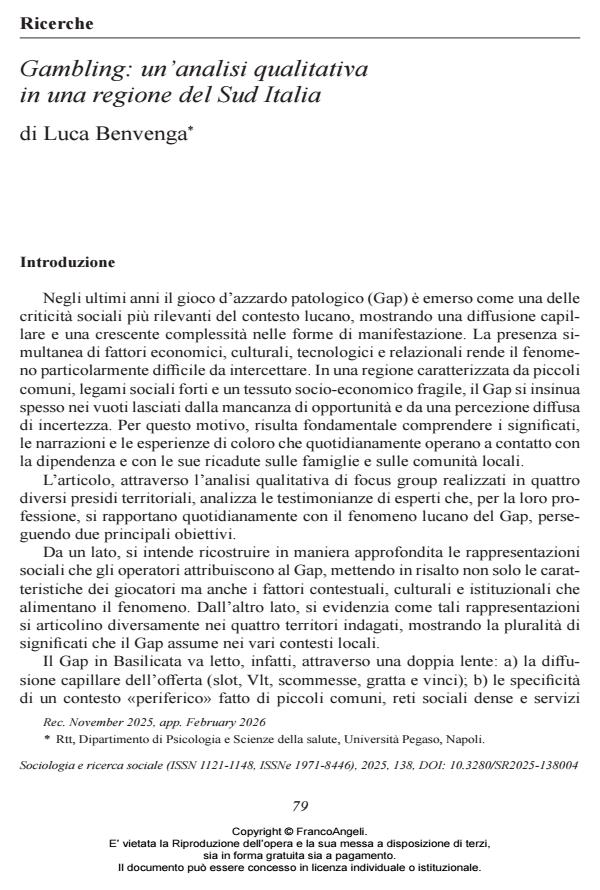
Below, you can see the article first page
If you want to buy this article in PDF format, you can do it, following the instructions to buy download credits
FrancoAngeli is member of Publishers International Linking Association, Inc (PILA), a not-for-profit association which run the CrossRef service enabling links to and from online scholarly content.
The article analyses pathological gambling (PG) in Basilicata, interpreting it as a social phenomenon rooted in specific territorial contexts. Through a qualita-tive study based on four focus groups conducted in different areas of the region, the article gathers the representations, experiences, and practices of professionals working in health, social, and third-sector services involved in addressing the phenomenon. The analysis highlights how PG develops at the intersection of so-cio-economic vulnerabilities, relational proximity, the widespread availability of gambling opportunities, and processes of cultural normalization of gambling, showing how these dynamics take on distinctive features in contexts where re-duced anonymity and the weight of stigma influence access to services and the demand for help.
- A. Bagnasco, L. Ghirotto, L. Sasso (2015), La ricerca qualitativa: una risorsa per i professio-nisti della salute, Milano, Edra Masson.
- A.J. Bond, P. Widdop, J. Myers (2024), «Gambling lifestyles: The importance of social capital and diverse networks», Leisure Studies, 43, 1, pp. 16-30, DOI: 10.1080/02614367.2023.2203511
- V. Codeluppi (2007), La vetrinizzazione sociale, Torino, Bollati Boringhieri.
- P. Corbetta (1999), Metodologia e tecniche della ricerca sociale, Bologna, il Mulino.
- A. Costa, C. Morgana, L. Zilioli (2023), «Stigma e malattia mentale. Opinioni e atteggiamenti all’interno dei servizi di cura. Indagine multicentrica nel territorio lombardo», Psichiatria Oggi, 36, 2, pp. 33-42.
- E.C. Devereux (1968), Gambling, in International Encyclopedia of the Social Sciences, Lon-don, Macmillan, vol. 6.
- E. Freidson (1977), Tipi sociologici di malattia, in G. Abbatecola, L. Melocchi (a c. di), Il po-tere della medicina, Milano, Etas.
- E. Goffman (1969), La vita quotidiana come rappresentazione, Bologna, il Mulino.
- E. Goffman (2006), Selection from «Stigma», in L.J. Davis (ed.), The Disability Studies Reader, New York-London, Routledge.
- E. Goffman (2009), Stigma, New York, Simon & Schuster.
- S. Hall, C. Critcher, T. Jefferson, J. Clarke, B. Roberts (2020), Devianza, conflitti e media, a cura di L. Benvenga e C. Rinaldi, Milano, Mimesis.
- D. Marchetti, M.C. Verrocchio, M. D’Ettorre (2020), «Gioco d’azzardo e suicidalità. Una ras-segna di studi recenti», Psicologia della Salute, 3, pp. 35-63.
- A. Monreal-Bartolomé, S. Thomas, M.C. Van Schalkwyk, M. Daube, H. Pitt, D. McGee, M. McKee (2023), «Preventive gambling programs for adolescents and young adults: A syste-matic review», International Journal of Environmental Research and Public Health, 20, 6, 4691.
- R.K. Merton (1948), Social theory and social structure, New York, The Free Press.
- Ministero della Salute (2020), Disturbo da gioco d’azzardo, https://www.salute.gov.it/portale/news/p3_2_3_1_1.jsp?lingua=italiano&menu=dossier&p=dadossier&id=66.
- N.H. Nailah, M.M. Rozi (2024), «Online gambling addiction prevention strategy for minors ba-sed on legal and sociological approaches», Tauco – International Journal of Social Sciences and Humanities, 1, 2, pp. 138-50.
- R. Rossi, A. Nairn (2024), «Priming young minds. The appeal of gambling advertising to children and young people», Journal of the Association for Consumer Research, 9, 2, pp. 187-99.
- S. Sarti, M. Triventi (2016), «The role of social and cognitive factors in individual gambling. An empirical study on college students», Social Science Research, 62, pp. 219-37,
- T.J. Scheff (2005), «Looking-glass self: Goffman as symbolic interactionist», Symbolic Interac-tion, 28, 2, pp. 147-66,
- R.M. Stetzka, S. Winter (2023), «How rational is gambling?», Journal of Economic Surveys, 37, 4, pp. 1432-88.
- S. Thomas, M.C.I. van Schalkwyk, M. Daube, H. Pitt, D. McGee, M. McKee (2023), «Pro-tecting children and young people from contemporary marketing for gambling», Health Promotion International, 38, 2, daac194.
- W.I. Thomas (1901), «The gaming instinct», American Journal of Sociology, 6, 750.
- W.I. Thomas, F. Znaniecki (1918-1920), The Polish Peasant in Europe and America, Chicago, University of Chicago Press, voll. 1-2.
Luca Benvenga, Gambling: un’analisi qualitativa in una regione del Sud Italia in "SOCIOLOGIA E RICERCA SOCIALE " 138/2025, pp 79-93, DOI: 10.3280/SR2025-138004