Labour, Performance and Outsourcing Processes: Historical-conceptual framework and Strategic-organizational Rationale
Journal title QUADERNI DI ECONOMIA DEL LAVORO
Author/s Azio Barani
Publishing Year 2026 Issue 2022/116
Language Italian Pages 18 P. 237-254 File size 103 KB
DOI 10.3280/QUA2022-116010
DOI is like a bar code for intellectual property: to have more infomation
click here
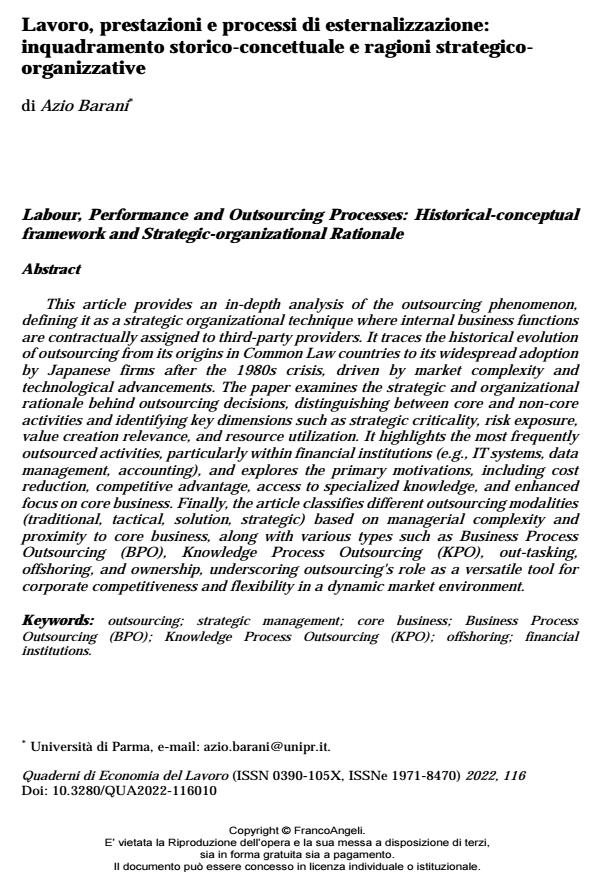
Below, you can see the article first page
If you want to buy this article in PDF format, you can do it, following the instructions to buy download credits
FrancoAngeli is member of Publishers International Linking Association, Inc (PILA), a not-for-profit association which run the CrossRef service enabling links to and from online scholarly content.
This article provides an in-depth analysis of the outsourcing phenomenon, defining it as a strategic organizational technique where internal business functions are contractually assigned to third-party providers. It traces the historical evolution of outsourcing from its origins in Common Law countries to its widespread adoption by Japanese firms after the 1980s crisis, driven by market complexity and technological advancements. The paper examines the strategic and organizational rationale behind outsourcing decisions, distinguishing between core and non-core activities and identifying key dimensions such as strategic criticality, risk exposure, value creation relevance, and resource utilization. It highlights the most frequently outsourced activities, particularly within financial institutions (e.g., IT systems, data management, accounting), and explores the primary motivations, including cost reduction, competitive advantage, access to specialized knowledge, and enhanced focus on core business. Finally, the article classifies different outsourcing modalities (traditional, tactical, solution, strategic) based on managerial complexity and proximity to core business, along with various types such as Business Process Outsourcing (BPO), Knowledge Process Outsourcing (KPO), out-tasking, offshoring, and ownership, underscoring outsourcing's role as a versatile tool for corporate competitiveness and flexibility in a dynamic market environment.
Keywords: outsourcing; strategic management; core business; Business Process Outsourcing (BPO); Knowledge Process Outsourcing (KPO); offshoring; financial institutions.
- Balzani M. e De Bernardi P. (2003). La gestione dei servizi in outsourcing: il modello delle società di servizi. Torino: Giappichelli Editore.
- Brancato E. (2012). La catena del valore dell’intermediazione creditizia nell’economia delle imprese bancarie. Profili di innovazione finanziaria, organizzativa e tecnologica. Milano: FrancoAngeli.
- Campanella F. e Clavarino F. (2004). Outsourcing. Profili economici, gestionali e organizzativi. Milano: FrancoAngeli.
- Caroli M. e Fontana F. (2017). Strategia d’impresa: Il processo di direzione strategica. McGraw-Hill Education.
- Costaguta M. (1996). I contratti di outsourcing. Quaderni di diritto commerciale. Milano: Giuffrè.
- Dassi R. (2004). Il contratto di outsourcing. Milano: Giuffrè.
- Deloitte & Touche LLP. (2018). Deloitte’s 2018 Global Outsourcing Survey.
- De Paolis E. (2000). Outsourcing bancario. Bancaria Editrice.
- Domberger S. (1998). The Contracting Organization: A Strategic Guide to Outsourcing. Oxford University Press.
- Dui E. (2007). L’outsourcing in sanità. Profili giuridici ed economici. Milano: Giuffrè.
- Feenstra R.C. e Hanson G.H. (1999). The impact of outsourcing and high-technology imports on wages: evidence from the United States, 1979-1990. The Quarterly Journal of Economics, 114(3): 907-940.
- Gervasi L. e Ballarin F. (2006). Outsourcing IT. La scelta strategica, il processo, la gestione del contratto. Milano: FrancoAngeli.
- Gregori F. (2001). Outsourcing. Strategia e gestione dei processi. Milano: FrancoAngeli.
- Hassan M.A. e Mahomed S. (2022). Enhancing operational resilience through effective outsourcing risk management in financial institutions: A review. Journal of Financial Regulation and Compliance, 30(4): 450-466.
- ISFOL (2012). Rapporto ISFOL sulle tendenze dell’outsourcing in Italia.
- Kaplan R.S. e Atkinson A.A. (2002). Advanced management accounting. Prentice Hall.
- Kay J. (1993). Foundations of corporate success: How business strategies add value. Oxford University Press.
- Krasniqi B. e Metaj G. (2021). The Impact of Strategic Outsourcing on Firm Performance: A Literature Review. European Journal of Business and Management Research, 6(5): 184-192.
- Latham & Watkins LLP. (2020). Outsourcing – Guidance on the Legal and Regulatory Framework.
- Lemma F. e Thorp J. (2014). Governance of Outsourcing in Financial Institutions: A Guide to the European Regulatory Framework. Wolters Kluwer Law & Business.
- Mauri C. (2000). L’outsourcing nelle banche. Bancaria Editrice.
- McCahery J.A. e De Roode F.A. (2018). Financial Outsourcing: A Survey of the Regulatory and Governance Challenges. ECGI Working Paper Series in Law, n. 427/2018.
- Mihov A. e Panteleeva E. (2019). Outsourcing in the Financial Sector: Drivers, Risks, and Regulatory Challenges. Economic Alternatives, (2): 221-236.
- Pogliaghi M. e Niccolini L. (2006). Outsourcing IT. Guida alla scelta e alla gestione. Milano: FrancoAngeli.
- Prahalad C.K. e Hamel G. (1990). The core competence of the corporation. Harvard Business Review, 68(3): 79-91.
- Ricciardi M. (2009). L’outsourcing in banca. Bancaria Editrice.
- Rodrik D. (2011). The Globalization Paradox: Democracy and the Future of the World Economy. W.W. Norton & Company.
- Scannella E. (2012). La gestione dei contratti di outsourcing nelle pubbliche amministrazioni. Milano: FrancoAngeli.
- Strassman P.A. (2004). The Economics of Outsourcing. Information Economics Journal, giugno.
- Totaro F. (2007). Outsourcing e trasferimento di parte dell’azienda. Giurisprudenza italiana, 12. UTET.
- Tullini P. (2005). Le nuove forme di esternalizzazione dell’impresa. Bononia University Press.
- Van Long N. (2005). Outsourcing and Technology Spillovers. International Review of Economics & Finance, 14(3): 297-304.
- Van Mieghem J.A. (1999). Coordinating Investment. Production and Subcontracting. Management Science, 45(7): 954-971.
- Vanetti C.B. (1998). Outsourcing: alcune considerazioni sugli aspetti societari. Società, 11: 1275 ss.
Azio Barani, Lavoro, prestazioni e processi di esternalizzazione: inquadramento storico-concettuale e ragioni strategicoorganizzative in "QUADERNI DI ECONOMIA DEL LAVORO" 116/2022, pp 237-254, DOI: 10.3280/QUA2022-116010