Cracks in sovereign trust. Accounting and institutional crisis in a public monopoly: The Real Compagnia di Assicurazioni Marittime in the Kingdom of Naples (1751-1802)
Journal title CONTABILITÀ E CULTURA AZIENDALE
Author/s Alessio Maria Musella
Publishing Year 2026 Issue 2025/1
Language English Pages 34 P. 9-42 File size 285 KB
DOI 10.3280/CCA2025-001002
DOI is like a bar code for intellectual property: to have more infomation
click here
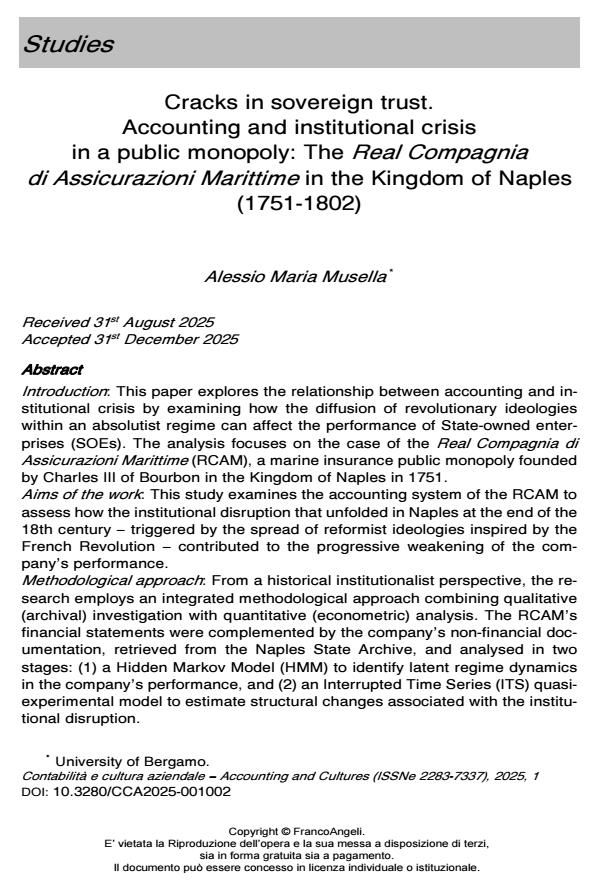
Below, you can see the article first page
If you want to buy this article in PDF format, you can do it, following the instructions to buy download credits
FrancoAngeli is member of Publishers International Linking Association, Inc (PILA), a not-for-profit association which run the CrossRef service enabling links to and from online scholarly content.
Introduction: This paper explores the relationship between accounting and in-stitutional crisis by examining how the diffusion of revolutionary ideologies within an absolutist regime can affect the performance of State-owned enter-prises (SOEs). The analysis focuses on the case of the Real Compagnia di Assicurazioni Marittime (RCAM), a marine insurance public monopoly founded by Charles III of Bourbon in the Kingdom of Naples in 1751. Aims of the work: This study examines the accounting system of the RCAM to assess how the institutional disruption that unfolded in Naples at the end of the 18th century – triggered by the spread of reformist ideologies inspired by the French Revolution – contributed to the progressive weakening of the com-pany’s performance. Methodological approach: From a historical institutionalist perspective, the re- search employs an integrated methodological approach combining qualitative (archival) investigation with quantitative (econometric) analysis. The RCAM’s financial statements were complemented by the company’s non-financial doc-umentation, retrieved from the Naples State Archive, and analysed in two stages: (1) a Hidden Markov Model (HMM) to identify latent regime dynamics in the company’s performance, and (2) an Interrupted Time Series (ITS) quasi-experimental model to estimate structural changes associated with the institu-tional disruption. Main findings: The findings demonstrate how the “crack in trust” in the abso-lutist government of King Ferdinand IV of Bourbon affected the RCAM’s fate, within a broader context shaped by reformist currents inspired by Enlighten-ment ideas and by the spread of libertarian thought from revolutionary France into the Kingdom of Naples. Contribution to the literature: This study contributes to the literature by high- lighting accounting’s potential to reflect institutional instability within a public monopoly. It also supports the use of econometrics in accounting history re-search.
Keywords: public monopoly, historical institutionalism, quantitative analysis, Southern Italy, marine insurance, state-owned enterprises
- Carnegie G.D., Napier C.J. (2012). Accounting’s past, present and future: The unifying power of history. Accounting, Auditing & Accountability Journal, 25(2): 328-369.
- Naples State Archive (NSA): mArchival Fund: Real Compagnia delle Assicurazioni Marittime (RCAM):
- – Section: Scritture Contabili e Bilanci; years: (1751-1802); Dossiers: n. 47-71.
- – Section: Deliberazioni; years: (1751-1797); Dossiers: n. 77-79.
- Acton H. (1998). The Bourbons of Naples: (1734-1825). London: Prion Books. Addobbati A. (2007). Commercio, rischio, guerra: Il mercato delle assicurazioni marittime di Livorno (1694-1795). Roma: Edizioni di Storia e Letteratura.
- Aguilera R., Duran P., Heugens P.P.M.A.R., Sauerwald S., Turturea R., Van Essen M. (2021). State ownership, political ideology, and firm performance around the world. Journal of World Business, 56(1): 101113.
- Anderson M.S. (1972). L’Europa nel Settecento (1713-1783). Milano: Edizioni di Comunità.
- Antonelli V., D’Alessio R., Rossi R. (2014). Budgetary practices in the Ministry of War and the Ministry of Munitions in Italy, 1915-1918. Accounting History Review, 24(2-3): 139-160.
- Ashforth B.E., Gibbs B.W. (1990). The double-edge of organizational legitima-tion. Organization Science, 1(2): 177-194.
- Assante F. (1979). Il mercato delle assicurazioni marittime a Napoli nel Sette-cento: Storia della Real Compagnia, 1751-1802. Napoli: Giannini Editore.
- Avallone P. (2012). Navigare sicuri nel Mediterraneo. Assicurazioni marittime nel Regno di Napoli (XVII-XIX secolo). In: Mafrici M., Vassallo C. (eds.), Sguardi mediterranei tra Italia e Levante (XVII-XIX secolo): 1-18. Malta: Malta University Press.
- Besley T., Dray S. (2024). Trust and state effectiveness: The political economy of compliance. The Economic Journal, 134(662): 2225-2251.
- Boolaky P., Tawiah V., Soobaroyen T. (2020). Why do African countries adopt IFRS? An institutional perspective. The International Journal of Accounting, 55(1): 2050005.
- Bortolotti B., Fotak V., Megginson W.L. (2015). The rise of sovereign wealth funds: definition, organization, and governance. In: Public Private Partner-ships for Infrastructure and Business Development: Principles, Practices, and Perspectives: 295-318. New York: Palgrave Macmillan US.
- Bouckaert G., van de Walle S. (2003). Comparing measures of citizen trust and user satisfaction as indicators of ‘good governance’: Difficulties in linking trust and satisfaction indicators. International Review of Administrative Sci-ences, 69(3): 329-343.
- Burchell S., Clubb C., Hopwood A., Hughes J., Nahapiet J. (1980). The roles of accounting in organisations and society. Accounting, Organizations and Society, 5(1): 5-27.
- Burton R.M., Obel B., Håkonsson D. (2015). Organizational design: A step-by-step approach. 3rd ed. Cambridge: Cambridge University Press.
- Buttà G. (1965). I Borboni di Napoli al cospetto di due secoli. Bologna: Forni Editore.
- Cappé O., Moulines E., Rydén T. (2005). Inference in Hidden Markov models. New York: Springer New York.
- Carnegie G.D. (2014). The present and future of accounting history. Account-ing, Auditing & Accountability Journal, 27(8): 1241-1249.
- Cassandro G. (1959). Note storiche sul contratto di assicurazione. Bollettino dell’Archivio Storico del Banco di Napoli, XIII.
- Ceccarelli G. (2020). Risky markets: Marine insurance in renaissance Flor-ence. Leiden: Brill.
- Chandar N., Miranti P.J. (2009). Integrating accounting and statistics: Fore-casting, budgeting and production planning at the American telephone and telegraph company during the 1920s. Accounting and Business Research, 39(4): 373-395.
- Christiansen H. (2013). Balancing commercial and non-commercial priorities of state-owned enterprises. OECD Corporate Governance Working Pa-pers, 6.
- Covaleski M.A., Dirsmith M.W. (1991). The management of legitimacy and pol-itics in public sector administration. Journal of Accounting and Public Pol-icy, 10(2): 135-156.
- Coufalová L., Mikula Š., Žídek L. (2023). Misreporting in financial statements in a centrally planned economy: The case of Czechoslovak state-owned enterprises in late socialism. Accounting History, 28(1): 170-191.
- Dacin M.T., Goodstein J., Scott W.R. (2002). Institutional theory and institu-tional change: Introduction to the special research forum. Academy of Man-agement Journal, 45(1): 45-57.
- David P.A. (2007). Path dependence: A foundational concept for historical so-cial science. Cliometrica, 1(2): 91-114.
- de Fonseca Pimentel E. (1799). Il Monitore Napoletano del 1799. Napoli.
- De Jorio M. (1778). Storia del commercio e della navigazione dal principio del mondo sino à nostri giorni. Napoli: Stamperia Simoniana.
- De Martino G. (1995). Gli illuministi meridionali: storia e cultura nel Regno di Napoli tra ‘600 e ‘700. Napoli: Liguori Editore.
- Deephouse D., Suchman M. (2008). Legitimacy in organizational institutional-ism. In: Greenwood R., Oliver C., Suddaby R., Sahlin K. (eds.), The SAGE Handbook of Organizational Institutionalism: 49-77. London: SAGE Publi-cations Ltd.
- Di Cimbrini T., Musella A.M., Corsi C. (2023). Accounting for and of the epi-demic in Bologna in 1855: The medicus-politicus in the Papal States. Ac-counting History, 29(1-2024): 123-155.
- Di Cimbrini T., Musella A.M., Fosco G. (2024). How does accounting save lives? An econometric analysis exploring the effectiveness of the Crispi-Pagliani Health Reform (1888) in Italy. Accounting History, 29(1): 156-178.
- Di Cimbrini T. (2015). Welfare or politics? The identity of Italian mutual aid societies as revealed by a latent class cluster analysis of their annual re-ports. Accounting History, 20(3): 310-341.
- DiMaggio P.J., Powell W.W. (1983). The iron cage revisited: Institutional iso-morphism and collective rationality in organizational fields. American So-ciological Review, 48(2): 147-160.
- Dumas A. (1863). I Borboni di Napoli. Napoli: Stabilimento tipografico del Ple-biscito a Chiaia.
- Ellis C., Stimson J.A. (2012). Ideology in America. Cambridge: Cambridge Uni-versity Press.
- Ferron J., Rendina-Gobioff G. (2014). Interrupted time series design. Wiley StatsRef: Statistics Reference Online.
- Fowler C.J., Keeper T. (2016). Twenty years of accounting history (1996-2015): Evidence of the changing faces of accounting history research. Accounting History, 21(4): 389-418.
- Gianfelici C., Martin-Sardesai A., Guthrie J. (2024). Investigating the develop-ment of narratives in directors’ reports: an analysis of Barilla over six dec-ades. Accounting, Auditing & Accountability Journal, 37(9): 192-215.
- Gleijeses V. (1976). Napoli nostra e nuove storie. Napoli: Società Editrice Na-poletana.
- Gomes D., Sargiacomo M., (2013). Accounting and accountability in local gov-ernment: An introduction. Accounting History, 18(4): 439-446.
- Günther J. (2017). Capital market effects around dividend announcements: An analysis of the Berlin stock exchange in 1895. Accounting History Review, 27(3): 249-278.
- Hinings C.R., Greenwood R. (1988). The dynamics of strategic change. Oxford: Basil Blackwell.
- Hoffman A.J. (1999). Institutional development and change: Environmentalism and the U.S. chemical industry. Academy of Management Journal, 42(4): 351-371.
- Hopwood A.G. (1987). The archaeology of accounting systems. Accounting, Organizations and Society, 12(3): 207-234.
- Islam R. (2018). One more time: What are institutions and how do they change? Washington, DC: World Bank Group.
- Jepperson R.L. (2021). Institutions, institutional effects, and institutionalism (1991). In: Jepperson R.L., Meyer J.W. (eds.), Institutional theory: The cul-tural construction of organisations, states, and identities: 37-66. Cam-bridge: Cambridge University Press.
- Koning E.A. (2016). The three institutionalisms and institutional dynamics: Un-derstanding endogenous and exogenous change. Journal of Public Policy, 36(4): 639-664.
- Lindner J. (2003). Institutional stability and change: Two sides of the same coin. Journal of European Public Policy, 10(6): 912-935.
- Lounsbury M., Zhao E.Y. (2013). Neo-institutional theory. Oxford Bibliog-raphies.
- MacDonald L.D., Richardson A.J. (2011). Does academic management ac-counting lag practice? A cliometric study. Accounting History, 16(4): 365-388.
- Mahoney J., Thelen K. (2010). A theory of gradual institutional change. In: Ma-honey J., Thelen K. (eds.), Explaining institutional change: 1-37. Cam-bridge: Cambridge University Press.
- Maresca B. (1888). Memoria sugli avvenimenti di Napoli nell’anno 1799 scritta da Amedeo Ricciardi napoletano. Archivio storico per le province napole-tane, XIII: 55-56.
- Marisca C., Rappazzo N. (2025). When accounting history almost merges with economic history: Exploring trade credit dynamics through bankrupts’ fi-nancial data. An analysis of Italian textile industry at the turn of 19th century. Roma: Rirea Historica.
- Masayoshi N., Kitaura T., Sumi Y., Shimizu Y. (2021). Corporate governance in Japan in the 1930s and its impact on financial reporting practice. Ac-counting History Review, 31(2): 193-214.
- McDowall D., McCleary R., Bartos B.J. (2019). Interrupted time series analysis. Oxford: Oxford University Press.
- McInnes W.M. (2002). An agency perspective on the accounting costs used in various roles in the regulation of a state-owned natural monopoly: The Brit-ish Gas Corporation 1972-86. Accounting, Business & Financial History, 12(3): 387-418.
- McWatters C.S. (2025). Our tradition of innovation: thirty-five years of Account-ing History Review. Accounting History Review, 35(3): 229-232.
- Meyer J.W., Rowan B. (1977). Institutionalised organisations: Formal structure as myth and ceremony. American Journal of Sociology, 83(2): 340-363.
- Mezias S.J. (1990). An institutional model of organizational practice: Financial reporting at the Fortune 200. Administrative Science Quarterly, 35(3): 431-457.
- Miller G. (2000). Rational choice and dysfunctional institutions. Governance, 13(4): 535-547.
- Mor B., Garhwal S., Kumar A. (2021). A systematic review of Hidden Markov Models and their applications. Archives of computational methods in engi-neering, 28(3): 1429-1448.
- Musacchio A., Lazzarini S.G. (2018). State-owned enterprises as multination-als: Theory and research directions. In: Cuervo-Cazurra A. (ed.), State-owned multinationals. JIBS special collections: 23-52. Cham: Palgrave Macmillan.
- North D.C. (2009). Institutions, institutional change and economic perfor-mance. 27th ed. New York: Cambridge University Press.
- North D.C. (1992). Transaction costs, institutions, and economic performance: 13-15. San Francisco: ICS Press.
- OECD (2017). Trust and public policy: How better governance can help rebuild public trust. OECD Public Governance Reviews. Paris: OECD Publishing.
- Phan D., Joshi M., Tran-Nam B. (2018). The history of accounting standard setting in an emerging transition economy: The case of Vietnam. Account-ing History, 23(3): 379-406.
- Piccinno L. (2016). Genoa, 1340-1620: Early development of marine insurance. In: Leonard A.B. (ed.), Marine insurance: Origins and institutions, 1300-1850: 24-45. London: Palgrave Macmillan.
- Pierson P. (2004). Politics in time: History, institutions, and social analysis. Princeton: Princeton University Press.
- Pirolo F. (2017). La creazione della “Real Compagnia di Assicurazioni Marit-time” (1751). In: Morozzo della Rocca C., Tiboni F. (eds.), Transire mare. Atti del Convegno di Cultura Navale e Marittima (Genova 2016): 393-400. Firenze: GoWare.
- Pittroff E. (2021). The legitimacy of global accounting rules: A note on the chal-lenges from path-dependence theory. Journal of Management and Govern-ance, 25(2): 379-396.
- Rabiner L., Juang B. (2003). An introduction to Hidden Markov Models. IEEE ASSP Magazine, 3(1): 4-16.
- Rao A.M. (2021). La repubblica napoletana del 1799. Napoli: FedOA Press. Rothstein B. (2005). Social traps and the problem of trust. Cambridge: Cambridge University Press.
- Sargiacomo M., Servalli S., Carnegie G.D. (2012). Accounting for killing: Ac-countability for death. Accounting History, 17(3-4): 393-413.
- Sargiacomo M. (2009). Accounting for ‘the good administration of justice’: The Farnese state of Abruzzo in the sixteenth century. Accounting History, 14(3): 235-267.
- Sargiacomo M. (2008). Accounting and the ‘art of government’: Margaret of Austria in Abruzzo (1539-1586). European Accounting Review, 17(4): 667-695.
- Sargiacomo M. (2006). Using accounting records to enhance an understanding of a seventeenth-century Italian feudal community: The case of the com-mune of Penne (1664-90). Accounting History, 11(4): 475-502.
- Sasaki S. (2001). The historical significance of the revaluation of fixed assets in Japan’s state-owned railway system, 1955-6. Accounting, Business & Fi-nancial History, 11(3): 293-309.
- Schipa M. (1921). Il regno di Napoli in una descrizione veneta del 1793. Archi-vio storico per le province napoletane, VII, fasc. I-V.
- Schisani M.C., Ragozini G. (2025). Marine insurance firms, business networks, and the modernisation of the financial sector in Southern Italy (1820-1900). Business History, 67(3): 665-710.
- Schisani M.C. (2001). La Borsa di Napoli: 1778-1860. Istituzione, regolazione e attività. Napoli: Edizioni Scientifiche Italiane.
- Scott W.R. (2014). Institutions and organisations: Ideas, interests and identi-ties. Thousand Oaks: Sage Publications.
- Servalli S. (2023). Artificial Intelligence in Historical Investigations: Observa-tions. Accounting and Cultures, 2(1): 5-7.
- Stefani G. (1958). Insurance in Venice from the origins to the end of the Serenissima: Documents, published for the 125th anniversary of the com-pany [Assicurazioni Generali di Trieste e Venezia] 1831-1956. Vol. 1. Trieste: Assicurazioni Generali di Trieste e Venezia.
- Suchman M.C. (1995). Managing legitimacy: Strategic and institutional ap-proaches. Academy of Management Review, 20(3): 571-610.
- Suddaby R., Foster W.M., Mills A.J. (2013). Historical institutionalism. In: Bucheli M., Wadhwani R.D. (eds.), Organisations in time: History, theory, methods: 100-123. Oxford: Oxford University Press.
- Sumi Y., Kitaura T., Shimizu Y., Noguchi M. (2024). Extrinsic shocks and cor-porate accounting behaviour: The case of the Great Kanto Earthquake in 1923. Accounting History, 29(1): 66-87.
- Talbot P.A. (2010). Colonel William Henry Sykes: His contribution to statistical accounting. Accounting History, 15(2): 253-276.
- Thelen K. (1999). Historical institutionalism in comparative politics. Annual Re-view of Political Science, 2(1): 369-404.
- Venturi F. (1971). Napoli capitale nel pensiero dei riformatori illuministi. In: Sto-ria di Napoli, vol. VIII. Napoli: Società Editrice Storia di Napoli.
- Venturi F. (1962). Illuministi italiani. Riformatori napoletani. Napoli: Ricciardi Editore.
- Villani P. (1973). Mezzogiorno tra riforme e rivoluzione. Roma: Laterza. Walker S.P. (2008). Innovation, convergence and argument without end in accounting history. Accounting, Auditing & Accountability Journal, 21(2): 296-322.
- Walker S.P. (2005). Accounting in History. The Accounting Historians Journal, 32(2): 233-259.
- Wang Y., Liu Q. (2006). Comparison of Akaike information criterion (AIC) and Bayesian information criterion (BIC) in selection of stock–recruitment rela-tionships. Fisheries Research, 77(2): 220-225.
- Xu L., Ji S., Dellaportas S. (2021). The role of institutional entrepreneurship in the development of accounting in the early 20th century in China. Business History, 63(6): 1007-1029.
- Xu L., Cortese C., Zhang E. (2014). Ideology diffusion and the role of account-ing: A Gramscian approach to understanding China’s transition from 1949 to 1957. Accounting History, 19(4): 434-451.
Alessio Maria Musella, Cracks in sovereign trust. Accounting and institutional crisis in a public monopoly: The Real Compagnia di Assicurazioni Marittime in the Kingdom of Naples (1751-1802) in "CONTABILITÀ E CULTURA AZIENDALE" 1/2025, pp 9-42, DOI: 10.3280/CCA2025-001002