Regionalismo differenziato, diritti fondamentali, unità della Repubblica: nodi critici e limiti costituzionali
Journal title CITTADINANZA EUROPEA (LA)
Author/s Silvio Gambino
Publishing Year 2026 Issue 2026/1
Language Italian Pages 99 P. 23-121 File size 481 KB
DOI 10.3280/CEU2026-001002
DOI is like a bar code for intellectual property: to have more infomation
click here
Below, you can see the article first page
If you want to buy this article in PDF format, you can do it, following the instructions to buy download credits
FrancoAngeli is member of Publishers International Linking Association, Inc (PILA), a not-for-profit association which run the CrossRef service enabling links to and from online scholarly content.
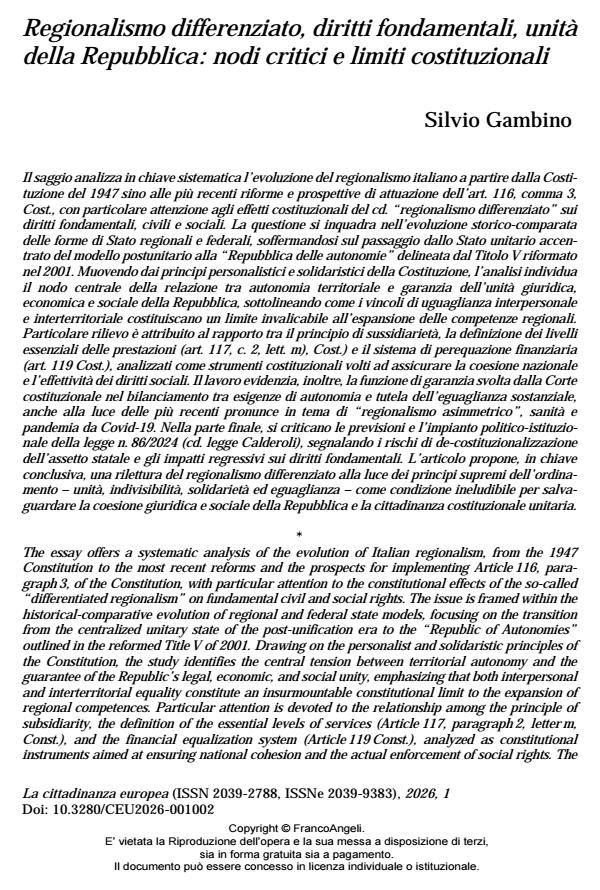
The essay offers a systematic analysis of the evolution of Italian regionalism, from the 1947 Constitution to the most recent reforms and the prospects for implementing Article 116, paragraph 3, of the Constitution, with particular attention to the constitutional effects of the socalled “differentiated regionalism” on fundamental civil and social rights. The issue is framed within the historicalcomparative evolution of regional and federal state models, focusing on the transition from the centralized unitary state of the postunification era to the “Republic of Autonomies” outlined in the reformed Title V of 2001. Drawing on the personalist and solidaristic principles of the Constitution, the study identifies the central tension between territorial autonomy and the guarantee of the Republic’s legal, economic, and social unity, emphasizing that both interpersonal and interterritorial equality constitute an insurmountable constitutional limit to the expansion of regional competences. Particular attention is devoted to the relationship among the principle of subsidiarity, the definition of the essential levels of services (Article 117, paragraph 2, letter m, Const.), and the financial equalization system (Article 119 Const.), analyzed as constitutional instruments aimed at ensuring national cohesion and the actual enforcement of social rights. The essay also highlights the Constitutional Court’s role as a guarantor in balancing regional autonomy with substantive equality, especially in light of recent rulings on asymmetric regionalism, healthcare governance, and the management of the Covid19 pandemic. In its concluding part, the essay critically assesses the provisions and institutional design of Law no. 86/2024 (the socalled Calderoli Law), pointing out the risks of a deconstitutionalization of the state structure and the regressive impact on fundamental rights. Ultimately, it proposes a reinterpretation of differentiated regionalism in the light of the Constitution’s supreme principles – unity, indivisibility, solidarity, and equality – as essential conditions for safeguarding the Republic’s legal and social cohesion and its unified constitutional citizenship.
Silvio Gambino, Regionalismo differenziato, diritti fondamentali, unità della Repubblica: nodi critici e limiti costituzionali in "CITTADINANZA EUROPEA (LA)" 1/2026, pp 23-121, DOI: 10.3280/CEU2026-001002