The sociologist and the sirens: iconography and inspiration of a metaphor thirty years later
Titolo Rivista SOCIOLOGIA E RICERCA SOCIALE
Autori/Curatori Paul Atkinson, Silvia Cataldi
Anno di pubblicazione 2026 Fascicolo 2025/138
Lingua Inglese Numero pagine 27 P. 33-59 Dimensione file 248 KB
DOI 10.3280/SR2025-138002
Il DOI è il codice a barre della proprietà intellettuale: per saperne di più
clicca qui
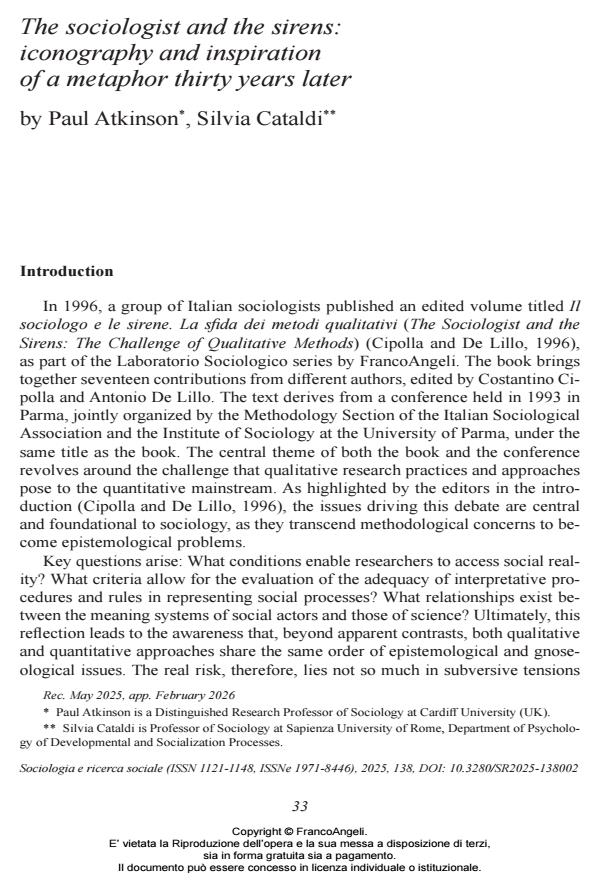
Qui sotto puoi vedere in anteprima la prima pagina di questo articolo.
Se questo articolo ti interessa, lo puoi acquistare (e scaricare in formato pdf) seguendo le facili indicazioni per acquistare il download credit. Acquista Download Credits per scaricare questo Articolo in formato PDF
FrancoAngeli è membro della Publishers International Linking Association, Inc (PILA), associazione indipendente e non profit per facilitare (attraverso i servizi tecnologici implementati da CrossRef.org) l’accesso degli studiosi ai contenuti digitali nelle pubblicazioni professionali e scientifiche.
The paper revisits the 1996 volume The Sociologist and the Sirens: The Challenge of Qualitative Methods (Cipolla and De Lillo, eds.), reflecting on the enduring relevance of its central metaphor. While the volume, based on a 1993 conference, set out to explore the tensions between qualitative and quantitative approaches, this article reclaims and further develops that metaphor, interpreting it as a lens through which to understand the challenges and ambiguities inherent in all social research. Beyond methodological binaries, both qualitative and quanti-tative traditions reveal similar tensions: between subjectivity and rigor, uncertain-ty and control, sensitivity and formalization. Nearly thirty years later, the sirens continue to symbolize research practice as a liminal, hybrid process – requiring navigation between opposing poles such as emotion and reason, involvement and detachment. In this view, the sirens represent not only the seductive risk of meth-odological dadaism, but also the generative tensions that shape the sociological imagination, inviting researchers to embrace complexity, inhabit liminal spaces, and engage with the transformative and risky nature of the research encounter.
- H.C. Andersen (1837), Den lille Havfrue, in Eventyr, fortalte for Børn. Første Samling, Tredie Hefte, Copenhagen, C.A. Reitzel.
- R. Barton (1968), The concept of property-space in social research, in H.M. Blalock, A.B. Blalock (eds.), Methodology in social research, New York, McGraw-Hill.
- J. Baudrillard (1979), La seduction, Paris, Éditions Galilée.
- W.I. Beveridge (1950), The art of scientific investigation, New York, Norton and Company.
- H. Blumer (1954), «What is wrong with social theory?», American Sociological Review, 19, 1, pp. 3-10.
- G. Boccaccio (1349-1351), De genealogia deorum gentilium; trans. by B.E.T. Whiting, Cam-bridge, Harvard University Press, 1972.
- d. boyd, K. Crawford (2012), «Critical questions for big data», Information, Communication & Society, 15, 5, pp. 662-79, DOI: 10.1080/1369118X.2012.678878
- P. Bourdieu (1999), The weight of the world. Social suffering in contemporary society, Stan-ford, Stanford University Press.
- L.J. Breen, D. Darlaston-Jones (2010), «Moving beyond the enduring dominance of positivism in psychological research: Implications for psychology in Australia», Australian Psycholo-gist, 45, 1, pp. 67-76, DOI: 10.1080/00049530903503296
- M. Bulmer, J. Solomos (2004), Researching race and racism, London, Routledge.
- M. Burawoy (2005), «For Public Sociology», American Sociological Review, 70, 1, pp. 4-28.
- R. Calasso (2017), Le nozze di Cadmo e Armonia, Milano, Adelphi.
- E. Campelli (1990), La logica della ricerca empirica, Milano, FrancoAngeli.
- E. Campelli (1996), Metodi qualitativi e teoria sociale, in C. Cipolla, A. De Lillo (a c. di), Il
- sociologo e le sirene. La sfida dei metodi qualitativi, Milano, FrancoAngeli.
- M. Cardano (2003), Tecniche di ricerca qualitativa. Percorsi di ricerca nelle scienze sociali, Roma, Carocci.
- M. Cardano (2011), La ricerca qualitativa, Bologna, il Mulino.
- M.C. Catone, S. Cataldi (2026), Crowdsourcing platforms in social research: methodological and ethical issues, in M.G. Grassia, M. Marino, B. Aragona, E. Amaturo, C. Crocetta, C.N. Lauro (eds.), Data Science and Social Research, vol. III: Epistemology, Methods, Technol-ogy, Applications, and Relation to Artificial Intelligence, Cham, Springer.
- C. Cipolla, A. De Lillo (a c. di) (1996), Il sociologo e le sirene. La sfida dei metodi qualitativi, Milano, FrancoAngeli.
- J. Clifford, G. E. Marcus (1986), Writing culture. The poetics and politics of ethnography, Berkeley, University of California Press.
- J.S. Coleman (1958), «Relational analysis: The study of social organizations with survey meth-ods», Human Organization, 17, 4, pp. 28-36.
- A. Colombis (1996), Fuori dal mito: la sociologia «qualitativa» è una forma della mente, in C. Cipolla C., De Lillo A. (a c. di), Il sociologo e le sirene, Milano, FrancoAngeli.
- C. Corradi (1986), «Resa-e-cattura: Il contributo di Kurt H. Wolff all’epistemologia dell’analisi qualitativa», Studi di Sociologia, 24, 2, pp. 215-28.
- J.W. Creswell (2003), Research design. Qualitative, quantitative, and mixed methods ap-proaches, Thousand Oaks, Sage Publications, 2nd ed.
- J.W. Creswell, V.L. Plano Clark (2018), Designing and conducting mixed methods research, Thousand Oaks, Sage Publications, 3rd ed.
- F. de la Motte Fouqué (1811), Undine, Berlin, Selbstverlag.
- N.K. Denzin (2012), «Triangulation 2.0», Journal of Mixed Methods Research, 6, 2, pp. 80-8, DOI: 10.1177/1558689812437186
- N.K. Denzin, Y.S. Lincoln (eds.) (2018), The Sage Handbook of Qualitative Research, Thousand Oaks, Sage Publications, 5th ed.
- B. de S. Santos (2014), Epistemologies of the South: Justice Against Epistemicide, Boulder, Paradigm Publishers.
- P. DiMaggio, M. Nag, D. Blei (2013), «Exploiting affinities between topic modeling and the sociological perspective on culture», Poetics, 41, 6, pp. 570-606.
- J.D. Douglas (1976), Investigative social research. Individual and team field research, Thousand Oaks, Sage Publications.
- V. Falco, D. Cuntrera M. Attanasio (2023), «Gender differences in career advancements in Ital-ian universities over the last 20 years», Genus, 79, 14,
- F. Ferrarotti (1961), Sociologia come partecipazione e altri saggi, Torino, Taylor.
- A. Fine, H. Deegan (1996), «Qualitative research and the serendipity factor», International Journal of Qualitative Studies in Education, 9, 1, pp. 13-28.
- C. Geertz (1973), The Interpretation of Cultures, New York, Basic Books.
- A. Giddens (1984), The Constitutuion of Society, Cambridge, Polity Press.
- G. Gobo (2008), Doing Ethnography, London, Sage Publications.
- G. Gobo (2005), «The renaissance of qualitative methods», Forum Qualitative Sozialforschung/ Forum: Qualitative Social Research, 6, 3,
- P. Govoni (2008), A long-term history of women and the sciences in Italian universities, in S. Badaloni, C.A. Drace, O. Gia, M.C. Levorato, F. Vidotto (a cura di), Under-representation of women in science and technology, Quaderni del Comitato Pari Opportunità, 7, Padova, Cleup.
- J.C. Greene, V.J. Caracelli, W. F. Graham (1989), «Toward a conceptual framework for mixed-method evaluation designs», Educational Evaluation and Policy Analysis, 11, 3, pp. 255-74.
- E. G. Guba, Y.S. Lincoln (1994), Competing paradigms in qualitative research, in N.K. Denzin,
- Y.S. Lincoln (eds.), Handbook of qualitative research, London, Sage Publications.
- A.M. Hancock (2016), Intersectionality. An intellectual history, New York, Oxford University Press.
- D. Haraway (1988), «Situated knowledges. The science question in feminism and the privilege of partial perspective», Feminist Studies, 14, 3, pp. 575-99.
- S. Harding (1991), Whose science? Whose knowledge? Thinking from women’s lives, Ithaca, Cornell University Press.
- S.N. Hesse-Biber (2012), Handbook of feminist research. Theory and praxis, Thousand Oaks, Sage Publications.
- Homer (800 bce), The Odyssey; trans. by R. Fagles, London, Penguin Books, 1997.
- J.P.A. Ioannidis (2005), «Why most published research findings are false», Plos Medicine, 2, 8, e124,
- D. Kaplan (2004), The Sage Handbook of Quantitative Methodology for the Social Sciences, Thousand Oaks, Sage Publications.
- R. Kitchin (2014), The data revolution. Big data, open data, data infrastructures and their consequences, London, Sage Publications.
- J.I. Kitsuse, M. Spector (1973), «Toward a sociology of social problems: Social conditions, value judgments, and social change», Social Problems, 20, 4, pp. 407-19,
- P.F. Lazarsfeld (1955), Interpretation of statistical relations as a research operation, in P.F. Lazarsfeld, M. Rosenberg (eds.), The language of social research: A reader in the method-ology of social research, Glencoe, Free Press.
- F. Leonardi (1991), «Contro l’analisi qualitativa», Sociologia e ricerca sociale, 35, pp. 3-29.
- J.A. Maxwell (2012), Qualitative research design. An interactive approach, Thousand Oaks, Sage Publications, 3rd ed.
- C. Menger (1883), Utersuchungen uber die Method der Sozialwissenshaften und der Poli-tischen Oekonomie Insbesondere, Leipzig, Duncker & Humblot; en. tr. F.J. Nock, Investi-gations into the Method of the Social Sciences with Special Reference to Economics, New York, New York University Press.
- R.K. Merton (1957), Social theory and social structure, rev. ed., Glencoe, Free Press.
- R.K. Merton, E. Barber (2004), The travels and adventures of serendipity. A study in sociologi-cal semantics and the sociology of science, Princeton, Princeton University Press.
- K. Mruck, C.A. Cisneros Puebla, R.B. Faux (2005), «Editorial: About Qualitative Research Centers and Peripheries», Forum Qualitative Sozialforschung Forum: Qualitative Social Research, 6, 3,
- L.K. Nelson (2020), «Computational grounded theory. A methodological framework», Socio-logical Methods & Research, 49, 1, pp. 3-42.
- C. O’Neil (2016), Weapons of math destruction. How big data increases inequality and threat-ens democracy, New York, Crown Publishing Group.
- Open Science Collaboration (2015), «Estimating the reproducibility of psychological science», Science, 349, 6251, aac4716,
- Ovid (ca. 8 dC), Metamorphosis; trans. by A.D. Melville, Oxford, Oxford University Press, 2004.
- R.E. Park, E.W. Burgess (1921), Introduction to the science of sociology, Chicago, University of Chicago Press.
- P. Parra Saiani (2001), «Triangolazione e processi valutativi», Rassegna Italiana di Valutazio-ne, 24, pp. 49-65.
- Plato (370 bce), Phaedrus; trans. by B. Jowett, Champaign, Project Gutenberg, 2008.
- F. Porsia (a c. di) (9th century), Liber monstrorum, Napoli, Liguori, 2005.
- A. Pushkin (1827), Narrative poem, in The Complete Works of Alexander Pushkin, vol. 2, Lon-don, Penguin Classics.
- C. Ranci (1998), Relazioni difficili. L’interazione tra il ricercatore e l’attore sociale, in A. Melucci, Verso una sociologia riflessiva. Ricerca qualitativa e cultura, Bologna, il Mulino.
- G. Rose (1997), «Situating knowledges: positionality, reflexivities and other tactics», Environment and Planning D: Society and Space, 15, 3, pp. 305-20.
- A. Rouvroy, T. Berns (2013), «Gouvernementalité algorithmique et perspectives d’émancipa-tion: Le disparate comme condition d’individuation par les données massives», Réseaux, 177, 1, pp. 163-96.
- W.R. Shadish, T.D. Cook, D.T. Campbell (2002), Experimental and Quasi-Experimental De-signs for Generalized Causal Inference, Boston, Houghton Mifflin Company, 2nd ed.
- D.B. Shank (2016), «Using crowdsourcing websites for sociological research: The case of Am-azon Mechanical Turk», The American Sociologist, 47, 1, pp. 47-55.
- D.E. Smith (1990), The Conceptual Practices of Power: A Feminist Sociology of Knowledge, Boston, Northeastern University Press.
- G.C. Spivak (1988), Can the subaltern speak?, London, Macmillan.
- A. Tashakkori, C. Teddlie (1998), Mixed methodology. Combining qualitative and quantitative approaches, Thousand Oaks, Sage Publications.
- G. Tomasi di Lampedusa (1961), Il professore e la sirena, Milano, Feltrinelli; en. tr. The profes-sor and the siren, New York, New York Review Books, 1998.
- L. Wacquant (2004), Body & Soul: Notebooks of an Apprentice Boxer, Oxford, Oxford Uni-versity Press.
- M. Warner (1998), Introduction, in G. Tomasi di Lampedusa, The professor and the siren, New York, New York Review Books.
- K.H. Wolff (1976), Surrender and catch: Experience and inquiry today, Dordrecht, D. Reidel Publishing Company.
- O. Yaqub (2018), «Serendipity: Towards a taxonomy and a theory, Research Policy, 47, 8, pp. 1367-79,
Paul Atkinson, Silvia Cataldi, The sociologist and the sirens: iconography and inspiration of a metaphor thirty years later in "SOCIOLOGIA E RICERCA SOCIALE " 138/2025, pp 33-59, DOI: 10.3280/SR2025-138002