"The people is my Caesar": verità e pubblicità nell’amministrazione della giustizia secondo Jeremy Bentham
Titolo Rivista SOCIOLOGIA DEL DIRITTO
Autori/Curatori Marco Segatti
Anno di pubblicazione 2013 Fascicolo 2013/1
Lingua Italiano Numero pagine 12 P. 147-158 Dimensione file 188 KB
DOI 10.3280/SD2013-001011
Il DOI è il codice a barre della proprietà intellettuale: per saperne di più
clicca qui
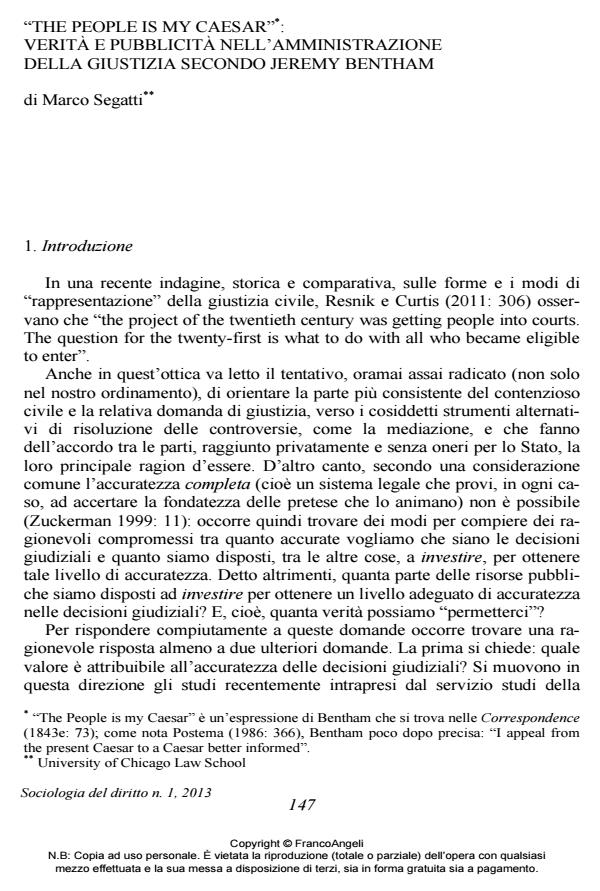
Qui sotto puoi vedere in anteprima la prima pagina di questo articolo.
Se questo articolo ti interessa, lo puoi acquistare (e scaricare in formato pdf) seguendo le facili indicazioni per acquistare il download credit. Acquista Download Credits per scaricare questo Articolo in formato PDF
FrancoAngeli è membro della Publishers International Linking Association, Inc (PILA), associazione indipendente e non profit per facilitare (attraverso i servizi tecnologici implementati da CrossRef.org) l’accesso degli studiosi ai contenuti digitali nelle pubblicazioni professionali e scientifiche.
Questo articolo discute alcuni aspetti della teoria benthamiana del giudizio e analizza lo stretto collegamento tra il valore dell’accuratezza delle decisioni giudiziali e la necessità che queste vengano giustificate pubblicamente, all’esito di un procedimento pubblico. Si individuano tre dimensioni del valore dell’accuratezza, a partire da tre funzioni del principio di pubblicità. La pubblicità può essere intesa come strumento dell’accuratezza. In questo caso, il valore dell’accuratezza coincide con la realizzazione degli obiettivi che il legislatore ha attribuito alla legge sostanziale. Inoltre, la pubblicità può servire come veicolo per la trasformazione delle pratiche di governo. In questo caso, l’accuratezza delle decisioni delinea una particolare concezione dei rapporti tra cittadini e tra autorità e cittadini. Infine, la pubblicità costituisce un test dell’accuratezza. In questo caso, la pubblicità offre un’occasione per valutare le conseguenze dell’applicazione della legge sostanziale.
Parole chiave:Bentham, Giudizio, Accuratezza, Pubblicità
- Bentham, Jeremy, 1843a. Essay on the Promulgation of Laws. In John Bowring (a cura di), The Works of Jeremy Bentham, vol. I. Edinburgh: William Tait. —, 1843b. Scotch Reform. In John Bowring (a cura di), The Works of Jeremy Bentham, vol. V. Edinburgh: William Tait. —, 1843c. Rationale of Judicial Evidence. In John Bowring (a cura di), The Works of Jeremy Bentham, vol. VI. Edinburgh: William Tait. —, 1843d. The Constitutional Code. In John Bowring (a cura di), The Works of Jeremy Bentham, vol. IX. Edinburgh: William Tait. —, 1843e. Correspondence. In John Bowring (a cura di), The Works of Jeremy Bentham, vol. X. Edinburgh: William Tait. —, 1977. A Comment on the Commentaries and A Fragment on Government, a cura di J. H Burns & H. L. A. Hart. London: Athlone Press
- Cappelletti, Mauro (a cura di), 1978. Access to Justice. 4 voll. Milano: Giuffrè
- Dinwiddy, John Rowland, 2004. Bentham: Selected Writings of John Dinwiddy, a cura di William Twining. Stanford: Stanford University Press
- Draper, Anthony, 2004. Corruptions in the Administration of Justice: Bentham’s Critique of Civil Procedure, 1806-1811. Journal of Bentham Studies, 7: 1-22
- Ferraro, Francesco, 2011. Il giudice utilitarista: Flessibilità e tutela delle aspettative nel pensiero giuridico di Jeremy Bentham. Pisa: ETS
- Foucault, Michel, [1975] 1976. Sorvegliare e punire: Nascita della prigione. Torino: Einaudi
- Giacomelli, Silvia, & Giuliana, Palumbo, 2011. Giustizia civile e funzionamento dell’economia. Analisi giuridica dell’economia, 10, 1: 7-16.
- Perelman, Jeremy, & Katharine Young, 2010. Rights as Footprints: A New Metaphor for Contemporary Human Rights Practice. Northwestern Journal of International Human Rights, 9, 1: 27-58
- Postema, Gerald J., 1986. Bentham and the Common Law Tradition. Oxford: Clarendon Press
- Putnam, Hilary, 2001. Enlightenment and Pragmatism. Assen: Koninklijke van Gorcum
- Resnik, Judith, & Dennis Curtis, 2011. Representing Justice: Invention, Controversy, and Rights in City-States and Democratic Courtrooms. New Haven: Yale University Press
- Rosen, Frederick, 1983. Jeremy Bentham and Representative Democracy: A Study of the Constitutional Code. Oxford: Clarendon Press
- Sandefur, Rebecca L., 2008. Access to Civil Justice and Race, Class, and Gender Inequality. Annual Review of Sociology, 34: 339-358
- Sen, Amartya, 1985. Well-being, Agency and Freedom: The Dewey Lectures 1984. Journal of Philosophy, 82, 4: 169-221
- Taruffo, Michele, 1997. Idee per una teoria della decisione giusta. Rivista trimestrale di diritto e procedura civile, 51, 2: 315 ss
- Taruffo, Michele, 2009. La semplice verità: Il giudice e la costruzione dei fatti. Roma- Bari: Laterza
- Zuckerman, Adrian A. S., 1999. The Dimensions of Civil Justice. In Adrian A.S. Zuckerman (a cura di), Civil Justice in Crisis: Comparative Perspectives of Civil Procedure. Oxford: Oxford University Press.
Marco Segatti, "The people is my Caesar": verità e pubblicità nell’amministrazione della giustizia secondo Jeremy Bentham in "SOCIOLOGIA DEL DIRITTO " 1/2013, pp 147-158, DOI: 10.3280/SD2013-001011